Axon's Recent Decline and the Shifting Landscape of Autonomous Security
A 22% stock drop for Axon Enterprise over the last month, alongside a Goldman Sachs price target adjustment, points to a recalibration in the autonomous security and physical AI market.
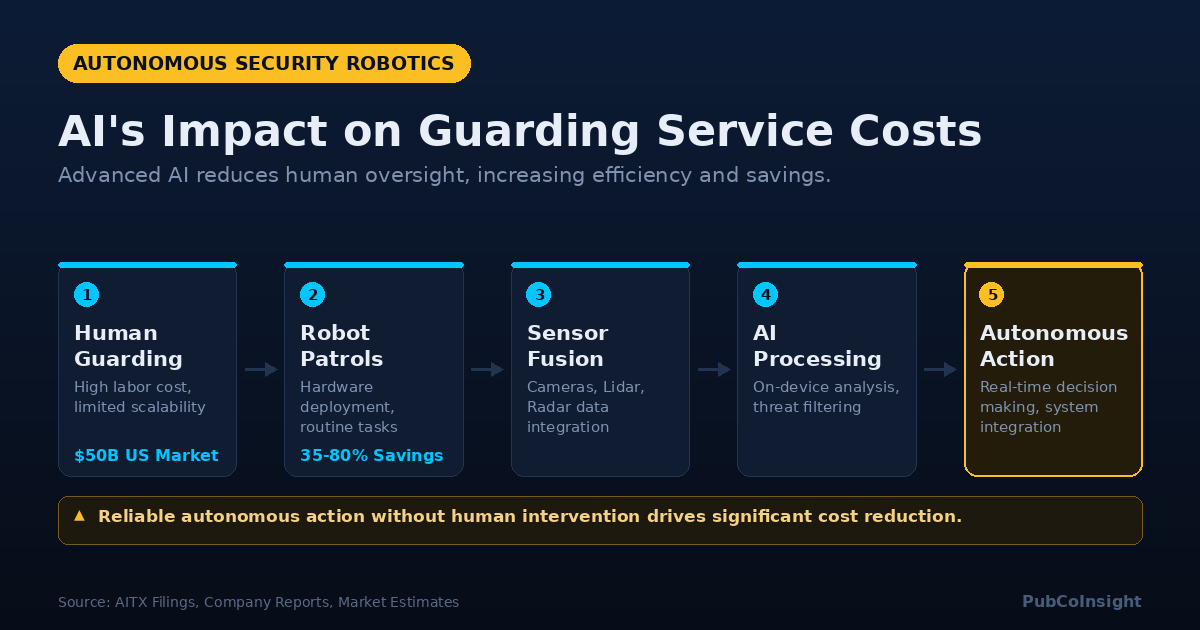
The Mechanism of Cost Savings in Autonomous Guarding
Autonomous security systems achieve cost savings primarily through labor displacement and increased operational efficiency. A single autonomous unit can perform tasks that would otherwise require multiple human guards, especially for routine patrols, perimeter monitoring, and initial incident response. The mechanism involves a combination of sensor fusion, on-device AI processing, and cloud-based analytics. Robots like those from Artificial Intelligence Technology Solutions (AITX) or Serve Robotics (SERV) integrate cameras, thermal sensors, lidar, and microphones. On-device AI filters out ambient noise and irrelevant visual data, identifying potential threats or anomalies. This pre-processed data is then sent to a central monitoring station, reducing the data load and the need for constant human vigilance. The critical bottleneck sits in the real-time decision-making and adaptive learning capabilities of the AI. Simple object detection is mature. Distinguishing between a stray animal and an intruder, or identifying suspicious behavior patterns, requires significantly more advanced algorithms and extensive training data. Furthermore, the ability of these systems to integrate with diverse existing security platforms, like access control systems or alarm networks, is crucial. A robot that identifies a breach but cannot automatically trigger a lockdown or notify specific personnel falls short of its full potential. The true value comes from the system's ability to act autonomously on detected threats, or at least provide highly actionable intelligence, reducing the human response time and labor cost. If the AI cannot reliably handle false positives or adapt to dynamic environments, human oversight remains high, eroding the cost savings.Companies Navigating the Autonomous Security Landscape
The autonomous security and physical AI market features a range of companies, each with distinct approaches to hardware, software, and service delivery. In the mobile robotics space, Serve Robotics Inc. (SERV) focuses on last-mile delivery robots, which share underlying navigation and obstacle avoidance technologies with security applications. Their systems demonstrate advanced urban navigation capabilities. Unusual Machines, Inc. (UMAC), which saw a 6% jump on September 24, 2026, after strategic investment led by drone executive Allan Evans, is also active in the drone sector, a segment with clear overlaps into aerial surveillance for security. Red Cat Holdings, Inc. (RCAT) and Ondas Inc. (ONDS) are also significant players in the drone and autonomous systems market. Ondas recently acquired three defense technology firms for $56 million, as reported on September 23, 2026, aiming to build an integrated autonomous defense systems platform. This move suggests a strategy to own more of the component stack, from hardware to software, for specialized applications. The sensor and perception layer is critical for all autonomous systems. Kopin Corporation (KOPN), trading at $4.87, develops microdisplays and optical solutions. Fabric.AI, in collaboration with Kopin, filed two patent applications covering fiber-coupled and connector-free MicroLED optical interconnects on September 23, 2026. This kind of advanced display technology is crucial for augmented reality interfaces used by human operators interacting with robotic systems, or for direct robot vision systems. MicroVision, Inc. (MVIS), at $1.62, focuses on lidar technology, a key component for accurate 3D mapping and object detection in autonomous navigation. Arbe Robotics Ltd. (ARBE), priced at $0.674, specializes in high-resolution 4D imaging radar, offering another critical sensing modality for adverse weather conditions where optical sensors may struggle. On the software and AI side, BigBear.ai Holdings, Inc. (BBAI), trading at $2.8, provides AI-powered analytics and decision intelligence, often for government and defense applications. Their capabilities in processing large datasets and generating actionable insights are directly transferable to complex security scenarios. Lantronix, Inc. (LTRX), at $6.6, offers intelligent edge computing and connectivity solutions, which are essential for enabling autonomous devices to communicate, process data locally, and integrate into broader networks without constant cloud reliance.Artificial Intelligence Technology Solutions, Inc.
Artificial Intelligence Technology Solutions, Inc. (AITX) operates through its subsidiaries, focusing on building and leasing autonomous security robots and remote monitoring systems. The company structures its offerings on a recurring monthly subscription model. AITX’s primary subsidiary, Robotic Assistance Devices, Inc. (RAD-I), markets an AI-driven "Solutions-as-a-Service" model aimed at the security and guarding services industry. The company estimates this market to be approximately $50 billion in the United States. AITX states its solutions are designed to deliver cost savings between 35% and 80% compared with traditional manned security and monitoring. This is achieved through a suite of stationary and mobile devices integrated with the company's software and monitoring platforms. AITX describes its operations across three main pillars: stationary security devices (RAD-I), mobile autonomous platforms (RAD-M), and the SARA agentic artificial intelligence platform (RAD-G). The ROAMEO mobile security unit, part of RAD-M, began early commercial deployment in May 2026. RAD Lanka, a wholly owned subsidiary in Sri Lanka operating under Port City Colombo status, supports software development, AI initiatives, and technical operations. The company envisions an integrated autonomous-security deployment across campuses or communities, internally referred to as "RAD Town." For the fiscal year ended February 28, 2026, AITX reported revenue of $7,745,336, a 26% increase over the prior fiscal year. Gross profit rose 48% to $5,533,700, and gross margin expanded to approximately 71% from 61%. Operating expenses remained essentially flat at about $17,477,097, leading to an improvement in loss from operations by approximately $2.0 million, to $(11,943,397). The company reported a net loss of approximately $14.5 million for the fiscal year ended February 28, 2026, with an accumulated deficit of approximately $171 million as of that date. The public record does not yet establish a clear path to sustained positive cash flow from operations. For the year ended February 28, 2026, the company had negative cash flow from operating activities of $9,344,534. As of February 28, 2026, AITX had negative working capital of $17,017,745. The company's independent registered public accounting firm included an explanatory paragraph in its report expressing substantial doubt about AITX's ability to continue as a going concern. AITX recently updated hardware pricing on September 24, 2026, to reflect rising materials, compute, and transportation costs, and expanded a national dealer relationship with a third order on September 23, 2026. The company also expanded its higher education presence on September 18, 2026.What to watch
Investors should monitor several specific developments in the coming months. For Ondas Inc. (ONDS), the integration of its recently acquired defense technology firms will be key. Watch for announcements regarding how these acquisitions, totaling $56 million, translate into new product offerings or expanded market reach in their next quarterly filing. For Artificial Intelligence Technology Solutions (AITX), the expansion of its national dealer network and further deployments of its ROAMEO mobile security unit, as mentioned in recent 8-K filings, will indicate progress on its subscription model. Specific customer wins or expanded contracts, particularly in the "RAD Town" integrated deployment model, would be concrete evidence of traction. The company's next quarterly report will provide updated figures on revenue, subscription counts, and cash position, which will be crucial for assessing its financial trajectory. For Kopin Corporation (KOPN), the progress of the Fabric.AI patent applications on MicroLED optical interconnects, filed September 23, 2026, will signal innovation in critical display components. Any further details on commercialization plans for these technologies would be significant. Across the sector, watch for any shifts in regulatory approvals for autonomous systems operating in public or semi-public spaces, as these can significantly impact deployment timelines and market access., { "label": "Robot Patrols", "note": "Hardware deployment, routine tasks", "metric": "35-80% Savings" }, { "label": "Sensor Fusion", "note": "Cameras, Lidar, Radar data integration" }, { "label": "AI Processing", "note": "On-device analysis, threat filtering" }, { "label": "Autonomous Action", "note": "Real-time decision making, system integration" } ], "highlight": 4, "highlight_note": "Reliable autonomous action without human intervention drives significant cost reduction.", "footnote": "Source: AITX Filings, Company Reports, Market Estimates" }Companies mentioned
| Ticker | Company | Price |
|---|---|---|
| AITX client | Artificial Intelligence Technology Solutions Inc | $0.0032 |
| ARBE | Arbe Robotics Ltd. | $0.674 |
| BBAI | BigBear.ai Holdings, Inc. | $2.8 |
| KOPN | Kopin Corporation | $4.87 |
| LTRX | Lantronix, Inc. | $6.6 |
| MVIS | MicroVision, Inc. | $1.62 |
| ONDS | Ondas Inc. | $7.6 |
| RCAT | Red Cat Holdings, Inc. | $6.8 |
| SERV | Serve Robotics Inc. | $4.51 |
| UMAC | Unusual Machines, Inc. | $23.93 |
Listed alphabetically, not ranked. Prices as of 2026-09-25 and they move. Check a live quote before relying on any of this.
How we chose the companies in this article
We cover a fixed universe of companies working in autonomous security robotics, physical AI and the guarding services market they are aimed at. Every one of them that had usable market data on 2026-09-25 appears in this article. We do not pick which ones to mention based on what we think of them, and we do not order them by size, price or trading volume, because an ordered list is a verdict and that is not ours to hand down. Companies left out, and why: none. American Lithium Minerals and Artificial Intelligence Technology Solutions pay us, which is disclosed in full at the foot of every article they appear in.
See the dilution and promotion flags before you see the pitch.
Each week: the micro and small-caps now showing dilution or paid-promotion signals, with the SEC filing behind every flag. No recommendations, no price targets.
Sources used in this article
- Sterling, Axon, Herc, Nextpower, and FTAI Aviation Shares Plummet, What You Need To Know StockStory · 2026-09-25
- Meet the Super Semiconductor ETF With 34.7% of Its Assets Parked in Intel, AMD, Micron, and Nvidia Motley Fool · 2026-09-25
- If I Were in My 30s, I'd Buy This Magnificent ETF and Hold It for the Next 30 Years Motley Fool · 2026-09-25
- A Ferrari Doesn’t Hold Value As Well As An NVIDIA Corporation (NVDA) GPU, According To Jim Cramer Insider Monkey · 2026-09-25
- Wall St futures gain as AI enthusiasm eases worries over higher oil prices, yields Reuters · 2026-09-25
- Why Okta Stock Was Rocking it This Week Motley Fool · 2026-09-25
- Should Investors Worry About Michael Burry's Big AI Stock Shorts Motley Fool · 2026-09-25
- Warren Buffett's Successor, Greg Abel, Has 55% of Berkshire Hathaway's $360 Billion Portfolio Invested in 4 Standout Stocks Motley Fool · 2026-09-25
- Here's Why Grail Stock Surged 55% This Week Motley Fool · 2026-09-25
- The eVTOL Trade Has Been Deflating for Months. Here's the 1 Catalyst That Could Reverse It. Motley Fool · 2026-09-25
- Why Beta Technologies Stock Was Climbing This Week Motley Fool · 2026-09-25
- Unusual Machines Jumps 6% as Drone Names Bounce Together; Ondas Climbs 4%, Red Cat Rises 3% 24/7 Wall St. · 2026-09-24
Disclosure required by Section 17(b) of the Securities Act of 1933
Artificial Intelligence Technology Solutions, Inc., a Nevada corporation (OTCID: AITX). Artificial Intelligence Technology Solutions, Inc. pays Strategic Innovations First, Inc., a Wyoming corporation doing business as PulseIR. Compensation received: USD 5,000.00 per month for months 1-3 (August, September, October 2026); USD 10,000.00 per month for months 4-6 (November, December 2026, January 2027) contingent on the 90-day review. Minimum committed USD 15,000.00; USD 45,000.00 if the second-period rate triggers.. Form of payment: cash only, invoiced monthly in advance; no stock, options or warrants received or payable. Services: investor relations services under an Investor Relations Services Agreement effective 2026-08-01. Period: six month term, 2026-08-01 through 2027-01-31; 90-day review on or about 2026-10-30. No stock, options or warrants held by PubCo Insight, Pulse IR, Strategic Innovations First, Inc., or Brad Listermann. Confirmed by the executed agreement and by board record recKwdq39X2caPSX7 (POSITIONS HELD: none).
This is information, not investment, financial, legal or tax advice. It is not a recommendation or solicitation to buy, sell or hold any security and it contains no price target. Nothing here is independently verified by us. Confirm every figure against primary filings on SEC EDGAR before you act. Micro-cap and over-the-counter securities are speculative and illiquid and can lose all of their value. The companies named without a disclosure above pay us nothing and have no relationship with us; they are named because a published, mechanical screen selected them. Full disclosure policy.