Market Pulse: Biotech & MedTech Catalysts
Big Pharma M&A Frenzy and FDA Delays Reshape Small Cap Biotech Valuations
Sanofi's $41 billion Insmed buyout and Vertex's FDA delay for Povetacicept are forcing a sharp re-evaluation of small cap biotech cash runways and clinical pipelines.
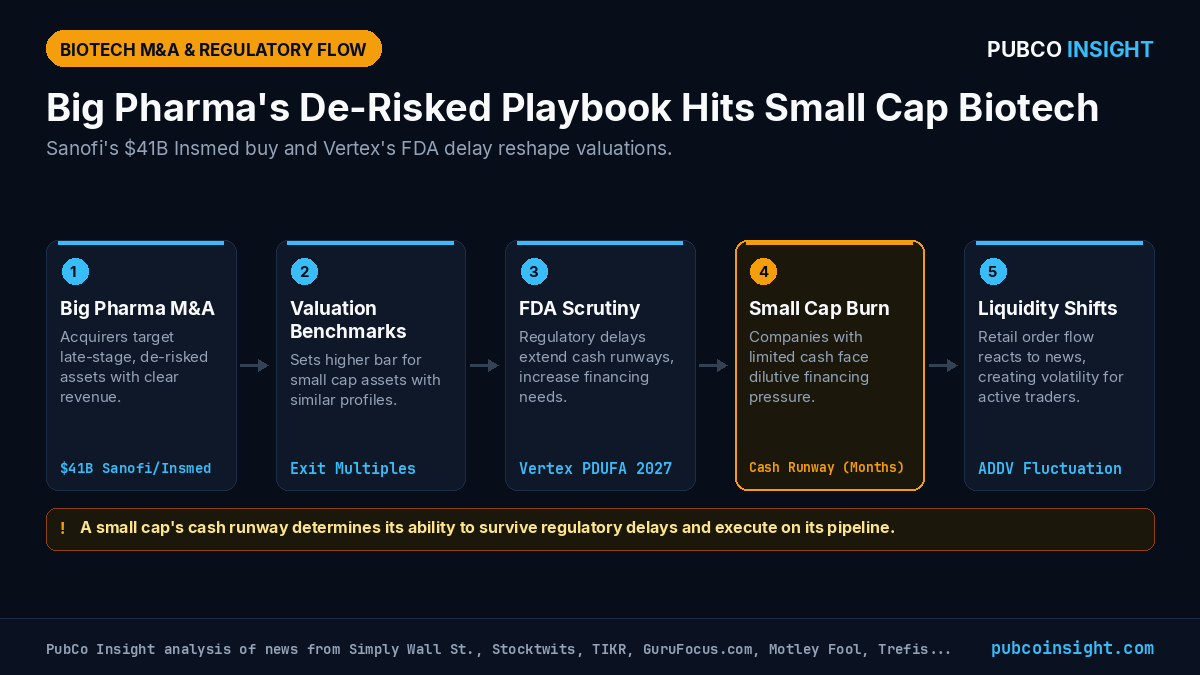
The biotech sector is buzzing with two seismic events this week: Sanofi's colossal $41 billion acquisition of Insmed and Vertex Pharmaceuticals' unexpected FDA decision delay for Povetacicept in IgA nephropathy. These aren't isolated incidents; they are direct signals from Big Pharma, dictating the new rules of engagement for small cap and microcap biotechs. Eli Lilly (LLY) continues its buying spree, as noted by Stocktwits on November 28, 2026, further amplifying the M&A narrative.
Sanofi's move for Insmed, a company whose sales gave notice a year early according to Trefis on November 27, 2026, underscores a critical shift: Big Pharma is paying up for validated assets with clear revenue pathways. This isn't about speculative early-stage bets anymore; it's about late-stage de-risked products that can immediately bolster top lines. Conversely, Vertex's (VRTX) FDA PDUFA extension for Povetacicept, pushing the decision into 2027 and causing Vertex shares to drop 7.06% on November 27, 2026, highlights the brutal reality of regulatory hurdles. This delay, while not "thesis changing" for Citi, as reported by Stocktwits, creates an immediate window for rivals like Vera Therapeutics, whose stock surged on the news, as Motley Fool noted on November 27, 2026. For small cap and microcap players, these events are not just headlines; they are direct inputs into their cost of capital, partnership prospects, and ultimate survival.
Market Transmission Mechanism: From Big Pharma Balance Sheets to Small Cap Burn Rates
Big Pharma's M&A appetite, exemplified by Sanofi's Insmed deal and Eli Lilly's continued acquisitions, directly impacts small cap biotech valuations through several channels. First, it sets a clear precedent for what Big Pharma is willing to pay for de-risked assets. This creates a valuation floor for small cap companies with similar late-stage pipelines, particularly those addressing high-unmet-need areas or with unique mechanisms of action. Active traders and fund managers use these large deals to benchmark potential exit multiples for their smaller holdings. Second, the capital deployed in these mega-deals tightens the pool of available targets, driving up the perceived value of remaining independent small cap biotechs. This can lead to increased inbound interest and potentially more favorable terms for smaller companies seeking partnerships or buyouts. However, this also raises the bar for operational execution and clinical trial success. Big Pharma isn't buying potential; it's buying proof. Third, FDA regulatory decisions, like the PDUFA extension for Vertex's Povetacicept, transmit rapidly through the small cap ecosystem by highlighting the inherent risks in clinical development. A delay, even if ultimately resolved, can significantly extend a small cap's cash runway requirements, increasing the need for dilutive financing or bridge loans. This directly impacts the burn rate and balance sheet health of companies reliant on a single or limited pipeline. The market instantly re-rates risk, punishing companies with insufficient cash to weather such delays and rewarding those with diversified pipelines or stronger financial positions. Retail order flow often reacts sharply to these regulatory news items, creating volatility that active traders can exploit.
The weekly Flags Watchlist: small-caps now showing dilution or promotion signals, each linked to the SEC filing behind the flag.
How the Small Cap and Microcap Cohort Positions Around This Trend
The current environment demands that small cap and microcap biotechs demonstrate clear clinical progress, efficient capital management, and a robust strategy for navigating regulatory pathways. Companies with strong balance sheets and diversified pipelines are better positioned to weather the storm of FDA delays or capitalize on Big Pharma's M&A hunger. Consider Capricor Therapeutics, Inc. (CAPR), with a 30-day average daily dollar volume (ADDV) of $38.2 million, indicating significant liquidity. Capricor focuses on novel biologic therapies for rare diseases. Its operational milestones, particularly in advancing its lead asset, CAP-1002, for Duchenne muscular dystrophy, will be closely watched. The company's ability to secure non-dilutive funding or partnerships, given Big Pharma's current M&A focus, could be a key determinant of its trajectory. Inovio Pharmaceuticals, Inc. (INO), with an ADDV of $31.4 million, is another name garnering attention. Inovio's DNA medicines platform has broad applications, but its cash runway and progress in late-stage clinical trials, particularly for its HPV-related programs, are critical. The market's shift towards de-risked assets means Inovio needs to demonstrate clear clinical efficacy and a path to commercialization to attract significant Big Pharma interest or sustain investor confidence. Ocugen, Inc. (OCGN), trading with an ADDV of $6.0 million, operates in gene and cell therapies. Its balance sheet constraints and the need for significant capital to fund ongoing research and development are paramount. In an environment where FDA delays can be costly, Ocugen's ability to manage its burn rate and secure strategic partnerships will be crucial. PDS Biotechnology Corporation (PDSB), with an ADDV of $5.9 million, is developing immunotherapies for cancer and infectious diseases. PDSB's operational execution in advancing its lead candidates through clinical trials, particularly in demonstrating differentiated efficacy, will be key to attracting attention from larger players. The company's cash position relative to its clinical development timelines is a constant focus for active traders. Further down the liquidity scale, we find companies like Autonomix Medical, Inc. (AMIX), with an ADDV of $4.7 million. Autonomix focuses on medical devices for treating chronic pain. While not a traditional biotech, its regulatory pathway with the FDA for device approval shares similar risks and timelines. Its ability to achieve regulatory milestones and secure commercial partnerships will define its success. Adagio Medical Holdings, Inc. (ADGM), with a much lower ADDV of $179K, is another medical device company. Its focus on cardiac ablation technologies means it also faces stringent FDA oversight. For companies with lower liquidity like Adagio Medical, any regulatory delay or unexpected clinical outcome can have a disproportionately large impact on share price and financing capabilities. Finally, Dragonfly Energy Holdings Corp. (DFLI), with an ADDV of $123K, operates in battery storage, a completely different sector. Its inclusion here highlights that while the biotech M&A and FDA news dominates, the broader small cap market still includes diverse companies. Dragonfly's operational milestones, such as manufacturing scale-up and market penetration, are distinct from biotech's clinical trials, but its need for capital and ability to execute on its business plan are universal challenges for small cap companies.What Active Traders and Desks Are Watching Next
* Q4 2026 and Q1 2027 Earnings Calls: Scrutiny on cash burn rates, updated cash runway guidance, and any forward-looking statements regarding M&A interest or partnership discussions from small cap biotechs. * FDA Advisory Committee Meetings and PDUFA Dates: Upcoming regulatory decisions for key assets across the small cap biotech landscape. Specific attention will be on companies with single-asset pipelines. * Major Biotech Conferences (e.g., JP Morgan Healthcare Conference in January 2027): These events often serve as catalysts for partnership announcements, M&A rumors, and financing deals. * Updates on Vertex's Povetacicept and Vera Therapeutics' TRUTAKNA: Any new data or regulatory commentary on these IgA nephropathy treatments will inform the competitive landscape and potential for other renal disease assets. * Big Pharma Capital Allocation Announcements: Any further signals from Eli Lilly, Sanofi, or other major players regarding their M&A strategies or therapeutic area focus will guide small cap investment. * Interest Rate Environment: Continued monitoring of Fed policy and credit market conditions, as higher interest rates directly impact the cost of capital for cash-hungry small cap biotechs.Companies mentioned
| Ticker | Company | Price |
|---|---|---|
| ADGM | Adagio Medical Holdings, Inc. | $1.18 |
| AMIX | Autonomix Medical, Inc. | $0.934 |
| CAPR | Capricor Therapeutics, Inc. | $1.88 |
| DFLI | Dragonfly Energy Holdings Corp. | $1.55 |
| INO | Inovio Pharmaceuticals, Inc. | $1.73 |
| OCGN | Ocugen, Inc. | $0.783 |
| PDSB | PDS Biotechnology Corporation | $0.591 |
Listed alphabetically, not ranked. Prices as of 2026-11-28 and they move. Check a live quote before relying on any of this.
How we chose the companies in this article
Candidate pool of 10 small-cap, microcap, and OTC names in Market Pulse: Biotech & MedTech Catalysts; ranked by 30-day average daily dollar volume (Yahoo Finance) as of 2026-11-28. All compensated IR clients are excluded from this editorial lane.
PubCo Insight
See the dilution and promotion flags before you see the pitch.
Each week: the micro and small-caps now showing dilution or paid-promotion signals, with the SEC filing behind every flag. No recommendations, no price targets.
Every flag links to its EDGAR filing so you can check it yourself. Sponsored coverage disclosed under SEC 17(b). One-click unsubscribe.
Sources used in this article
- Novo Nordisk Stock And Other GLP 1 Leaders Worth Watching Now Simply Wall St. · 2026-11-28
- Biotech Dealmaker: Sanofi’s $41B Insmed Buyout Anchors Holiday Week As Lilly Continues Buying Spree Stocktwits · 2026-11-28
- What Does Vertex Pharmaceuticals (VRTX) PDUFA Extension Mean For Povetacicept In IgA Nephropathy? Simply Wall St. · 2026-11-28
- Vera Therapeutics Is the Real Winner in Vertex’s FDA Delay. Its Rival Drug Already Sells TIKR · 2026-11-28
- 3 Low Debt Stocks That Look Built for Higher Interest Rates Simply Wall St. · 2026-11-28
- What Is The Biggest Threat To Eli Lilly Stock? Trefis · 2026-11-27
- 5 Stocks That Should Double in 3 Years Insider Monkey · 2026-11-27
- Mental Health Clinical Trials - Global Strategic Business Report 2026: Capitalize on the $5.2 Billion Market with IQVIA, ICON, Eli Lilly, and COMPASS Pathways GlobeNewswire · 2026-11-27
- Prediction: Eli Lilly’s $92 Billion Revenue Outlook Could Be Just the Beginning 24/7 Wall St. · 2026-11-27
- Is Most-Watched Stock Eli Lilly and Company (LLY) Worth Betting on Now? Zacks · 2026-11-27
- 9 Big Funds Bought Merck Last Quarter, While 15 Sold. Who’s Right? TIKR · 2026-11-27
- How GLP 1 Coverage Could Send You Beyond XLV Simply Wall St. · 2026-11-27
PubCo Insight publishes research on small and micro-cap companies. Nothing here is investment advice, we make no buy or sell recommendations, and we publish no price targets. Small and micro-cap shares are speculative and illiquid and you can lose everything you put into them. Check every figure against primary filings on SEC EDGAR before you act on it.