Market Pulse: Crypto Treasury & FinTech Movers
Bitcoin's Bipartisan Embrace and the Small Cap Crypto Miners' AI Pivot
Michael Saylor's latest comments on Bitcoin's political traction, coupled with Coinbase's federal trust charter, are reshaping capital flows for small-cap crypto miners and fintechs.
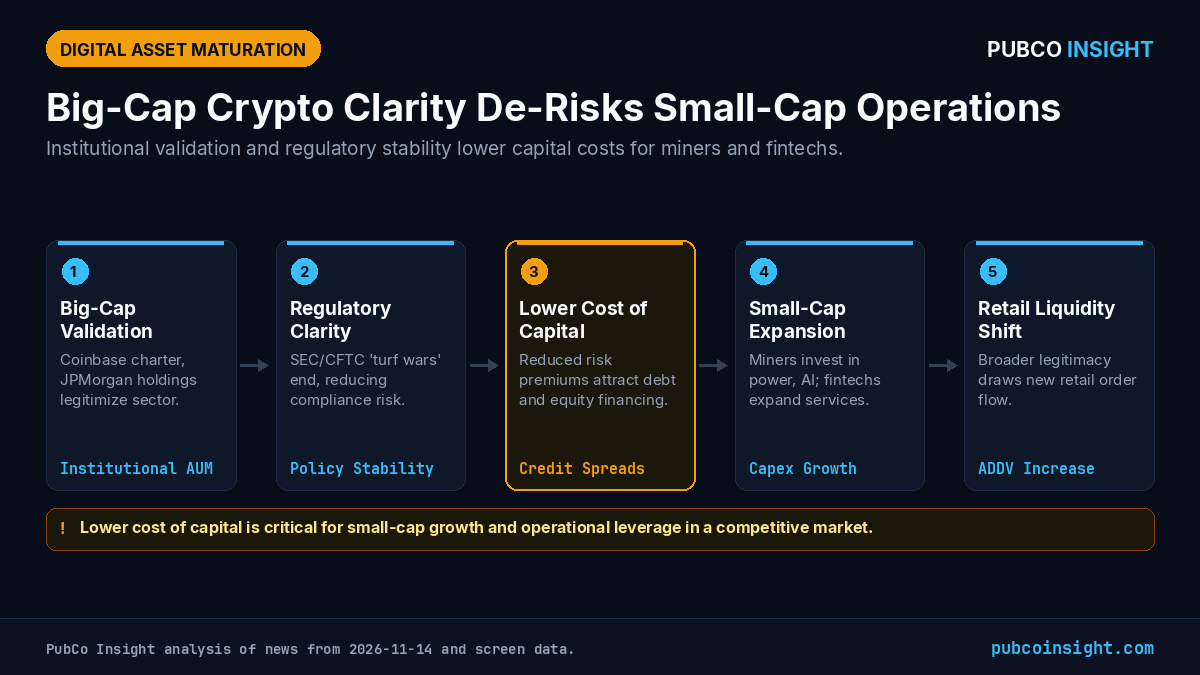
The narrative around digital assets just got a significant upgrade. Michael Saylor of Strategy (MSTR) declared on November 14, 2026, that Bitcoin is now a bipartisan issue, transcending traditional political divides. This isn't just rhetoric; it’s a direct response to the increasing institutional adoption, exemplified by JPMorgan’s (IBIT) approaching $1 billion in crypto-linked holdings and Coinbase’s (COIN) securing a federal trust charter. While Bitcoin itself saw a dip below $70,000 this week, these structural shifts signal a maturation that active small-cap traders and microcap fund managers cannot ignore.
This evolving regulatory and institutional landscape directly impacts the small-cap and microcap ecosystem, particularly those in high-performance computing and digital asset mining. The "turf wars" between the SEC and CFTC, which Coinbase CEO Brian Armstrong credits with ending, provide a clearer operating environment. This clarity reduces regulatory risk premiums, making it easier for smaller players to secure capital and plan long-term. Furthermore, the push for bipartisan support implies a more stable policy outlook, a stark contrast to the volatile regulatory swings that have historically plagued the sector. For small-cap miners, this translates into more predictable cost of capital and potentially better access to debt financing, crucial for expanding operations and upgrading hardware. The shift is not just about Bitcoin's price, but about the underlying infrastructure and the institutional plumbing being laid.
Market Transmission Mechanism: From Regulatory Clarity to Balance Sheet Strength
The transmission mechanism from big-cap regulatory wins to small-cap balance sheets is direct and powerful. When Coinbase secures a federal trust charter, it validates the entire digital asset ecosystem. This isn't just about Coinbase; it’s about the regulatory framework solidifying, which in turn de-risks the sector for traditional financial institutions. Banks, previously hesitant to engage deeply with crypto businesses due to compliance uncertainties, now have a clearer path. This translates into improved access to banking services for smaller crypto firms, potentially lowering transaction costs and improving treasury management. For high-performance computing (HPC) hosting providers, particularly those focused on Bitcoin mining, this clarity is a lifeline. Power costs and grid stability remain paramount, as seen with TeraWulf (WULF) backing Muskie Power Plan initiatives. But beyond operational efficiency, the ability to secure financing for new facilities or energy infrastructure becomes easier when the underlying business model is less exposed to sudden regulatory shifts. Lower perceived risk can lead to tighter credit spreads for small-cap borrowers, reducing their cost of capital. This is critical for companies like Hut 8 (HUT) which, while already locking in AI lease revenue, still needs access to efficient capital for further expansion. The retail order flow also responds to this perceived stability. When mainstream news outlets like Motley Fool and Simply Wall St. discuss Bitcoin's bipartisan appeal and institutional moves, it signals legitimacy to a broader retail investor base, potentially increasing liquidity and trading volumes for related small-cap tickers.
The weekly Flags Watchlist: small-caps now showing dilution or promotion signals, each linked to the SEC filing behind the flag.
How the Small-Cap and Microcap Cohort Positions Around This Trend
The small-cap and microcap companies in the digital asset and high-performance computing space are positioning themselves strategically around this evolving macro trend. TeraWulf Inc. (WULF), with a 30-day average daily dollar volume of $601.0M, is actively involved in energy infrastructure, backing the Muskie Power Plan. Their strategy of integrating with established power grids, as reported on November 14, 2026, positions them for long-term operational stability and cost control. This focus on sustainable energy sources is crucial as the sector faces increasing scrutiny over its environmental footprint. Hut 8 Corp. (HUT), trading with a 30-day average daily dollar volume of $463.4M, is diversifying its revenue streams beyond pure Bitcoin mining. The company has locked in AI lease revenue, as highlighted by Simply Wall St. on November 14, 2026. This move into high-performance computing for AI applications provides a hedge against Bitcoin price volatility and leverages their existing infrastructure. While Simply Wall St. suggests the stock looks fully priced on Beacon Point lease news, the strategic pivot into AI hosting demonstrates adaptability within the broader HPC market. Riot Platforms, Inc. (RIOT), with a 30-day average daily dollar volume of $379.2M, remains a significant player in the Bitcoin mining space. Their scale allows for operational efficiencies, but like all miners, they are sensitive to Bitcoin price movements and energy costs. MARA Holdings, Inc. (MARA), with a 30-day average daily dollar volume of $298.9M, also falls into this category, with both companies needing to navigate the balance between mining profitability and capital expenditure for expansion. CleanSpark, Inc. (CLSK), seeing a 30-day average daily dollar volume of $157.0M, has been consistently expanding its mining capacity, often through strategic acquisitions of facilities. Their focus on proprietary software and energy management tools aims to optimize efficiency and reduce operational costs, a key differentiator in a competitive market. Bit Digital, Inc. (BTBT), a smaller player with a 30-day average daily dollar volume of $22.7M, also operates in the Bitcoin mining sector, facing similar capital and operational challenges as its larger peers but with a tighter margin for error due to its smaller scale and lower liquidity. Finally, 1895 Bancorp of Wisconsin Inc (BCOW), a regional bank with a 30-day average daily dollar volume of $355K, represents the traditional finance side. While not a crypto miner, regional banks face pressures from hot CPI and rate-sensitive lending, as noted by Stocktwits regarding Coinbase's federal charter. The increasing legitimacy of digital assets, driven by big-cap moves, could eventually open new avenues for regional banks to offer services related to digital assets, either directly or through partnerships, though this remains an emerging trend for smaller financial institutions. Their challenge is adapting to a rapidly changing fintech landscape without overextending their balance sheets.What Active Traders and Desks Are Watching Next
* **Bitcoin ETF Inflows/Outflows:** Monitor daily reports on Bitcoin ETF flows, particularly from large institutional players like JPMorgan (IBIT), to gauge continued institutional adoption and sentiment. * **Miner Hashrate and Difficulty Adjustments:** Track network hashrate and difficulty adjustments for Bitcoin. Significant shifts can indicate changes in miner profitability and operational health, impacting publicly traded mining companies. * **Q4 2026 Earnings Reports:** Pay close attention to Q4 2026 earnings for WULF, HUT, RIOT, MARA, and CLSK. Focus on revenue diversification, energy costs, and capital expenditure plans. * **SEC/CFTC Regulatory Guidance:** Watch for any new guidance or enforcement actions from the SEC or CFTC that could further clarify or complicate the operating environment for digital asset firms. * **Interest Rate Decisions:** The Federal Reserve's next interest rate decision will impact the cost of capital for all small-cap companies, including those in high-performance computing and fintech. * **Regional Bank Earnings and Loan Growth:** Observe regional bank earnings, like BCOW, for signs of how they are navigating rate-sensitive lending and if they are beginning to explore digital asset related services. * **AI Infrastructure Demand:** Monitor news and reports on demand for high-performance computing infrastructure for AI, which could directly benefit diversified miners like Hut 8.Companies mentioned
| Ticker | Company | Price |
|---|---|---|
| BCOW | 1895 Bancorp of Wisconsin Inc | $13.95 |
| BTBT | Bit Digital, Inc. | $0.662 |
| CLSK | CleanSpark, Inc. | $6.65 |
| HUT | Hut 8 Corp. | $57.57 |
| MARA | MARA Holdings, Inc. | $6.99 |
| RIOT | Riot Platforms, Inc. | $17.52 |
| WULF | TeraWulf Inc. | $12.62 |
Listed alphabetically, not ranked. Prices as of 2026-11-14 and they move. Check a live quote before relying on any of this.
How we chose the companies in this article
Candidate pool of 10 small-cap, microcap, and OTC names in Market Pulse: Crypto Treasury & FinTech Movers; ranked by 30-day average daily dollar volume (Yahoo Finance) as of 2026-11-14. All compensated IR clients are excluded from this editorial lane.
PubCo Insight
See the dilution and promotion flags before you see the pitch.
Each week: the micro and small-caps now showing dilution or paid-promotion signals, with the SEC filing behind every flag. No recommendations, no price targets.
Every flag links to its EDGAR filing so you can check it yourself. Sponsored coverage disclosed under SEC 17(b). One-click unsubscribe.
Sources used in this article
- Strategy's Michael Saylor Says Bitcoin Is Now a Bipartisan Issue That Crosses Party Lines. Here's Why He's Right. Motley Fool · 2026-11-14
- How Index Removal Will Impact Strategy Stock Investors Simply Wall St. · 2026-11-14
- Coinbase CEO Brian Armstrong Credits SEC, CFTC Chiefs For Ending ‘Turf Wars’ Over Stock Perps Stocktwits · 2026-11-14
- US Fintech Weekly: Coinbase Secures Federal Trust Charter, While Hot CPI Pressures Rate-Sensitive Lenders Stocktwits · 2026-11-14
- What Could 5,000 XRP, 5,000 Cardano and 5,000 Stellar Be Worth by 2028? 24/7 Wall St. · 2026-11-14
- Robinhood Markets Wins US Supreme Court Review in IPO Disclosure Case MT Newswires · 2026-11-14
- TeraWulf (WULF) Backs Muskie Power Plan With Bill Credits And Grid Upgrades Simply Wall St. · 2026-11-14
- Hut 8 (HUT) Locked In AI Lease Revenue, Is The Stock Expensive? Simply Wall St. · 2026-11-14
- Hut 8 (HUT) Stock Looks Fully Priced On Beacon Point Lease News Simply Wall St. · 2026-11-14
- Bitcoin market outlook: extreme fear, oversold signals, and key support levels Investing.com · 2026-11-13
- What Could $1,000 in Bitcoin Be Worth in 5 Years? 24/7 Wall St. · 2026-11-13
- Weekly Wrap: Bitcoin Falls Below $70,000 As Crypto Selling Worsens CryptoProwl · 2026-11-13
PubCo Insight publishes research on small and micro-cap companies. Nothing here is investment advice, we make no buy or sell recommendations, and we publish no price targets. Small and micro-cap shares are speculative and illiquid and you can lose everything you put into them. Check every figure against primary filings on SEC EDGAR before you act on it.