Black Mass Export License Points to Maturing Battery Recycling Infrastructure
American Battery Technology Corporation's $100 million black mass export license on October 2, 2026, highlights the growing global trade in recycled battery materials and the evolving economics of a circular battery supply chain.
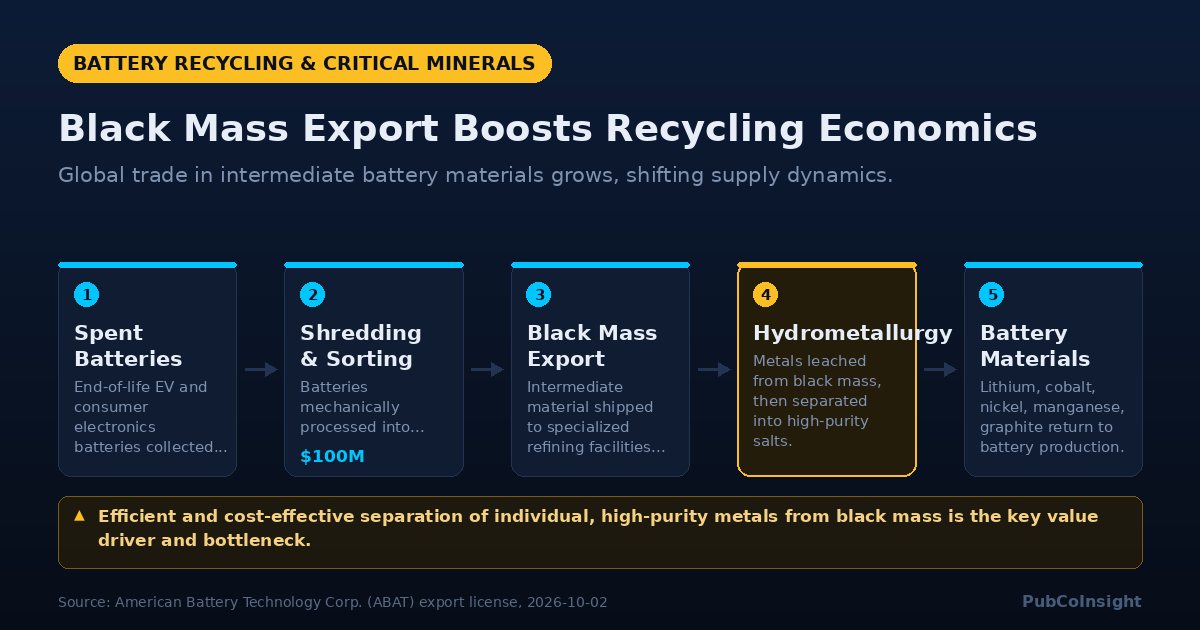
The Mechanism of Black Mass and its Value
Black mass is the pulverized, unsorted material recovered from spent lithium-ion batteries. It contains a mix of valuable metals: lithium, cobalt, nickel, manganese, and graphite. The exact composition varies depending on the battery chemistry, whether it is an NMC (nickel-manganese-cobalt) or LFP (lithium-iron-phosphate) type, for example. Recovering these metals requires specialized hydrometallurgical or pyrometallurgical processes. Hydrometallurgy uses aqueous solutions to leach metals from the black mass, then separates them through solvent extraction or precipitation. Pyrometallurgy involves smelting the black mass at high temperatures, which recovers metals like nickel and cobalt in an alloy, but often volatilizes lithium and graphite, making their recovery more challenging. The value in black mass lies in its concentrated critical mineral content. Instead of digging new ore, recyclers are essentially "mining" existing batteries. The bottleneck in this process is the efficient and cost-effective separation of individual high-purity metals. If a processor can reliably extract battery-grade lithium carbonate or hydroxide, nickel sulfate, and cobalt sulfate from black mass, they create a new, potentially more sustainable, and less geopolitically constrained supply source. The export license for ABAT's black mass indicates that the initial shredding and sorting, the "pre-processing," is happening, but the final, high-value refining may be occurring in facilities outside the US. This could be due to specific technological expertise, lower operating costs, or existing infrastructure for certain refining processes in other countries. The success of this global trade depends on consistent quality of black mass and transparent pricing mechanisms that reflect the contained metal values.Companies Operating in Battery Recycling and Critical Minerals
Several companies are active in developing new sources for battery minerals, including through recycling. American Battery Technology Company (ABAT), trading at $1.83, is a key player in this evolving space, now with a significant export license for its black mass. Their focus is on developing and commercializing a hydrometallurgical process for lithium-ion battery recycling. Other companies are focused on primary extraction. Atlas Lithium Corporation (ATLX), priced at $2.09, is advancing its processing plant for lithium in Brazil. Standard Lithium Ltd. (SLI), at $1.49, is targeting a 2026 decision for its Arkansas lithium project, which aims to extract lithium from brine. ioneer Ltd (IONR), trading at $2.84, is developing the Rhyolite Ridge lithium-boron project in Nevada. This project aims to produce both lithium carbonate and boric acid from a single ore body, leveraging the co-location of these two critical minerals. In the rare earths and other critical minerals space, MP Materials (MP) operates the Mountain Pass rare earth mine in California. USA Rare Earth, Inc. (USAR), at $11.82, is working on its own domestic rare earth processing capabilities. NioCorp Developments Ltd. (NB), trading at $3.28, is developing a critical minerals project in Nebraska for niobium, scandium, and titanium. Critical Metals Corp. (CRML), at $6.82, recently secured Greenland government approval for its Tanbreez mining plan, valid through 2050, for rare earth elements. These companies represent different facets of the broader critical minerals supply chain, from raw material extraction to advanced processing and, increasingly, recycling.American Lithium Minerals, Inc.
American Lithium Minerals, Inc. (AMLM) is an exploration stage company focused on lithium and boron properties in Nevada. It trades over the counter under the ticker AMLM, currently priced at $0.0678. The company was incorporated in Nevada in 2005. Its primary project is the Sarcobatus Lithium property, which comprises 1,780 acres of mining claims in Central Nevada. AMLM's stated business plan involves exploring for lithium in Nevada and expanding its exploration and acquisition of mineral properties worldwide. The company also states an intention to develop Real World Asset Tokens to provide capital for mining operations. AMLM's most recent substantive filing, a Regulation A offering on Form 1-A qualified on February 4, 2026, details its plans. This offering covers up to 80,000,000 units, with an additional 120,000,000 shares issuable if attached warrants are fully exercised. Each unit includes one share of common stock and a warrant to purchase 1.5 shares of common stock at an exercise price of $0.05 per share, expiring on December 31, 2028. The company has not generated significant revenues to date and is pre-revenue. Its activities since 2009 have focused on lithium exploration in Central Nevada, where the Sarcobatus project is located. The public record does not yet establish a measured or indicated resource estimate for the Sarcobatus project. AMLM has also acquired and divested cobalt, nickel, and graphite prospects in Central Nevada, and rare earth elements projects in Kingman, Arizona, and Southeast Illinois. The company aims to consolidate in-ground mining assets and innovate through blockchain technology, envisioning an interoperable ecosystem where assets can be tokenized and traded. Its long-term vision includes creating an ecosystem where assets from a Nevada gold vein to a lithium deposit can be securely acquired, transparently tokenized, and efficiently traded.What to watch
The battery recycling sector will see continued developments in the coming months. Watch for further export licenses for black mass and other intermediate battery materials, which will indicate the evolving global trade flows and refining capacities. ABAT's next financial results announcement will provide insight into the operational impact of its recent export license. For Standard Lithium (SLI), the targeted 2026 decision for its Arkansas lithium project is a key milestone. Critical Metals (CRML) will be watched for progress on its Tanbreez mining plan in Greenland, following its recent government approval. For American Lithium Minerals (AMLM), updates on exploration activities at its Sarcobatus Lithium property in Central Nevada and any further details on its Real World Asset Tokens initiative would be relevant. Investors should also monitor the broader regulatory landscape for battery materials, as government incentives and restrictions can significantly impact project economics and supply chain strategies., { "label": "Shredding & Sorting", "note": "Batteries mechanically processed into black mass, removing casings.", "metric": "$100M" }, { "label": "Black Mass Export", "note": "Intermediate material shipped to specialized refining facilities globally." }, { "label": "Hydrometallurgy", "note": "Metals leached from black mass, then separated into high-purity salts." }, { "label": "Battery Materials", "note": "Lithium, cobalt, nickel, manganese, graphite return to battery production." } ], "highlight": 3, "highlight_note": "Efficient and cost-effective separation of individual, high-purity metals from black mass is the key value driver and bottleneck.", "footnote": "Source: American Battery Technology Corp. (ABAT) export license, 2026-10-02" }Companies mentioned
| Ticker | Company | Price |
|---|---|---|
| ABAT | American Battery Technology Company | $1.83 |
| AMLM client | American Lithium Minerals, Inc. | $0.0678 |
| ATLX | Atlas Lithium Corporation | $2.09 |
| CRML | Critical Metals Corp. | $6.82 |
| IONR | ioneer Ltd | $2.84 |
| NB | NioCorp Developments Ltd. | $3.28 |
| SLI | Standard Lithium Ltd. | $1.49 |
| USAR | USA Rare Earth, Inc. | $11.82 |
Listed alphabetically, not ranked. Prices as of 2026-10-13 and they move. Check a live quote before relying on any of this.
How we chose the companies in this article
We cover a fixed universe of companies working in lithium, boron and the critical minerals that feed battery and energy-storage supply chains. Every one of them that had usable market data on 2026-10-13 appears in this article. We do not pick which ones to mention based on what we think of them, and we do not order them by size, price or trading volume, because an ordered list is a verdict and that is not ours to hand down. Companies left out, and why: none. American Lithium Minerals and Artificial Intelligence Technology Solutions pay us, which is disclosed in full at the foot of every article they appear in.
See the dilution and promotion flags before you see the pitch.
Each week: the micro and small-caps now showing dilution or paid-promotion signals, with the SEC filing behind every flag. No recommendations, no price targets.
Sources used in this article
- Albemarle (ALB) Dips More Than Broader Market: What You Should Know Zacks · 2026-10-12
- Albemarle (ALB) Stock Looks Above Fair Value On Current Sales Simply Wall St. · 2026-10-12
- Albemarle (ALB), Why Is The Story Getting More Complicated? Simply Wall St. · 2026-10-12
- USA Rare Earth Drops 6% With Milestone-Based Government Funding Still Ahead of It; MP Materials Falls 6%, Critical Metals Holds Steady 24/7 Wall St. · 2026-10-12
- UUUU's Growth Projects Require Heavy Investment: Can It Deliver? Zacks · 2026-10-12
- Albemarle Has Lost 52% Since April: BMO Sees 70% Upside TIKR · 2026-10-11
- What $10,000 Invested in USA Rare Earth 1 Year Ago Is Worth Today Motley Fool · 2026-10-11
- Altius Minerals Heads 3 Canadian Lithium Stocks To Watch Simply Wall St. · 2026-10-09
- Brokers Suggest Investing in Albemarle (ALB): Read This Before Placing a Bet Zacks · 2026-10-08
- Albemarle (ALB) Stock Gets Fair Value Trim As Analysts Turn More Cautious Simply Wall St. · 2026-10-08
- MP Materials Announces Date for Third Quarter 2026 Financial Results and Webcast Business Wire · 2026-10-08
- Can MP Materials Deliver Another Year of Production Growth? Zacks · 2026-10-08
Disclosure required by Section 17(b) of the Securities Act of 1933
American Lithium Minerals, Inc.. American Lithium Minerals, Inc. (issuer) paid Strategic Innovations First, Inc., an affiliate of PubCo Insight and Pulse IR. Compensation received: USD 11,550.00 total, three equal monthly installments of USD 3,850.00. Form of payment: cash only; no stock, options or warrants. Services: investor relations, marketing and content creation under Master Services Agreement dated June 22, 2026. Period: three month initial term, June 2026 through August 2026. No position, options or warrants held by PubCo Insight, Pulse IR, Strategic Innovations First, Inc., or Brad Listermann.
This is information, not investment, financial, legal or tax advice. It is not a recommendation or solicitation to buy, sell or hold any security and it contains no price target. Nothing here is independently verified by us. Confirm every figure against primary filings on SEC EDGAR before you act. Micro-cap and over-the-counter securities are speculative and illiquid and can lose all of their value. The companies named without a disclosure above pay us nothing and have no relationship with us; they are named because a published, mechanical screen selected them. Full disclosure policy.