Export License Opens New Lane for US Battery Recycling
American Battery Technology Company secured a Department of Commerce license to export $100 million in black mass, a move that could reshape how recycled battery materials flow from the US to global markets.
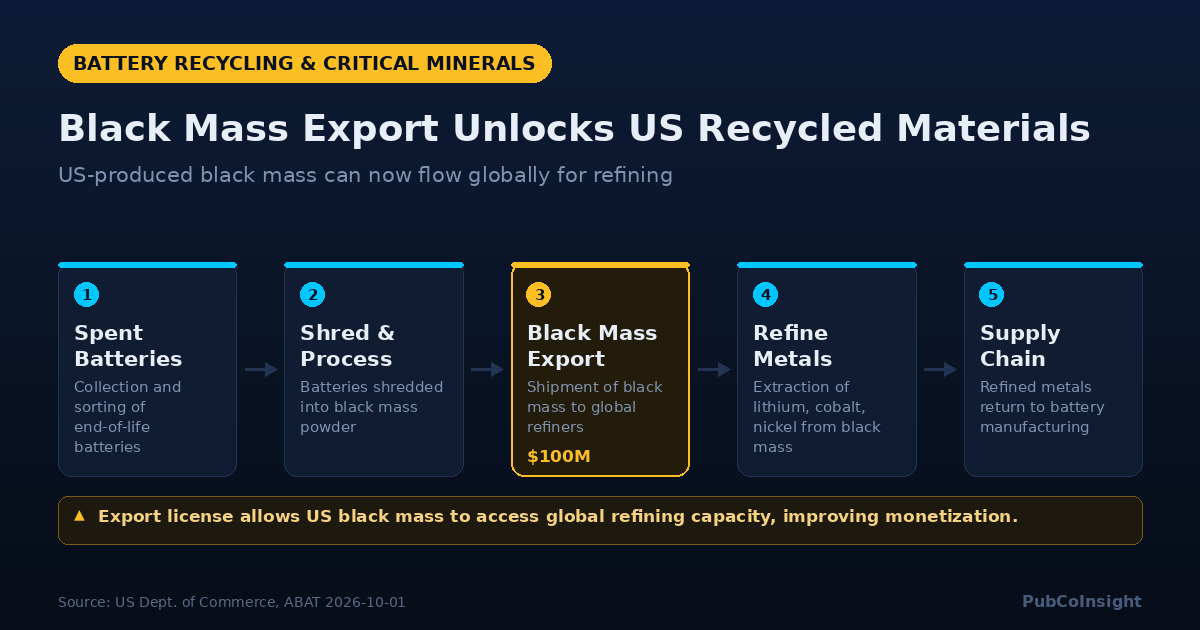
The Mechanics of Black Mass Export
Battery recycling begins with shredding spent lithium-ion batteries into a fine, dark powder known as black mass. This material contains high concentrations of valuable critical minerals like lithium, cobalt, nickel, and manganese. Extracting these individual metals from black mass is a complex hydrometallurgical or pyrometallurgical process, requiring specialized facilities and significant capital. The challenge is that not all regions possess the full suite of processing capabilities. Some facilities excel at initial shredding and black mass production, while others specialize in the subsequent refining of specific metals. An export license for black mass bridges this gap. It allows a company to process batteries into an intermediate product, the black mass, and then ship that concentrated material to a facility elsewhere in the world that has the capacity and technology to extract the final, refined critical minerals. This avoids the need for every recycling plant to be a full-spectrum refinery, lowering the capital expenditure for initial processing sites. It also creates a global market for black mass itself, turning an intermediate product into a tradeable commodity. The risk is that if the receiving country's refining capacity is limited or if geopolitical tensions restrict trade, the value chain can still seize up. The proof of its effectiveness will be sustained, high-volume exports and the subsequent return of refined materials or equivalent value to the originating market.Companies in the Critical Minerals Recycling and Exploration Space
Several companies are navigating the complex landscape of critical minerals, from primary extraction to recycling. American Battery Technology Company (ABAT), trading at $2.28, just secured the export license for its black mass, directly impacting its ability to participate in the global recycled materials market. This move allows ABAT to leverage its black mass production while potentially selling to international refiners. In the primary extraction sector, Atlas Lithium Corporation (ATLX), priced at $2.46, focuses on lithium exploration. Similarly, ioneer Ltd (IONR) at $2.88 is developing its Rhyolite Ridge lithium-boron project in Nevada. Standard Lithium Ltd. (SLI), with shares at $1.79, is advancing its Smackover brine projects in Arkansas, aiming to produce battery-grade lithium carbonate. These companies are working to bring new sources of critical minerals online. NioCorp Developments Ltd. (NB), trading at $3.43, is developing a niobium, scandium, and titanium project in Nebraska, with the potential for rare earth elements. Critical Metals Corp. (CRML), at $7.20, is involved in various critical metals projects, including rare earths. USA Rare Earth, Inc. (USAR), priced at $13.80, is focused on rare earth element processing and supply chain development, particularly in the United States. These companies represent different facets of securing a domestic supply of essential materials, from early-stage exploration to advanced processing.American Lithium Minerals, Inc.
American Lithium Minerals, Inc. (AMLM) trades over the counter at $0.065 and is an exploration stage company with no current revenue. The company’s stated focus is on lithium and boron properties located in Nevada. AMLM was incorporated in Nevada in March 2005. Its primary project is the Sarcobatus Lithium property, which covers 1,780 acres of mining claims in Central Nevada. The company has focused its activities on lithium exploration in this region since 2009. AMLM’s strategy involves acquiring mineral rights and exploring for lithium. The company has also held and divested cobalt, nickel, graphite, and rare earth element prospects in Nevada, Arizona, and Illinois in the past. American Lithium Minerals qualified a Regulation A offering on Form 1-A on February 4, 2026. This offering covers up to 80,000,000 units, with an additional 120,000,000 shares potentially issuable if the attached warrants are fully exercised. Each unit in the offering includes one share of common stock and one warrant to purchase 1.5 shares of common stock, exercisable at $0.05 per share until December 31, 2028. The public record does not yet establish any proven or probable reserves for the Sarcobatus project. The company intends to expand its exploration and acquisition efforts for mineral properties worldwide and is also developing the use of Real World Asset Tokens to provide capital for mining operations. AMLM announced on September 30, 2026, the completion of a PCAOB audit and a planned uplisting to OTCQB in the fourth quarter of 2026.What to watch
Investors in this sector should monitor several specific developments. For American Battery Technology Company (ABAT), the key will be the volume and destination of actual black mass exports following the October 1, 2026, Department of Commerce license approval. Look for subsequent announcements regarding specific export deals or partnerships. For American Lithium Minerals (AMLM), the stated uplisting to OTCQB in the fourth quarter of 2026 is a concrete event to watch, as is any progress on the Sarcobatus Lithium property, particularly the release of initial resource estimates or drilling results. For the broader sector, keep an eye on permit approvals for new mining projects like ioneer Ltd's Rhyolite Ridge, and any further government initiatives or funding announcements related to domestic critical minerals processing and recycling infrastructure. Offtake agreements for both primary and recycled materials will also indicate market demand and project viability., {"label": "Shred & Process", "note": "Batteries shredded into black mass powder"}, {"label": "Black Mass Export", "note": "Shipment of black mass to global refiners", "metric": "$100M"}, {"label": "Refine Metals", "note": "Extraction of lithium, cobalt, nickel from black mass"}, {"label": "Supply Chain Re-entry", "note": "Refined metals return to battery manufacturing"}], "highlight": 2, "highlight_note": "Export license allows US black mass to access global refining capacity, improving monetization.", "footnote": "Source: US Dept. of Commerce, ABAT 2026-10-01"}Companies mentioned
| Ticker | Company | Price |
|---|---|---|
| ABAT | American Battery Technology Company | $2.28 |
| AMLM client | American Lithium Minerals, Inc. | $0.065 |
| ATLX | Atlas Lithium Corporation | $2.46 |
| CRML | Critical Metals Corp. | $7.2 |
| IONR | ioneer Ltd | $2.88 |
| NB | NioCorp Developments Ltd. | $3.43 |
| SLI | Standard Lithium Ltd. | $1.79 |
| USAR | USA Rare Earth, Inc. | $13.8 |
Listed alphabetically, not ranked. Prices as of 2026-10-02 and they move. Check a live quote before relying on any of this.
How we chose the companies in this article
We cover a fixed universe of companies working in lithium, boron and the critical minerals that feed battery and energy-storage supply chains. Every one of them that had usable market data on 2026-10-02 appears in this article. We do not pick which ones to mention based on what we think of them, and we do not order them by size, price or trading volume, because an ordered list is a verdict and that is not ours to hand down. Companies left out, and why: none. American Lithium Minerals and Artificial Intelligence Technology Solutions pay us, which is disclosed in full at the foot of every article they appear in.
See the dilution and promotion flags before you see the pitch.
Each week: the micro and small-caps now showing dilution or paid-promotion signals, with the SEC filing behind every flag. No recommendations, no price targets.
Sources used in this article
- 3 Canadian Lithium Stocks With Earnings Growth Up To 61% Simply Wall St. · 2026-10-02
- Albemarle Corporation to Release Third Quarter 2026 Earnings Results on Wednesday, November 4, 2026 PR Newswire · 2026-10-01
- Mizuho Cuts Price Target on Albemarle to $130 From $140, Keeps Neutral Rating MT Newswires · 2026-10-01
- Mizuho Adjusts Price Target on Albemarle to $130 From $140, Maintains Neutral Rating MT Newswires · 2026-10-01
- Is Sociedad Química Y Minera De Chile (NYSE:SQM) Reasonable After A 52% Run? Simply Wall St. · 2026-10-01
- Sociedad Química Y Minera De Chile (SQM) Looks Undervalued On Paper, So Why Is The Market Hesitant? Simply Wall St. · 2026-10-01
- Lithium Americas Corp. (LAC) Stock Declines While Market Improves: Some Information for Investors Zacks · 2026-10-01
- MP Materials CEO Earns C$39 Million to Top Bedford's 2026 Mining Compensation Rankings CNW Group · 2026-10-01
- Critical Metals And 2 Top Rare Earth Stocks To Watch Simply Wall St. · 2026-10-01
- 3 Lithium Stocks To Own In October 2026 Simply Wall St. · 2026-10-01
- Tungsten Has Tripled in 2026 as U.S. Explorers Race to Drill CNW Group · 2026-10-01
- American Battery Technology Shares Rise 10% After Receiving Export Approval InvestorsHub · 2026-10-01
Disclosure required by Section 17(b) of the Securities Act of 1933
American Lithium Minerals, Inc.. American Lithium Minerals, Inc. (issuer) paid Strategic Innovations First, Inc., an affiliate of PubCo Insight and Pulse IR. Compensation received: USD 11,550.00 total, three equal monthly installments of USD 3,850.00. Form of payment: cash only; no stock, options or warrants. Services: investor relations, marketing and content creation under Master Services Agreement dated June 22, 2026. Period: three month initial term, June 2026 through August 2026. No position, options or warrants held by PubCo Insight, Pulse IR, Strategic Innovations First, Inc., or Brad Listermann.
This is information, not investment, financial, legal or tax advice. It is not a recommendation or solicitation to buy, sell or hold any security and it contains no price target. Nothing here is independently verified by us. Confirm every figure against primary filings on SEC EDGAR before you act. Micro-cap and over-the-counter securities are speculative and illiquid and can lose all of their value. The companies named without a disclosure above pay us nothing and have no relationship with us; they are named because a published, mechanical screen selected them. Full disclosure policy.