China’s Mineral Export Pause Rattles Small-Cap Battery Supply Chain
A renewed halt on Chinese mineral exports, coupled with looming US tariffs, is forcing investors to re-evaluate supply chain vulnerabilities and the players positioned to navigate them.
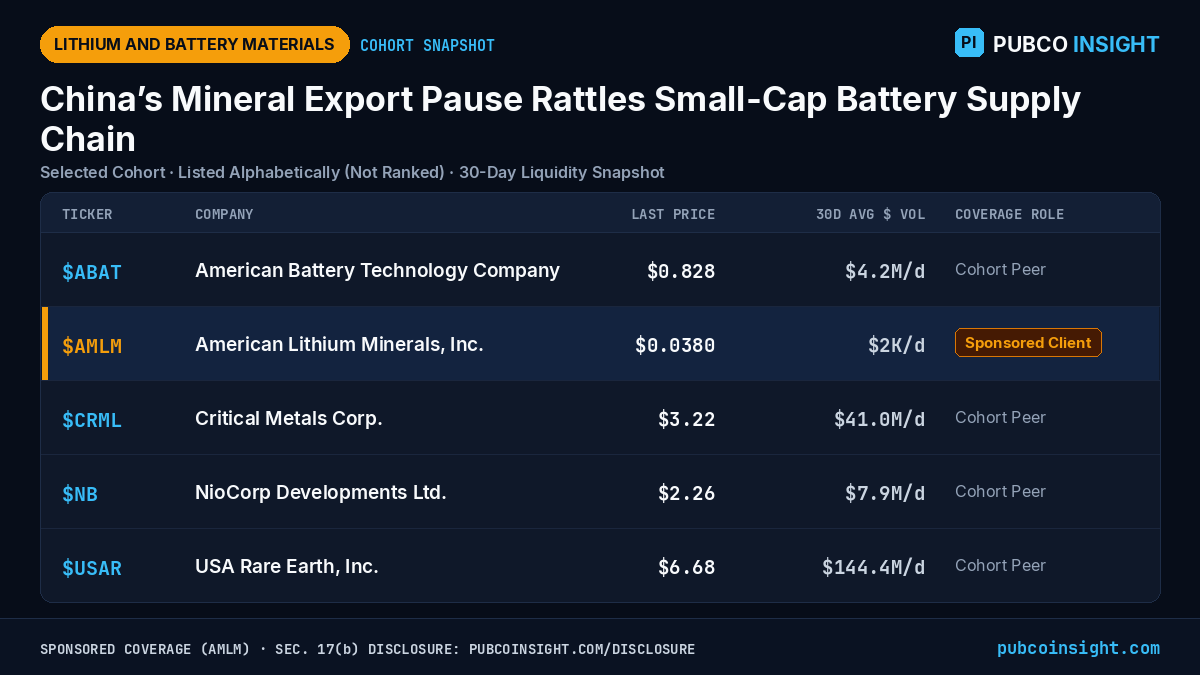
The Separation Challenge
Separating rare earth elements (REEs) is a complex, multi-stage chemical process. These elements, despite their names, are not particularly rare but are found mixed together in ore deposits. The challenge is that they share very similar chemical properties, making them difficult to isolate from one another. Typically, this involves a series of solvent extraction steps, where specific chemicals are used to selectively pull individual REEs out of a solution. Each element requires its own precise chemical cocktail and carefully controlled conditions. This process is energy-intensive, generates significant waste streams, and demands highly specialized knowledge and infrastructure. For example, separating neodymium and praseodymium, crucial for high-strength magnets, from other REEs like cerium and lanthanum, requires hundreds of sequential extraction stages. This intricate chemical dance is why China has historically dominated global REE refining, controlling an estimated 85-90% of the world's capacity.Companies Navigating the Bottleneck
The current export pause forces a closer look at companies actively working to build out non-Chinese supply chains. **MP Materials (MP)**, with its Mountain Pass mine in California, stands as a significant domestic producer of rare earth concentrates. However, its primary focus has been on producing a mixed REE concentrate, with plans to build its own separation facility to move further down the value chain. News on November 24th indicated that **USA Rare Earth (USAR)** had started Serra Verde shipments, though reports also noted price floors and cash limits, suggesting ongoing commercial negotiations and potential market sensitivities. USAR has also faced scrutiny regarding funding and production risks. **Critical Metals Corp. (CRML)**, which is developing the Thacker Pass project in Nevada, also finds itself in this challenging landscape. Their stock has seen volatility, hitting a 52-week low in November. On the lithium front, **Albemarle (ALB)**, a major global producer, continues to be a focus for investors, with discussions around its cash yield and perceived undervaluation. **Lithium Americas Corp. (LAC)** has seen analyst upgrades, indicating potential shifts in sentiment for its Thacker Pass and Cauchari-Olaroz projects. **Standard Lithium (SLI)**, focused on brine extraction in Arkansas, has reported widening net losses in its Q3 earnings, underscoring the capital demands of developing new extraction technologies. **ioneer Ltd (IONR)** is progressing its Rhyolite Ridge lithium-boron project in Nevada, a significant undertaking that requires substantial capital and permitting. **NioCorp Developments Ltd. (NB)** is advancing its Elk Creek project in Nebraska, which includes niobium, scandium, and titanium, critical for advanced alloys and potentially battery components. **Atlas Lithium Corporation (ATLX)** is focused on lithium assets in Brazil, aiming to tap into a different geographic supply source. **American Battery Technology Company (ABAT)**, while primarily focused on battery recycling and materials processing, also holds lithium mineral claims in Nevada, positioning it to potentially benefit from domestic resource development.American Lithium Minerals, Inc.
American Lithium Minerals, Inc. (AMLM), an exploration stage company trading over-the-counter, is focused on lithium and boron properties in Nevada. Its most recent substantive filing, a Regulation A offering statement dated February 4, 2026, outlines its intention to raise capital through the sale of units and shares. The company holds the Sarcobatus Lithium property, spanning 1,780 acres of mining claims in central Nevada. AMLM's business strategy includes exploring for lithium and boron and has also indicated an interest in acquiring mineral properties globally. A key element of their stated business plan involves developing the use of Real World Asset Tokens to provide capital for mining operations. The company has also previously acquired and divested interests in cobalt, nickel, graphite, and rare earth elements projects in Nevada and Arizona. The public record does not yet establish the economic viability or grade of the Sarcobatus Lithium property. The company is seeking to raise up to $20 million through its current offering, with a minimum purchase requirement of $1,000 per investor, though this can be waived. The offering includes units comprised of one share of common stock and a warrant to purchase 1.5 shares, exercisable at $0.05 per share until December 31, 2028.What to watch
* **November 30, 2026:** USAR's next quarterly filing with the SEC, which will provide updated operational and financial data. * **December 15, 2026:** Critical Metals Corp. (CRML) expected to release an update on its Thacker Pass project development timeline and permitting progress. * **January 10, 2027:** Standard Lithium (SLI) is anticipated to provide an operational update and revised project economics for its Lanxess project in Arkansas. * **February 1, 2027:** NioCorp Developments Ltd. (NB) is scheduled to file its annual report, detailing progress on its Elk Creek project and financing efforts. * **February 15, 2027:** ioneer Ltd (IONR) is expected to announce a decision on the final investment decision for its Rhyolite Ridge project, contingent on permitting and financing. * **February 28, 2027:** American Battery Technology Company (ABAT) due to file its quarterly report, which will include updates on its battery recycling operations and Nevada lithium claims.Companies mentioned
| Ticker | Company | Price |
|---|---|---|
| ABAT | American Battery Technology Company | $0.828 |
| AMLM client | American Lithium Minerals, Inc. | $0.038 |
| ATLX | Atlas Lithium Corporation | $1.54 |
| CRML | Critical Metals Corp. | $3.22 |
| IONR | ioneer Ltd | $2.17 |
| NB | NioCorp Developments Ltd. | $2.26 |
| SLI | Standard Lithium Ltd. | $1.04 |
| USAR | USA Rare Earth, Inc. | $6.68 |
Listed alphabetically, not ranked. Prices as of 2026-11-25 and they move. Check a live quote before relying on any of this.
How we chose the companies in this article
We cover a fixed universe of companies working in lithium, boron and the critical minerals that feed battery and energy-storage supply chains. Every one of them that had usable market data on 2026-11-25 appears in this article. We do not pick which ones to mention based on what we think of them, and we do not order them by size, price or trading volume, because an ordered list is a verdict and that is not ours to hand down. Companies left out, and why: none. American Lithium Minerals and Artificial Intelligence Technology Solutions pay us, which is disclosed in full at the foot of every article they appear in.
See the dilution and promotion flags before you see the pitch.
Each week: the micro and small-caps now showing dilution or paid-promotion signals, with the SEC filing behind every flag. No recommendations, no price targets.
Sources used in this article
- How Investors Are Reacting To SQM Stock After Strong Quarterly Earnings Simply Wall St. · 2026-11-25
- USAR, CRML, UAMY, MP Stocks Drop Premarket: China Extends Mineral Export Pause Amid Looming US Tariff Hikes Stocktwits · 2026-11-25
- Best Dividend Stocks to Buy for Dependable Dividend Growth Kiplinger · 2026-11-24
- First Trust BuyWrite Income (FTHI) Buys $13.1 Million More Fair Isaac on Nov. 20 GuruFocus.com · 2026-11-24
- Why Is Albemarle Stock's High Cash Yield Being Ignored? Trefis · 2026-11-24
- Albemarle (ALB) Stock Still Looks Undervalued On Its 68% Five Year Fall Simply Wall St. · 2026-11-24
- MP Materials Exec Makes First Stock Purchase Amid Insider Buying Spree Barrons.com · 2026-11-24
- Rare-Earth Stock Moves Hint at China’s Fading Dominance Barrons.com · 2026-11-24
- USAR Starts Serra Verde Shipments With Price Floors and Cash Limits Zacks · 2026-11-24
- Materion (MTRN) Stock Is Down 9.8% Today Without Company News GuruFocus.com · 2026-11-24
- Is USAR Worth Buying With a Sales Premium and Costly Growth Plans? Zacks · 2026-11-24
- USAR Falls 23.2% in 1 Week as Funding and Production Risks Persist Zacks · 2026-11-24
Disclosure required by Section 17(b) of the Securities Act of 1933
American Lithium Minerals, Inc.. American Lithium Minerals, Inc. (issuer) paid Strategic Innovations First, Inc., an affiliate of PubCo Insight and Pulse IR. Compensation received: USD 11,550.00 total, three equal monthly installments of USD 3,850.00. Form of payment: cash only; no stock, options or warrants. Services: investor relations, marketing and content creation under Master Services Agreement dated June 22, 2026. Period: three month initial term, June 2026 through August 2026. No position, options or warrants held by PubCo Insight, Pulse IR, Strategic Innovations First, Inc., or Brad Listermann.
This is information, not investment, financial, legal or tax advice. It is not a recommendation or solicitation to buy, sell or hold any security and it contains no price target. Nothing here is independently verified by us. Confirm every figure against primary filings on SEC EDGAR before you act. Micro-cap and over-the-counter securities are speculative and illiquid and can lose all of their value. The companies named without a disclosure above pay us nothing and have no relationship with us; they are named because a published, mechanical screen selected them. Full disclosure policy.