China's Rare Earth Export Restrictions Highlight Critical Mineral Bottlenecks
Geopolitical tensions are sharpening the focus on domestic rare earth processing and the complex supply chains for battery and energy storage materials.
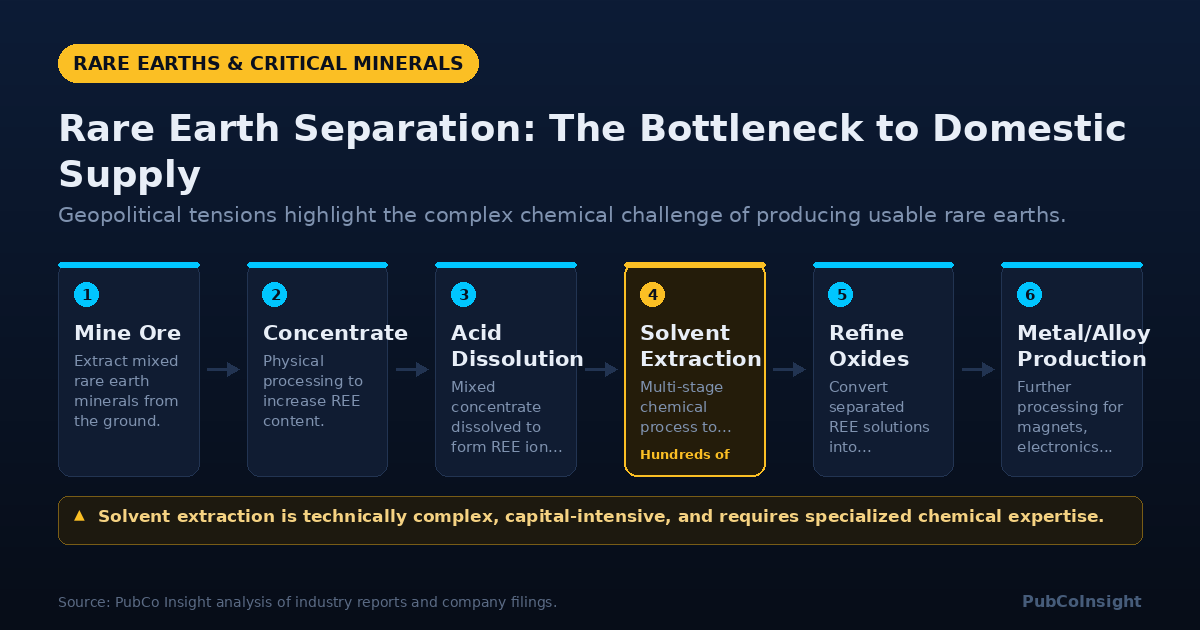
The Complexities of Rare Earth Separation
Rare earth elements, or REEs, are not truly rare in the Earth's crust, but they are rarely found in economic concentrations. More critically, they are almost never found in forms that can be directly used. The challenge lies in their chemical similarity. All 17 REEs, from lanthanum to lutetium, share similar electron configurations. This makes them difficult to separate from each other once mined from an ore body. The physical mechanism for separation typically involves solvent extraction. Mined rare earth concentrate, often a mixed oxide, is first dissolved in acid. This creates a solution containing various REE ions. This solution then undergoes a multi-stage process where it is mixed with an organic solvent. Each stage is designed to selectively extract specific REE ions based on slight differences in their chemical properties. The process is repeated hundreds, sometimes thousands, of times in a series of tanks and mixers. Each separation column targets a specific element or a small group of elements. The output is individual, high-purity rare earth oxides, which are then converted into metals or alloys for use in magnets, catalysts, and other high-tech applications. The difficulty, and the bottleneck, is the sheer scale and precision required for this chemical separation, which demands significant capital, specialized expertise, and often, environmentally robust waste management.Operators in the Critical Minerals Space
Several companies are working to address these supply chain challenges, each with a distinct approach. MP Materials (MP), trading at $17.61, operates Mountain Pass in California, the only integrated rare earth mining and processing site in North America. MP Materials extracts and processes rare earth concentrates, aiming to expand its capabilities to produce separated rare earth oxides and metals domestically. USA Rare Earth, Inc. (USAR), priced at $17.61, is developing the Round Top heavy rare earth and critical minerals project in Texas. USAR’s strategy centers on a comprehensive domestic supply chain, from mining to separation and alloy production. The company has emphasized its ability to process a wide range of critical minerals alongside rare earths. Critical Metals Corp. (CRML), at $7.28, is focused on European assets. The company recently provided an update on its proposed acquisition of European Lithium, which holds the Wolfsberg lithium project in Austria. CRML's strategy involves securing critical mineral supply chains closer to European manufacturing hubs. In the lithium sector, Standard Lithium Ltd. (SLI), trading at $2.42, is advancing its Smackover project in Arkansas. On August 31, 2026, its joint venture, Smackover Lithium, signed a 10-year offtake agreement with LG Energy Solution for lithium carbonate from the South West Arkansas Project. This deal highlights the growing demand for domestically sourced battery-grade lithium. Albemarle (ALB), a major player in the broader lithium market, recently announced a CEO succession plan on September 3, 2026, with Ragnar Udd named President and CEO. While a larger cap company, its strategic decisions impact the entire lithium supply chain. Atlas Lithium Corporation (ATLX), priced at $3.33, is developing lithium projects in Brazil. The company focuses on hard-rock lithium deposits, which can offer different processing advantages compared to brine operations. ioneer Ltd (IONR), at $3.14, is developing the Rhyolite Ridge Lithium-Boron Project in Nevada. This project is unique for its co-production of lithium and boron, two critical materials for the energy transition. Boron is essential for various high-strength alloys and specialized glass, while lithium is, of course, a core battery component. NioCorp Developments Ltd. (NB), trading at $4.13, is working on the Elk Creek Critical Minerals Project in Nebraska. This project targets niobium, scandium, and titanium, with potential for rare earth byproducts. Niobium is crucial for high-strength low-alloy steel, scandium for aerospace alloys, and titanium for lightweight, strong materials. American Battery Technology Company (ABAT), at $2.78, focuses on battery recycling and primary extraction technologies. The company hosted DOE leadership on August 31, 2026, to showcase its commercial technologies aimed at strengthening U.S. critical minerals supply chains. ABAT announced its highest ever gross profit and successful appeal for reinstatement of a $57 million DOE grant in its Q4 FY2026 financial results.American Lithium Minerals, Inc.
American Lithium Minerals, Inc. (AMLM), trading over the counter at $0.0676, is an exploration stage company with a stated focus on lithium and boron properties in Nevada. The company incorporated in Nevada on March 10, 2005. Its current primary project is the Sarcobatus Lithium property, comprising 1,780 acres of mining claims in Central Nevada. AMLM's activities since 2009 have centered on lithium exploration in this region. The company has also acquired and divested cobalt, nickel, and graphite prospects in Central Nevada, and rare earth elements projects in Kingman, Arizona, and Southeast Illinois. AMLM is pre-revenue. The SEC qualified a Regulation A offering on Form 1-A on February 4, 2026. This offering covers up to 80,000,000 units, with up to 120,000,000 shares issuable if the attached warrants are fully exercised. Each unit in the offering includes one share of common stock and one warrant to purchase 1.5 shares of common stock, exercisable at $0.05 per share until December 31, 2028. The maximum total offering amount is $20,000,000. AMLM’s filings state an intention to expand its exploration and acquisition for mineral properties worldwide, and also to develop the use of Real World Asset Tokens to provide capital for mining. While the company has identified specific properties and an exploration focus, the public record does not yet establish a definitive resource estimate or a timeline for moving beyond the exploration stage for its Sarcobatus project. The company does not currently own any real property such as land or physical plants.What to watch
Investors in the critical minerals space should monitor several key indicators. The ongoing geopolitical climate around rare earth shipments will remain a primary driver, with any further restrictions or policy shifts from China directly impacting market sentiment and supply chain strategies. For CRML, the progress of its proposed acquisition of European Lithium, including the September court date for the merger deal, is a critical near-term event. The success of Standard Lithium's Smackover project, particularly its ability to scale production following the LG Energy Solution offtake, will be important to observe. For AMLM, updates on exploration results from the Sarcobatus Lithium property, including any preliminary resource assessments or drilling programs, would provide more clarity on the project's potential. Broader government initiatives, such as the $500 million critical minerals push mentioned by former President Trump, could also create tailwinds for domestic projects, particularly those with advanced permitting or development stages., { "label": "Concentrate", "note": "Physical processing to increase REE content." }, { "label": "Acid Dissolution", "note": "Mixed concentrate dissolved to form REE ion solution." }, { "label": "Solvent Extraction", "note": "Multi-stage chemical process to separate individual REEs.", "metric": "Hundreds of stages" }, { "label": "Refine Oxides", "note": "Convert separated REE solutions into high-purity oxides." }, { "label": "Metal/Alloy Production", "note": "Further processing for magnets, electronics, defense." } ], "highlight": 3, "highlight_note": "Solvent extraction is technically complex, capital-intensive, and requires specialized chemical expertise.", "footnote": "Source: PubCo Insight analysis of industry reports and company filings." }Companies mentioned
| Ticker | Company | Price |
|---|---|---|
| ABAT | American Battery Technology Company | $2.78 |
| AMLM client | American Lithium Minerals, Inc. | $0.0676 |
| ATLX | Atlas Lithium Corporation | $3.33 |
| CRML | Critical Metals Corp. | $7.28 |
| IONR | ioneer Ltd | $3.14 |
| NB | NioCorp Developments Ltd. | $4.13 |
| SLI | Standard Lithium Ltd. | $2.42 |
| USAR | USA Rare Earth, Inc. | $17.61 |
Listed alphabetically, not ranked. Prices as of 2026-09-05 and they move. Check a live quote before relying on any of this.
How we chose the companies in this article
We cover a fixed universe of companies working in lithium, boron and the critical minerals that feed battery and energy-storage supply chains. Every one of them that had usable market data on 2026-09-05 appears in this article. We do not pick which ones to mention based on what we think of them, and we do not order them by size, price or trading volume, because an ordered list is a verdict and that is not ours to hand down. Companies left out, and why: none. American Lithium Minerals and Artificial Intelligence Technology Solutions pay us, which is disclosed in full at the foot of every article they appear in.
See the dilution and promotion flags before you see the pitch.
Each week: the micro and small-caps now showing dilution or paid-promotion signals, with the SEC filing behind every flag. No recommendations, no price targets.
Sources used in this article
- Why Is Albemarle (ALB) Up 5.4% Since Last Earnings Report? Zacks · 2026-09-04
- Albemarle’s Next CEO Inherits A $250 Million Swing Per Dollar Benzinga · 2026-09-04
- Jim Cramer Bullish on MP Materials (MP) But Warns Investors Not to Expect Quick Results Insider Monkey · 2026-09-04
- Energy Fuels' Q2 Loss Widens: Is a Recovery on the Horizon? Zacks · 2026-09-04
- USA Rare Earth Rises 4%, Then Coughs Up Gains as Chinese Suppliers Refuse U.S. Shipments 24/7 Wall St. · 2026-09-04
- MP Materials (MP) Stock Looks Expensive On Sales But Strong On Returns Simply Wall St. · 2026-09-04
- MP, CRML, USAR Stocks In Focus: China Reportedly Blocks Some Rare Earth Shipments To US Stocktwits · 2026-09-04
- ‘Some of These Lasers Were the Size of Buildings’: Now They Need 12 Minerals China Cut Off 24/7 Wall St. · 2026-09-04
- Albemarle Names Ragnar Udd President and CEO MT Newswires · 2026-09-03
- Albemarle Announces CEO Succession Plan PR Newswire · 2026-09-03
- LGES signs 10-year deal with US-based Smackover Lithium Just Auto · 2026-09-03
- MP Materials to Participate in Jefferies 2026 Global Industrials Conference Business Wire · 2026-09-02
Disclosure required by Section 17(b) of the Securities Act of 1933
American Lithium Minerals, Inc.. American Lithium Minerals, Inc. (issuer) paid Strategic Innovations First, Inc., an affiliate of PubCo Insight and Pulse IR. Compensation received: USD 11,550.00 total, three equal monthly installments of USD 3,850.00. Form of payment: cash only; no stock, options or warrants. Services: investor relations, marketing and content creation under Master Services Agreement dated June 22, 2026. Period: three month initial term, June 2026 through August 2026. No position, options or warrants held by PubCo Insight, Pulse IR, Strategic Innovations First, Inc., or Brad Listermann.
This is information, not investment, financial, legal or tax advice. It is not a recommendation or solicitation to buy, sell or hold any security and it contains no price target. Nothing here is independently verified by us. Confirm every figure against primary filings on SEC EDGAR before you act. Micro-cap and over-the-counter securities are speculative and illiquid and can lose all of their value. The companies named without a disclosure above pay us nothing and have no relationship with us; they are named because a published, mechanical screen selected them. Full disclosure policy.