Axon's 2026 Outlook Highlights Connected Devices, Shifts Focus in Guarding Market
Axon Enterprise raised its 2026 revenue forecast on August 14, pointing to connected devices as a key growth driver, a signal that physical AI integration is now central to scaling security operations.
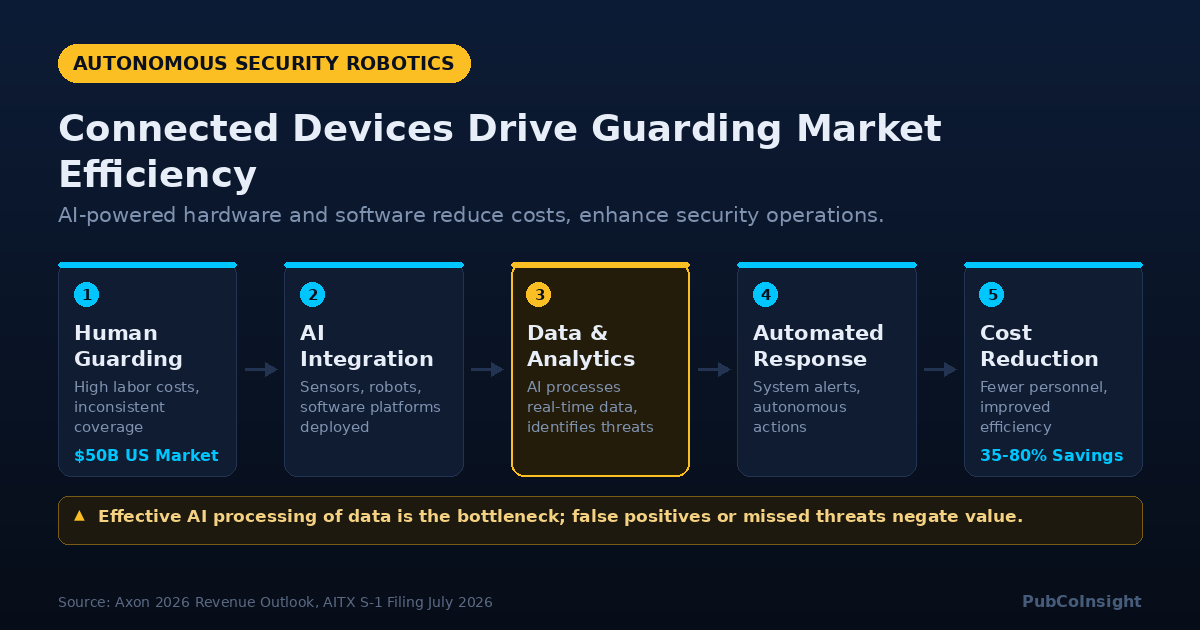
The Mechanism of Connected Security
Connected security devices integrate physical hardware, like cameras or robots, with a centralized software platform. This platform uses artificial intelligence to process data, identify anomalies, and trigger responses. The core value proposition is efficiency. A single human operator can monitor multiple autonomous units or stationary devices. These units collect data, perform patrols, and identify threats with a consistency that human guards cannot always match. For this system to matter, the AI must be robust enough to minimize false positives and accurately distinguish threats from benign events. This requires significant training data and sophisticated machine learning models. The hardware must be durable, energy-efficient, and capable of operating autonomously for extended periods. Connectivity is also paramount; devices need reliable, low-latency communication to transmit data and receive commands. A break in connectivity renders an autonomous unit a static object. The shift is from reactive security, where a human responds to an event, to proactive or even predictive security. AI analyzes patterns, flags unusual behavior, and can even anticipate potential issues. This reduces response times and, in theory, prevents incidents. The cost savings come from reducing the number of human guards needed for routine tasks, allowing them to focus on higher-value interventions or supervision. The system proves wrong if the AI consistently fails to detect threats, generates excessive false alarms, or if the hardware proves too expensive to maintain or deploy at scale, negating the promised cost savings.Companies Operating in Autonomous Security Robotics
Several companies are developing and deploying solutions in this evolving market. They approach the challenge from different angles, focusing on various aspects of autonomous security and physical AI. In the realm of mobile autonomous platforms, Serve Robotics Inc. (SERV), currently priced at $4.99, is known for its sidewalk delivery robots. While primarily focused on food delivery, the underlying autonomous navigation and object detection technology has clear parallels to mobile security applications. The question for Serve is whether it can pivot or expand its physical AI beyond its current delivery niche, as Zacks noted on August 14. Unusual Machines, Inc. (UMAC), trading at $34.06, and Red Cat Holdings, Inc. (RCAT), at $11.13, are both heavily involved in drone technology. Unusual Machines saw its stock pop on August 14 after tariff news, with Piper Sandler reportedly bullish on its prospects. Drones offer an aerial perspective for security, capable of patrolling large areas quickly and accessing difficult terrain. Their value in guarding services lies in rapid deployment for perimeter checks, event monitoring, and emergency response. Red Cat focuses on drone hardware and software, including its "Teal Drones" subsidiary, which produces American-made drones for defense and public safety. For companies providing the underlying sensor and perception technology, Arbe Robotics Ltd. (ARBE), priced at $0.797, develops 4D imaging radar solutions. This technology is crucial for autonomous systems to "see" in challenging conditions like fog or heavy rain, offering a higher resolution picture than traditional radar. MicroVision, Inc. (MVIS), at $2.24, is a player in lidar technology, another key sensor for autonomous navigation and mapping. Similarly, Kopin Corporation (KOPN), trading at $5.50, provides micro-displays and optical systems essential for augmented reality applications, which could be integrated into advanced security systems for human operators. On the software and AI side, BigBear.ai Holdings, Inc. (BBAI), at $3.27, offers AI-powered analytics and data processing capabilities. Their focus is on decision intelligence, which translates raw data into actionable insights for defense, intelligence, and commercial customers. This type of AI is critical for making sense of the vast amounts of data collected by connected security devices. Lantronix, Inc. (LTRX), priced at $6.47, provides embedded computing and networking solutions, which form the backbone for connecting these diverse devices and ensuring secure data transmission. Ondas Inc. (ONDS), trading at $9.24, operates in critical infrastructure wireless networks and autonomous drone solutions. Its subsidiary, Ondas Networks, provides private industrial wireless networks, which are vital for reliable communication between autonomous security assets, especially in large industrial or municipal deployments. Ondas also saw increased attention on August 14 following tariff news. The company reported solid sales growth but a wider-than-expected Q2 loss.Artificial Intelligence Technology Solutions, Inc.
Artificial Intelligence Technology Solutions, Inc. (AITX), trading on the OTCID tier at $0.007, operates through subsidiaries focused on autonomous security robots and remote monitoring systems. The company structures its offerings on a recurring monthly subscription model. This approach aims to provide predictable revenue streams rather than relying on one-off hardware sales. AITX's operations are divided into three main pillars. Robotic Assistance Devices, Inc. (RAD-I) handles stationary security devices. The company targets the estimated $50 billion U.S. security and guarding services market with these solutions. AITX states its solutions can deliver significant cost savings, between 35% and 80%, compared to traditional manned security. Robotic Assistance Devices Mobile (RAD-M) focuses on mobile autonomous platforms, including the ROAMEO mobile security unit, which began early commercial deployment in May 2026. This mobile segment is characterized by management as having a higher revenue ceiling than stationary solutions. The third pillar, Robotic Assistance Devices Group (RAD-G), is dedicated to the SARA agentic artificial intelligence platform. This platform is intended for licensing, with the expectation of generating substantial revenue. A wholly-owned subsidiary, RAD Lanka, located in Sri Lanka, supports software development, AI initiatives, and technical operations across the company's various units. The company's internal long-term vision for this integrated strategy is referred to as "RAD Town," envisioning comprehensive autonomous-security deployments across large campuses or communities. For the fiscal year ended February 28, 2026, AITX reported revenue of $7,745,336, a 26% increase year-over-year. Gross profit rose 48% to $5,533,700, with gross margin expanding to approximately 71%. Operating expenses remained flat at around $17,477,097, and the loss from operations improved by approximately $2.0 million to $(11,943,397). The company reported a net loss of approximately $14.5 million for the fiscal year and had an accumulated deficit of approximately $171 million as of that date. The public record does not yet establish consistent positive cash flow from operations. As of February 28, 2026, AITX had negative cash flow from operating activities of $9,344,534 and negative working capital of $17,017,745. The company's independent registered public accounting firm included an explanatory paragraph in its report expressing substantial doubt about AITX's ability to continue as a going concern.What to watch
Monitor the pace of Axon Enterprise's connected device deployments. Their next quarterly earnings call will likely elaborate on specific product lines driving this growth, offering insight into which types of connected devices are gaining traction. Watch for any public statements or filings from Axon detailing their partnerships with smaller, specialized robotics or AI firms. This could indicate strategic acquisitions or collaborations that validate specific technologies. For Ondas Inc. (ONDS), track the impact of new orders on its revenue growth in the second half of the year, as suggested by Zacks on August 14. Specifically, look for details on whether these orders are for its critical infrastructure networks or its drone solutions, and how they contribute to profitability timelines. For Serve Robotics Inc. (SERV), watch for any announcements regarding expansion beyond food delivery or new pilot programs in security applications, which would signal a broader market strategy. For Unusual Machines (UMAC), observe how new tariffs on drone imports translate into actual sales figures and market share gains in future filings. For Artificial Intelligence Technology Solutions (AITX), review upcoming 8-K filings for updates on ROAMEO mobile security unit deployments and any new subscription contracts for RAD-I stationary devices. Pay attention to any disclosures regarding the SARA platform's licensing progress. The company's ability to achieve positive cash flow from operations, as discussed in its July 17, 2026 S-1 filing, remains a key indicator., { "label": "AI Integration", "note": "Sensors, robots, software platforms deployed" }, { "label": "Data & Analytics", "note": "AI processes real-time data, identifies threats" }, { "label": "Automated Response", "note": "System alerts, autonomous actions" }, { "label": "Cost Reduction", "note": "Fewer personnel, improved efficiency", "metric": "35-80% Savings" } ], "highlight": 2, "highlight_note": "Effective AI processing of data is the bottleneck; false positives or missed threats negate value.", "footnote": "Source: Axon 2026 Revenue Outlook, AITX S-1 Filing July 2026" }Companies mentioned
| Ticker | Company | Price |
|---|---|---|
| AITX client | Artificial Intelligence Technology Solutions Inc | $0.007 |
| ARBE | Arbe Robotics Ltd. | $0.797 |
| BBAI | BigBear.ai Holdings, Inc. | $3.27 |
| KOPN | Kopin Corporation | $5.5 |
| LTRX | Lantronix, Inc. | $6.47 |
| MVIS | MicroVision, Inc. | $2.24 |
| ONDS | Ondas Inc. | $9.24 |
| RCAT | Red Cat Holdings, Inc. | $11.13 |
| SERV | Serve Robotics Inc. | $4.99 |
| UMAC | Unusual Machines, Inc. | $34.06 |
Listed alphabetically, not ranked. Prices as of 2026-08-16 and they move. Check a live quote before relying on any of this.
How we chose the companies in this article
We cover a fixed universe of companies working in autonomous security robotics, physical AI and the guarding services market they are aimed at. Every one of them that had usable market data on 2026-08-16 appears in this article. We do not pick which ones to mention based on what we think of them, and we do not order them by size, price or trading volume, because an ordered list is a verdict and that is not ours to hand down. Companies left out, and why: none. American Lithium Minerals and Artificial Intelligence Technology Solutions pay us, which is disclosed in full at the foot of every article they appear in.
See the dilution and promotion flags before you see the pitch.
Each week: the micro and small-caps now showing dilution or paid-promotion signals, with the SEC filing behind every flag. No recommendations, no price targets.
Sources used in this article
- Bill Ackman Put 4.9% of Pershing Square USA Into the Netflix Trade That Cost Him $400 Million in 2022 Motley Fool · 2026-08-16
- AMD Just Borrowed $4.75 Billion, More Than Triple Its Last Bond Sale Motley Fool · 2026-08-16
- If You've Saved This Much for Retirement by Age 50, You're Ahead of the Game Motley Fool · 2026-08-16
- Firefly Aerospace Is Awarded New Orbital Contract From Department of Defense Motley Fool · 2026-08-16
- Why Data Centers Are Turning Energy Stocks Into AI Plays Motley Fool · 2026-08-16
- Could Investing $5,000 in SpaceX Help Make You a Millionaire? Motley Fool · 2026-08-16
- CrowdStrike Is One of My Largest Holdings and Trading Near Its All-Time High. Here's Why I'm Not Buying More Shares Right Now. Motley Fool · 2026-08-16
- If You'd Put $5,000 Into Rocket Lab 5 Years Ago, Here's How Much You'd Have Today Motley Fool · 2026-08-16
- How could open-weight models impact GenAI ROIC? Investing.com · 2026-08-15
- SpaceX Stock Is Down 33% From Its High. Elon Musk Expects Revenue to Rise 53-Fold to $1 Trillion by 2030. Motley Fool · 2026-08-15
- Is It Too Late to Buy Ondas Stock? Motley Fool · 2026-08-15
- Piper Sandler Is Bullish on Unusual Machines Stock. Here's Why. Barchart · 2026-08-15
Disclosure required by Section 17(b) of the Securities Act of 1933
Artificial Intelligence Technology Solutions, Inc., a Nevada corporation (OTCID: AITX). Artificial Intelligence Technology Solutions, Inc. pays Strategic Innovations First, Inc., a Wyoming corporation doing business as PulseIR. Compensation received: USD 5,000.00 per month for months 1-3 (August, September, October 2026); USD 10,000.00 per month for months 4-6 (November, December 2026, January 2027) contingent on the 90-day review. Minimum committed USD 15,000.00; USD 45,000.00 if the second-period rate triggers.. Form of payment: cash only, invoiced monthly in advance; no stock, options or warrants received or payable. Services: investor relations services under an Investor Relations Services Agreement effective 2026-08-01. Period: six month term, 2026-08-01 through 2027-01-31; 90-day review on or about 2026-10-30. No stock, options or warrants held by PubCo Insight, Pulse IR, Strategic Innovations First, Inc., or Brad Listermann. Confirmed by the executed agreement and by board record recKwdq39X2caPSX7 (POSITIONS HELD: none).
This is information, not investment, financial, legal or tax advice. It is not a recommendation or solicitation to buy, sell or hold any security and it contains no price target. Nothing here is independently verified by us. Confirm every figure against primary filings on SEC EDGAR before you act. Micro-cap and over-the-counter securities are speculative and illiquid and can lose all of their value. The companies named without a disclosure above pay us nothing and have no relationship with us; they are named because a published, mechanical screen selected them. Full disclosure policy.