Counter-Drone Market Heats Up: Motorola Acquires D-Fend, Fortem Secures Lockheed Martin Funding
Strategic investments and consolidation are accelerating in the counter-drone sector, as major players like Motorola and Lockheed Martin commit significant capital to emerging technologies.
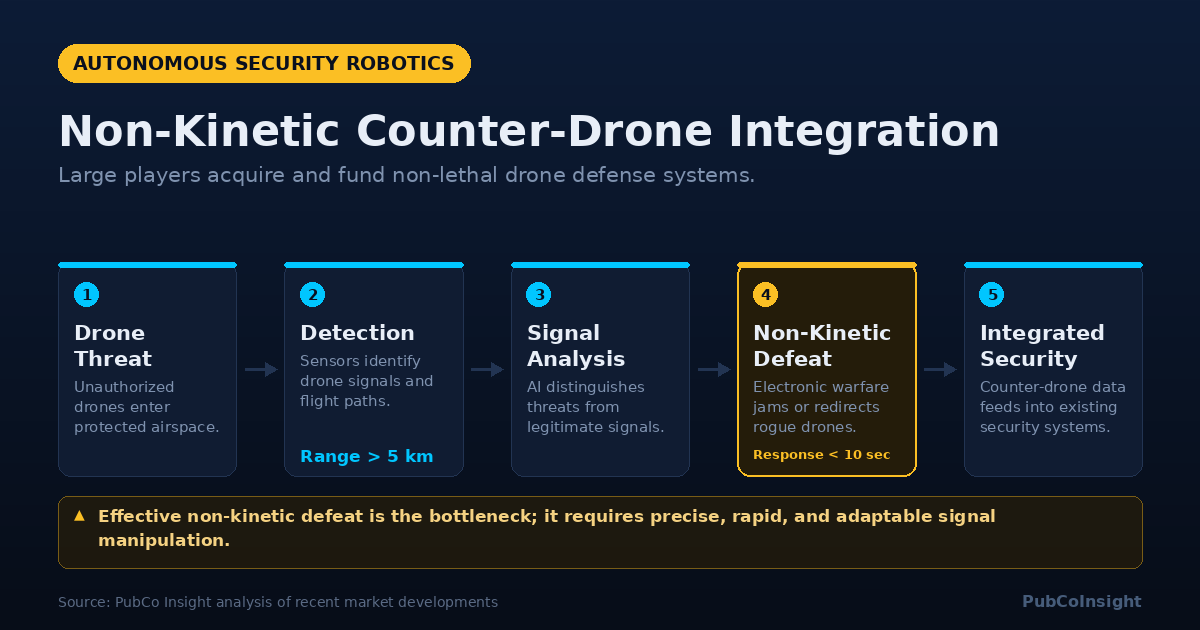
The Mechanism of Counter-Drone Defense
Counter-drone systems operate on a layered defense principle, moving from detection to identification, tracking, and finally, neutralization. The core challenge lies in distinguishing legitimate airborne objects from threats, often in complex urban or operational environments. Detection typically involves a combination of radar, acoustic sensors, and optical systems. Radar provides long-range initial alerts, while acoustic sensors can pinpoint smaller, quieter drones closer in. Optical systems, including thermal and electro-optical cameras, then provide visual confirmation and precise tracking. Once detected and identified as a threat, the system must track the drone's flight path and intent. This is where AI and machine learning become critical, analyzing flight patterns, speeds, and payloads to predict behavior and classify risk levels. The final step, neutralization, is the most varied. Kinetic solutions involve physically intercepting or shooting down a drone, but these carry risks of collateral damage, especially in populated areas. Non-kinetic methods are gaining traction for this reason. These include radio frequency (RF) jamming, which disrupts the drone's control signals, forcing it to land or return to its operator. GPS spoofing can mislead a drone's navigation, sending it off course. Directed energy weapons, while still largely in development, offer another non-kinetic option to disable drones through high-power microwaves or lasers. The difficulty lies in achieving precise, rapid neutralization without interfering with legitimate communications or damaging nearby infrastructure. The value sits in the ability to reliably and safely neutralize a drone without physical interception, a capability that minimizes risk and maximizes operational flexibility.Companies Operating in This Sector
Several companies are navigating this evolving counter-drone space, each with distinct approaches. Ondas Inc. (ONDS), trading at $7.24, recently launched its Dronebuster REACH system on September 30, 2026. This long-range non-kinetic counter-UAS solution extends defeat capabilities, indicating a focus on broader area protection. Ondas also expanded its counter-drone portfolio, as noted on October 2, 2026, suggesting a strategy of continuous product development and market penetration. Unusual Machines, Inc. (UMAC), currently priced at $22.37, is also active in the counter-drone market. While their stock tumbled 8% on October 1, 2026, despite the Pentagon's autonomous warfare push, the company's defense-focused counter-drone expansion and Draganfly stake were highlighted on September 30, 2026, as potential catalysts for its narrative. This indicates a play on both direct counter-drone technology and strategic partnerships. Beyond direct counter-drone systems, other firms contribute to the broader autonomous security ecosystem. Serve Robotics Inc. (SERV), priced at $4.615, focuses on last-mile delivery robotics, a different segment of physical AI, but one that shares underlying autonomous navigation and perception technologies. Arbe Robotics Ltd. (ARBE), at $0.613, develops high-resolution 4D imaging radar for autonomous vehicles, a technology with clear crossover applications for drone detection and tracking in complex environments. Arbe closed a $15 million underwritten registered direct offering on September 28, 2026. Kopin Corporation (KOPN), trading at $4.91, specializes in micro-displays and optical solutions, components crucial for advanced sensor systems used in both drones and counter-drone platforms. MicroVision, Inc. (MVIS), at $1.48, also works in lidar technology, another key sensor for autonomous perception. Lantronix, Inc. (LTRX), priced at $7.19, provides secure data access and management, essential for the networked operation of sophisticated security robotics. BigBear.ai Holdings, Inc. (BBAI), at $2.65, offers AI-powered analytics and decision intelligence, which can be applied to process vast amounts of sensor data for threat assessment and response in counter-drone operations. Red Cat Holdings, Inc. (RCAT), at $6.4, is involved in drone development and services, including defense applications, making them a player on both sides of the drone/counter-drone equation.Artificial Intelligence Technology Solutions, Inc.
Artificial Intelligence Technology Solutions, Inc. (AITX), trading over the counter at $0.0027, operates through subsidiaries like Robotic Assistance Devices, Inc. (RAD-I), Robotic Assistance Devices Mobile (RAD-M), and Robotic Assistance Devices Group (RAD-G). The company develops and leases AI-driven security robots and remote monitoring systems. Their business model centers on a recurring monthly subscription, rather than outright hardware sales. RAD-I, the primary subsidiary, targets the estimated $50 billion U.S. security and guarding services market with an AI-driven "Solutions-as-a-Service" model. AITX claims its solutions can deliver cost savings between 35% and 80% compared to traditional manned security. These solutions employ a suite of stationary and mobile devices integrated with the company's software and monitoring platforms. Stationary security devices fall under RAD-I. Mobile autonomous platforms, including the ROAMEO mobile security unit, are part of RAD-M, with early commercial deployment beginning in May 2026. The SARA agentic artificial intelligence platform is managed by RAD-G. AITX also maintains Robotic Assistance Devices Lanka (Private) Limited (RAD Lanka) in Sri Lanka, operating under Port City Colombo status. This subsidiary supports software development, AI initiatives, and technical operations across the company's divisions. The long-term vision, referred to internally as "RAD Town," involves integrated autonomous-security deployments across campuses, communities, or larger jurisdictions. For the fiscal year ended February 28, 2026, AITX reported revenue of $7,745,336, a 26% increase over the prior year. Gross profit rose 48% to $5,533,700, expanding gross margin to approximately 71% from 61%. Operating expenses remained largely flat at $17,477,097, leading to an improved loss from operations of $(11,943,397), a $2.0 million improvement. The company reported a net loss of approximately $14.5 million for the fiscal year and an accumulated deficit of approximately $171 million as of that date. The company had negative cash flow from operating activities of $9,344,534 for the year ended February 28, 2026, and negative working capital of $17,017,745. Management does not anticipate positive cash flow from operations in the near term. The public record does not yet establish consistent positive cash flow from operations. On September 30, 2026, AITX's RAD subsidiary received an additional RIO 360 order from a healthcare client. The company's filings, which are numerous and recent, provide further detail on its financial condition and operational plans.What to watch
Monitor the integration of D-Fend Solutions into Motorola's security portfolio. Specific product launches or expanded service offerings under the Motorola brand, leveraging D-Fend's technology, will indicate the speed and depth of this integration. Watch for further strategic partnerships or acquisitions in the counter-drone space, particularly from major defense contractors following Lockheed Martin's lead with Fortem Technologies. Look for new contract awards for counter-UAS systems, especially those specifying non-kinetic defeat mechanisms, as these validate the market's preference for less disruptive solutions. Ondas Inc.'s (ONDS) sales figures for its Dronebuster REACH system will be a direct measure of market acceptance for its long-range non-kinetic offerings. For Artificial Intelligence Technology Solutions, Inc. (AITX), watch for updates on the commercial deployment of its ROAMEO mobile security unit and any new licensing agreements for its SARA platform, as these represent key growth vectors outlined in its filings. The company's upcoming quarterly filings will provide critical updates on revenue, subscription counts, and cash position, offering insight into its progress towards sustainable operations., { "label": "Threat ID", "note": "AI analyzes flight patterns, payloads to classify risk." }, { "label": "Precise Tracking", "note": "Sensors and AI maintain constant lock on target." }, { "label": "Non-Kinetic Neutralization", "note": "RF jamming, GPS spoofing, directed energy disable drone safely." } ], "highlight": 3, "highlight_note": "Reliable, safe neutralization without collateral damage is the primary value driver.", "footnote": "Source: PubCo Insight analysis of market developments (2026)" }Companies mentioned
| Ticker | Company | Price |
|---|---|---|
| AITX client | Artificial Intelligence Technology Solutions Inc | $0.0027 |
| ARBE | Arbe Robotics Ltd. | $0.613 |
| BBAI | BigBear.ai Holdings, Inc. | $2.65 |
| KOPN | Kopin Corporation | $4.91 |
| LTRX | Lantronix, Inc. | $7.19 |
| MVIS | MicroVision, Inc. | $1.48 |
| ONDS | Ondas Inc. | $7.24 |
| RCAT | Red Cat Holdings, Inc. | $6.4 |
| SERV | Serve Robotics Inc. | $4.615 |
| UMAC | Unusual Machines, Inc. | $22.37 |
Listed alphabetically, not ranked. Prices as of 2026-10-04 and they move. Check a live quote before relying on any of this.
How we chose the companies in this article
We cover a fixed universe of companies working in autonomous security robotics, physical AI and the guarding services market they are aimed at. Every one of them that had usable market data on 2026-10-04 appears in this article. We do not pick which ones to mention based on what we think of them, and we do not order them by size, price or trading volume, because an ordered list is a verdict and that is not ours to hand down. Companies left out, and why: none. American Lithium Minerals and Artificial Intelligence Technology Solutions pay us, which is disclosed in full at the foot of every article they appear in.
See the dilution and promotion flags before you see the pitch.
Each week: the micro and small-caps now showing dilution or paid-promotion signals, with the SEC filing behind every flag. No recommendations, no price targets.
Sources used in this article
- Kevin Warsh Was Confirmed as Fed Chair in the Most Divisive Vote in Federal Reserve History, 54-45. Here's Why That Split Still Matters Now That He's Raised Rates for the First Time Since 2023. Motley Fool · 2026-10-04
- Will Selling Chips Strengthen Arm’s Moat or Put It at Risk? Insider Monkey · 2026-10-04
- 1 Unstoppable Cryptocurrency to Buy Before It Soars Over 250%, According to Wall Street Analysts Motley Fool · 2026-10-04
- 2 Brokerage Stocks to Buy Before Their October Earnings Reports Motley Fool · 2026-10-04
- 3 No-Brainer Stocks to Buy If Data Center Expenditures Hit $3 Trillion by 2030 Motley Fool · 2026-10-04
- 3 Investing Rules That CNBC's Jim Cramer Swears By Motley Fool · 2026-10-04
- YouTube's Lead Over Netflix in TV Viewing Keeps Growing. Is Netflix Stock a Sell? Motley Fool · 2026-10-03
- Wall Street Is Bracing for the Fed's Next Move on Rates. These 3 Stocks Win Either Way. Motley Fool · 2026-10-03
- Nvidia (NVDA) Is At The Center Of An $8 Billion AI Financing Shift Simply Wall St. · 2026-10-03
- Meta's Muse AI: Good or Bad for E-Commerce? Shopify and Amazon Are Taking Opposite Approaches. Motley Fool · 2026-10-03
- Stocktwits Defense Watch: BA, RTX, LHX Score Major Deals As ONDS Expands Counter-Drone Push Stocktwits · 2026-10-03
- Axon Enterprise (AXON) Stock Falls Amid Market Uptick: What Investors Need to Know Zacks · 2026-10-02
Disclosure required by Section 17(b) of the Securities Act of 1933
Artificial Intelligence Technology Solutions, Inc., a Nevada corporation (OTCID: AITX). Artificial Intelligence Technology Solutions, Inc. pays Strategic Innovations First, Inc., a Wyoming corporation doing business as PulseIR. Compensation received: USD 5,000.00 per month for months 1-3 (August, September, October 2026); USD 10,000.00 per month for months 4-6 (November, December 2026, January 2027) contingent on the 90-day review. Minimum committed USD 15,000.00; USD 45,000.00 if the second-period rate triggers.. Form of payment: cash only, invoiced monthly in advance; no stock, options or warrants received or payable. Services: investor relations services under an Investor Relations Services Agreement effective 2026-08-01. Period: six month term, 2026-08-01 through 2027-01-31; 90-day review on or about 2026-10-30. No stock, options or warrants held by PubCo Insight, Pulse IR, Strategic Innovations First, Inc., or Brad Listermann. Confirmed by the executed agreement and by board record recKwdq39X2caPSX7 (POSITIONS HELD: none).
This is information, not investment, financial, legal or tax advice. It is not a recommendation or solicitation to buy, sell or hold any security and it contains no price target. Nothing here is independently verified by us. Confirm every figure against primary filings on SEC EDGAR before you act. Micro-cap and over-the-counter securities are speculative and illiquid and can lose all of their value. The companies named without a disclosure above pay us nothing and have no relationship with us; they are named because a published, mechanical screen selected them. Full disclosure policy.