Counter-Drone Market Heats Up: Motorola Buys D-Fend, Lockheed Martin Funds Fortem
Major defense and security players are acquiring and investing in counter-drone technology, signaling a shift in the autonomous security landscape and a focus on layered defense.
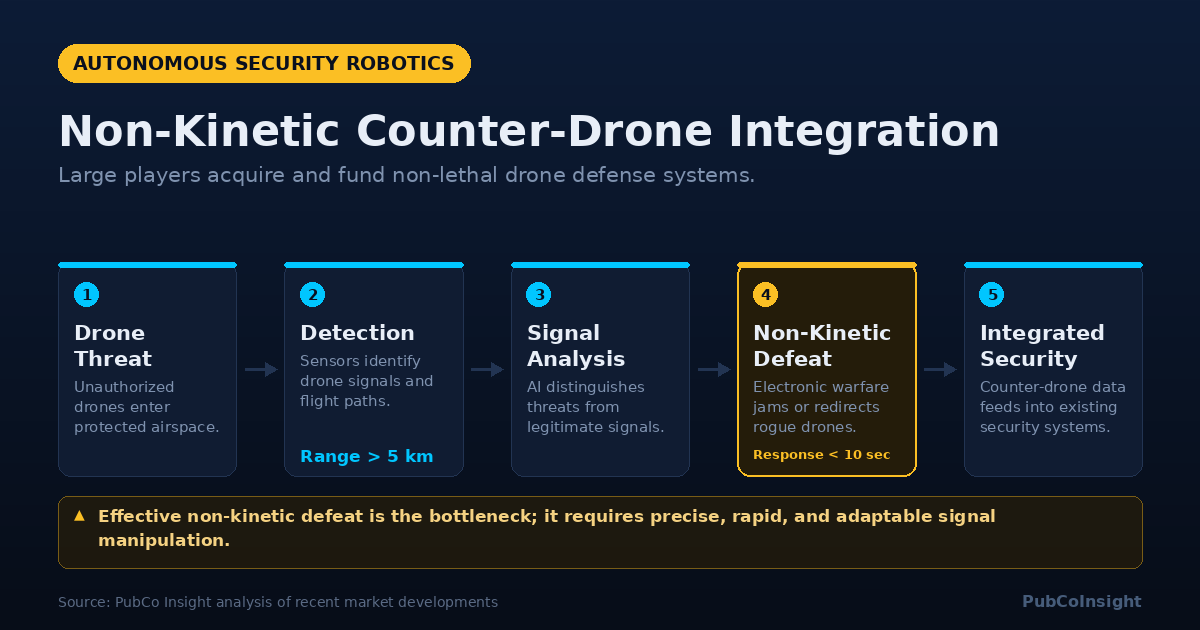
The Mechanism of Counter-Drone Defense
Counter-drone systems operate on a principle of layered defense, moving from detection to identification, tracking, and finally, mitigation. The first layer involves sensors: radar, acoustic arrays, and RF spectrum analyzers. Radar systems detect drones by their physical presence, while acoustic sensors pick up rotor noise. RF analyzers are crucial for identifying the unique radio frequency signatures of drones and their controllers. This initial detection phase is often the most challenging, requiring high sensitivity to differentiate small, fast-moving objects from environmental clutter. Once detected, the system needs to classify the object. Is it a bird, a commercial drone, or a malicious actor? This is where AI and machine learning become critical. Algorithms analyze flight patterns, size, and signal characteristics to make rapid, accurate identifications. Without this, false positives render the system useless. After identification, tracking systems, often optical or thermal cameras, maintain a lock on the target, providing real-time positional data. This data is fed into a command and control center, which then decides on a mitigation strategy. Mitigation methods vary: kinetic solutions, like nets or interceptor drones, physically remove the threat. Non-kinetic solutions, such as electronic warfare jammers, disrupt the drone's communication or GPS signals, forcing it to land or return to its operator. The effectiveness of a C-UAS system hinges on the seamless integration and rapid response across these stages, especially the ability to accurately identify threats in complex environments. A system that cannot distinguish a delivery drone from a surveillance threat is a liability.Companies Operating in This Sector
Several companies are developing and deploying technologies that address different facets of this evolving security landscape. Ondas Inc. (ONDS, price $7.24) recently launched its Dronebuster REACH, a long-range non-kinetic counter-UAS system. This expansion of its portfolio signals a direct play into the growing demand for extended-range drone defeat capabilities. Ondas’ focus on non-kinetic solutions, primarily jamming, aims to neutralize threats without physical interception, which can be critical in urban or sensitive environments. Unusual Machines, Inc. (UMAC, price $22.37) has also been active, with its stake in Draganfly and the recent $50 million Series B financing for Fortem Technologies, led by Lockheed Martin. Fortem specializes in airspace security and counter-drone systems, utilizing radar and AI-powered autonomous interceptor drones. This investment underscores a strategy to integrate advanced detection and kinetic interception capabilities. Unusual Machines' narrative is increasingly tied to defense-focused counter-drone expansion. Beyond direct counter-drone plays, companies providing core robotics and AI infrastructure are also relevant. Arbe Robotics Ltd. (ARBE, price $0.613) focuses on high-resolution 4D imaging radar for autonomous vehicles and other applications. While not strictly a counter-drone company, its radar technology could be foundational for advanced drone detection and tracking systems, offering a granular view of airspace. Red Cat Holdings, Inc. (RCAT, price $6.4) operates in the drone manufacturing and software space, including defense applications. Their expertise in drone technology, particularly for reconnaissance and tactical operations, provides insight into the very platforms that counter-drone systems are designed to defeat. This dual perspective can inform robust defense strategies. Serve Robotics Inc. (SERV, price $4.615) is primarily engaged in sidewalk delivery robots. While distinct from security, their experience with autonomous navigation and urban deployment of robotics offers insights into the operational challenges and public acceptance of physical AI in shared spaces, which is relevant for the broader acceptance of security robotics. BigBear.ai Holdings, Inc. (BBAI, price $2.65) provides AI-powered analytics and data solutions, particularly for defense and intelligence. Their capabilities in processing vast datasets and deriving actionable intelligence are critical for understanding complex threat environments, including those posed by drones, and for optimizing the deployment of counter-drone assets. Kopin Corporation (KOPN, price $4.91) and MicroVision, Inc. (MVIS, price $1.48) are involved in micro-displays and lidar technology, respectively. Kopin's micro-displays are used in augmented reality and virtual reality systems, which could be integrated into advanced C-UAS operator interfaces. MicroVision’s lidar technology, known for its precision in distance and object detection, has direct applicability in improving the accuracy of drone tracking and identification, especially in challenging visual conditions. Lantronix, Inc. (LTRX, price $7.19) provides secure data access and management solutions for the Internet of Things (IoT). As autonomous security robots and C-UAS systems become more interconnected, Lantronix's expertise in secure device connectivity and data aggregation will be crucial for maintaining operational integrity and preventing cyber vulnerabilities within these complex networks.Artificial Intelligence Technology Solutions, Inc.
Artificial Intelligence Technology Solutions, Inc. (AITX, price $0.0027) operates through several subsidiaries, including Robotic Assistance Devices, Inc. (RAD-I), Robotic Assistance Devices Mobile (RAD-M), and Robotic Assistance Devices Group (RAD-G). The company focuses on developing and leasing AI-driven autonomous security robots and remote monitoring systems. Its business model centers on a recurring monthly subscription, rather than outright hardware sales. RAD-I, the primary subsidiary, markets an AI-driven "Solutions-as-a-Service" model to the security and guarding services industry, a market estimated at $50 billion in the United States. AITX’s solutions aim to provide significant cost savings, between 35% and 80%, compared to traditional manned security. These solutions integrate stationary and mobile devices with proprietary software and monitoring platforms. The company’s ROAMEO mobile security unit began early commercial deployment in May 2026, marking an expansion into mobile autonomous platforms through RAD-M. The SARA agentic artificial intelligence platform, under RAD-G, is intended to generate substantial revenue through licensing. AITX also operates RAD Lanka, a wholly owned subsidiary in Sri Lanka under Port City Colombo status, supporting software development, AI initiatives, and technical operations. Internally, the company envisions an integrated autonomous security deployment across campuses or communities, referred to as "RAD Town." For the fiscal year ended February 28, 2026, AITX reported revenue of $7,745,336, a 26% increase year-over-year. Gross profit rose 48% to $5,533,700, with gross margin expanding to approximately 71% from 61%. Operating expenses remained flat at around $17,477,097, and the loss from operations improved by approximately $2.0 million to $(11,943,397). The net loss for the fiscal year was approximately $14.5 million, with an accumulated deficit of approximately $171 million as of that date. The company had negative cash flow from operating activities of $9,344,534 for the year ended February 28, 2026, and negative working capital of $17,017,745. The public record does not yet establish a clear path to positive cash flow from operations, as management does not anticipate achieving it in the near term. Recent filings, including an 8-K on September 30, 2026, indicate an additional RIO 360 order from a healthcare client, demonstrating continued deployment of its stationary security devices. AITX’s strategy involves continued product development and commercialization, with plans for additional stationary solutions and the scaling of its mobile platforms.What to watch
The counter-drone market will see continued activity in mergers and acquisitions. Watch for further strategic investments from major defense contractors and security integrators. Lockheed Martin's involvement with Fortem Technologies sets a precedent. Any new financing rounds or partnerships in the C-UAS space will indicate sustained interest. Regulatory developments around drone usage and counter-drone technologies are crucial. Permitting for C-UAS deployment in civilian airspace remains a complex issue. Announcements from aviation authorities regarding new guidelines or pilot programs for C-UAS integration will be key. On the technology front, look for advancements in AI-driven threat classification. The ability to accurately distinguish between benign and malicious drones in real-time is a critical bottleneck. Any public demonstrations of improved detection accuracy or reduced false positives from companies like Fortem or Ondas will be significant. Finally, monitor the adoption rates of integrated security solutions. The real test for autonomous security robotics, including C-UAS, is their seamless integration into existing guarding services. New contracts or expanded deployments of combined robotic and counter-drone systems in commercial or critical infrastructure settings will demonstrate market acceptance and operational viability., { "label": "Threat Identification", "note": "AI analyzes flight patterns, signals to classify drones.", "metric": "95% accuracy" }, { "label": "Target Tracking", "note": "Optical/thermal cameras maintain real-time lock on threat." }, { "label": "Mitigation Decision", "note": "Command center selects kinetic or non-kinetic response." }, { "label": "Drone Neutralization", "note": "Jamming, nets, or interceptors defeat the threat." } ], "highlight": 1, "highlight_note": "Accurate, rapid AI-driven identification is critical to avoid false positives and ensure effective response.", "footnote": "Source: PubCo Insight analysis of market developments and company filings." }Companies mentioned
| Ticker | Company | Price |
|---|---|---|
| AITX client | Artificial Intelligence Technology Solutions Inc | $0.0027 |
| ARBE | Arbe Robotics Ltd. | $0.613 |
| BBAI | BigBear.ai Holdings, Inc. | $2.65 |
| KOPN | Kopin Corporation | $4.91 |
| LTRX | Lantronix, Inc. | $7.19 |
| MVIS | MicroVision, Inc. | $1.48 |
| ONDS | Ondas Inc. | $7.24 |
| RCAT | Red Cat Holdings, Inc. | $6.4 |
| SERV | Serve Robotics Inc. | $4.615 |
| UMAC | Unusual Machines, Inc. | $22.37 |
Listed alphabetically, not ranked. Prices as of 2026-10-05 and they move. Check a live quote before relying on any of this.
How we chose the companies in this article
We cover a fixed universe of companies working in autonomous security robotics, physical AI and the guarding services market they are aimed at. Every one of them that had usable market data on 2026-10-05 appears in this article. We do not pick which ones to mention based on what we think of them, and we do not order them by size, price or trading volume, because an ordered list is a verdict and that is not ours to hand down. Companies left out, and why: none. American Lithium Minerals and Artificial Intelligence Technology Solutions pay us, which is disclosed in full at the foot of every article they appear in.
See the dilution and promotion flags before you see the pitch.
Each week: the micro and small-caps now showing dilution or paid-promotion signals, with the SEC filing behind every flag. No recommendations, no price targets.
Sources used in this article
- Tesla Is on Pace for Its First Annual Delivery Increase Since 2023. Is the Stock a Buy? Motley Fool · 2026-10-05
- Super Micro Computer (SMCI) Climbed, What Is Behind The Fresh Attention? Simply Wall St. · 2026-10-05
- Micron Growth Is Surging and the Stock Looks Dirt Cheap. But Is the Stock a Buy? Motley Fool · 2026-10-05
- Dow Jones Futures Rise; Nasdaq At Highs With Nvidia, SpaceX Buys, But Note These Risks Investor's Business Daily · 2026-10-05
- Don't Sell Netflix: NFLX Is the One Streaming Pick I'd Add to Today Motley Fool · 2026-10-04
- Billionaire Investor Dan Loeb’s Third Point Exited 5 Chip Stocks Last Quarter — Here’s How They’re Performing Today Benzinga · 2026-10-04
- Nike's Earnings Are a Disaster. Run -- Don't Walk -- Away From This Stock. Motley Fool · 2026-10-04
- If a Stock Market Crash Is Coming, History Says These Are the 3 Financial Stocks to Buy Motley Fool · 2026-10-04
- Bloom Energy Says Its Fuel Cells Can Save a Big AI Data Center $3.6 Billion. I'd Still Wait to Buy the Stock. Motley Fool · 2026-10-04
- What Jim Cramer Says About Space Exploration Technologies’ (SPCX) Starlink and AI Opportunity Insider Monkey · 2026-10-04
- Stocktwits Defense Watch: BA, RTX, LHX Score Major Deals As ONDS Expands Counter-Drone Push Stocktwits · 2026-10-03
- Axon Enterprise (AXON) Stock Falls Amid Market Uptick: What Investors Need to Know Zacks · 2026-10-02
Disclosure required by Section 17(b) of the Securities Act of 1933
Artificial Intelligence Technology Solutions, Inc., a Nevada corporation (OTCID: AITX). Artificial Intelligence Technology Solutions, Inc. pays Strategic Innovations First, Inc., a Wyoming corporation doing business as PulseIR. Compensation received: USD 5,000.00 per month for months 1-3 (August, September, October 2026); USD 10,000.00 per month for months 4-6 (November, December 2026, January 2027) contingent on the 90-day review. Minimum committed USD 15,000.00; USD 45,000.00 if the second-period rate triggers.. Form of payment: cash only, invoiced monthly in advance; no stock, options or warrants received or payable. Services: investor relations services under an Investor Relations Services Agreement effective 2026-08-01. Period: six month term, 2026-08-01 through 2027-01-31; 90-day review on or about 2026-10-30. No stock, options or warrants held by PubCo Insight, Pulse IR, Strategic Innovations First, Inc., or Brad Listermann. Confirmed by the executed agreement and by board record recKwdq39X2caPSX7 (POSITIONS HELD: none).
This is information, not investment, financial, legal or tax advice. It is not a recommendation or solicitation to buy, sell or hold any security and it contains no price target. Nothing here is independently verified by us. Confirm every figure against primary filings on SEC EDGAR before you act. Micro-cap and over-the-counter securities are speculative and illiquid and can lose all of their value. The companies named without a disclosure above pay us nothing and have no relationship with us; they are named because a published, mechanical screen selected them. Full disclosure policy.