Ondas Secures $50 Million U.S. Army Contract, Expands Counter-Drone Reach to NFL Games
Ondas Inc. announced a significant expansion in its counter-drone operations on August 7, 2026, with a new U.S. Army contract and a deal to protect Jacksonville Jaguars NFL home games, highlighting a growing convergence of defense and commercial autonomous security applications.
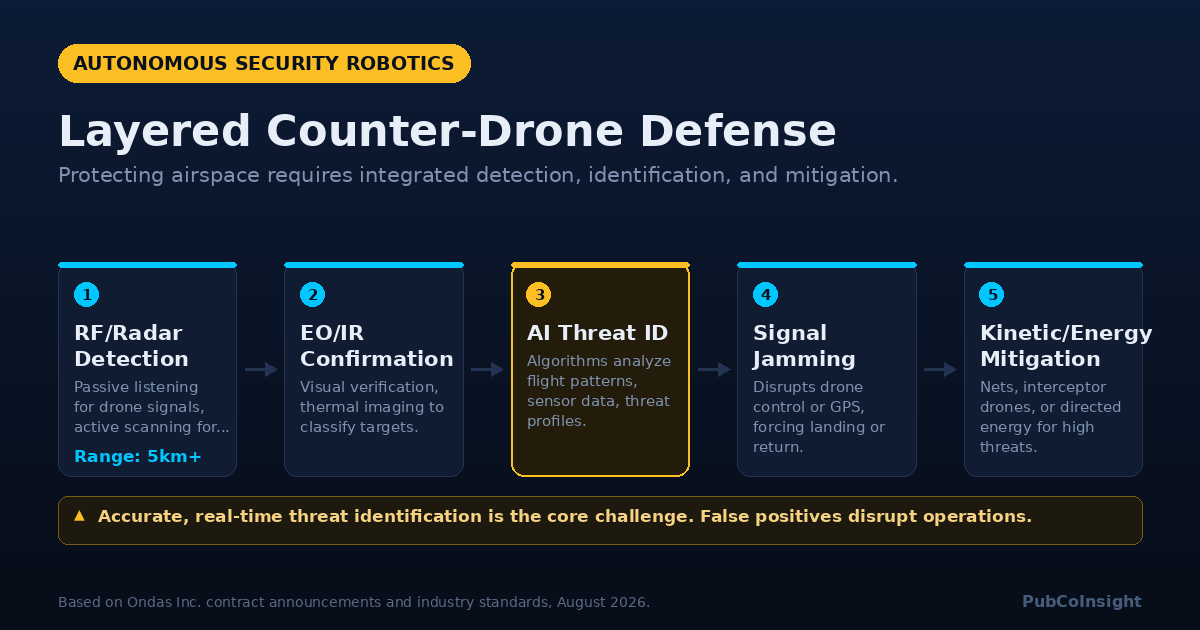
The Mechanism of Counter-Drone Defense
Counter-drone technology operates on a layered defense principle, integrating detection, identification, and mitigation. The first layer, detection, relies on a combination of radio frequency (RF) sensors, radar, and electro-optical/infrared (EO/IR) cameras. RF sensors passively listen for the unique control signals emitted by drones and their operators, providing an initial alert and often direction. Radar systems actively scan the airspace for small, fast-moving objects, effective even in adverse weather. EO/IR cameras provide visual confirmation, allowing for classification of detected objects as hostile or benign, a critical step to avoid false positives. Once a drone is detected and identified as a threat, mitigation becomes the focus. Passive mitigation involves jamming the drone's control signals or GPS, causing it to return to its operator, land, or drift. Active mitigation, often reserved for high-threat scenarios, includes kinetic solutions like nets or interceptor drones, or directed energy weapons. The challenge lies in distinguishing legitimate drones, such as those used for photography or delivery, from malicious ones, especially in crowded urban or event environments. This requires sophisticated AI algorithms to analyze flight patterns, sensor data, and known threat profiles in real-time. The bottleneck often sits in the identification stage; a system that can accurately and quickly classify a drone as a threat, without false positives, is invaluable. False positives can lead to unnecessary disruptions or even legal issues, especially in civilian airspace.Companies Operating in This Sector
The autonomous security robotics and physical AI sector is broad, encompassing everything from mobile guarding units to sophisticated counter-drone systems. Several companies are navigating this landscape, each with distinct offerings. Ondas Inc. (ONDS), with its recent U.S. Army contract and NFL deal, is clearly expanding its footprint in counter-drone solutions. Ondas has also been developing its Grasshopper™ autonomous aerial delivery system, as evidenced by a recent Air Force Research Laboratory (AFRL) contract. This suggests a dual focus on both defensive and logistical drone applications. Its stock currently trades at $9.11. In the broader robotics and AI space, Serve Robotics Inc. (SERV) is focused on last-mile delivery robots, as seen in its Q2 2026 results which showed increased revenue despite a wider loss. Its stock is at $5.085. Unusual Machines, Inc. (UMAC) also reported Q2 losses but a first-half turn to profit, with its stock at $26.11. These companies operate in the commercial robotics segment, distinct from security applications but leveraging similar underlying AI and autonomous navigation technologies. For components and enabling technologies, Kopin Corporation (KOPN) at $4.27, and MicroVision, Inc. (MVIS) at $3.39, focus on micro-displays and lidar solutions respectively. These are critical for advanced sensing and human-machine interfaces in robotics. Arbe Robotics Ltd. (ARBE), trading at $0.768, specializes in imaging radar, another key sensor technology for autonomous systems. Lantronix, Inc. (LTRX), at $5.97, provides embedded computing and networking solutions essential for connecting and managing robotic fleets. On the software and AI analytics side, BigBear.ai Holdings, Inc. (BBAI) at $3.27, develops AI-powered analytics and decision intelligence software for defense and intelligence clients. This type of advanced analytics is crucial for interpreting sensor data from autonomous security systems and making informed decisions. Red Cat Holdings, Inc. (RCAT), priced at $9.21, is involved in drone technology, including hardware and software for defense and commercial applications, placing it in a similar operational sphere to Ondas in terms of aerial systems.Artificial Intelligence Technology Solutions, Inc.
Artificial Intelligence Technology Solutions, Inc. (AITX), trading at $0.0069 on the OTCID tier, develops and leases AI-driven security robots and remote monitoring systems. The company operates through a Solutions-as-a-Service model, generating recurring monthly subscription revenue rather than one-time hardware sales. Its operations are structured across several subsidiaries: Robotic Assistance Devices, Inc. (RAD-I) for stationary security devices, Robotic Assistance Devices Mobile (RAD-M) for mobile autonomous platforms, and Robotic Assistance Devices Group (RAD-G) for its SARA agentic artificial intelligence platform. RAD-I focuses on the $50 billion U.S. security and guarding services market, aiming to deliver cost savings between 35% and 80% compared to traditional manned security. The company's solutions integrate stationary and mobile devices with its proprietary software and monitoring platforms. RAD-M began early commercial deployment of its ROAMEO mobile security unit in May 2026. RAD-G is intended to generate revenue through SARA platform licensing. AITX also operates RAD Lanka, a wholly-owned subsidiary in Sri Lanka, which supports software development, AI initiatives, and technical operations. This global footprint, specifically its presence in Port City Colombo, suggests a strategic move to leverage international talent for its development efforts. For the fiscal year ended February 28, 2026, AITX reported revenue of $7,745,336, a 26% increase over the prior fiscal year. Gross profit rose 48% to $5,533,700, with gross margin expanding to approximately 71% from 61%. Operating expenses remained relatively flat at $17,477,097, leading to an improved loss from operations of $(11,943,397). The net loss for the fiscal year was approximately $14.5 million, with an accumulated deficit of $171 million. The company's independent registered public accounting firm has expressed substantial doubt about its ability to continue as a going concern, a standard disclosure given its accumulated deficit and negative working capital of $17,017,745 as of February 28, 2026. The public record does not yet establish the full commercial scale of the RAD-M ROAMEO deployments or the specific revenue contributions from SARA platform licensing. Management has stated its belief that RAD-I's recurring revenue and gross margin could, on a standalone basis, support positive cash flow operations, and that RAD-M will surpass RAD-I's monthly recurring revenue contribution at some future point. The company anticipates subscription gross margin to exceed 75% and outright-sale gross margin to exceed 50%, based on average bill of materials costs and market-accepted pricing.What to watch
Investors should monitor several specific developments. For Ondas (ONDS), the implementation timeline and specific deliverables for the $50 million U.S. Army contract will be important. Details on the deployment schedule and operational effectiveness of the counter-drone systems at Jacksonville Jaguars NFL games will provide real-world performance indicators. For Serve Robotics (SERV), the upcoming Q3 2026 earnings call will offer insight into whether revenue growth can outpace widening losses. Unusual Machines (UMAC) will need to demonstrate sustained profitability following its first-half turn. For Artificial Intelligence Technology Solutions (AITX), watch for further 8-K filings detailing new customer deployments for its RAD-M ROAMEO units and any specific licensing agreements for the SARA platform. The company's next 10-Q filing will provide updated financial metrics, particularly regarding cash flow from operations and progress toward stated gross margin targets., { "label": "EO/IR Confirmation", "note": "Visual verification, thermal imaging to classify targets." }, { "label": "AI Threat ID", "note": "Algorithms analyze flight patterns, sensor data, threat profiles." }, { "label": "Signal Jamming", "note": "Disrupts drone control or GPS, forcing landing or return." }, { "label": "Kinetic/Energy Mitigation", "note": "Nets, interceptor drones, or directed energy for high threats." } ], "highlight": 2, "highlight_note": "Accurate, real-time threat identification is the core challenge. False positives disrupt operations.", "footnote": "Based on Ondas Inc. contract announcements and industry standards, August 2026." }Companies mentioned
| Ticker | Company | Price |
|---|---|---|
| AITX client | Artificial Intelligence Technology Solutions Inc | $0.0069 |
| ARBE | Arbe Robotics Ltd. | $0.768 |
| BBAI | BigBear.ai Holdings, Inc. | $3.27 |
| KOPN | Kopin Corporation | $4.27 |
| LTRX | Lantronix, Inc. | $5.97 |
| MVIS | MicroVision, Inc. | $3.39 |
| ONDS | Ondas Inc. | $9.11 |
| RCAT | Red Cat Holdings, Inc. | $9.21 |
| SERV | Serve Robotics Inc. | $5.085 |
| UMAC | Unusual Machines, Inc. | $26.11 |
Listed alphabetically, not ranked. Prices as of 2026-08-09 and they move. Check a live quote before relying on any of this.
How we chose the companies in this article
We cover a fixed universe of companies working in autonomous security robotics, physical AI and the guarding services market they are aimed at. Every one of them that had usable market data on 2026-08-09 appears in this article. We do not pick which ones to mention based on what we think of them, and we do not order them by size, price or trading volume, because an ordered list is a verdict and that is not ours to hand down. Companies left out, and why: none. American Lithium Minerals and Artificial Intelligence Technology Solutions pay us, which is disclosed in full at the foot of every article they appear in.
See the dilution and promotion flags before you see the pitch.
Each week: the micro and small-caps now showing dilution or paid-promotion signals, with the SEC filing behind every flag. No recommendations, no price targets.
Sources used in this article
- Palantir Is Worth $413 Billion. The $500 Billion Line Sits Almost Exactly at Its Record High. Motley Fool · 2026-08-09
- Tron Just Added $2.2 Billion in Stablecoins in July. Does That Make It a Buy? Motley Fool · 2026-08-09
- Why Voyager Stock Skyrocketed This Week Motley Fool · 2026-08-09
- Don't Be Fooled: Warren Buffett's and Greg Abel's $366 Billion Warning to Wall Street Echoes Louder Than Ever Motley Fool · 2026-08-09
- $10,000 in Axon Stock a Decade Ago Would Be Worth About $329,000 Today. The Stock Is Down Over the Past Year. Motley Fool · 2026-08-08
- Nvidia vs. Navitas Semiconductor: Here's What Their Revenue Trends Tell Investors About These Artificial Intelligence Companies Motley Fool · 2026-08-08
- Why the Market Continues to Sleep on Micron's Growth Potential Motley Fool · 2026-08-08
- Warren Buffett Warned About the Dot-Com Bubble. Now, the Stock Market Is Flashing the Same Warning Signal. Motley Fool · 2026-08-08
- Only 2 of These 5 Nuclear Stocks Sell Fuel Today. Here's What the Market Pays for the Other 3. Motley Fool · 2026-08-08
- AMD just made bold move to challenge Nvidia TheStreet · 2026-08-08
- When Leverage Goes Wrong on Wall Street Motley Fool · 2026-08-08
- Axon Enterprise vs. Chewy: Do Customers of Police or Pets Make One Stock a Better Buy in 2026? Motley Fool · 2026-08-07
Disclosure required by Section 17(b) of the Securities Act of 1933
Artificial Intelligence Technology Solutions, Inc., a Nevada corporation (OTCID: AITX). Artificial Intelligence Technology Solutions, Inc. pays Strategic Innovations First, Inc., a Wyoming corporation doing business as PulseIR. Compensation received: USD 5,000.00 per month for months 1-3 (August, September, October 2026); USD 10,000.00 per month for months 4-6 (November, December 2026, January 2027) contingent on the 90-day review. Minimum committed USD 15,000.00; USD 45,000.00 if the second-period rate triggers.. Form of payment: cash only, invoiced monthly in advance; no stock, options or warrants received or payable. Services: investor relations services under an Investor Relations Services Agreement effective 2026-08-01. Period: six month term, 2026-08-01 through 2027-01-31; 90-day review on or about 2026-10-30. No stock, options or warrants held by PubCo Insight, Pulse IR, Strategic Innovations First, Inc., or Brad Listermann. Confirmed by the executed agreement and by board record recKwdq39X2caPSX7 (POSITIONS HELD: none).
This is information, not investment, financial, legal or tax advice. It is not a recommendation or solicitation to buy, sell or hold any security and it contains no price target. Nothing here is independently verified by us. Confirm every figure against primary filings on SEC EDGAR before you act. Micro-cap and over-the-counter securities are speculative and illiquid and can lose all of their value. The companies named without a disclosure above pay us nothing and have no relationship with us; they are named because a published, mechanical screen selected them. Full disclosure policy.