Counter-Drone Systems Expand Range and Focus as Pentagon Shifts Defense Strategy
The September 30 launch of Ondas' Dronebuster REACH highlights a sector-wide push into long-range, non-kinetic counter-UAS, driven by a Pentagon directive for AI-driven autonomous warfare.
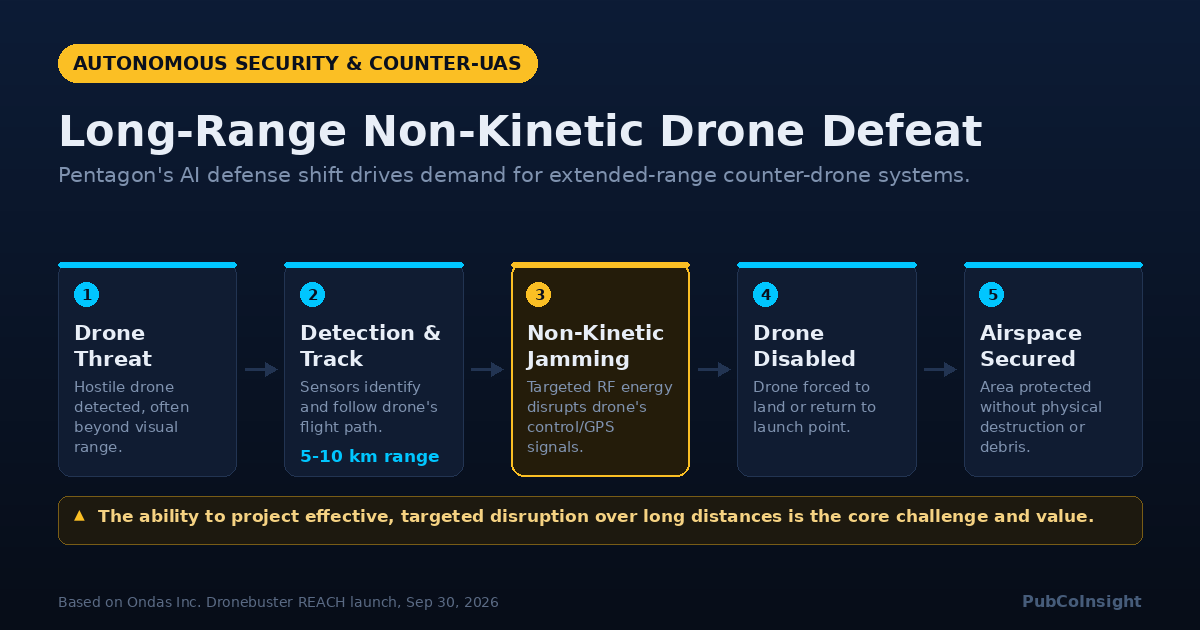
The Mechanism of Non-Kinetic Counter-UAS
Non-kinetic counter-UAS systems work by disrupting a drone's operational capabilities without physically destroying it. This typically involves jamming its communication links, spoofing its GPS signals, or overriding its control systems. The core challenge is range and precision. A drone's control signal can be weak and encrypted. Its GPS receiver can be designed to filter out spoofed signals. Long-range non-kinetic defeat requires powerful, directional jamming or sophisticated cyber-takeover capabilities. The Dronebuster REACH, for instance, focuses on extending this non-kinetic defeat to greater distances. This means projecting targeted radio frequency energy with enough power and accuracy to overwhelm or confuse a drone's onboard systems from kilometers away, not just hundreds of meters. The technology relies on advanced antenna arrays and signal processing to concentrate energy on specific frequency bands used by drones, while minimizing interference with other legitimate signals. The primary bottleneck for these systems is the power-to-range ratio, the ability to maintain effective disruption over increasing distances without requiring impractical power sources. Proving its effectiveness involves field tests against various drone models in diverse environments, demonstrating consistent disruption of control, navigation, or data links without collateral impact.Companies Operating in this Sector
Several companies are navigating this evolving landscape, from specialized counter-drone developers to broader autonomous security providers. Ondas Inc. (ONDS), trading at $7.33, is a key player in the counter-drone space. Its September 30 launch of Dronebuster REACH demonstrates a direct response to the demand for extended-range non-kinetic solutions. Ondas' existing portfolio includes other Dronebuster models, suggesting a modular approach to counter-UAS technology. The company also operates through its Ondas Networks subsidiary, focusing on private industrial wireless networks, which could provide a backbone for integrated security solutions. Unusual Machines, Inc. (UMAC), priced at $24.48, also emphasizes defense-focused counter-drone expansion. UMAC's narrative is shifting with its investments in drone technology, including a strategic stake in Draganfly. This suggests a dual approach: developing its own counter-drone capabilities while also investing in companies that produce drones, potentially integrating defensive and offensive applications. UMAC's focus appears to be on expanding its footprint in the broader drone ecosystem, including defense applications. Red Cat Holdings, Inc. (RCAT), at $6.46, is another company active in the drone sector, particularly through its Teal Drones subsidiary, which manufactures unmanned aerial systems for defense and public safety. While Red Cat is primarily a drone manufacturer, the increasing focus on counter-UAS systems directly impacts the operational environment for their products, necessitating robust anti-jamming and anti-spoofing measures in their own designs. Beyond counter-drone specialists, other firms contribute to the broader autonomous security robotics market. Axon Enterprise, Inc. (AXON) is known for its connected public safety technologies, including body cameras and TASER devices. While not directly in counter-UAS, Axon's integration of AI into law enforcement tools and its focus on public safety infrastructure intersect with the wider autonomous security narrative. Serve Robotics Inc. (SERV), trading at $4.65, focuses on last-mile autonomous delivery robots. While distinct from security, Serve Robotics' deployment of autonomous mobile platforms in urban environments contributes to the development of navigation, perception, and operational safety systems that are foundational to all forms of physical AI. Companies like Arbe Robotics Ltd. (ARBE), at $0.62, and MicroVision, Inc. (MVIS), at $1.50, develop advanced sensing technologies, particularly radar and lidar, which are critical for autonomous navigation and object detection in both security robots and counter-drone systems. Arbe's 4D imaging radar is designed for automotive safety, but its high-resolution capabilities are directly transferable to enhancing the situational awareness of autonomous security platforms and detecting small, fast-moving aerial threats. MicroVision's lidar technology serves similar purposes, providing precise depth mapping for autonomous systems. Kopin Corporation (KOPN), priced at $4.60, provides micro-displays and optical solutions, often for augmented and virtual reality applications, but also for defense and industrial systems. These components are vital for the human-machine interface in advanced robotics and drone control systems, enabling operators to visualize data and control complex autonomous platforms. Lantronix, Inc. (LTRX), at $7.21, provides secure data access and management solutions for the Internet of Things (IoT). Their technology enables secure communication and remote management of connected devices, including autonomous robots and drone systems, ensuring data integrity and operational reliability in distributed security networks. BigBear.ai Holdings, Inc. (BBAI), with a price of $2.65, specializes in artificial intelligence, machine learning, and data analytics for defense and intelligence clients. Their AI platforms are crucial for processing vast amounts of sensor data generated by autonomous security systems, identifying threats, and supporting decision-making in complex environments, including those involving drone detection and response.Artificial Intelligence Technology Solutions, Inc.
Artificial Intelligence Technology Solutions, Inc. (AITX), trading at $0.0027, operates through subsidiaries like Robotic Assistance Devices, Inc. (RAD-I), Robotic Assistance Devices Mobile (RAD-M), and Robotic Assistance Devices Group (RAD-G). The company focuses on building and leasing autonomous security robots and remote monitoring systems. AITX’s model centers on a recurring monthly subscription for its AI-driven "Solutions-as-a-Service," targeting the security and guarding services industry. RAD-I markets stationary security devices. The company claims these solutions offer cost savings between 35% and 80% compared to traditional manned security. RAD-M develops mobile autonomous platforms, including the ROAMEO mobile security unit, which began early commercial deployment in May 2026. AITX states RAD-M is projected to surpass RAD-I's monthly recurring revenue contribution at some future point. RAD-G focuses on the SARA agentic artificial intelligence platform, which the company intends to license for substantial revenue. AITX's wholly-owned subsidiary, RAD Lanka, located in Sri Lanka's Port City Colombo, supports software development, AI initiatives, and technical operations across the company's subsidiaries. The company refers to its long-term strategy as "RAD Town," envisioning integrated autonomous security deployments across campuses or communities. Financially, AITX reported revenue of $7,745,336 for the fiscal year ended February 28, 2026, a 26% increase year-over-year. Gross profit rose 48% to $5,533,700, with gross margin expanding to approximately 71%. Operating expenses remained flat at around $17,477,097. The company's loss from operations improved by approximately $2.0 million to $(11,943,397). AITX reported a net loss of approximately $14.5 million for the fiscal year and had an accumulated deficit of approximately $171 million as of February 28, 2026. The public record does not yet establish a clear path to sustained positive cash flow from operations, as the company reported negative cash flow of $9,344,534 from operating activities for the year ended February 28, 2026, and an accumulated deficit of $171,121,742. Despite this, management has characterized RAD-I's recurring revenue and gross margin as being able to support positive cash flow operations on a standalone basis. AITX recently received an additional RIO 360 order from a healthcare client on September 30, and updated hardware pricing on September 24 to reflect rising materials, compute, and transportation costs.What to watch
The Pentagon's mapping out of an AI-driven defense shift with an autonomous warfare command, reported on October 1, provides a significant backdrop. Watch for specific contract awards or pilot programs stemming from this directive, particularly those that name counter-drone systems or autonomous guarding services. Ondas' Dronebuster REACH launch on September 30 sets a benchmark for long-range non-kinetic capabilities; look for competitive responses or independent validation of its effective range and defeat capabilities. Unusual Machines' continued expansion in defense-focused counter-drone technology, highlighted on September 30 and 29, merits attention for any new product announcements or strategic partnerships beyond its Draganfly stake. For AITX, monitor its upcoming 8-K filings for updates on ROAMEO deployments, SARA platform licensing agreements, or further details on its "RAD Town" strategy. The company's recent pricing adjustments for hardware will also be reflected in future revenue and gross margin figures., { "label": "Detection & Track", "note": "Sensors identify and follow drone's flight path.", "metric": "5-10 km range" }, { "label": "Non-Kinetic Jamming", "note": "Targeted RF energy disrupts drone's control/GPS signals." }, { "label": "Drone Disabled", "note": "Drone forced to land or return to launch point." }, { "label": "Airspace Secured", "note": "Area protected without physical destruction or debris." } ], "highlight": 2, "highlight_note": "The ability to project effective, targeted disruption over long distances is the core challenge and value.", "footnote": "Based on Ondas Inc. Dronebuster REACH launch, Sep 30, 2026" }Companies mentioned
| Ticker | Company | Price |
|---|---|---|
| AITX client | Artificial Intelligence Technology Solutions Inc | $0.0027 |
| ARBE | Arbe Robotics Ltd. | $0.62 |
| BBAI | BigBear.ai Holdings, Inc. | $2.65 |
| KOPN | Kopin Corporation | $4.6 |
| LTRX | Lantronix, Inc. | $7.21 |
| MVIS | MicroVision, Inc. | $1.5 |
| ONDS | Ondas Inc. | $7.33 |
| RCAT | Red Cat Holdings, Inc. | $6.46 |
| SERV | Serve Robotics Inc. | $4.65 |
| UMAC | Unusual Machines, Inc. | $24.48 |
Listed alphabetically, not ranked. Prices as of 2026-10-01 and they move. Check a live quote before relying on any of this.
How we chose the companies in this article
We cover a fixed universe of companies working in autonomous security robotics, physical AI and the guarding services market they are aimed at. Every one of them that had usable market data on 2026-10-01 appears in this article. We do not pick which ones to mention based on what we think of them, and we do not order them by size, price or trading volume, because an ordered list is a verdict and that is not ours to hand down. Companies left out, and why: none. American Lithium Minerals and Artificial Intelligence Technology Solutions pay us, which is disclosed in full at the foot of every article they appear in.
See the dilution and promotion flags before you see the pitch.
Each week: the micro and small-caps now showing dilution or paid-promotion signals, with the SEC filing behind every flag. No recommendations, no price targets.
Sources used in this article
- Amazon Stock Pays $0 in Dividends. Here's Why Long-Term Investors Should Own It Anyway. Motley Fool · 2026-10-01
- GE Vernova's CEO Just Delivered Great News to Shareholders Motley Fool · 2026-10-01
- History Says AMD Stock's $1 Trillion Milestone Isn't a Ceiling Motley Fool · 2026-10-01
- Sweetgreen Is Up 32% Since the Cyclospora Outbreak Ended. Is There More Room To Run? Motley Fool · 2026-10-01
- Meta reportedly calls its AI data centers ‘pilot models’ — its research tax credits jumped from $700M to $3.9B Moneywise · 2026-10-01
- Is SpaceX's Starship a Threat to Rocket Lab Stock Now That It Has Reached Orbit? Motley Fool · 2026-10-01
- EQ Resources (ASX:EQR) Is Down 11.6% After Swinging Back To Full-Year Profitability – What's Changed Simply Wall St. · 2026-10-01
- CoreWeave (CRWV) Unveils Forge For AI Development Simply Wall St. · 2026-10-01
- Is Carmax a Buy After Its Latest Earnings Report? Motley Fool · 2026-10-01
- Uber Wants 50,000 Rivians. Here's Why Robotaxis, Not EVs, Might Be Rivian's Biggest Opportunity. Motley Fool · 2026-10-01
- ONDS, AVAV, KTOS, RCAT, UMAC Stocks Rise Overnight: Pentagon Maps Out AI-Driven Defense Shift With Autonomous Warfare Command Stocktwits · 2026-10-01
- Axon Enterprise, Inc (AXON) Is a Trending Stock: Facts to Know Before Betting on It Zacks · 2026-09-30
Disclosure required by Section 17(b) of the Securities Act of 1933
Artificial Intelligence Technology Solutions, Inc., a Nevada corporation (OTCID: AITX). Artificial Intelligence Technology Solutions, Inc. pays Strategic Innovations First, Inc., a Wyoming corporation doing business as PulseIR. Compensation received: USD 5,000.00 per month for months 1-3 (August, September, October 2026); USD 10,000.00 per month for months 4-6 (November, December 2026, January 2027) contingent on the 90-day review. Minimum committed USD 15,000.00; USD 45,000.00 if the second-period rate triggers.. Form of payment: cash only, invoiced monthly in advance; no stock, options or warrants received or payable. Services: investor relations services under an Investor Relations Services Agreement effective 2026-08-01. Period: six month term, 2026-08-01 through 2027-01-31; 90-day review on or about 2026-10-30. No stock, options or warrants held by PubCo Insight, Pulse IR, Strategic Innovations First, Inc., or Brad Listermann. Confirmed by the executed agreement and by board record recKwdq39X2caPSX7 (POSITIONS HELD: none).
This is information, not investment, financial, legal or tax advice. It is not a recommendation or solicitation to buy, sell or hold any security and it contains no price target. Nothing here is independently verified by us. Confirm every figure against primary filings on SEC EDGAR before you act. Micro-cap and over-the-counter securities are speculative and illiquid and can lose all of their value. The companies named without a disclosure above pay us nothing and have no relationship with us; they are named because a published, mechanical screen selected them. Full disclosure policy.