Asset Trimming and Upstream Bottlenecks Restructure the Critical Mineral Supply Chain
As refiners report surging operational margins and juniors prune non-core claims, physical constraints in solvent extraction and sediment leaching dictate where capital accumulates.
On July 21, 2026, Critical Metals Corp announced a formal strategic review of its non-core assets. The decision marked a clean shift in how junior mineral developers manage capital when primary projects reach capital-intensive engineering stages. While broad claim accumulation defined earlier market cycles, operators across the critical mineral space are now divesting secondary properties to fund core permitting, metallurgical testing, and processing infrastructure.
This operational consolidation coincides with widening margin gaps between raw extractors and downstream chemical processors. On August 6, 2026, Albemarle reported a 3,300% jump in second-quarter earnings, driven by lithium compound pricing that tripled its operational EBITDA. On August 6, 2026, MP Materials beat revenue estimates while advancing its Project Swarm expansion and commercial magnet manufacturing ramp, demonstrating that demand for refined magnetic and battery compounds continues to outpace production growth. Meanwhile, developers holding early-stage physical claims without secured processing pathways continue to trade at heavy discounts relative to their net asset values.
Capital deployment across the sector is concentrating at two precise physical bottlenecks: raw resource extraction paired with direct chemical refining, and domestic oxide-to-magnet synthesis. On July 31, 2026, Goldman Sachs highlighted an emerging global mine-to-magnet investment cycle driven by artificial intelligence power requirements and defense supply chain reshoring. On August 7, 2026, federal initiatives highlighted $3 billion in designated mineral project funding to counter concentrated foreign processing capacity. Navigating this environment requires understanding the technical hurdles of chemical separation and the specific strategic positioning of key market operators.
Strategic Bottlenecks: How Mineral Separation Dictates Capital Flow
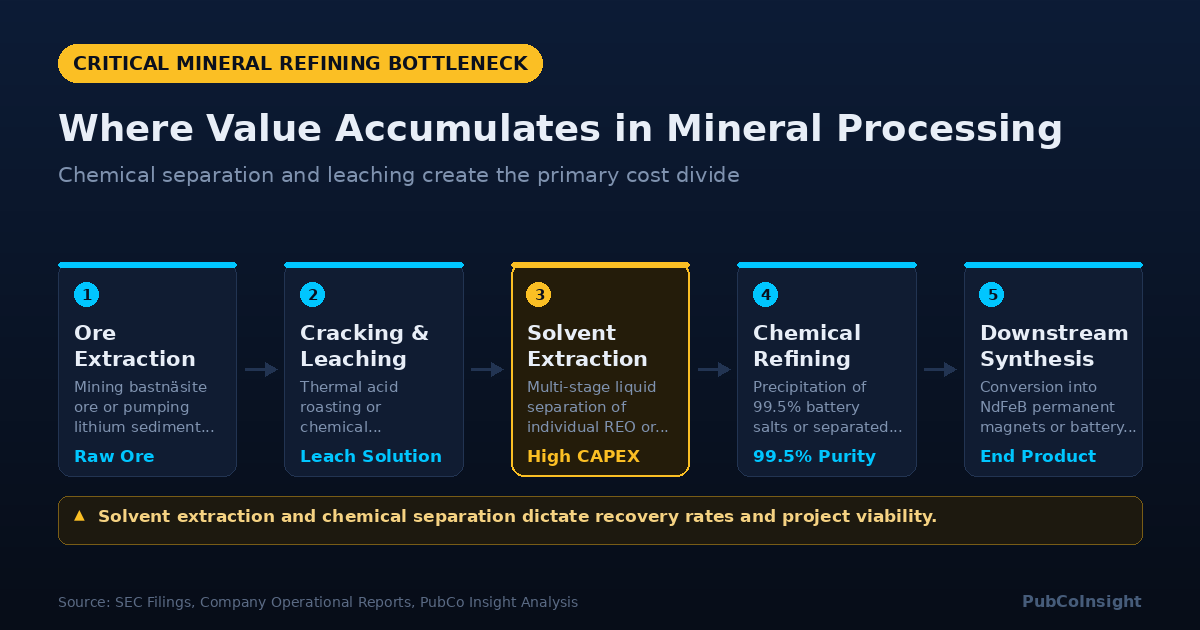
The primary barrier in critical mineral supply chains is rarely the physical availability of raw ore in the ground. The critical constraint lies in liquid-liquid solvent extraction and chemical conversion. Rare earth elements do not occur as pure isolated metals, they exist tightly bound within complex monazite, bastnäsite, or eudialyte mineral matrices. Separating individual light rare earth oxides like neodymium and praseodymium, or heavy rare earth oxides like dysprosium and terbium, requires passing dissolved ore through dozens or hundreds of sequential mixer-settler extraction stages. Minute differences in ionic radii govern how each element shifts between aqueous acid solutions and organic solvent phases, demanding extreme chemical precision, high reagent volumes, and continuous quality control.
A parallel bottleneck governs sedimentary and brine lithium deposits. Extracting lithium from claystone or subsurface brine requires separating target lithium ions from overwhelming quantities of background sodium, potassium, calcium, and magnesium. Direct lithium extraction systems use ion-exchange media, adsorption columns, or selective membranes to capture lithium ions while rejecting impurities. If the background chemistry contains high levels of interfering divalent ions, reagent consumption spikes and recovery rates drop significantly, rendering massive tonnage deposits commercially unviable.
For any junior operator, proving a resource on paper is only the first step. To generate commercial value, a developer must demonstrate a repeatable chemical flow sheet that converts run-of-mine ore into 99.5% pure battery-grade lithium hydroxide, lithium carbonate, or individual rare earth oxides. Without a validated, cost-effective chemical separation process, in-ground mineral tonnage remains economically illiquid.
Operators Navigating the Upstream Market
Companies across the micro and small-cap critical mineral landscape are taking distinct approaches to solvent extraction, claim development, and portfolio management. The market reflects a clear operational split between pure-play lithium extractors, rare earth processing specialists, and multi-asset developers.
In the rare earth and hard-rock segment, Critical Metals Corp. (CRML, price $7.25) is streamlining its operational footprint by reviewing non-core assets while defending its primary Tanbreez rare earth project in Greenland. On July 23, 2026, the company advanced to the final evaluation round of the Kenyan government tender for the Mrima Hill rare earth and niobium project, seeking to expand its deposit base. USA Rare Earth, Inc. (USAR, price $19.33) and NioCorp Developments Ltd. (NB, price $5.36) are pursuing domestic processing paths. NioCorp is working on commercial-scale extraction flowsheets for niobium, scandium, and rare earth oxides from its Nebraska deposit, while USA Rare Earth is focusing on integrated mine-to-magnet capabilities to bypass foreign supply chains.
In the lithium and battery materials segment, operators are testing multiple extraction models across diverse geologies:
- ioneer Ltd (IONR, price $3.5) is advancing its Rhyolite Ridge lithium-boron sediment project in Nevada, relying on continuous acid leaching and co-product boron crystallisation to lower net lithium production costs.
- Standard Lithium Ltd. (SLI, price $2.37) is scaling direct lithium extraction column technology on tailbrines in Arkansas, aiming to bypass conventional solar evaporation ponds entirely.
- Atlas Lithium Corporation (ATLX, price $3.11) is focusing on hard-rock pegmatite exploration in Brazil, where dense spodumene ore can be processed using standard gravity and flotation circuits to yield high-grade concentrate.
- American Battery Technology Company (ABAT, price $2.61) is combining primary battery-grade lithium resource development in Nevada with closed-loop lithium-ion battery recycling technology. On August 5, 2026, peer developer Stardust Power announced an offtake agreement, illustrating growing commercial demand for domestic battery chemical supply contracts.
- American Lithium Minerals, Inc. (AMLM, price $0.068) maintains exploration holdings in Central Nevada sediments while pursuing asset tokenization structures.
American Lithium Minerals, Inc. (AMLM)
American Lithium Minerals, Inc. operates as an exploration-stage mineral enterprise incorporated in Nevada on March 10, 2005. It trades over the counter under the ticker AMLM and files public disclosures with the SEC under CIK 1356371. The company is pre-revenue and maintains a dual-track corporate strategy focused on mineral claim exploration in Nevada alongside the development of Real World Asset (RWA) tokens designed to digitise in-ground mineral interests and provide alternative funding mechanisms for mining projects.
The core physical asset held by American Lithium Minerals is the Sarcobatus Lithium property, which consists of 1,780 acres of unpatented mining claims located in Central Nevada. The company has focused its exploration activities on lithium brine and sediment opportunities in Central Nevada since 2009. Over its corporate history, the company has also acquired and divested secondary mineral claims, including cobalt, nickel, and graphite prospects in Central Nevada, as well as rare earth element prospects in Kingman, Arizona and Southeast Illinois.
On February 4, 2026, the SEC qualified the company's Regulation A offering circular on Form 1-A. The qualified offering statement authorizes a best-efforts capital raise of up to $20,000,000 in total securities worldwide. The structure includes:
- Up to $8,000,000 offered in Units at $0.10 per Unit, with a maximum of 80,000,000 Units. Each Unit consists of one share of common stock (par value $0.001) and one warrant to purchase 1.5 shares of common stock.
- Up to $12,000,000 in common stock, representing up to 120,000,000 shares issuable upon full exercise of the underlying warrants. The warrants carry an exercise price of $0.05 to $0.10 per share and remain valid through December 31, 2028.
- A minimum investor subscription threshold of $1,000, subject to discretionary waiver by management.
The public SEC filings do not establish certified mineral reserves under S-K 1300 standards, updated NI 43-101 technical feasibility studies, active metallurgical recovery testing, or commercial revenue generated from the Sarcobatus claims. The company relies entirely on external capital raised through equity issuances and Reg A offerings to sustain operations and execute work programs.
According to its use-of-proceeds filings, American Lithium Minerals intends to deploy capital raised from the Regulation A offering toward general exploration expenditures on its Sarcobatus claims, potential acquisitions of third-party gold and critical metal properties, development of its proprietary RWA tokenisation platform, and general corporate working capital.
What to watch
- Kenya Tender Decision: The official announcement from the Kenyan government regarding the final contract award for the Mrima Hill rare earth and niobium project, following Critical Metals Corp's (CRML) advancement to the final round on July 23, 2026.
- Project Swarm Commercial Progress: Operational disclosures from MP Materials regarding magnet production throughput and heavy rare earth separation milestones following its August 6, 2026 Q2 update.
- Thacker Pass Construction Draws: Capital deployment updates and construction progress filings from Lithium Americas (LAC) following its $175 million balance sheet financing on August 6, 2026.
- Reg A Subscription Filings: Subsequent SEC disclosures on EDGAR by American Lithium Minerals, Inc. (AMLM) detailing net capital raised and warrant exercises under its qualified $20 million Regulation A offering circular.
Companies mentioned
| Ticker | Company | Price |
|---|---|---|
| ABAT | American Battery Technology Company | $2.61 |
| AMLM client | American Lithium Minerals, Inc. | $0.068 |
| ATLX | Atlas Lithium Corporation | $3.11 |
| CRML | Critical Metals Corp. | $7.25 |
| IONR | ioneer Ltd | $3.5 |
| NB | NioCorp Developments Ltd. | $5.36 |
| SLI | Standard Lithium Ltd. | $2.37 |
| USAR | USA Rare Earth, Inc. | $19.33 |
Listed alphabetically, not ranked. Prices as of 2026-08-10 and they move. Check a live quote before relying on any of this.
How we chose the companies in this article
We cover a fixed universe of companies working in lithium, boron and the critical minerals that feed battery and energy-storage supply chains. Every one of them that had usable market data on 2026-08-10 appears in this article. We do not pick which ones to mention based on what we think of them, and we do not order them by size, price or trading volume, because an ordered list is a verdict and that is not ours to hand down. Companies left out, and why: none. American Lithium Minerals and Artificial Intelligence Technology Solutions pay us, which is disclosed in full at the foot of every article they appear in.
See the dilution and promotion flags before you see the pitch.
Each week: the micro and small-caps now showing dilution or paid-promotion signals, with the SEC filing behind every flag. No recommendations, no price targets.
Sources used in this article
- MP Materials Q2 Earnings Call Highlights MarketBeat · 2026-08-08
- Albemarle Q2 Earnings Call Highlights MarketBeat · 2026-08-07
- S&P 500 Posts Weekly Gain as Tech Giants Surge MT Newswires · 2026-08-07
- Baird Adjusts Albemarle Price Target to $157 From $178 MT Newswires · 2026-08-07
- Citigroup Adjusts Albemarle Price Target to $175 From $225 MT Newswires · 2026-08-07
- BMO Capital Adjusts Albemarle Price Target to $200 From $250 MT Newswires · 2026-08-07
- UBS Adjusts Price Target on Albemarle to $175 From $205, Maintains Buy Rating MT Newswires · 2026-08-07
- ALB Q2 Earnings Call Highlights Storage Demand, Q3 Pressure Zacks · 2026-08-07
- MP Earnings Show Chinese Rare-Earth Monopoly Is Fading. The Stock Is Up. Barrons.com · 2026-08-07
- MP Materials to Participate in Canaccord Genuity’s 46th Annual Growth Conference Business Wire · 2026-08-07
- Trump Touts $3 Billion in Minerals Projects to Counter China Bloomberg · 2026-08-07
- Top Rare-Earths Stocks Poised to Ride the U.S. Reshoring Wave Motley Fool · 2026-08-07
Disclosure required by Section 17(b) of the Securities Act of 1933
American Lithium Minerals, Inc.. American Lithium Minerals, Inc. (issuer) paid Strategic Innovations First, Inc., an affiliate of PubCo Insight and Pulse IR. Compensation received: USD 11,550.00 total, three equal monthly installments of USD 3,850.00. Form of payment: cash only; no stock, options or warrants. Services: investor relations, marketing and content creation under Master Services Agreement dated June 22, 2026. Period: three month initial term, June 2026 through August 2026. No position, options or warrants held by PubCo Insight, Pulse IR, Strategic Innovations First, Inc., or Brad Listermann.
This is information, not investment, financial, legal or tax advice. It is not a recommendation or solicitation to buy, sell or hold any security and it contains no price target. Nothing here is independently verified by us. Confirm every figure against primary filings on SEC EDGAR before you act. Micro-cap and over-the-counter securities are speculative and illiquid and can lose all of their value. The companies named without a disclosure above pay us nothing and have no relationship with us; they are named because a published, mechanical screen selected them. Full disclosure policy.