Western Capital Confronts China's Rare Earth Monopoly in Nevada, Greenland, and Kenya
Public equity backing and government stakes are converging on critical mineral developers as operators attempt to build downstream processing outside Chinese control.
On July 28, 2026, Critical Metals Corp. chief executive officer Tony Sage publicly defended the development timeline of the Tanbreez rare earth project in Greenland, stating plainly that Western markets must beat China's monopoly on critical mineral processing. That statement came on the heels of direct government intervention across the sector, highlighted by the United States taking a $400 million equity stake in MP Materials. Wall Street research desks, including Goldman Sachs, now frame the sector around an accelerated mine-to-magnet investment cycle driven by artificial intelligence infrastructure, defense procurement, and permanent magnet supply constraints.
The push to secure critical elements has exposed a sharp divide between raw resource extraction and chemical processing capacity. Upstream deposits are abundant worldwide, but heavy rare earth oxides, high-purity lithium compounds, and refined boron remain heavily bottlenecked at the refining stage. Mining rock out of the ground does not alter supply chain realities until chemical separation plants turn raw concentrates into battery-grade or magnet-grade materials.
As Western governments step directly onto balance sheets to fund processing infrastructure, small-cap exploration and development companies are attempting to advance assets through permitting, metallurgical testing, and project-level financing. Understanding which operators hold viable geology and actual processing flowsheets separates structural supply additions from promotional white papers.
How chemical separation defines critical mineral control
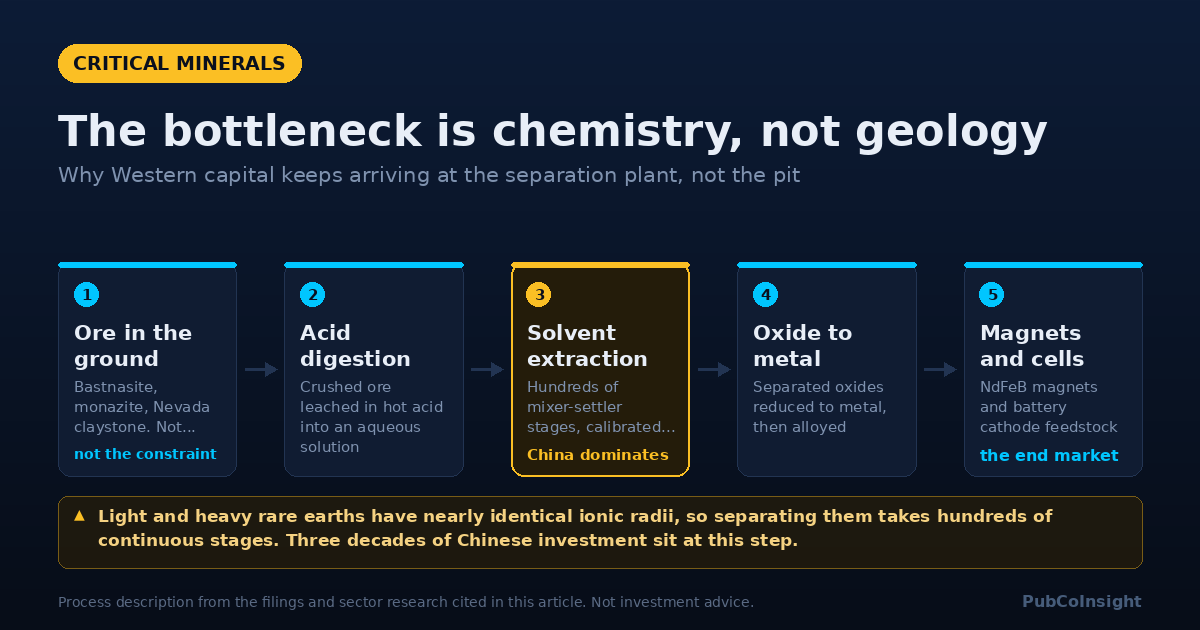
The core bottleneck in critical mineral supply chains is not geological scarcity. It is chemical separation. Rare earth elements occur together in mineral deposits like bastnäsite, monazite, or eudialyte. Because light rare earths like lanthanum and cerium share nearly identical ionic radii with heavy rare earths like dysprosium and terbium, separating them requires hundreds of continuous liquid-liquid solvent extraction stages.
In a standard solvent extraction circuit, crushed ore is digested in hot acid to create an aqueous leach solution. That solution passes through series of mixer-settler tanks containing organic solvents. The solvent selectively binds to specific metal ions, extracting them step by step. Reagents must be precisely calibrated for temperature, pH, and flow rates. Deviations of half a pH point dump target metals into waste streams or contaminate adjacent oxide fractions. China dominates this step because it built massive chemical processing infrastructure over three decades, accepting the environmental and capital costs that Western capital avoided.
Lithium extraction presents a parallel chemical processing challenge. Hard-rock spodumene concentrates require high-temperature calcination at 1,050 degrees Celsius to convert alpha-spodumene to reactive beta-spodumene before acid leaching. Claystone deposits, found extensively in Nevada basins, demand precise acid consumption ratios to strip lithium from smectite minerals without leaching excessive iron and aluminum into the solution. Direct lithium extraction technologies replace evaporative brine ponds with selective adsorbents or ion-exchange resins, but they require massive volumes of wash water and high reagent cycles to maintain recovery rates.
For any junior operator, project viability hinges entirely on reagent consumption costs, energy inputs, and recovery efficiency at scale. A deposit boasting high-grade rare earths or lithium in rock assays means nothing if the flowsheet requires more acid, water, or thermal energy than the recovered oxide market value can clear.
How North American and international operators are positioning assets
Across the North American and international markets, several distinct groups of operators are advancing critical mineral assets through permitting, feasibility, and corporate tender processes.
In the rare earth and specialized refractory metal space, Critical Metals Corp. (CRML, $6.78) is attempting to build out multi-jurisdictional assets. Beyond its focus on the Tanbreez project in Greenland, the company advanced to the final round of a Kenyan government tender in July 2026 for the Mrima Hill project, a site known for rare earth elements and niobium. In domestic processing, USA Rare Earth, Inc. (USAR, $17.275) is targeting an integrated supply chain combining mine site development with downstream permanent magnet manufacturing capacity. NioCorp Developments Ltd. (NB, $5.19) continues to focus on its Elk Creek deposit in Nebraska, designed to produce niobium, scandium, and titanium metals for structural steel and defense alloys.
In domestic lithium and co-product extraction, operators are tackling varied mineralogies across different geologies:
- ioneer Ltd (IONR, $3.36): Developing the Rhyolite Ridge lithium-boron deposit in Esmeralda County, Nevada. The unique searlesite ore deposit allows for simultaneous recovery of lithium carbonate and boric acid, lowering net operating costs per tonne through co-product credit revenues.
- Standard Lithium Ltd. (SLI, $2.21): Processing Smackover Formation brines in Arkansas, utilizing direct lithium extraction technology to bypass traditional evaporation ponds by integrating with existing commercial bromine processing facilities.
- Atlas Lithium Corporation (ATLX, $2.94): Advancing hard-rock pegmatite projects in Minas Gerais, Brazil, focused on dense media separation to produce high-purity spodumene concentrates for conversion facilities.
- American Battery Technology Company (ABAT, $2.32): Operating a battery recycling plant in Nevada while advancing a lithium claystone project in Nye County, relying on commercial-scale hydrometallurgical processing techniques.
American Lithium Minerals, Inc. (OTC: AMLM)
American Lithium Minerals, Inc. (AMLM, $0.0838) operates as an exploration-stage micro-cap mineral company registered under CIK 1356371. The company is pre-revenue and maintains no real estate, physical plant, or operating producing mines. Its corporate filings on EDGAR document a business model directed at acquiring, exploring, and potentially developing lithium and critical mineral claims in the Southwestern United States.
The primary asset described in the company's regulatory filings is the Sarcobatus Lithium property. The project comprises 1,780 acres of unpatented mining claims located in Sarcobatus Flat, a hydrographic basin situated in Central Nevada. Nevada clay and brine basins have attracted significant regional exploration due to lithium concentration within playa sediments, but project viability depends on detailed hydrological testing, drill spacing, and chemical leaching parameters.
On February 4, 2026, the SEC qualified a Regulation A offering statement on Form 1-A filed by American Lithium Minerals. The qualified offering structure allows the company to raise up to $20,000,000 in gross proceeds. This includes up to $8,000,000 generated through the sale of 80,000,000 units priced at $0.10 per unit, with each unit consisting of one share of common stock and one warrant. An additional $12,000,000 in gross proceeds could be realized if investors exercise the attached 120,000,000 warrants at the set exercise price prior to their expiration date on December 31, 2028.
The public record does not establish recent verified drill assay results, a completed preliminary economic assessment, or an independent NI 43-101 compliant technical report defining estimated lithium reserves or resources on the Sarcobatus property.
In recent SEC disclosures, the management of American Lithium Minerals outlined plans to incorporate Real World Asset tokens into its corporate financing model. The filings describe an intention to use blockchain-based token structures to raise project-level capital and acquire undervalued gold and battery mineral prospects. The public filings provide minimal operational detail regarding software development timelines, regulatory approvals for token issuance, or commercial implementation of this funding mechanism.
What to watch
- August 2026 Quarterly Filings: Form 10-Q disclosures from domestic battery material developers, detailing second-quarter operating burn rates, cash balances, and updated project timelines.
- Kenyan Government Tender Award: Official notifications regarding the final selection for the Mrima Hill rare earth and niobium concession involving Critical Metals Corp.
- Federal Permitting Milestones: Decision records from the Bureau of Land Management regarding Environmental Impact Statements for Nevada claystone and lithium-boron project sites.
- Regulation A Offering Capital Updates: SEC filings from American Lithium Minerals showing the gross proceeds raised and share issuances completed under its qualified Form 1-A financing structure.
Companies mentioned
| Ticker | Company | Price |
|---|---|---|
| ABAT | American Battery Technology Company | $2.32 |
| AMLM client | American Lithium Minerals, Inc. | $0.0838 |
| ATLX | Atlas Lithium Corporation | $2.94 |
| CRML | Critical Metals Corp. | $6.78 |
| IONR | ioneer Ltd | $3.36 |
| NB | NioCorp Developments Ltd. | $5.19 |
| SLI | Standard Lithium Ltd. | $2.21 |
| USAR | USA Rare Earth, Inc. | $17.275 |
Listed alphabetically, not ranked. Prices as of 2026-08-05 and they move. Check a live quote before relying on any of this.
How we chose the companies in this article
We cover a fixed universe of companies working in lithium, boron and the critical minerals that feed battery and energy-storage supply chains. Every one of them that had usable market data on 2026-08-05 appears in this article. We do not pick which ones to mention based on what we think of them, and we do not order them by size, price or trading volume, because an ordered list is a verdict and that is not ours to hand down. Companies left out, and why: none. American Lithium Minerals and Artificial Intelligence Technology Solutions pay us, which is disclosed in full at the foot of every article they appear in.
See the dilution and promotion flags before you see the pitch.
Each week: the micro and small-caps now showing dilution or paid-promotion signals, with the SEC filing behind every flag. No recommendations, no price targets.
Sources used in this article
- Will Bartolomeo’s Board Appointment Reshape Albemarle’s (ALB) Energy Storage Strategy? Simply Wall St. · 2026-08-04
- Wheaton Precious Metals to Report Q2 Earnings: What to Expect? Zacks · 2026-08-04
- ATI Set to Report Q2 Earnings: What's in Store for the Stock? Zacks · 2026-08-04
- Century Aluminum to Report Q2 Earnings: Here's What to Expect Zacks · 2026-08-04
- CF to Report Q2 Earnings: What's in the Cards for the Stock? Zacks · 2026-08-04
- Here's How to Play Albemarle Stock Before Q2 Earnings Release Zacks · 2026-08-04
- Should You Buy, Sell or Hold MP Stock Before Q2 Earnings Release? Zacks · 2026-08-04
- Gear Up for Albemarle (ALB) Q2 Earnings: Wall Street Estimates for Key Metrics Zacks · 2026-08-03
- China Is Getting More Anxious About Mythos Before Trump Meets Xi Bloomberg · 2026-08-03
- Washington Picked MP Materials Long Before Lutnick’s Export Order Landed Moby · 2026-08-03
- Do Options Traders Know Something About Albemarle Stock We Don't? Zacks · 2026-07-31
- Nucor Outshines Albemarle in Charlotte Stock Duel 24/7 Wall St. · 2026-07-31
Disclosure required by Section 17(b) of the Securities Act of 1933
American Lithium Minerals, Inc.. American Lithium Minerals, Inc. (issuer) paid Strategic Innovations First, Inc., an affiliate of PubCo Insight and Pulse IR. Compensation received: USD 11,550.00 total, three equal monthly installments of USD 3,850.00. Form of payment: cash only; no stock, options or warrants. Services: investor relations, marketing and content creation under Master Services Agreement dated June 22, 2026. Period: three month initial term, June 2026 through August 2026. No position, options or warrants held by PubCo Insight, Pulse IR, Strategic Innovations First, Inc., or Brad Listermann.
This is information, not investment, financial, legal or tax advice. It is not a recommendation or solicitation to buy, sell or hold any security and it contains no price target. Nothing here is independently verified by us. Confirm every figure against primary filings on SEC EDGAR before you act. Micro-cap and over-the-counter securities are speculative and illiquid and can lose all of their value. The companies named without a disclosure above pay us nothing and have no relationship with us; they are named because a published, mechanical screen selected them. Full disclosure policy.