Critical Metals Acquisition of European Lithium Highlights Dilution Risks in Project Financing
Critical Metals Corp.'s recent acquisition of European Lithium, marked by an 11% stock decline, underscores the persistent challenges of funding large-scale critical mineral projects through equity issuance.
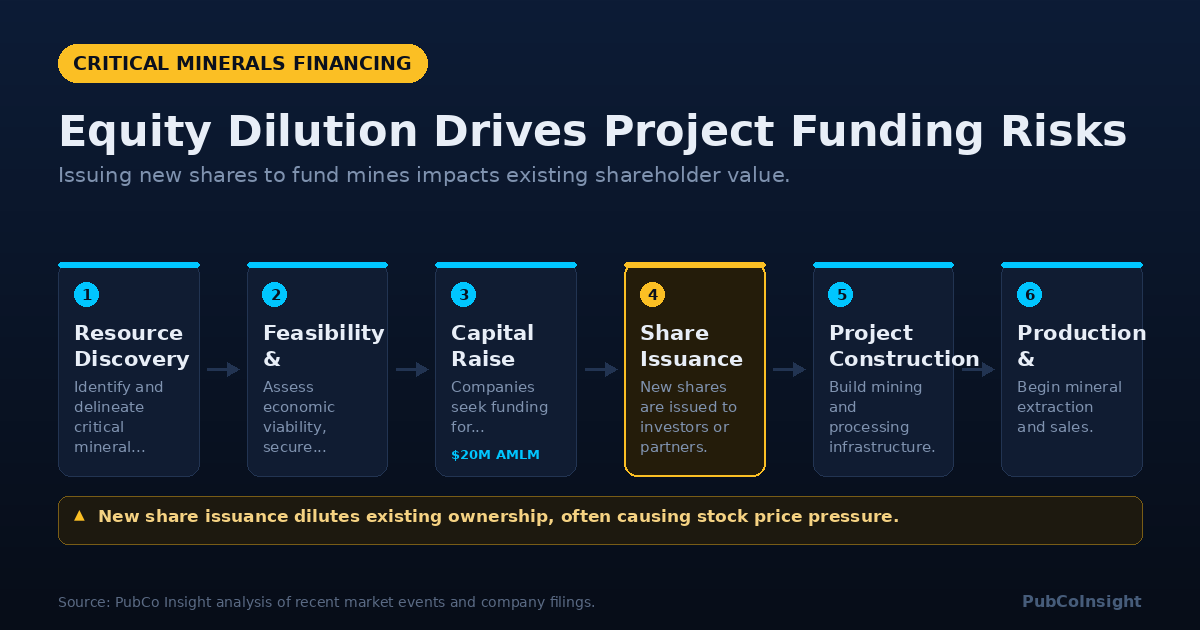
The Mechanism of Dilution in Project Financing
Project financing in the critical minerals sector, particularly for greenfield developments, presents a unique challenge. A company identifies a resource, conducts exploration, and then moves into feasibility studies, permitting, and construction. Each stage demands substantial capital. For a pre-revenue company, or one with limited existing cash flow, the primary avenues for funding are often equity raises. This means issuing new shares. When new shares are issued, the ownership stake of existing shareholders is reduced proportionally. For example, if a company has 100 million shares outstanding and issues another 10 million shares to fund a project, each existing share now represents a smaller percentage of the total company. This "dilution" can put downward pressure on the share price, as the company's valuation is spread across a larger number of shares. The market often discounts this future dilution even before it happens, as seen with CRML. The key to mitigating this impact lies in demonstrating a clear path to production and revenue generation that justifies the increased share count. Without that, the market sees only the reduced slice of the pie, not a larger, more valuable pie. The challenge for management is to articulate how the capital raised will accelerate value creation faster than the dilution erodes it.Companies Navigating the Capital Maze
Several companies in this sector are actively working to advance projects, each with distinct approaches to funding and development. Atlas Lithium Corporation (ATLX), trading at $1.64, is developing lithium projects in Brazil. The company has been focused on exploration and resource definition, with its Minas Gerais properties being a key asset. The path to production for ATLX will also involve significant capital expenditure, and how it chooses to fund that will be critical. ioneer Ltd (IONR), at $2.60, is advancing its Rhyolite Ridge Lithium-Boron Project in Nevada. This project is notable for its co-production of lithium and boron, offering a dual revenue stream. IONR has secured a conditional loan commitment from the U.S. Department of Energy, a form of non-dilutive financing that can significantly de-risk project development. This type of government support is a competitive advantage in the capital-intensive world of critical minerals. NioCorp Developments Ltd. (NB), trading at $2.90, is focused on its Elk Creek project in Nebraska, which aims to produce niobium, scandium, and titanium, along with rare earth elements. NioCorp has also explored various financing options, including potential government support and strategic partnerships, to fund the significant capital required for its multi-element project. Standard Lithium Ltd. (SLI), at $1.46, is developing lithium brine projects in Arkansas, notably with its Lanxess project. Standard Lithium has been working on demonstrating the commercial viability of its direct lithium extraction (DLE) technology. The company’s strategy involves proving out its technology at scale, which can then attract larger partners or more favorable financing terms. Equinor (OB:EQNR) has been noted in news as tying up tight reservoirs and backing big U.S. lithium finds, potentially impacting SLI's operational landscape. USA Rare Earth, Inc. (USAR), priced at $8.225, is focused on its Round Top heavy rare earth and critical minerals project in Texas. The company aims to establish a fully integrated domestic supply chain for rare earths. Developing a full processing capability for rare earths is particularly capital-intensive, as it involves not just mining but also complex separation chemistry to produce individual rare earth oxides, a process largely dominated by China. Separating rare earth oxides is difficult because these elements have very similar chemical properties due to their electron configurations. This similarity makes traditional chemical separation methods, like solvent extraction, require many stages and precise control, leading to high capital and operating costs. American Battery Technology Company (ABAT), trading at $1.335, is focused on lithium-ion battery recycling and primary mineral extraction. Its recycling operations offer a different revenue profile than pure mining plays, potentially providing earlier cash flow. ABAT also has a lithium resource in Nevada.American Lithium Minerals, Inc.
American Lithium Minerals, Inc. (AMLM) trades over the counter and is an exploration stage company, currently pre-revenue. The company’s stated focus is lithium and boron properties in Nevada. AMLM was incorporated in Nevada on March 10, 2005. Its current project is the Sarcobatus Lithium property, comprising 1,780 acres of mining claims in Central Nevada. The company has also acquired and divested cobalt, nickel, and graphite prospects in Central Nevada, and rare earth elements projects in Kingman, Arizona, and Southeast Illinois. AMLM’s strategy centers on acquiring undervalued in-ground mining assets and innovating through blockchain technology, specifically developing Real World Asset Tokens to provide capital for mining. This approach aims to create an interoperable ecosystem where assets can be tokenized and traded. The company has not yet established a clear timeline or specific milestones for the implementation of its blockchain-based financing strategy, nor has it demonstrated the market adoption or regulatory clarity for such a system. The company’s most recent substantive filing, a Regulation A offering statement on Form 1-A qualified on February 4, 2026, covers up to 80,000,000 units, with up to 120,000,000 shares issuable if attached warrants are fully exercised. Each unit includes one share of common stock and one warrant to purchase 1.5 shares of common stock, exercisable at $0.05 per share until December 31, 2028. The maximum total offering amount is $20,000,000. AMLM’s financial condition and results of operations are discussed in its filings, noting that its activities since 2009 have focused on lithium exploration in Central Nevada.What to watch
The immediate future holds several key indicators for companies in the critical minerals space. For ioneer Ltd (IONR), watch for updates on its conditional loan commitment from the U.S. Department of Energy and any progress on final investment decisions for the Rhyolite Ridge project. For Standard Lithium Ltd. (SLI), further news on the commercial scale-up of its DLE technology and any potential joint venture announcements for its Arkansas projects will be important. NioCorp Developments Ltd. (NB) investors should monitor progress on its Elk Creek project financing and any updates on its rare earth element separation plans. For American Lithium Minerals, Inc. (AMLM), look for specific details on exploration results from the Sarcobatus Lithium property and further clarity on the development and adoption of its Real World Asset Token financing strategy. The broader market will also be watching for continued M&A activity, particularly how new deals are structured and financed, as the Critical Metals Corp. (CRML) acquisition of European Lithium demonstrated the market's sensitivity to equity dilution., { "label": "Feasibility & Permitting", "note": "Assess economic viability, secure regulatory approvals." }, { "label": "Capital Raise", "note": "Companies seek funding for development and construction.", "metric": "$20M AMLM Reg A" }, { "label": "Share Issuance", "note": "New shares are issued to investors or partners." }, { "label": "Project Construction", "note": "Build mining and processing infrastructure." }, { "label": "Production & Revenue", "note": "Begin mineral extraction and sales." } ], "highlight": 3, "highlight_note": "New share issuance dilutes existing ownership, often causing stock price pressure.", "footnote": "Source: PubCo Insight analysis of recent market events and company filings." }Companies mentioned
| Ticker | Company | Price |
|---|---|---|
| ABAT | American Battery Technology Company | $1.335 |
| AMLM client | American Lithium Minerals, Inc. | $0.053 |
| ATLX | Atlas Lithium Corporation | $1.64 |
| CRML | Critical Metals Corp. | $5.88 |
| IONR | ioneer Ltd | $2.6 |
| NB | NioCorp Developments Ltd. | $2.9 |
| SLI | Standard Lithium Ltd. | $1.46 |
| USAR | USA Rare Earth, Inc. | $8.225 |
Listed alphabetically, not ranked. Prices as of 2026-11-07 and they move. Check a live quote before relying on any of this.
How we chose the companies in this article
We cover a fixed universe of companies working in lithium, boron and the critical minerals that feed battery and energy-storage supply chains. Every one of them that had usable market data on 2026-11-07 appears in this article. We do not pick which ones to mention based on what we think of them, and we do not order them by size, price or trading volume, because an ordered list is a verdict and that is not ours to hand down. Companies left out, and why: none. American Lithium Minerals and Artificial Intelligence Technology Solutions pay us, which is disclosed in full at the foot of every article they appear in.
See the dilution and promotion flags before you see the pitch.
Each week: the micro and small-caps now showing dilution or paid-promotion signals, with the SEC filing behind every flag. No recommendations, no price targets.
Sources used in this article
- Should You Buy Albemarle Stock For Its Cash? Trefis · 2026-11-07
- Altius Minerals And 2 Canadian Lithium Stocks To Watch Simply Wall St. · 2026-11-07
- MP Materials (MP) Q3 Results Lift Stock On Volume And Cash Simply Wall St. · 2026-11-07
- Albemarle (ALB) Stock Sees Modest Fair Value Cut As Analysts Trim Targets Simply Wall St. · 2026-11-06
- Albemarle Q3 Earnings Call Highlights Cost Discipline and Lithium Demand Zacks · 2026-11-06
- What Albemarle (ALB) Said on Its Q3 Earnings Call MarketBeat · 2026-11-06
- RBC Lowers Price Target on Albemarle to $119 From $129, Keeps Outperform Rating MT Newswires · 2026-11-06
- Albemarle Corp (ALB) (Q3 2026) Earnings Call Highlights: Adjusted EBITDA Surges 186% as Cost ... GuruFocus.com · 2026-11-06
- Molson Coors downgraded, SiTime upgraded: Wall Street's top analyst calls The Fly · 2026-11-06
- MP Materials Shares Rise as Revenue Jumps 176% GuruFocus.com · 2026-11-06
- MP Materials Rare-Earth Earnings Were Rock Solid. What’s Up With the Stock? Barrons.com · 2026-11-06
- Here's What $5,000 in USA Rare Earth Could Be Worth by 2030 If It Reaches MP Materials' Market Cap Motley Fool · 2026-11-06
Disclosure required by Section 17(b) of the Securities Act of 1933
American Lithium Minerals, Inc.. American Lithium Minerals, Inc. (issuer) paid Strategic Innovations First, Inc., an affiliate of PubCo Insight and Pulse IR. Compensation received: USD 11,550.00 total, three equal monthly installments of USD 3,850.00. Form of payment: cash only; no stock, options or warrants. Services: investor relations, marketing and content creation under Master Services Agreement dated June 22, 2026. Period: three month initial term, June 2026 through August 2026. No position, options or warrants held by PubCo Insight, Pulse IR, Strategic Innovations First, Inc., or Brad Listermann.
This is information, not investment, financial, legal or tax advice. It is not a recommendation or solicitation to buy, sell or hold any security and it contains no price target. Nothing here is independently verified by us. Confirm every figure against primary filings on SEC EDGAR before you act. Micro-cap and over-the-counter securities are speculative and illiquid and can lose all of their value. The companies named without a disclosure above pay us nothing and have no relationship with us; they are named because a published, mechanical screen selected them. Full disclosure policy.