Kenya's Mrima Hill Tender Highlights the Solvent Extraction Bottleneck in Rare Earths and Niobium
Critical Metals Corp's advance in Kenya underscores the technical separation hurdles and asset positioning across North American and international critical mineral developers.
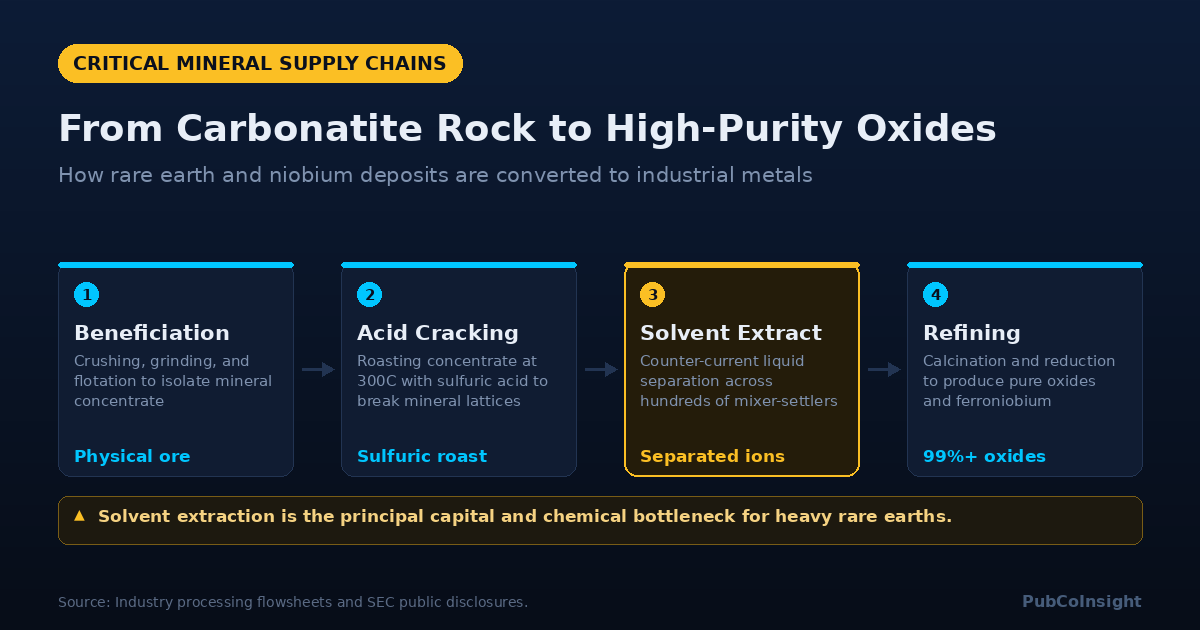
Hydro-Metallurgical Extraction and Solvent Extraction Dynamics
Carbonatite deposits contain rare earth elements trapped within monazite, bastnäsite, or apatite minerals, alongside niobium housed within pyrochlore. Processing begins with physical crushing, grinding, and froth flotation to remove gangue minerals like calcite and fluorite, generating a physical concentrate. Cracking the mineral lattice requires aggressive thermal or chemical treatment. Carbonatite concentrates are baked with concentrated sulfuric acid at temperatures exceeding 300 degrees Celsius, or roasted with sodium hydroxide to convert insoluble rare earth phosphate matrices into soluble sulfates or hydroxides. Water leaching yields a pregnant leach solution containing trivalent rare earth ions mixed with heavy concentrations of iron, aluminum, thorium, and phosphate impurities. Precipitation steps remove iron and radionuclides before the solution enters the primary chemical bottleneck: liquid-liquid solvent extraction. Separating individual rare earth elements is chemically difficult because all lanthanides exhibit identical oxidation states of plus three and feature nearly identical ionic radii. Lanthanide contraction causes atomic radii to shrink by only fractions of an angstrom from lanthanum down to lutetium. Solvent extraction circuits pump aqueous pregnant leach solution through dozens or hundreds of continuous counter-current mixer-settler units containing organic extractants dissolved in kerosene. Organophosphorus reagents selectively bind heavier, smaller rare earth ions in preference to lighter, larger ions. Achieving high-purity oxides of neodymium, praseodymium, dysprosium, and terbium demands tight pH regulation, high reagent volumes, and continuous acid stripping loops across dedicated extraction batteries. Niobium extraction follows a distinct chemical pathway. Pyrochlore mineral concentrates are treated with hydrofluoric acid or subjected to high-temperature chlorination to form soluble niobium fluorides or volatile niobium pentachloride. Liquid-liquid extraction using methyl isobutyl ketone separates niobium from titanium and tantalum. Calcination produces pure niobium pentoxide, which is subsequently reduced via aluminothermic reactions with aluminum powder to yield commercial ferroniobium containing approximately 66 percent niobium metal.Operators Across Hard-Rock, Sedimentary, and Brine Assets
Critical Metals Corp. (CRML, trading at $6.78) is expanding its project pipeline beyond its flagship Tanbreez rare earth deposit in southern Greenland by competing in the Kenyan state tender for Mrima Hill. The company launched an internal asset review in July 2026 to optimize non-core holdings while pursuing carbonatite-hosted rare earths and niobium in East Africa. USA Rare Earth, Inc. (USAR, $17.275) is developing a domestic rare earth supply chain linked to its Round Top deposit in Hudspeth County, Texas. The Round Top deposit is a peralkaline rhyolite laccolith containing heavy rare earths, lithium, and gallium. The company is pairing deposit development with downstream metal and permanent magnet manufacturing facilities in Oklahoma to bypass overseas tolling networks. NioCorp Developments Ltd. (NB, $5.19) focuses exclusively on carbonatite mineralization at its Elk Creek project in Johnson County, Nebraska. Elk Creek represents a high-grade niobium, scandium, and titanium deposit. NioCorp's metallurgical flowsheet relies on acid roasting and pyrometallurgical reduction to isolate high-purity ferroniobium alongside scandium trioxide, avoiding traditional rare earth solvent extraction complexities by targeting distinct industrial metals. ioneer Ltd (IONR, $3.36) operates in the sedimentary critical mineral space at its Rhyolite Ridge lithium-boron deposit in Esmeralda County, Nevada. Rhyolite Ridge contains lithium embedded in searlesite rock, allowing ioneer to leach lithium and boron simultaneously using sulfuric acid without requiring high-temperature calcination. The resulting leach solution is processed into battery-grade lithium carbonate and technical-grade boric acid through direct crystallization. Standard Lithium Ltd. (SLI, $2.21) targets lithium recovery from subsurface Smackover formation brines in southern Arkansas. Standard Lithium utilizes direct lithium extraction technology, circulating tailbrine through solid adsorbent media to selectively capture lithium ions while bypassing traditional multi-year solar evaporation ponds. The concentrated eluate is subsequently converted into lithium hydroxide feedstock. Atlas Lithium Corporation (ATLX, $2.94) is advancing hard-rock lithium pegmatite deposits in the Minas Gerais region of Brazil. Atlas Lithium utilizes dense media separation plants to process high-grade spodumene ore into 6 percent lithium oxide concentrates for export to international chemical converters, avoiding complex on-site chemical refining. American Battery Technology Company (ABAT, $2.32) operates dual business lines in Tonopah, Nevada, focused on claystone lithium extraction and commercial lithium-ion battery recycling. The company's claystone processing flowsheet utilizes selective acid leaching and ion exchange purification to recover battery-grade lithium compounds from shallow sedimentary clays. American Lithium Minerals, Inc. (AMLM, $0.0838) maintains exploratory claims in Nevada while pursuing mineral acquisition and digital asset strategies, positioning its corporate footprint in the domestic exploration ecosystem.American Lithium Minerals, Inc.
American Lithium Minerals, Inc. trades on the over-the-counter market under ticker AMLM and maintains filings with the Securities and Exchange Commission under CIK 1356371. Incorporated in Nevada in March 2005, the company operates as an exploration-stage entity with no commercial production or operating revenues reported to date. The principal asset disclosed in SEC filings is the Sarcobatus Lithium property, which consists of 1,780 acres of unpatented placer mining claims located in Nye County, Nevada. Sarcobatus Flat represents a sedimentary basin containing potential lithium-bearing clays and evaporite brines. Historical corporate filings show a pattern of acquiring and divesting regional mineral claims, including past positions in Nevada cobalt, nickel, and graphite prospects, as well as historic rare earth exploration claims located in Kingman, Arizona, and southern Illinois. On February 4, 2026, the SEC qualified the company's Regulation A offering circular on Form 1-A. The qualified offering covers up to $20,000,000 in total capital raising through a best-efforts structure. The offering structure permits the sale of up to 80,000,000 units priced at $0.10 per unit, where each unit consists of one common share and one warrant. Each warrant entitles the holder to purchase 1.5 common shares at an exercise price of $0.05 per share through December 31, 2028. Full exercise of all underlying warrants would result in the issuance of up to 120,000,000 additional common shares. The public record does not yet establish verified drill core assay results, a formal S-K 1300 compliant mineral resource estimate, or active commercial off-take agreements for the Sarcobatus property. In recent disclosures and Form 1-A offering materials, management outlined an expanded business direction under the brand name American Mineral Resources. This strategy includes developing Real World Asset (RWA) tokens on public blockchain networks to tokenized mineral rights and raise capital. Disclosed objectives involve aggregating underlying mineral rights across gold, base metal, and lithium properties into a digital ecosystem alongside traditional public market equity structures. Capital allocation plans under the Regulation A proceeds summary reserve management discretion to direct funds toward property exploration, claim maintenance, blockchain software integration, and potential third-party asset acquisitions.What to watch
- Kenyan Ministry of Mining tender ruling: Official award decision regarding the Mrima Hill Rare Earth and Niobium Project mining license allocation in Kwale County, Kenya.
- AMLM SEC filings: Semiannual Form 1-A disclosures detailing total unit sales, capital raised, and warrant exercises under the qualified Regulation A offering.
- Sarcobatus exploration updates: Mining claim maintenance filings with the Bureau of Land Management and technical reports detailing geological sampling or drilling activity in Nye County, Nevada.
- USAR Oklahoma facility milestones: Operational commissioning updates and feedstock processing announcements at USA Rare Earth's magnet plant in Stillwater, Oklahoma.
- Standard Lithium commercial agreements: Finalization of binding off-take agreements and project financing terms for Smackover brine development in Arkansas.
Companies mentioned
| Ticker | Company | Price |
|---|---|---|
| ABAT | American Battery Technology Company | $2.32 |
| AMLM client | American Lithium Minerals, Inc. | $0.0838 |
| ATLX | Atlas Lithium Corporation | $2.94 |
| CRML | Critical Metals Corp. | $6.78 |
| IONR | ioneer Ltd | $3.36 |
| NB | NioCorp Developments Ltd. | $5.19 |
| SLI | Standard Lithium Ltd. | $2.21 |
| USAR | USA Rare Earth, Inc. | $17.275 |
Listed alphabetically, not ranked. Prices as of 2026-08-05 and they move. Check a live quote before relying on any of this.
How we chose the companies in this article
We cover a fixed universe of companies working in lithium, boron and the critical minerals that feed battery and energy-storage supply chains. Every one of them that had usable market data on 2026-08-05 appears in this article. We do not pick which ones to mention based on what we think of them, and we do not order them by size, price or trading volume, because an ordered list is a verdict and that is not ours to hand down. Companies left out, and why: none. American Lithium Minerals and Artificial Intelligence Technology Solutions pay us, which is disclosed in full at the foot of every article they appear in.
See the dilution and promotion flags before you see the pitch.
Each week: the micro and small-caps now showing dilution or paid-promotion signals, with the SEC filing behind every flag. No recommendations, no price targets.
Sources used in this article
- Albemarle (ALB) Earnings Hopes Build, Is It Still 35% Below Fair Value? Simply Wall St. · 2026-08-05
- Albemarle (ALB) Stock May Look Fully Priced After Its 79% Run Simply Wall St. · 2026-08-05
- Will Bartolomeo’s Board Appointment Reshape Albemarle’s (ALB) Energy Storage Strategy? Simply Wall St. · 2026-08-04
- Wheaton Precious Metals to Report Q2 Earnings: What to Expect? Zacks · 2026-08-04
- ATI Set to Report Q2 Earnings: What's in Store for the Stock? Zacks · 2026-08-04
- Century Aluminum to Report Q2 Earnings: Here's What to Expect Zacks · 2026-08-04
- CF to Report Q2 Earnings: What's in the Cards for the Stock? Zacks · 2026-08-04
- Here's How to Play Albemarle Stock Before Q2 Earnings Release Zacks · 2026-08-04
- Should You Buy, Sell or Hold MP Stock Before Q2 Earnings Release? Zacks · 2026-08-04
- Gear Up for Albemarle (ALB) Q2 Earnings: Wall Street Estimates for Key Metrics Zacks · 2026-08-03
- China Is Getting More Anxious About Mythos Before Trump Meets Xi Bloomberg · 2026-08-03
- Washington Picked MP Materials Long Before Lutnick’s Export Order Landed Moby · 2026-08-03
Disclosure required by Section 17(b) of the Securities Act of 1933
American Lithium Minerals, Inc.. American Lithium Minerals, Inc. (issuer) paid Strategic Innovations First, Inc., an affiliate of PubCo Insight and Pulse IR. Compensation received: USD 11,550.00 total, three equal monthly installments of USD 3,850.00. Form of payment: cash only; no stock, options or warrants. Services: investor relations, marketing and content creation under Master Services Agreement dated June 22, 2026. Period: three month initial term, June 2026 through August 2026. No position, options or warrants held by PubCo Insight, Pulse IR, Strategic Innovations First, Inc., or Brad Listermann.
This is information, not investment, financial, legal or tax advice. It is not a recommendation or solicitation to buy, sell or hold any security and it contains no price target. Nothing here is independently verified by us. Confirm every figure against primary filings on SEC EDGAR before you act. Micro-cap and over-the-counter securities are speculative and illiquid and can lose all of their value. The companies named without a disclosure above pay us nothing and have no relationship with us; they are named because a published, mechanical screen selected them. Full disclosure policy.