Critical Metals’ European Lithium Deal: New Shares, New Scale
Critical Metals Corp. finalized its acquisition of European Lithium, a move that introduced new shares to the market and expanded its project pipeline in a sector hungry for secure supply.
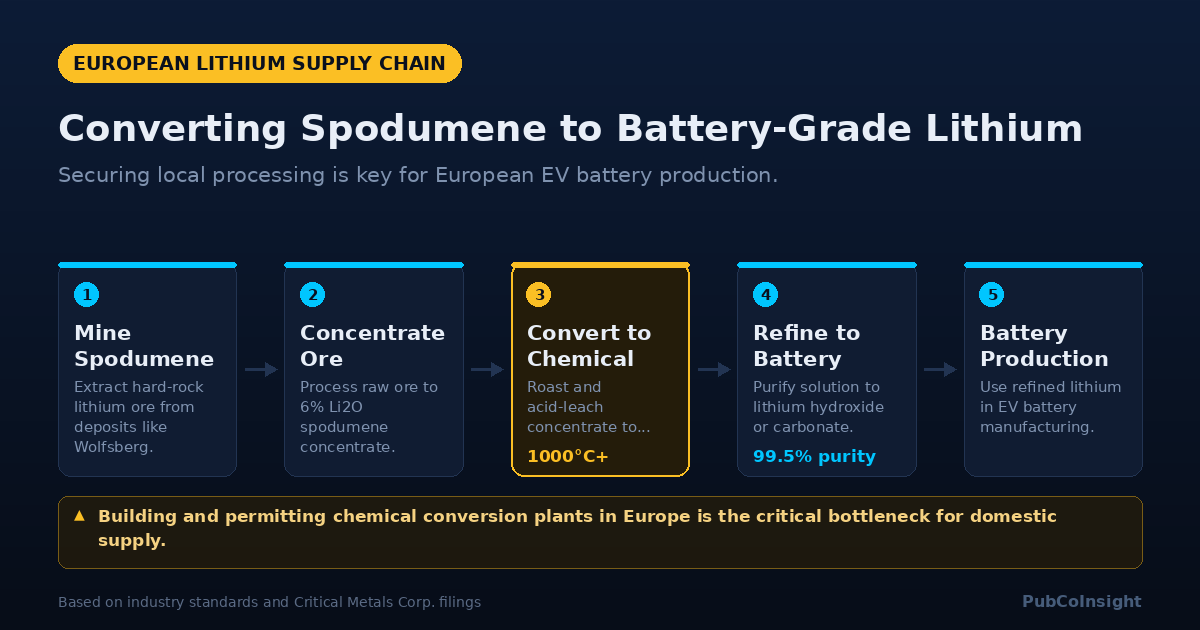
The Mechanism of European Lithium Supply
The European Union has declared lithium a critical raw material, emphasizing the need for domestic supply chains. Hard-rock lithium projects like Wolfsberg extract spodumene, a silicate mineral, from pegmatite deposits. This ore then undergoes a series of beneficiation steps, typically crushing, grinding, and flotation, to produce a spodumene concentrate. This concentrate, usually containing 6% lithium oxide (Li2O), is then shipped to a conversion plant. At the conversion plant, the spodumene concentrate is roasted at high temperatures, often above 1000°C, to convert the alpha-spodumene to beta-spodumene. This heat treatment changes the crystal structure, making the lithium more amenable to chemical extraction. The beta-spodumene is then acid-leached, typically with sulfuric acid, to dissolve the lithium. Impurities are removed through precipitation and filtration, yielding a lithium sulfate solution. This solution is then further processed, often through solvent extraction or ion exchange, to produce battery-grade lithium hydroxide or lithium carbonate. The bottleneck sits squarely at the conversion stage. Building a concentrator is one challenge, but constructing and permitting a chemical conversion plant in Europe, with its stringent environmental regulations, is a significantly larger hurdle. This is where the value is created, transforming a mineral concentrate into a high-purity chemical product ready for battery manufacturers. Without local conversion capacity, even a robust mining operation still relies on an external, often Asian, processing chain.Companies in the Lithium and Critical Minerals Space
Several companies are working to address these supply chain challenges, each with distinct approaches and assets. In the lithium brine sector, **Standard Lithium Ltd. (SLI)** focuses on direct lithium extraction (DLE) from brine resources. The company recently filed a positive preliminary economic assessment for its Franklin Project in East Texas, outlining a potential 70,000 tonnes per year of lithium hydroxide production. **ioneer Ltd (IONR)** is developing the Rhyolite Ridge Lithium-Boron Project in Nevada, a unique deposit that could produce both lithium carbonate and boric acid, diversifying its output beyond just battery metals. For hard-rock lithium, **Atlas Lithium Corporation (ATLX)** is advancing its projects in Brazil, a region gaining attention for its spodumene potential. **Lithium Americas Corp. (LAC)**, a larger player, continues to develop its Thacker Pass project in Nevada, which holds significant lithium clay resources. **Piedmont Lithium Inc. (PLL)**, while not listed in the provided data, is known for its hard-rock projects in North Carolina and Quebec, and its involvement in a joint venture with **Albemarle Corporation (ALB)**, a global lithium leader. Albemarle itself has a diverse portfolio of brine and hard-rock operations across the globe, including in Chile, Australia, and the U.S. In the rare earth elements (REE) space, **MP Materials (MP)** operates the Mountain Pass mine in California, the only integrated rare earth mining and processing site in North America. The company focuses on producing separated rare earth oxides, a crucial step in the REE supply chain. Separating rare earth oxides is difficult because these elements have very similar chemical properties, making it challenging to isolate individual elements from the mixed concentrate. This process typically involves complex solvent extraction circuits, where different organic solvents are used to selectively extract specific rare earth ions from an aqueous solution over hundreds of stages. **USA Rare Earth, Inc. (USAR)** is also active, with a focus on developing a full rare earth supply chain in the U.S., including mining, processing, and magnet manufacturing. **NioCorp Developments Ltd. (NB)** is developing a project in Nebraska that aims to produce niobium, scandium, and titanium, with potential for rare earth elements as well, diversifying the critical minerals focus. **American Battery Technology Company (ABAT)** is working on lithium-ion battery recycling and primary lithium hydroxide manufacturing from Nevada claystone resources, addressing both ends of the battery material lifecycle.American Lithium Minerals, Inc.
American Lithium Minerals, Inc. (AMLM) trades over the counter and is an exploration stage company, pre-revenue, focused on lithium and boron properties in Nevada. The company filed a Regulation A offering on Form 1-A, qualified on February 4, 2026, for up to 80,000,000 units, with an additional 120,000,000 shares issuable if warrants are fully exercised. Each unit includes one share of common stock and a warrant to purchase 1.5 shares of common stock at $0.05 per share, exercisable until December 31, 2028. AMLM’s primary asset is the Sarcobatus Lithium property, comprising 1,780 acres of mining claims in Central Nevada. The company’s filings indicate a history of acquiring and exploring mineral rights across North America, with a specific focus on lithium exploration in Central Nevada since 2009. While the company has previously acquired and divested cobalt, nickel, graphite, and rare earth prospects, its current stated emphasis is on the Sarcobatus lithium project. The public record does not yet establish a resource estimate or preliminary economic assessment for the Sarcobatus property. AMLM also states an intention to expand its exploration and acquisition efforts globally and is developing the use of Real World Asset Tokens to fund mining operations.What to watch
The coming months will bring several key developments for companies in this sector. For Critical Metals (CRML), watch for updates on the integration of European Lithium’s Wolfsberg project and any announcements regarding permitting or financing for the development of a European conversion facility. The company’s ability to secure offtake agreements with European battery manufacturers will be a strong indicator of progress. For Standard Lithium (SLI), the next steps for its Franklin Project, following the recent PEA filing on October 20th, will be critical. This includes further engineering studies and potential pilot plant developments. Investors should also monitor **Albemarle (ALB)**, with its Q3 2026 earnings release expected next week, as it will provide a broader market perspective on lithium demand and pricing trends. **MP Materials (MP)** is slated to participate in upcoming conferences, which could provide updates on its rare earth processing expansion and any new customer agreements for separated oxides. For **American Lithium Minerals (AMLM)**, watch for any announcements regarding exploration results from the Sarcobatus Lithium property, including drilling programs or initial resource estimates, which would be filed with the SEC., { "label": "Concentrate Ore", "note": "Process raw ore to 6% Li2O spodumene concentrate." }, { "label": "Convert to Chemical", "note": "Roast and acid-leach concentrate to lithium sulfate solution.", "metric": "1000°C+" }, { "label": "Refine to Battery Grade", "note": "Purify solution to lithium hydroxide or carbonate.", "metric": "99.5% purity" }, { "label": "Battery Production", "note": "Use refined lithium in EV battery manufacturing." } ], "highlight": 2, "highlight_note": "Building and permitting chemical conversion plants in Europe is the critical bottleneck for domestic supply.", "footnote": "Based on industry standards and Critical Metals Corp. filings" }Companies mentioned
| Ticker | Company | Price |
|---|---|---|
| ABAT | American Battery Technology Company | $1.58 |
| AMLM client | American Lithium Minerals, Inc. | $0.0518 |
| ATLX | Atlas Lithium Corporation | $1.895 |
| CRML | Critical Metals Corp. | $7.79 |
| IONR | ioneer Ltd | $2.8 |
| NB | NioCorp Developments Ltd. | $3.51 |
| SLI | Standard Lithium Ltd. | $1.5 |
| USAR | USA Rare Earth, Inc. | $10.48 |
Listed alphabetically, not ranked. Prices as of 2026-10-29 and they move. Check a live quote before relying on any of this.
How we chose the companies in this article
We cover a fixed universe of companies working in lithium, boron and the critical minerals that feed battery and energy-storage supply chains. Every one of them that had usable market data on 2026-10-29 appears in this article. We do not pick which ones to mention based on what we think of them, and we do not order them by size, price or trading volume, because an ordered list is a verdict and that is not ours to hand down. Companies left out, and why: none. American Lithium Minerals and Artificial Intelligence Technology Solutions pay us, which is disclosed in full at the foot of every article they appear in.
See the dilution and promotion flags before you see the pitch.
Each week: the micro and small-caps now showing dilution or paid-promotion signals, with the SEC filing behind every flag. No recommendations, no price targets.
Sources used in this article
- What Needs To Be True To Buy USA Rare Earth Stock? Trefis · 2026-10-29
- Albemarle (ALB) Earnings Expected to Grow: What to Know Ahead of Next Week's Release Zacks · 2026-10-28
- Trump’s Washington Is Now a Shareholder in 40 Companies 24/7 Wall St. · 2026-10-28
- Critical Metals Drops 7% as European Lithium Deal Sets Up New Share Issuance; United States Antimony and USA Rare Earth Decline 3%, MP Materials Eases 24/7 Wall St. · 2026-10-28
- Critical Metals Corp. Confirms Option Scheme Consideration for European Lithium Acquisition GlobeNewswire · 2026-10-28
- Critical Metals (CRML) Stock Looks Fully Priced After Mining Approval Simply Wall St. · 2026-10-28
- Investors Heavily Search Albemarle Corporation (ALB): Here is What You Need to Know Zacks · 2026-10-27
- Deutsche Bank Adjusts Lithium Americas Price Target to $2.80 From $4.20, Maintains Hold Rating MT Newswires · 2026-10-27
- MP Materials to Participate in Upcoming Conferences Business Wire · 2026-10-27
- MP Materials And 2 Other Top Growth Stocks Simply Wall St. · 2026-10-27
- Critical Minerals Stocks Rally as Sector Bid Broadens: United States Antimony and USA Rare Earth Jump 11%, Critical Metals Climbs 8% 24/7 Wall St. · 2026-10-27
- Critical Metals Corp. Acquisition of European Lithium Becomes Effective GlobeNewswire · 2026-10-27
Disclosure required by Section 17(b) of the Securities Act of 1933
American Lithium Minerals, Inc.. American Lithium Minerals, Inc. (issuer) paid Strategic Innovations First, Inc., an affiliate of PubCo Insight and Pulse IR. Compensation received: USD 11,550.00 total, three equal monthly installments of USD 3,850.00. Form of payment: cash only; no stock, options or warrants. Services: investor relations, marketing and content creation under Master Services Agreement dated June 22, 2026. Period: three month initial term, June 2026 through August 2026. No position, options or warrants held by PubCo Insight, Pulse IR, Strategic Innovations First, Inc., or Brad Listermann.
This is information, not investment, financial, legal or tax advice. It is not a recommendation or solicitation to buy, sell or hold any security and it contains no price target. Nothing here is independently verified by us. Confirm every figure against primary filings on SEC EDGAR before you act. Micro-cap and over-the-counter securities are speculative and illiquid and can lose all of their value. The companies named without a disclosure above pay us nothing and have no relationship with us; they are named because a published, mechanical screen selected them. Full disclosure policy.