Nevada Claystone Lithium Faces Brine Bottleneck as Critical Metals Drop
Recent declines in critical minerals stocks highlight a core challenge: bringing new lithium production online from unconventional sources, where the processing bottleneck remains the central problem.
The Mechanism: Extracting Lithium from Claystone
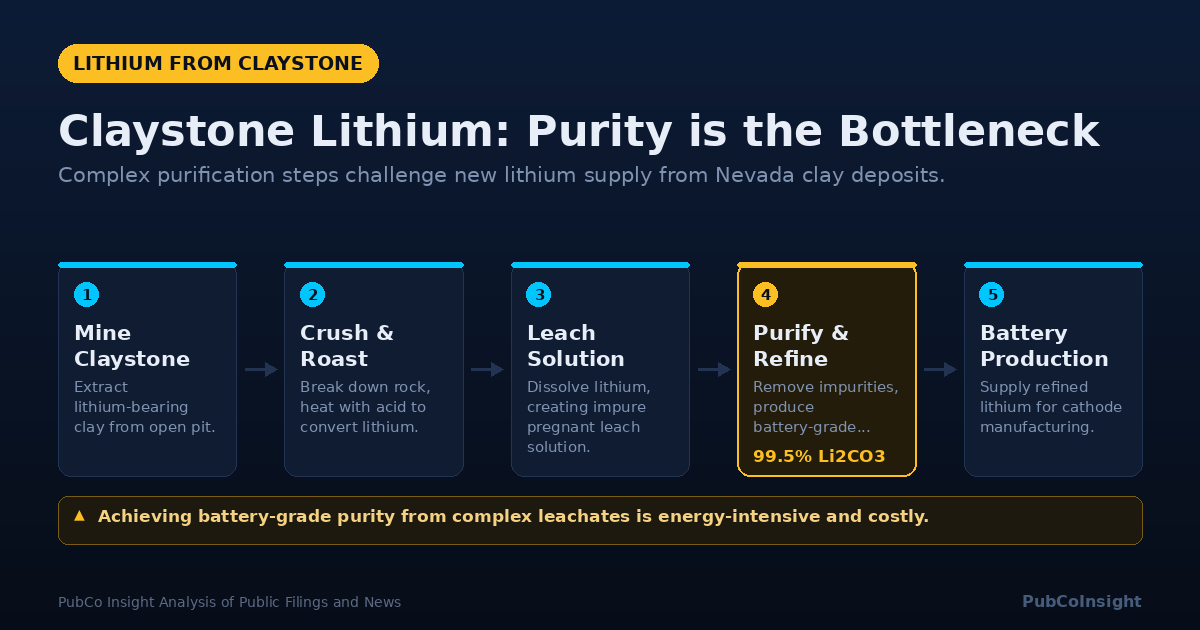
Lithium extraction from claystone, particularly from smectite-rich deposits, involves a different set of challenges than traditional hard rock or brine operations. Claystone deposits, like those found in Nevada, contain lithium bound within the mineral structure. To liberate this lithium, the rock must first be mined and crushed. The crucial step then involves a hydrometallurgical process. This often means roasting the crushed ore with an additive, typically sulfuric acid, at elevated temperatures to convert the lithium to a water-soluble form. After roasting, the material is leached with water, dissolving the lithium. The resulting pregnant leach solution, however, is not pure lithium. It contains a range of impurities, including magnesium, calcium, and iron, which must be removed through a series of purification steps, including precipitation, ion exchange, or solvent extraction. The final product is typically a lithium carbonate or lithium hydroxide, suitable for battery manufacturing. The bottleneck sits squarely in this purification stage. Achieving battery-grade purity from a complex clay leachate is expensive and energy-intensive, requiring precise control over chemical reactions and robust waste management. Failure here means a lower-value product, or no product at all.Companies Navigating Unconventional Lithium
Several companies are working to unlock lithium from sources beyond traditional brines and spodumene. Standard Lithium Ltd. (SLI) is focused on extracting lithium from brine resources in Arkansas, specifically from Smackover Formation brines, through direct lithium extraction (DLE) technologies. Their Franklin Project in Texas also involves a technical report for an economic study. Ioneer Ltd (IONR) is developing the Rhyolite Ridge project in Nevada, a unique lithium-boron deposit. This project aims to produce lithium carbonate and boric acid from an open-pit mine, leveraging a sulfuric acid leach process. Atlas Lithium Corporation (ATLX) holds lithium properties in Brazil, primarily targeting hard rock spodumene, a more conventional source, but their broader exploration strategy positions them within the expanding lithium landscape. American Battery Technology Company (ABAT) is pursuing a multi-pronged approach, including lithium-ion battery recycling and the development of a Nevada lithium resource, with an emphasis on closed-loop processes. NioCorp Developments Ltd. (NB) is developing a niobium, scandium, and titanium project in Nebraska, a different set of critical minerals, but one that highlights the broader push for domestic supply chains. Critical Metals Corp. (CRML) has recently been in the news regarding a European lithium deal and potential new share issuance, indicating their focus on expanding their portfolio of critical mineral assets. USA Rare Earth, Inc. (USAR) is advancing its Round Top heavy rare earth and critical minerals project in Texas, which also contains lithium, showcasing the multi-element potential of some deposits.American Lithium Minerals, Inc.
American Lithium Minerals, Inc. (AMLM) is an exploration stage company, pre-revenue, trading over the counter. The company's stated focus is lithium and boron properties in Nevada. AMLM was incorporated in Nevada on March 10, 2005. Its primary asset is the Sarcobatus Lithium property, which comprises 1,780 acres of mining claims in Central Nevada. The company's activities since 2009 have centered on lithium exploration at Sarcobatus. While AMLM has acquired and divested other prospects, including cobalt, nickel, graphite, and rare earth elements in Arizona and Illinois, its current project is the Nevada lithium property. The company's Regulation A offering, qualified by the SEC on February 4, 2026, covered up to 80,000,000 units, with an additional 120,000,000 shares issuable if warrants are exercised. Each unit included one share of common stock and one warrant to purchase 1.5 shares at $0.05, expiring December 31, 2028. The public record does not yet establish a measured or indicated resource for the Sarcobatus property. AMLM has stated an intention to expand its exploration and acquisition for mineral properties globally and is also exploring the use of Real World Asset Tokens to provide capital for mining. Its filings indicate a long-term vision to create an interoperable ecosystem for asset acquisition, tokenization, and trading, merging public markets with blockchain technology.What to watch
For Standard Lithium (SLI), watch for updates on the commercial scale-up of their DLE technology in Arkansas and any further technical reports for the Franklin Project in Texas. Ioneer (IONR) investors should monitor progress on permitting and financing for the Rhyolite Ridge project, particularly any announcements regarding offtake agreements or strategic partnerships that de-risk the capital expenditure. For companies like American Lithium Minerals (AMLM), the key watch item will be the publication of initial resource estimates or economic studies for the Sarcobatus property, which would provide a basis for evaluating the project's potential. Critical Metals (CRML) will likely see further news regarding the specifics of their European lithium acquisition and how any new share issuance impacts their capital structure. For USA Rare Earth (USAR), look for milestones at the Round Top project, including pilot plant results or definitive feasibility studies. Across the sector, watch for any shifts in government funding or policy support for domestic critical minerals processing, as this could significantly impact the economics of complex extraction projects., { "label": "Crush & Roast", "note": "Break down rock, heat with acid to convert lithium." }, { "label": "Leach Solution", "note": "Dissolve lithium, creating impure pregnant leach solution." }, { "label": "Purify & Refine", "note": "Remove impurities, produce battery-grade lithium compound.", "metric": "99.5% Li2CO3" }, { "label": "Battery Production", "note": "Supply refined lithium for cathode manufacturing." } ], "highlight": 3, "highlight_note": "Achieving battery-grade purity from complex leachates is energy-intensive and costly.", "footnote": "PubCo Insight Analysis of Public Filings and News" }Companies mentioned
| Ticker | Company | Price |
|---|---|---|
| ABAT | American Battery Technology Company | $1.415 |
| AMLM client | American Lithium Minerals, Inc. | $0.055 |
| ATLX | Atlas Lithium Corporation | $1.7 |
| CRML | Critical Metals Corp. | $7.16 |
| IONR | ioneer Ltd | $2.81 |
| NB | NioCorp Developments Ltd. | $3.34 |
| SLI | Standard Lithium Ltd. | $1.44 |
| USAR | USA Rare Earth, Inc. | $9.62 |
Listed alphabetically, not ranked. Prices as of 2026-11-02 and they move. Check a live quote before relying on any of this.
How we chose the companies in this article
We cover a fixed universe of companies working in lithium, boron and the critical minerals that feed battery and energy-storage supply chains. Every one of them that had usable market data on 2026-11-02 appears in this article. We do not pick which ones to mention based on what we think of them, and we do not order them by size, price or trading volume, because an ordered list is a verdict and that is not ours to hand down. Companies left out, and why: none. American Lithium Minerals and Artificial Intelligence Technology Solutions pay us, which is disclosed in full at the foot of every article they appear in.
See the dilution and promotion flags before you see the pitch.
Each week: the micro and small-caps now showing dilution or paid-promotion signals, with the SEC filing behind every flag. No recommendations, no price targets.
Sources used in this article
- 4 Critical Minerals Stocks That Could Benefit as the U.S. Reduces Reliance on China Motley Fool · 2026-11-01
- MP Materials Has Collapsed 60% From Its Highs. Here's Why I'm Not Buying (Yet). Motley Fool · 2026-11-01
- Lithium Americas And 2 Other Canadian Lithium Stocks To Watch Simply Wall St. · 2026-10-31
- 2 Industrial Stocks That Win Whether the AI Bubble Pops or Not Motley Fool · 2026-10-31
- Equinor (OB:EQNR) Ties Up Tight Reservoirs And Backs Big U.S. Lithium Find Simply Wall St. · 2026-10-31
- Albemarle (ALB) Q3 Earnings Preview: What You Should Know Beyond the Headline Estimates Zacks · 2026-10-30
- US Small Cap Value Portfolio ETF (DFSV) Adds Dick's and Cooper on Oct. 28 GuruFocus.com · 2026-10-30
- Critical Metals Sinks 11% as European Lithium Deal Nears New Share Issuance; USA Rare Earth Tumbles 10%, MP Materials Falls 6% 24/7 Wall St. · 2026-10-30
- Will Alpha Metallurgical (AMR) Report Negative Earnings Next Week? What You Should Know Zacks · 2026-10-30
- What iShares Russell 2000 Index Fund (IWM) Bought: Critical Metals Leads on Wednesday GuruFocus.com · 2026-10-30
- Elektros Inc. Examines Potential U.S. Lithium Opportunity ACCESS Newswire · 2026-10-29
- Albemarle (ALB) Dips More Than Broader Market: What You Should Know Zacks · 2026-10-29
Disclosure required by Section 17(b) of the Securities Act of 1933
American Lithium Minerals, Inc.. American Lithium Minerals, Inc. (issuer) paid Strategic Innovations First, Inc., an affiliate of PubCo Insight and Pulse IR. Compensation received: USD 11,550.00 total, three equal monthly installments of USD 3,850.00. Form of payment: cash only; no stock, options or warrants. Services: investor relations, marketing and content creation under Master Services Agreement dated June 22, 2026. Period: three month initial term, June 2026 through August 2026. No position, options or warrants held by PubCo Insight, Pulse IR, Strategic Innovations First, Inc., or Brad Listermann.
This is information, not investment, financial, legal or tax advice. It is not a recommendation or solicitation to buy, sell or hold any security and it contains no price target. Nothing here is independently verified by us. Confirm every figure against primary filings on SEC EDGAR before you act. Micro-cap and over-the-counter securities are speculative and illiquid and can lose all of their value. The companies named without a disclosure above pay us nothing and have no relationship with us; they are named because a published, mechanical screen selected them. Full disclosure policy.