Market Pulse: Cross-Border Resource & Tech Small-Caps
CROSS BORDER LIQUIDITY TRAPS: HOW CANADIAN AND AUSTRALIAN SMALL CAPS BRIDGE THE U.S. VALUATION GAP AS GOLD AND COPPER STALL
With gold facing its worst November in decades and copper on a thirteen week slide, resource issuers are weaponizing SEC reporting and AI discovery to capture U.S. retail order flow.
The traditional safety of the precious metals trade is fracturing as we head into the final weeks of 2026. Gold (GLD) is currently navigating its most aggressive November retreat since at least the year 2000, with some data points suggesting this is the sharpest monthly decline for the metal in nearly fifty years. The rapid exit of capital is staggering, evidenced by gold ETFs losing 2.2 billion dollars in a single week. This is not a slow leak: it is a full scale liquidation of the inflation hedge trade as investors pivot toward higher velocity assets. For the small cap and microcap universe, this macro rotation creates a brutal environment for companies that rely on commodity price momentum to sustain their share prices, yet it also creates a massive opportunity for those capable of bridging the valuation gap between foreign exchanges and U.S. liquidity.
While the big cap anchors like the Copper Miners ETF (COPX) endure a grueling thirteen week losing streak, the real story is happening in the plumbing of the market. Canadian and Australian issuers, long the backbone of the junior resource and energy sectors, are finding that a primary listing on the TSX or ASX is no longer enough to maintain a competitive cost of capital. As the SPY and gold fall in tandem, the traditional 60/40 portfolio is failing to provide its usual protection, forcing fund managers to hunt for idiosyncratic growth stories. These managers are increasingly looking at cross listed issuers that have done the hard work of SEC reporting to access the deeper pools of capital on the Nasdaq and NYSE.
The Market Transmission Mechanism: From Foreign Dirt to U.S. Desks
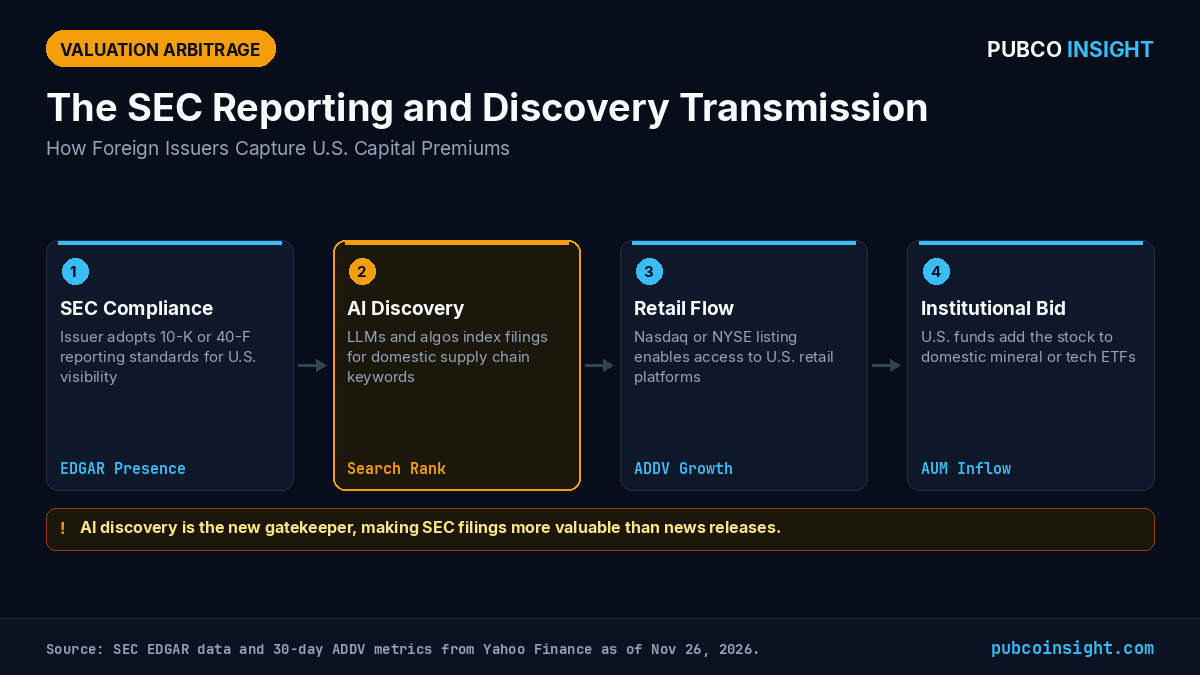
The transmission of macro news into the small cap ecosystem usually happens through the cost of capital. When gold prices crater, the ability of a junior miner to raise money on the TSX Venture exchange evaporates. However, the current cycle features a new variable: the AI search discovery layer. Institutional prop desks and retail platforms now use large language models to scan EDGAR filings for specific keywords related to domestic supply chains and high performance computing. A Canadian company that only files on SEDAR is effectively invisible to these automated discovery engines. By adopting full SEC reporting standards, foreign issuers move from being "untradeable" foreign entities to being "discoverable" domestic assets. This shift is critical because it changes the retail order flow profile. When a company like Perpetua Resources Corp. (PPTA) gains traction in Washington for its tungsten and antimony projects, the liquidity does not come from the local Canadian market. It comes from U.S. traders reacting to Department of Defense priorities and domestic mineral pushes. The transmission mechanism here is the regulatory bridge: the transition from a foreign private issuer status to a domestic filer. This allows the stock to be held in a wider range of U.S. based ETFs and mutual funds that are restricted from holding foreign listed securities. As the Copper Miners ETF (COPX) stalls, these specific domestic mineral stories become the primary beneficiaries of the remaining "hard asset" capital. Furthermore, the power bottleneck in the United States is acting as a secondary transmission line. We are seeing a massive convergence between traditional energy resource companies and the high performance computing (HPC) sector. The market is no longer valuing these companies solely on the spot price of their underlying commodity. Instead, they are being valued on their grid connections, their regulatory approvals, and their ability to provide the infrastructure required for the AI buildout. This is why a uranium driller or a bitcoin miner with a large power footprint can see its valuation decouple from the broader commodity slump.
The weekly Flags Watchlist: small-caps now showing dilution or promotion signals, each linked to the SEC filing behind the flag.
How the Small Cap and Microcap Cohort Positions Around This Trend
The current leader in this cross border liquidity capture is Hut 8 Corp. (HUT), which has seen its 30 day average daily dollar volume surge to 398.8 million dollars. While originally known as a bitcoin miner, Hut 8 Corp. (HUT) is aggressively repositioning as a player in the data center and HPC space. The company is currently navigating a massive 6.5 gigawatt ERCOT decision in Texas, which could redefine its revenue potential. Morgan Stanley recently noted that new chip export rules favor domestic data center developers like Hut 8 Corp. (HUT), giving them a competitive edge over international peers. This operational pivot, combined with a high volume Nasdaq listing, allows the company to trade at a premium that pure play miners on foreign exchanges simply cannot reach. In the energy sector, Uranium Energy Corp. (UEC) and Denison Mines Corp. (DNN) are demonstrating how to maintain liquidity even when the broader resource market is in retreat. Uranium Energy Corp. (UEC) maintains a robust 71.9 million dollar daily volume, benefiting from the volatility in big cap peers like Cameco. Meanwhile, Denison Mines Corp. (DNN), with a daily volume of 58.5 million dollars, is using its TSX and NYSE American dual listing to ensure that its recent drilling results reach the widest possible audience. For Denison Mines Corp. (DNN), the ability to report drilling milestones directly to the U.S. market is the difference between a muted reaction and a high volume trading event. These companies are not just mining uranium: they are mining U.S. institutional interest. The precious metals cohort is facing a more difficult path, but Endeavour Silver Corp. (EXK) and Avino Silver & Gold Mines Ltd. (ASM) are fighting the November gold slump by emphasizing their industrial utility. Endeavour Silver Corp. (EXK), with 56.9 million dollars in daily volume, and Avino Silver & Gold Mines Ltd. (ASM), with 17.3 million dollars, are both positioned to capture any rotation back into silver as an industrial component for the green energy transition. However, they remain heavily tethered to the broader silver price, which often mirrors the carnage seen in gold (GLD). Their challenge is to prove that their balance sheets can withstand a prolonged period of lower spot prices while maintaining their U.S. listing requirements. Perpetua Resources Corp. (PPTA) represents the most direct play on the "Washington push" for domestic minerals. With a 30 day average daily dollar volume of 32.8 million dollars, the company is leveraging its strategic importance to the U.S. military supply chain. Unlike a standard gold junior, Perpetua Resources Corp. (PPTA) is viewed through the lens of national security, which provides a valuation floor that is independent of the November gold selloff. Similarly, Bit Digital, Inc. (BTBT) is navigating the microcap space with 19.7 million dollars in daily volume. Like Hut 8, Bit Digital, Inc. (BTBT) is attempting to bridge the gap between crypto mining and AI compute, seeking to escape the "bitcoin proxy" label and achieve a more stable valuation based on recurring HPC revenue.What Active Traders and Desks Are Watching Next
The next 90 days will be a period of intense sorting as the market separates the truly funded issuers from those merely surviving on past momentum. Traders should focus on the following verifiable milestones:- ERCOT Batch Zero Decision (December 10): This decision will impact the 6.5 gigawatts of Texas data center load and will be a major catalyst for Hut 8 Corp. (HUT) and other power hungry issuers in the region.
- SEC Filing Deadlines for Foreign Private Issuers: Watch for companies transitioning from 40-F to 10-K filings, as this often signals an intent to court larger U.S. institutional investors and improve AI search discovery.
- Uranium Drilling Updates from the Athabasca Basin: Denison Mines Corp. (DNN) and other regional players are expected to release technical data that will test the market's appetite for long term energy plays amidst a short term commodity slump.
- Copper Approval Milestones: Keep a close eye on the stalled copper approvals mentioned in recent BHP news, as any movement here will directly impact the recovery potential for the Copper Miners ETF (COPX) and its small cap satellites.
- Antimony and Tungsten Policy Directives: Any further announcements from Washington regarding the domestic mineral push will serve as a primary driver for Perpetua Resources Corp. (PPTA) and its peers in the critical minerals space.
Companies mentioned
| Ticker | Company | Price |
|---|---|---|
| ASM | Avino Silver & Gold Mines Ltd. | $3.69 |
| BTBT | Bit Digital, Inc. | $0.481 |
| DNN | Denison Mines Corp. | $1.79 |
| EXK | Endeavour Silver Corp. | $6.14 |
| HUT | Hut 8 Corp. | $48.83 |
| PPTA | Perpetua Resources Corp. | $15.21 |
| UEC | Uranium Energy Corp. | $5.69 |
Listed alphabetically, not ranked. Prices as of 2026-11-26 and they move. Check a live quote before relying on any of this.
How we chose the companies in this article
Candidate pool of 10 small-cap, microcap, and OTC names in Market Pulse: Cross-Border Resource & Tech Small-Caps; ranked by 30-day average daily dollar volume (Yahoo Finance) as of 2026-11-26. All compensated IR clients are excluded from this editorial lane.
PubCo Insight
See the dilution and promotion flags before you see the pitch.
Each week: the micro and small-caps now showing dilution or paid-promotion signals, with the SEC filing behind every flag. No recommendations, no price targets.
Every flag links to its EDGAR filing so you can check it yourself. Sponsored coverage disclosed under SEC 17(b). One-click unsubscribe.
Sources used in this article
- Holding GLD For Stock Falls? Gold Missed This One Trefis · 2026-11-26
- Gold Is Having Its Worst November Since at Least 2000 24/7 Wall St. · 2026-11-25
- Gold Faces a Stunning November Not Seen in Nearly 50 Years GuruFocus.com · 2026-11-25
- Stocks or Gold? GDE Refuses to Choose: Every $100 Buys $90 of Each 24/7 Wall St. · 2026-11-25
- Gold ETFs Lose $2.2 Billion in a Week, Their Fastest Exit Since June BeInCrypto · 2026-11-25
- Copper Miners ETF Is on a 13-Week Losing Streak. When to Buy. Barrons.com · 2026-11-25
- Washington's Tungsten Push Opens A Less Obvious ETF Choice Simply Wall St. · 2026-11-25
- 5 Fastest Growing Mid Cap Stocks to Buy According to Hedge Funds Insider Monkey · 2026-11-25
- What Triggered The Move In Cameco Stock? Trefis · 2026-11-25
- Gold Is Down 35%—Is the Bull Case Broken or Just Bruised? MarketBeat · 2026-11-24
- Can Applied Digital Stock Double From Here? Trefis · 2026-11-24
- Why Is Applied Digital Stock Going Up? Trefis · 2026-11-24
PubCo Insight publishes research on small and micro-cap companies. Nothing here is investment advice, we make no buy or sell recommendations, and we publish no price targets. Small and micro-cap shares are speculative and illiquid and you can lose everything you put into them. Check every figure against primary filings on SEC EDGAR before you act on it.