Data Centers Drive Demand for Autonomous Security Robotics
The recent surge in orders for robotic security solutions within the data center sector highlights a critical shift in how these facilities manage physical safety and operational efficiency.
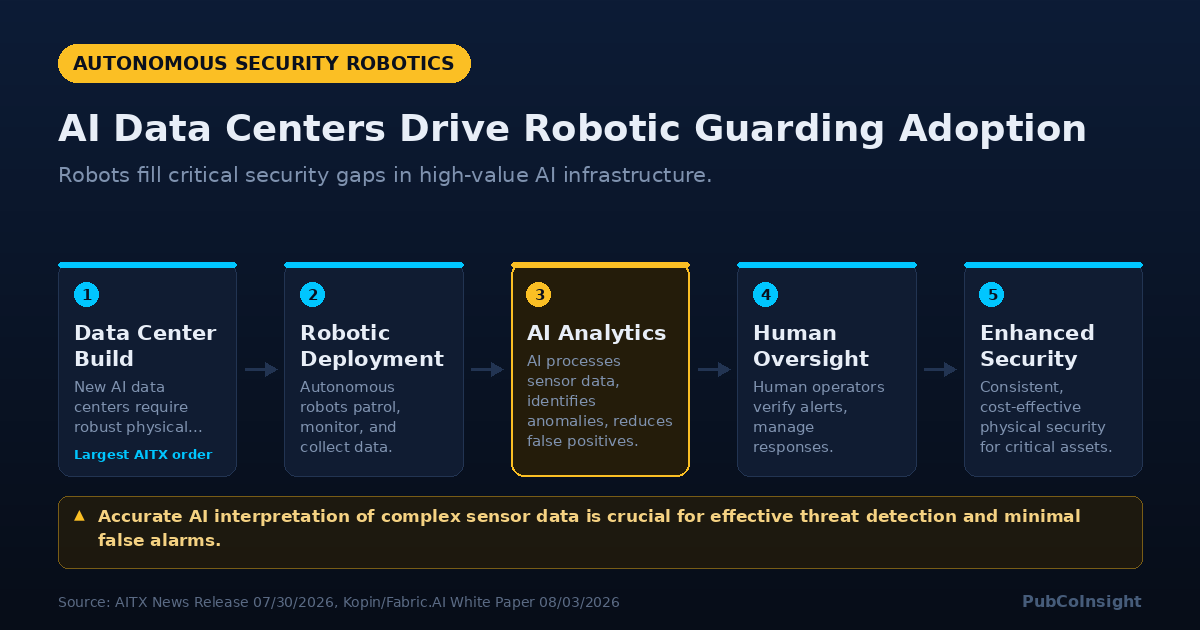
The Mechanism of Autonomous Security in Data Centers
The core mechanism driving autonomous security in data centers involves replacing or augmenting human patrols with robotic units equipped with a suite of sensors and AI-powered analytics. These robots conduct routine perimeter checks, monitor access points, and detect anomalies. The process begins with a defined patrol route, often mapped out in advance using CAD data of the facility. Robotic units, whether stationary or mobile, follow these routes, collecting visual, thermal, and audio data. This data feeds into a central AI platform. The AI analyzes real-time sensor inputs, comparing them against established baselines and threat models. For example, a thermal camera on a robot might detect an unusual heat signature from a server rack, or an acoustic sensor could pick up sounds of forced entry. The AI's ability to filter out false positives, like a passing animal versus a human intruder, is critical. This requires robust machine learning models trained on extensive datasets. The challenge lies in minimizing false alarms while ensuring no actual threats are missed. If an anomaly is detected, the system triggers an alert, often with a live video feed, to a human security operator for verification and response. The value sits in the AI's ability to interpret complex sensor data accurately and rapidly, reducing response times and operational costs. Without precise AI, the system becomes a source of constant, unmanageable alerts.Companies Operating in Autonomous Security
Several companies are carving out niches in this evolving sector, each with distinct approaches to physical AI and security robotics. Kopin Corporation (KOPN), with its recent white paper alongside Fabric.AI, focuses on advanced display and optical technologies. While not a direct security robotics provider, its MicroLED technology for optical interconnects is foundational for the next generation of high-speed, low-latency data centers. These data centers will, in turn, demand more sophisticated autonomous security, potentially benefiting companies building those solutions. Kopin's work on display technologies also finds application in augmented reality systems, which could integrate with robotic platforms for enhanced human-robot collaboration. In the realm of mobile robotics and drone technology, Red Cat Holdings, Inc. (RCAT) develops and markets drone solutions. While its primary focus has been on defense and public safety, the underlying drone autonomy and data capture capabilities have clear parallels with the needs of large-scale facility monitoring, including data centers. Unusual Machines, Inc. (UMAC) also operates in the drone space, with a focus on defense applications. Their experience in robust, autonomous flight and sensor integration could translate to specialized security roles where aerial surveillance complements ground-based robots. For companies focused on the physical security aspect, Lantronix, Inc. (LTRX) provides intelligent edge computing and connectivity solutions. Their hardware and software enable secure, reliable communication for IoT devices, including security cameras and sensors, which are integral to any autonomous security deployment. MicroVision, Inc. (MVIS) develops lidar technology for automotive safety, but lidar's precision mapping and object detection capabilities are directly applicable to autonomous navigation for security robots in complex environments. BigBear.ai Holdings, Inc. (BBAI) specializes in artificial intelligence and machine learning, offering predictive analytics and decision intelligence. While not building robots directly, BBAI's AI platforms could be leveraged by security robotics companies to enhance their threat detection, pattern recognition, and predictive maintenance capabilities, making autonomous systems more effective and proactive. Ondas Inc. (ONDS) operates through its Ondas Networks subsidiary, providing wireless connectivity solutions for critical infrastructure, including utilities and government entities. Reliable, secure wireless communication is a non-negotiable requirement for autonomous security robots that need to transmit high-bandwidth sensor data in real-time across large facilities. Ondas's expertise in private industrial networks ensures the backbone for these deployments. The recent addition of former Mossad Director David Barnea to Ondas's board on August 3 underscores the company's focus on national security applications, which often overlap with critical infrastructure protection. Serve Robotics Inc. (SERV) focuses on autonomous sidewalk delivery robots. While a different application, Serve's operational experience in deploying and managing autonomous fleets in urban environments, including navigation, obstacle avoidance, and remote monitoring, offers transferable knowledge for companies developing autonomous security patrols. Arbe Robotics Ltd. (ARBE) develops 4D imaging radar solutions, primarily for the automotive industry. This advanced radar technology provides high-resolution perception in all weather conditions, a critical capability for autonomous robots operating outdoors or in challenging industrial settings. On July 31, Arbe's Tier-1 Sensrad announced a collaboration with VirtuRail to strengthen tunnel safety with 4D imaging radar, showcasing the versatility of their technology beyond traditional automotive uses.Artificial Intelligence Technology Solutions, Inc.
Artificial Intelligence Technology Solutions, Inc. (AITX) trades on the OTCID tier under the symbol AITX. The company, through its subsidiaries, develops and leases AI-driven security robots and remote monitoring systems. This is primarily delivered through a recurring monthly subscription model. The company's operations are structured around three main pillars: stationary security devices (RAD-I), mobile autonomous platforms (RAD-M), and the SARA agentic artificial intelligence platform (RAD-G). RAD-I focuses on stationary units for the security and guarding services industry, which the company estimates as a $50 billion market in the United States. These solutions aim to provide significant cost savings, between 35% and 80%, compared to traditional manned security. The RAD-M division handles mobile autonomous platforms, including the ROAMEO mobile security unit, which began early commercial deployment in May 2026. The company views RAD-M as having a higher revenue ceiling than its stationary solutions. RAD-G is responsible for the SARA platform, which AITX intends to license, generating substantial revenue from this intellectual property. A wholly-owned subsidiary, RAD Lanka, located in Sri Lanka, supports software development, AI initiatives, and technical operations across the company's various divisions. The long-term vision, referred to internally as "RAD Town," involves integrated autonomous security deployments across entire campuses, communities, or jurisdictions. For the fiscal year ended February 28, 2026, AITX reported revenue of $7,745,336, a 26% increase over the prior fiscal year. Gross profit rose 48% to $5,533,700, with gross margin expanding to approximately 71% from 61%. Operating expenses remained largely flat at about $17,477,097, and the loss from operations improved by approximately $2.0 million to $(11,943,397). The company reported a net loss of approximately $14.5 million for the fiscal year and an accumulated deficit of approximately $171 million as of that date. The public record does not yet establish the specific financial terms or duration of the largest data center construction order received on July 30. Management does not anticipate having positive cash flow from operations in the near term. As of February 28, 2026, the company had negative cash flow from operating activities of $9,344,534 and negative working capital of $17,017,745. The company's independent registered public accounting firm included an explanatory paragraph in its report on consolidated financial statements, expressing substantial doubt about AITX's ability to continue as a going concern.What to watch
Investors should monitor the detailed financial disclosures regarding AITX's recent data center order, specifically the contract value and deployment timeline. The company's Q2 2026 financial results, due to be reported by August 14, will offer insight into the impact of its cost reduction plan announced on August 3. Watch for further developments from Kopin (KOPN) and Fabric.AI regarding their MicroLED optical interconnect technology, as advancements here could accelerate the build-out of next-generation AI data centers, increasing the addressable market for autonomous physical security. Also, pay attention to any new partnerships or pilot programs announced by Serve Robotics (SERV) that expand their autonomous fleet management expertise into new sectors beyond delivery, which could include security applications. Finally, look for filings from Ondas (ONDS) on August 13 regarding their Q2 2026 financial results, which may provide more details on their critical infrastructure deployments and any expansion into data center specific network solutions., { "label": "Robotic Deployment", "note": "Autonomous robots patrol, monitor, and collect data." }, { "label": "AI Analytics", "note": "AI processes sensor data, identifies anomalies, reduces false positives." }, { "label": "Human Oversight", "note": "Human operators verify alerts, manage responses." }, { "label": "Enhanced Security", "note": "Consistent, cost-effective physical security for critical assets." } ], "highlight": 2, "highlight_note": "Accurate AI interpretation of complex sensor data is crucial for effective threat detection and minimal false alarms.", "footnote": "Source: AITX News Release 07/30/2026, Kopin/Fabric.AI White Paper 08/03/2026" }Companies mentioned
| Ticker | Company | Price |
|---|---|---|
| AITX client | Artificial Intelligence Technology Solutions Inc | $0.0073 |
| ARBE | Arbe Robotics Ltd. | $0.729 |
| BBAI | BigBear.ai Holdings, Inc. | $3.15 |
| KOPN | Kopin Corporation | $4.15 |
| LTRX | Lantronix, Inc. | $6.1 |
| MVIS | MicroVision, Inc. | $3.66 |
| ONDS | Ondas Inc. | $8.86 |
| RCAT | Red Cat Holdings, Inc. | $8.86 |
| SERV | Serve Robotics Inc. | $5.69 |
| UMAC | Unusual Machines, Inc. | $26.67 |
Listed alphabetically, not ranked. Prices as of 2026-08-05 and they move. Check a live quote before relying on any of this.
How we chose the companies in this article
We cover a fixed universe of companies working in autonomous security robotics, physical AI and the guarding services market they are aimed at. Every one of them that had usable market data on 2026-08-05 appears in this article. We do not pick which ones to mention based on what we think of them, and we do not order them by size, price or trading volume, because an ordered list is a verdict and that is not ours to hand down. Companies left out, and why: none. American Lithium Minerals and Artificial Intelligence Technology Solutions pay us, which is disclosed in full at the foot of every article they appear in.
See the dilution and promotion flags before you see the pitch.
Each week: the micro and small-caps now showing dilution or paid-promotion signals, with the SEC filing behind every flag. No recommendations, no price targets.
Sources used in this article
- If a Stock Market Crash Is Coming, History Says the Smartest Investors Are Already Making This 1 Move Motley Fool · 2026-08-05
- Apple's Quarterly iPhone Sales Were Even Better Than They Seem Motley Fool · 2026-08-05
- SpaceX slides as AI spending worries overshadow early returns Reuters · 2026-08-05
- As 26-Year Stock Market Milestone Approaches, History Points to What Comes Next Motley Fool · 2026-08-05
- Andy Jassy Just Delivered Incredible News for Amazon Stock Investors Motley Fool · 2026-08-05
- Nvidia bankrolls its rivals Axios · 2026-08-05
- Opinion: The Greatest Fleecing of Retail Investors in Wall Street's Storied History Begins Tomorrow, Aug. 6 Motley Fool · 2026-08-05
- Trading in Pre-IPO Companies Is Taking Off in Popularity. Here's Why That's Bullish for Crypto. Motley Fool · 2026-08-05
- Alphabet Stock Could Soar as It Targets the $300 Billion AI Chip Market Dominated by Nvidia Motley Fool · 2026-08-05
- Can Dogecoin Reach $1 in the Second Half of 2026? The Answer Might Shock You. Motley Fool · 2026-08-05
- Axon Stock Diversifies Your Portfolio Less Than Its Business Does Trefis · 2026-08-04
- Is It Worth Investing in Axon (AXON) Based on Wall Street's Bullish Views? Zacks · 2026-08-04
Disclosure required by Section 17(b) of the Securities Act of 1933
Artificial Intelligence Technology Solutions, Inc., a Nevada corporation (OTCID: AITX). Artificial Intelligence Technology Solutions, Inc. pays Strategic Innovations First, Inc., a Wyoming corporation doing business as PulseIR. Compensation received: USD 5,000.00 per month for months 1-3 (August, September, October 2026); USD 10,000.00 per month for months 4-6 (November, December 2026, January 2027) contingent on the 90-day review. Minimum committed USD 15,000.00; USD 45,000.00 if the second-period rate triggers.. Form of payment: cash only, invoiced monthly in advance; no stock, options or warrants received or payable. Services: investor relations services under an Investor Relations Services Agreement effective 2026-08-01. Period: six month term, 2026-08-01 through 2027-01-31; 90-day review on or about 2026-10-30. No stock, options or warrants held by PubCo Insight, Pulse IR, Strategic Innovations First, Inc., or Brad Listermann. Confirmed by the executed agreement and by board record recKwdq39X2caPSX7 (POSITIONS HELD: none).
This is information, not investment, financial, legal or tax advice. It is not a recommendation or solicitation to buy, sell or hold any security and it contains no price target. Nothing here is independently verified by us. Confirm every figure against primary filings on SEC EDGAR before you act. Micro-cap and over-the-counter securities are speculative and illiquid and can lose all of their value. The companies named without a disclosure above pay us nothing and have no relationship with us; they are named because a published, mechanical screen selected them. Full disclosure policy.