Pentagon's Autonomous Warfare Command Drives Demand for AI Security Robotics
The Pentagon's new Autonomous Warfare Command, announced October 1, 2026, signals a strategic shift towards AI-driven defense, impacting companies developing autonomous security and counter-drone technologies.
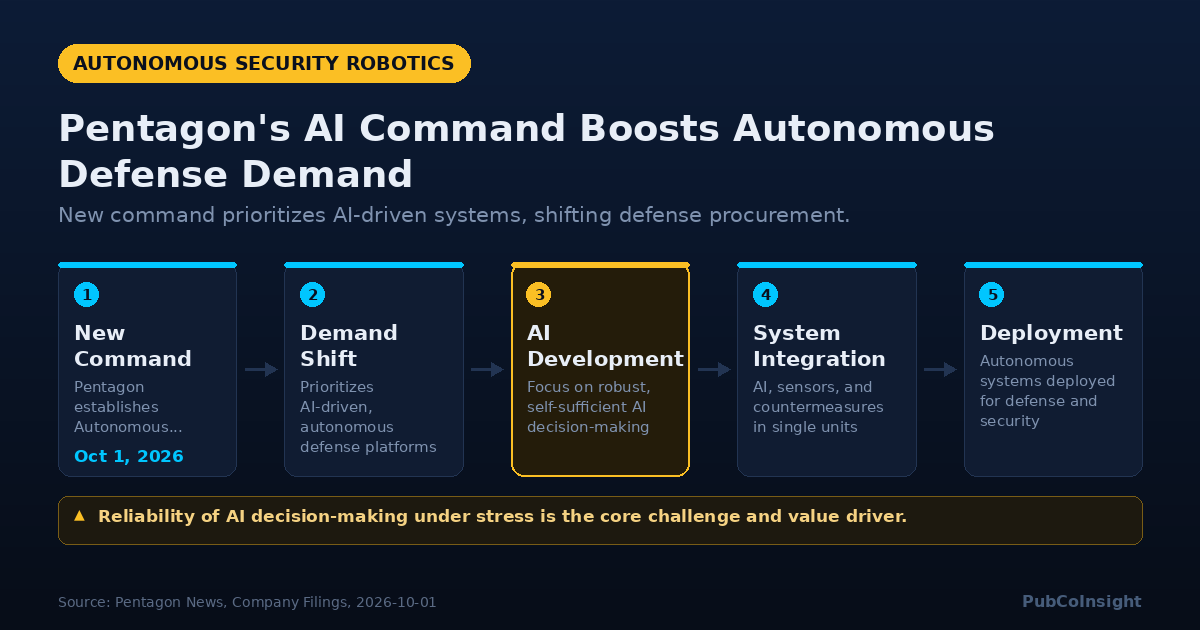
The Mechanism of Autonomous Defense Integration
The shift towards an Autonomous Warfare Command fundamentally alters the procurement landscape for defense contractors. Historically, defense acquisition focused on human-operated platforms, with automation as an enhancement. The new command flips this, prioritizing systems designed for autonomous operation from the ground up, with human oversight as the interface. This means a move away from simply adding AI to existing hardware. Instead, the focus shifts to robust, self-sufficient AI agents capable of complex decision-making in dynamic environments, often in swarms or coordinated networks. Consider a counter-drone system. Traditional systems rely on human operators to detect, classify, and then engage threats. An autonomous system, by contrast, integrates advanced sensors, AI-powered threat recognition, and non-kinetic defeat mechanisms into a single, self-operating unit. The AI must process vast amounts of real-time data from radar, electro-optical, and acoustic sensors, distinguish between benign and hostile targets, and then activate countermeasures like RF jamming or spoofing, all without direct human input for every step. The critical bottleneck here is the reliability and adaptability of the AI's decision-making algorithms under stress, particularly in contested electromagnetic environments. If the AI cannot reliably differentiate a drone from a bird, or if it can be easily spoofed, the entire system fails. The value sits in the sophistication of the AI's perception and decision stack, not just the hardware it runs on. This demands significant investment in machine learning models trained on diverse datasets, robust sensor fusion, and secure, resilient communication protocols.Companies Operating in Autonomous Security and Counter-Drone
Several companies are already positioned within this evolving defense and security landscape, each bringing distinct capabilities. Ondas Inc. (ONDS), for example, recently launched its Dronebuster REACH, a long-range non-kinetic counter-UAS system. This expansion of their counter-drone portfolio directly addresses the need for extended-range threat neutralization, a key requirement for protecting larger areas or high-value assets. Ondas' focus on non-kinetic solutions, which disrupt rather than destroy, aligns with tactical flexibility. Red Cat Holdings, Inc. (RCAT) operates in the drone and drone-related technology space, including commercial and defense applications. Their work often involves specialized drones and software for intelligence, surveillance, and reconnaissance (ISR). The Pentagon's new command will likely drive demand for more advanced, AI-enabled ISR platforms capable of autonomous mission execution and data analysis. Unusual Machines, Inc. (UMAC), despite a recent tumble, remains active in the counter-drone sector. Their focus on defense-oriented counter-drone expansion, alongside a strategic stake in Draganfly, points to an interest in both offensive and defensive autonomous aerial capabilities. The recent Powerus merger and Nasdaq listing as PUSA indicate a drive for broader market access and capital. Fortem Technologies, a counter-drone firm, also closed a $50 million Series B financing led by Lockheed Martin, highlighting significant investor interest in this specific segment. Beyond counter-drone, the broader autonomous security market includes companies like Lantronix, Inc. (LTRX), which provides intelligent edge computing and connectivity solutions critical for autonomous systems to operate and communicate securely. Their technology underpins the data flow necessary for AI-driven decision-making in remote or distributed robotic deployments. Kopin Corporation (KOPN) develops microdisplays and optical solutions, often for augmented reality (AR) and virtual reality (VR) systems. While not directly autonomous robotics, their technology can be crucial for human-machine interfaces, allowing operators to monitor and interact with autonomous systems effectively, particularly in command and control centers for new warfare paradigms. Arbe Robotics Ltd. (ARBE) focuses on high-resolution 4D imaging radar solutions. This technology is vital for autonomous vehicles and robotics, providing precise environmental sensing that complements optical and LiDAR systems. Accurate, all-weather perception is a foundational requirement for any truly autonomous platform, especially in complex defense scenarios. Arbe recently closed a $15 million registered direct offering, indicating capital deployment towards its radar technology. BigBear.ai Holdings, Inc. (BBAI) provides AI-powered analytics and decision intelligence solutions, often for government and defense clients. Their software capabilities are directly relevant to the "brain" of autonomous warfare, enabling predictive analysis and optimizing operational strategies for AI-driven fleets. MicroVision, Inc. (MVIS) develops LiDAR technology for automotive safety and autonomous driving. While primarily commercial, the precision sensing capabilities of LiDAR are increasingly being integrated into defense robotics for navigation, obstacle avoidance, and mapping in complex terrains. Finally, Serve Robotics Inc. (SERV), while focused on last-mile delivery robotics, demonstrates the broader commercial viability and development of autonomous mobile platforms. The underlying navigation, perception, and AI control systems developed for commercial applications often find parallel utility or inspiration in defense contexts, albeit with different performance requirements. Serve Robotics recently cut its 2026 revenue outlook, but continues to target a large market.Artificial Intelligence Technology Solutions, Inc.
Artificial Intelligence Technology Solutions, Inc. (AITX) operates through several subsidiaries, focusing on AI-driven security and productivity solutions for enterprise clients. The company trades over the counter under the ticker AITX. Its core business model centers on a "Solutions-as-a-Service" approach, leasing autonomous security robots and remote monitoring systems via recurring monthly subscriptions. This contrasts with a one-time hardware sale model. AITX's operations are structured around three primary pillars. The first, Robotic Assistance Devices, Inc. (RAD-I), markets stationary security devices to the security and guarding services industry. The company estimates this market to be approximately $50 billion in the United States. AITX states its solutions aim to deliver cost savings between 35% and 80% compared to traditional manned security. The second pillar, Robotic Assistance Devices Mobile (RAD-M), focuses on mobile autonomous platforms, including the ROAMEO mobile security unit. Early commercial deployment of ROAMEO began in May 2026. The company characterizes RAD-M as having a higher revenue ceiling than its stationary solutions. The third pillar, Robotic Assistance Devices Group (RAD-G), is dedicated to the SARA agentic artificial intelligence platform, which AITX intends to license for substantial revenue. A wholly-owned subsidiary, RAD Lanka, located in Sri Lanka and operating under Port City Colombo status, supports software development, AI initiatives, and technical operations across the company's subsidiaries. AITX refers to the long-term outcome of this integrated strategy as "RAD Town," envisioning autonomous-security deployments across campuses or communities. For the fiscal year ended February 28, 2026, AITX reported revenue of $7,745,336, a 26% increase over the prior year. Gross profit rose 48% to $5,533,700, with gross margin expanding to approximately 71% from 61%. Operating expenses remained flat at around $17,477,097, and the loss from operations improved by approximately $2.0 million to $(11,943,397). The company reported a net loss of approximately $14.5 million for the fiscal year ended February 28, 2026, with an accumulated deficit of approximately $171 million as of that date. The independent registered public accounting firm included an explanatory paragraph in its report expressing substantial doubt about AITX's ability to continue as a going concern. For the year ended February 28, 2026, the company had negative cash flow from operating activities of $9,344,534. As of February 28, 2026, AITX had an accumulated deficit of $171,121,742 and negative working capital of $17,017,745. The public record does not yet establish sustained positive cash flow from operations. The company recently received an additional RIO 360 order from a healthcare client on September 30, 2026, and updated hardware pricing to reflect rising materials, compute, and transportation costs on September 24, 2026.What to watch
Investors should monitor several concrete developments. The Pentagon's new Autonomous Warfare Command will issue specific procurement tenders and contracts, which will be publicly announced. Watch for the first major contract awards under this new command structure, particularly those specifying AI-driven autonomous systems. These will provide insight into the specific capabilities being prioritized. For Ondas (ONDS), watch for further deployments or contract wins related to their Dronebuster REACH system. Specific customer announcements or sales figures would be key. For Unusual Machines (UMAC), observe any new partnerships or product launches stemming from their defense-focused counter-drone expansion or their Draganfly stake. Any further details on the integration of Powerus Corporation's operations following the Nasdaq listing as PUSA will also be relevant. On the regulatory front, watch for any new guidelines or standards from the Department of Defense regarding the ethical use and operational parameters of autonomous weapons systems. These guidelines could impact product development cycles and market access for companies in the sector. Finally, for Artificial Intelligence Technology Solutions (AITX), look for updates on the commercial deployment of their ROAMEO mobile security units and any licensing agreements for the SARA AI platform. Specific figures on subscription growth and cash flow improvement will be critical to track in their upcoming filings., { "label": "Demand Shift", "note": "Prioritizes AI-driven, autonomous defense platforms" }, { "label": "AI Development", "note": "Focus on robust, self-sufficient AI decision-making" }, { "label": "System Integration", "note": "AI, sensors, and countermeasures in single units" }, { "label": "Deployment", "note": "Autonomous systems deployed for defense and security" } ], "highlight": 2, "highlight_note": "Reliability of AI decision-making under stress is the core challenge and value driver.", "footnote": "Source: Pentagon News, Company Filings, 2026-10-01" }Companies mentioned
| Ticker | Company | Price |
|---|---|---|
| AITX client | Artificial Intelligence Technology Solutions Inc | $0.0027 |
| ARBE | Arbe Robotics Ltd. | $0.592 |
| BBAI | BigBear.ai Holdings, Inc. | $2.74 |
| KOPN | Kopin Corporation | $4.61 |
| LTRX | Lantronix, Inc. | $7.06 |
| MVIS | MicroVision, Inc. | $1.5 |
| ONDS | Ondas Inc. | $7.12 |
| RCAT | Red Cat Holdings, Inc. | $6.33 |
| SERV | Serve Robotics Inc. | $4.75 |
| UMAC | Unusual Machines, Inc. | $21.78 |
Listed alphabetically, not ranked. Prices as of 2026-10-02 and they move. Check a live quote before relying on any of this.
How we chose the companies in this article
We cover a fixed universe of companies working in autonomous security robotics, physical AI and the guarding services market they are aimed at. Every one of them that had usable market data on 2026-10-02 appears in this article. We do not pick which ones to mention based on what we think of them, and we do not order them by size, price or trading volume, because an ordered list is a verdict and that is not ours to hand down. Companies left out, and why: none. American Lithium Minerals and Artificial Intelligence Technology Solutions pay us, which is disclosed in full at the foot of every article they appear in.
See the dilution and promotion flags before you see the pitch.
Each week: the micro and small-caps now showing dilution or paid-promotion signals, with the SEC filing behind every flag. No recommendations, no price targets.
Sources used in this article
- How to Earn $272 a Month From Realty Income (O) Stock (That's $3,264 Per Year) Motley Fool · 2026-10-02
- Analog Chips Are the Silent Winners of the AI Trade. These 3 Growth Stocks Are Capitalizing on the Opportunity. Motley Fool · 2026-10-02
- Here's Why I'm Buying Chainlink (LINK) Right Now Motley Fool · 2026-10-02
- Peter Lynch Averaged a 29.2% Annual Return Running Fidelity's Magellan Fund From 1977 to 1990. Here's What Made That Track Record Nearly Impossible to Repeat. Motley Fool · 2026-10-02
- Nvidia and Musk's robotic big bets will test Anthropic's latest projections Yahoo Finance · 2026-10-02
- What Could Send NVIDIA Stock Higher? Trefis · 2026-10-02
- One Reason Intel Stock Looks Better Than Its Price Trefis · 2026-10-02
- PayPal Is 83% Below Its High. Here's What Would Send the Stock Back There. Motley Fool · 2026-10-02
- Stocktwits Space Race Weekly: SPCX Holds Pole Position As ASTS, RKLB, PL, RDW, FLY Lose Altitude Stocktwits · 2026-10-02
- Micron is about to do something that would surprise most Magnificent 7 investors Yahoo Finance · 2026-10-02
- The Nasdaq Rose 1.9% in September. Intel Exploded 34% GuruFocus.com · 2026-10-01
- Unusual Machines Tumbles 8% Despite Pentagon’s Autonomous Warfare Push; AeroVironment Eases, Red Cat Pulls Back 24/7 Wall St. · 2026-10-01
Disclosure required by Section 17(b) of the Securities Act of 1933
Artificial Intelligence Technology Solutions, Inc., a Nevada corporation (OTCID: AITX). Artificial Intelligence Technology Solutions, Inc. pays Strategic Innovations First, Inc., a Wyoming corporation doing business as PulseIR. Compensation received: USD 5,000.00 per month for months 1-3 (August, September, October 2026); USD 10,000.00 per month for months 4-6 (November, December 2026, January 2027) contingent on the 90-day review. Minimum committed USD 15,000.00; USD 45,000.00 if the second-period rate triggers.. Form of payment: cash only, invoiced monthly in advance; no stock, options or warrants received or payable. Services: investor relations services under an Investor Relations Services Agreement effective 2026-08-01. Period: six month term, 2026-08-01 through 2027-01-31; 90-day review on or about 2026-10-30. No stock, options or warrants held by PubCo Insight, Pulse IR, Strategic Innovations First, Inc., or Brad Listermann. Confirmed by the executed agreement and by board record recKwdq39X2caPSX7 (POSITIONS HELD: none).
This is information, not investment, financial, legal or tax advice. It is not a recommendation or solicitation to buy, sell or hold any security and it contains no price target. Nothing here is independently verified by us. Confirm every figure against primary filings on SEC EDGAR before you act. Micro-cap and over-the-counter securities are speculative and illiquid and can lose all of their value. The companies named without a disclosure above pay us nothing and have no relationship with us; they are named because a published, mechanical screen selected them. Full disclosure policy.