Ondas Defense Expansion Signals Shift in Autonomous Security Market
Ondas' recent $50 million U.S. Army order for lethal unmanned systems and the appointment of a former Mossad chief highlight a growing convergence between defense technology and commercial autonomous security, pushing the sector into new operational and strategic territory.
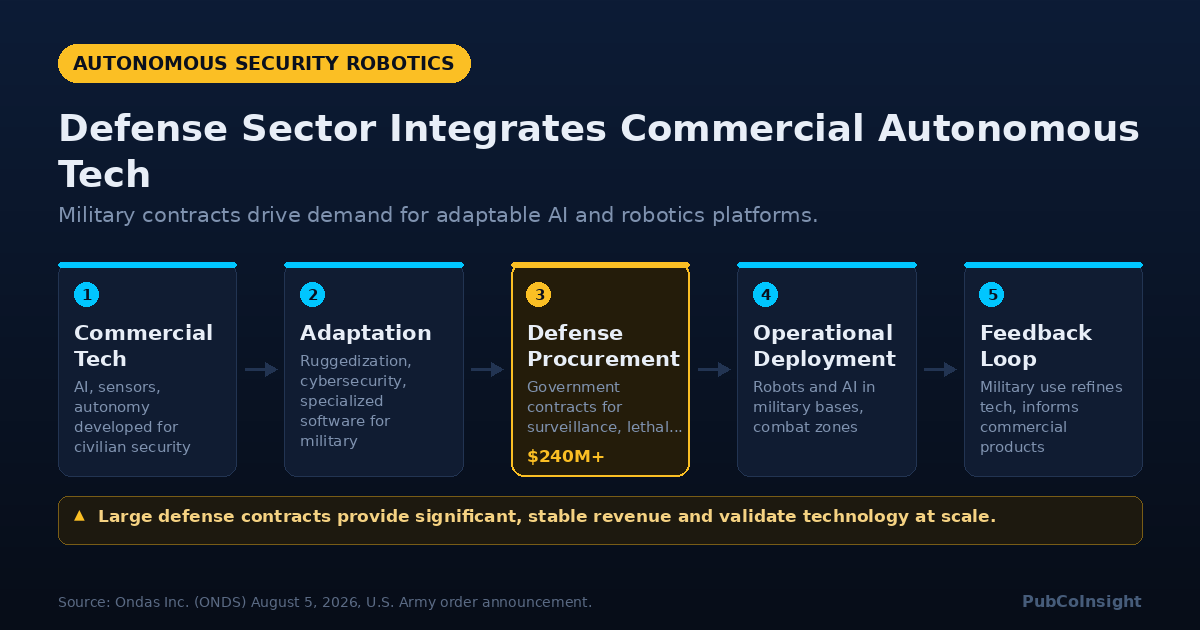
The Mechanism of Crossover Value
The core value proposition for autonomous security robotics in commercial settings centers on cost reduction and enhanced vigilance. Robots do not tire, they follow protocols precisely, and they can operate in hazardous environments. These same attributes translate directly to defense applications. A fixed-position autonomous security unit, for instance, can monitor a remote military installation with greater consistency and lower human risk than a manned guard post. Mobile platforms, whether ground-based or aerial, offer persistent surveillance capabilities that can augment or replace human patrols in contested zones. The crossover hinges on several key technological pillars. First, advanced sensor suites, including thermal imaging, lidar, and high-resolution optical cameras, provide comprehensive situational awareness. These sensors, initially developed for industrial or commercial security, offer crucial data for military intelligence and target identification. Second, AI and machine learning algorithms are central. They process vast amounts of sensor data, identify threats, classify objects, and predict behaviors, reducing the cognitive load on human operators. This is particularly vital in defense, where rapid decision-making under stress is paramount. Third, robust communication protocols and secure data links are essential for both commercial and military deployments, ensuring reliable control and data integrity. Finally, the modularity of many autonomous platforms allows for rapid adaptation. A commercial chassis designed for patrolling a warehouse can, with different sensor packages and software, become a reconnaissance unit for a forward operating base. The distinction between "security" and "defense" blurs when the underlying technology is about persistent, intelligent monitoring and response. The challenge lies in meeting military-grade specifications for ruggedness, cybersecurity, and operational reliability in extreme conditions.Companies Operating in This Space
Several companies in the small and micro-cap autonomous security robotics sector are navigating this evolving landscape, some with direct defense ties and others focused on adjacent commercial applications that could eventually cross over. Ondas (ONDS), with its Mistral Inc. subsidiary, is now a prominent example of this defense pivot. The company's recent U.S. Army orders for lethal unmanned systems, totaling over $240 million, clearly position it as a supplier to the military. The appointment of David Barnea, a former Mossad chief, to lead Ondas' defense expansion underscores a serious commitment to this market. Ondas Systems, the company's other primary business, focuses on mission-critical wireless networks for industrial and government applications, providing a complementary technology base. Ondas stock trades at $8.87. Other companies focus on the foundational technologies that enable both commercial and defense applications. Arbe Robotics Ltd. (ARBE), trading at $0.706, develops high-resolution 4D imaging radar solutions. This technology, critical for autonomous vehicle navigation and collision avoidance in commercial settings, also has clear applications in military surveillance and target tracking, offering superior performance in adverse weather conditions compared to optical sensors. Similarly, MicroVision, Inc. (MVIS), at $3.18, focuses on lidar technology. While primarily targeting automotive ADAS and industrial applications, its high-resolution 3D sensing capabilities are valuable for military mapping, navigation in complex terrain, and perimeter security where precise environmental understanding is necessary. Kopin Corporation (KOPN), priced at $3.95, develops micro-displays and optical modules, components essential for augmented and virtual reality systems. These systems are increasingly used in military training, heads-up displays for pilots, and advanced soldier systems, offering a pathway for defense integration. On the AI and data analytics side, BigBear.ai Holdings, Inc. (BBAI), trading at $3.03, provides AI-powered analytics and data solutions, with a significant portion of its business already tied to government and defense contracts. Their predictive analytics can optimize logistics, enhance intelligence gathering, and support strategic decision-making, making them a direct player in the defense AI ecosystem. Companies like Lantronix, Inc. (LTRX), at $5.89, provide secure data access and management solutions for the Internet of Things (IoT) and IT infrastructure. Their embedded and external networking solutions are crucial for connecting and securing autonomous devices, whether in a commercial factory or a military network. In the drone and unmanned systems space, Red Cat Holdings, Inc. (RCAT), priced at $8.66, develops and markets drone technology, including consumer and enterprise drones, and software. While their focus has been on commercial and recreational markets, the underlying drone platforms and flight control systems are adaptable for military reconnaissance, surveillance, and even light payload delivery, especially for smaller, tactical operations. Unusual Machines, Inc. (UMAC), at $25.73, is another player focusing on unmanned systems. Their specific applications and market focus will dictate their potential for defense crossover, but the general trend favors modularity and adaptability in these platforms. Finally, Serve Robotics Inc. (SERV), trading at $5.66, specializes in sidewalk delivery robots. While seemingly far removed from defense, their expertise in urban autonomous navigation, obstacle avoidance, and last-mile logistics could find niche applications in military supply chains or base operations, particularly in non-combat support roles.Artificial Intelligence Technology Solutions, Inc.
Artificial Intelligence Technology Solutions, Inc. (AITX) operates on the OTCID tier at $0.007, focusing on AI-driven security and productivity solutions through its subsidiaries. The company structures its offerings as a "Solutions-as-a-Service" model, providing autonomous security robots and remote monitoring systems on a recurring monthly subscription basis. This model aims to deliver cost savings between 35% and 80% compared to traditional manned security, targeting an estimated $50 billion U.S. guarding services market. AITX's operations are organized around three principal pillars. Robotic Assistance Devices, Inc. (RAD-I) handles stationary security devices. Robotic Assistance Devices Mobile (RAD-M) develops mobile autonomous platforms, with early commercial deployments of its ROAMEO mobile security unit beginning in May 2026. Robotic Assistance Devices Group (RAD-G) focuses on the SARA agentic artificial intelligence platform. The company also maintains RAD Lanka, a wholly owned subsidiary in Sri Lanka operating under Port City Colombo status, which supports software development, AI initiatives, and technical operations across the company's various units. The long-term vision, referred to internally as "RAD Town," envisages integrated autonomous security deployments across large campuses, communities, or jurisdictions. For the fiscal year ended February 28, 2026, AITX reported revenue of $7,745,336, a 26% increase over the prior year. Gross profit rose 48% to $5,533,700, with gross margin expanding to approximately 71% from 61%. Operating expenses remained largely flat at $17,477,097, leading to an improved loss from operations of $(11,943,397). The company reported a net loss of approximately $14.5 million for the fiscal year, with an accumulated deficit of approximately $171 million as of that date. Cash flow from operating activities was negative $9,344,534 for the year. The public record does not yet establish the specific number of active subscriptions or units deployed for RAD-I or RAD-M, making it difficult to precisely track the growth of their recurring revenue base. Management has stated that RAD-I's recurring revenue and gross margin could, on a standalone basis, support positive cash flow operations, and anticipates RAD-M will eventually surpass RAD-I's monthly recurring revenue contribution. They project subscription gross margin to exceed 75% and outright-sale gross margin to exceed 50%, based on current costs and market-accepted pricing. The company's recent filings include an 8-K on August 5, 2026, and a July 16, 2026 S-1 filing detailing its business and financial condition.What to watch
The defense sector's increasing interest in autonomous systems points to several key areas for observation. Watch for further U.S. Army or other government contract awards to Ondas' Mistral subsidiary. These announcements will confirm the depth of the defense market penetration. Monitor the integration of David Barnea into Ondas' defense strategy; specific project announcements or new partnerships will indicate the direction and pace of this expansion. For companies providing core technologies like radar, lidar, and AI, look for any new certifications, partnerships, or contract wins that explicitly mention defense or government applications, even if they originate from commercial product lines. Specifically, watch for any announcements from Arbe Robotics or MicroVision regarding military-grade product development or testing. Also, keep an eye on federal budget allocations for autonomous systems and AI in defense, as these will directly impact the funding available for new projects and procurements., { "label": "Adaptation", "note": "Ruggedization, cybersecurity, specialized software for military" }, { "label": "Defense Procurement", "note": "Government contracts for surveillance, lethal systems", "metric": "$240M+" }, { "label": "Operational Deployment", "note": "Robots and AI in military bases, combat zones" }, { "label": "Feedback Loop", "note": "Military use refines tech, informs commercial products" } ], "highlight": 2, "highlight_note": "Large defense contracts provide significant, stable revenue and validate technology at scale.", "footnote": "Source: Ondas Inc. (ONDS) August 5, 2026, U.S. Army order announcement." }Companies mentioned
| Ticker | Company | Price |
|---|---|---|
| AITX client | Artificial Intelligence Technology Solutions Inc | $0.007 |
| ARBE | Arbe Robotics Ltd. | $0.706 |
| BBAI | BigBear.ai Holdings, Inc. | $3.03 |
| KOPN | Kopin Corporation | $3.95 |
| LTRX | Lantronix, Inc. | $5.89 |
| MVIS | MicroVision, Inc. | $3.18 |
| ONDS | Ondas Inc. | $8.87 |
| RCAT | Red Cat Holdings, Inc. | $8.66 |
| SERV | Serve Robotics Inc. | $5.66 |
| UMAC | Unusual Machines, Inc. | $25.73 |
Listed alphabetically, not ranked. Prices as of 2026-08-06 and they move. Check a live quote before relying on any of this.
How we chose the companies in this article
We cover a fixed universe of companies working in autonomous security robotics, physical AI and the guarding services market they are aimed at. Every one of them that had usable market data on 2026-08-06 appears in this article. We do not pick which ones to mention based on what we think of them, and we do not order them by size, price or trading volume, because an ordered list is a verdict and that is not ours to hand down. Companies left out, and why: none. American Lithium Minerals and Artificial Intelligence Technology Solutions pay us, which is disclosed in full at the foot of every article they appear in.
See the dilution and promotion flags before you see the pitch.
Each week: the micro and small-caps now showing dilution or paid-promotion signals, with the SEC filing behind every flag. No recommendations, no price targets.
Sources used in this article
- Axon Just Delivered a Huge Beat-and-Raise. So Why Is the Stock Down? Motley Fool · 2026-08-06
- Where Will SpaceX Stock Be in 1 Year? Motley Fool · 2026-08-06
- Talen Energy Q2 Earnings Call Highlights MarketBeat · 2026-08-06
- Billionaire Bill Ackman Built a $2.1 Billion Stake in Microsoft After the Stock Slid. Is It Still a Buy? Motley Fool · 2026-08-06
- Analysis-Samsung, SK Hynix shareholders call for bigger payouts from AI cash mountain Reuters · 2026-08-06
- Marvell Is Positioned to Absorb a Disproportionate Amount of This AI Capex Surge, So I Keep Buying 24/7 Wall St. · 2026-08-06
- One Massive AI Hardware Truth Keeps Me Loading Up On AMAT Ahead of Aug. 13 Earnings Print 24/7 Wall St. · 2026-08-06
- AI Electricity Demand: GE Vernova and Eaton Will Capture This Next Wave of Capex 24/7 Wall St. · 2026-08-06
- How Vertiv is Becoming a Pure Play Digital Version of Schneider Electric for an AI-First World 24/7 Wall St. · 2026-08-06
- Who Will Benefit Most From Amazon and Microsoft’s Hyperscaler Leading AI Capex This Quarter? 24/7 Wall St. · 2026-08-06
- ATN International (ATNI) Reports Q2 Loss, Tops Revenue Estimates Zacks · 2026-08-06
- Axon Enterprise Q2 Earnings Call Highlights MarketBeat · 2026-08-05
Disclosure required by Section 17(b) of the Securities Act of 1933
Artificial Intelligence Technology Solutions, Inc., a Nevada corporation (OTCID: AITX). Artificial Intelligence Technology Solutions, Inc. pays Strategic Innovations First, Inc., a Wyoming corporation doing business as PulseIR. Compensation received: USD 5,000.00 per month for months 1-3 (August, September, October 2026); USD 10,000.00 per month for months 4-6 (November, December 2026, January 2027) contingent on the 90-day review. Minimum committed USD 15,000.00; USD 45,000.00 if the second-period rate triggers.. Form of payment: cash only, invoiced monthly in advance; no stock, options or warrants received or payable. Services: investor relations services under an Investor Relations Services Agreement effective 2026-08-01. Period: six month term, 2026-08-01 through 2027-01-31; 90-day review on or about 2026-10-30. No stock, options or warrants held by PubCo Insight, Pulse IR, Strategic Innovations First, Inc., or Brad Listermann. Confirmed by the executed agreement and by board record recKwdq39X2caPSX7 (POSITIONS HELD: none).
This is information, not investment, financial, legal or tax advice. It is not a recommendation or solicitation to buy, sell or hold any security and it contains no price target. Nothing here is independently verified by us. Confirm every figure against primary filings on SEC EDGAR before you act. Micro-cap and over-the-counter securities are speculative and illiquid and can lose all of their value. The companies named without a disclosure above pay us nothing and have no relationship with us; they are named because a published, mechanical screen selected them. Full disclosure policy.