Ondas Secures $330 Million in New Defense Orders, Share Price Falls
Ondas Inc. announced $330 million in new defense orders across two days in October, yet its stock declined, highlighting the market's focus on revenue conversion and the path from order book to realized income in autonomous systems.
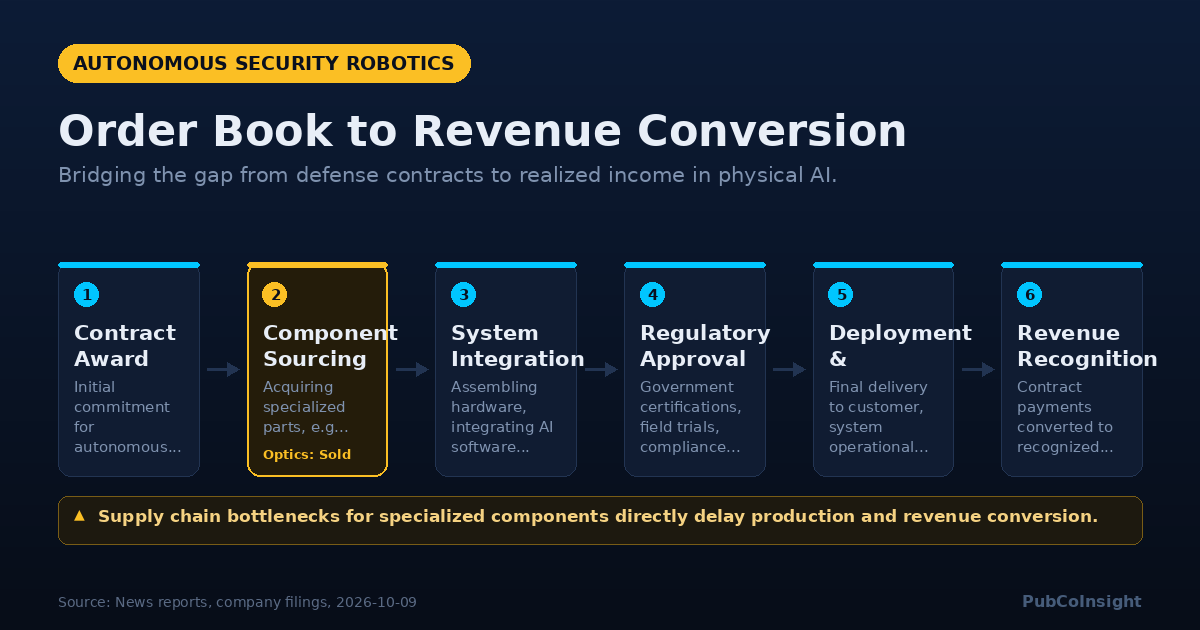
The Mechanism of Revenue Conversion in Autonomous Systems
Converting a defense order for autonomous systems into revenue involves several distinct stages, each with its own set of challenges. First, the initial contract award often represents a commitment, not an immediate cash infusion. It typically involves a down payment, followed by progress payments tied to specific milestones. These milestones can include design completion, prototype delivery, successful testing, and final system deployment. For complex defense hardware, such as advanced drones or specialized robotics, design and manufacturing can span years. Kopin Corporation (KOPN), for example, recently secured an additional $18.6 million U.S. Army contract for its color MicroLED technology, a component that will be integrated into larger systems. This kind of contract often funds development and production, but revenue recognition aligns with delivery and acceptance of those components. Second, the supply chain for specialized components presents bottlenecks. Optical parts, for instance, are currently experiencing significant demand, with Lumentum's CEO stating they are "completely sold out" through early 2029. This scarcity affects companies like MicroVision, Inc. (MVIS) and Arbe Robotics Ltd. (ARBE), which rely on advanced sensor and lidar components for their autonomous solutions. Delays in acquiring these critical parts directly impact production schedules and, by extension, revenue recognition. A company might have a firm order, but if it cannot source the necessary components, it cannot build and deliver the product. This is where the constraint often sits: the physical availability of highly specialized, often custom-made, sub-systems. Without these components, the assembly line stops, regardless of the signed contract. Third, system integration and regulatory approvals add further complexity. Autonomous defense systems require rigorous testing and certification processes, often involving multiple government agencies. Each stage of approval can introduce delays. Final deployment and acceptance by the customer are the ultimate triggers for full revenue recognition, and these can be contingent on performance metrics, field trials, and compliance with strict operational protocols.Companies Operating in This Part of the Sector
Several companies navigate this intricate landscape, each with distinct approaches to technology and market penetration. Ondas (ONDS), with its recent $330 million in defense orders, focuses on autonomous systems for critical infrastructure and defense. Its subsidiary, Ondas Networks, develops wireless data platforms for industrial IoT and mission-critical applications, while American Robotics builds autonomous drone systems. The challenge for Ondas is to demonstrate a clear, accelerated path from these substantial defense contracts to recognized revenue, particularly given the market's current skepticism. In the broader autonomous security and physical AI space, Axon Enterprise (AXON) is a significant player, known for its Taser devices and body cameras, but increasingly expanding into AI-powered drone contracts, such as Lakeland’s decade-long AI drone agreement. Axon’s strategy involves integrating hardware with a recurring software and services model. ADT Inc. (ADT) operates in the traditional security services market, but its moves into smart home and commercial automation suggest a longer-term convergence with autonomous monitoring solutions. Companies like Kopin Corporation (KOPN) provide critical enabling technologies, such as micro-displays, for augmented and virtual reality applications often used in defense and industrial sectors. Kopin's recent $18.6 million U.S. Army contract for color MicroLED technology underscores the demand for high-performance visual components in advanced systems. Red Cat Holdings, Inc. (RCAT) focuses on drone technology, including hardware and software for defense, enterprise, and consumer markets. Serve Robotics Inc. (SERV) operates in a different segment, deploying autonomous sidewalk delivery robots, showcasing the diversity of physical AI applications. Lantronix, Inc. (LTRX) provides secure data access and management solutions for IoT and remote environments, essential for managing fleets of autonomous devices. BigBear.ai Holdings, Inc. (BBAI) offers AI-powered analytics and data solutions, primarily to government and defense clients, which can underpin the intelligence gathering and decision-making capabilities of autonomous security systems. MicroVision, Inc. (MVIS) and Arbe Robotics Ltd. (ARBE) are deeply involved in lidar and radar technology, respectively, which are foundational for autonomous navigation and perception across various applications, from vehicles to security robots. Unusual Machines, Inc. (UMAC) also operates in the robotics sector, though its specific focus often involves customized solutions for niche industrial applications.Artificial Intelligence Technology Solutions, Inc.
Artificial Intelligence Technology Solutions, Inc. (AITX) trades on the OTCID tier under the symbol AITX. The company, through its subsidiaries, develops and leases autonomous security robots and remote monitoring systems. Its business model centers on a recurring monthly subscription for these services, rather than one-time hardware sales. This "Solutions-as-a-Service" approach is designed to provide cost savings of 35% to 80% compared with traditional manned security. AITX operates through several subsidiaries: Robotic Assistance Devices, Inc. (RAD-I) for stationary security devices, Robotic Assistance Devices Mobile (RAD-M) for mobile autonomous platforms like the ROAMEO unit, and Robotic Assistance Devices Group (RAD-G) which manages the SARA agentic artificial intelligence platform. RAD-M began early commercial deployment of its ROAMEO mobile security unit in May 2026. The company also has Robotic Assistance Devices Residential (RAD-R) and Robotic Assistance Devices Lanka (Private) Limited (RAD Lanka), the latter supporting software development and AI initiatives from Sri Lanka. AITX envisions an integrated autonomous security deployment strategy it calls "RAD Town," aiming for comprehensive coverage across campuses, communities, or jurisdictions. For the fiscal year ended February 28, 2026, AITX reported revenue of $7,745,336, a 26% increase over the prior year. Gross profit rose 48% to $5,533,700, with gross margin expanding to approximately 71%. Operating expenses remained flat at around $17,477,097, and the loss from operations improved by approximately $2.0 million to $(11,943,397). The company reported a net loss of approximately $14.5 million for the fiscal year and an accumulated deficit of approximately $171 million as of that date. The public record does not yet establish a clear path to sustained positive cash flow from operations. The company's filings indicate a negative cash flow from operating activities of $9,344,534 for the year ended February 28, 2026, and negative working capital of $17,017,745. Management does not anticipate having positive cash flow from operations in the immediate future. Recent 8-K filings on October 7th, 6th, and 5th, 2026, detail new orders, including a third ROAMEO order from a global logistics client and an expanded relationship with a property management client, demonstrating ongoing customer acquisition and expansion within its service model.What to watch
Investors should track specific, checkable developments. For Ondas (ONDS), the key is the conversion rate of its $330 million in new defense orders into recognized revenue. Look for quarterly filings detailing progress payments, delivery milestones, and actual revenue recognition from these contracts. Delays in component acquisition or regulatory approvals will directly impact this. For Axon Enterprise (AXON), watch for further details on its AI drone contracts, specifically the Lakeland agreement. The rollout schedule and initial performance metrics will indicate the scalability of its drone-as-a-service model. Kopin Corporation (KOPN) has secured an additional $18.6 million U.S. Army contract for color MicroLED technology; monitor the timing of its AUSA 2026 product introductions and subsequent revenue contributions from this and similar defense-related awards. For Artificial Intelligence Technology Solutions (AITX), focus on the reported growth in subscription counts and monthly recurring revenue (MRR) as detailed in its 8-K filings. The company's stated goal of RAD-I supporting positive cash flow operations on a standalone basis, and RAD-M surpassing RAD-I's MRR, provides clear metrics to track. The commercial deployment progress of the ROAMEO mobile security unit, which began in May 2026, will be a critical indicator of RAD-M's potential. Serve Robotics (SERV) will present at Evercore ISI's 5th Annual Automation Tech & Physical AI Conference, offering a potential update on its deployment scale and operational metrics., { "label": "Component Sourcing", "note": "Acquiring specialized parts, e.g., optical components, lidar.", "metric": "Optics: Sold Out 2029" }, { "label": "System Integration", "note": "Assembling hardware, integrating AI software, internal testing." }, { "label": "Regulatory Approval", "note": "Government certifications, field trials, compliance checks." }, { "label": "Deployment & Acceptance", "note": "Final delivery to customer, system operational, performance verified." }, { "label": "Revenue Recognition", "note": "Contract payments converted to recognized income on financial statements." } ], "highlight": 1, "highlight_note": "Supply chain bottlenecks for specialized components directly delay production and revenue conversion.", "footnote": "Source: News reports, company filings, 2026-10-09" }Companies mentioned
| Ticker | Company | Price |
|---|---|---|
| AITX client | Artificial Intelligence Technology Solutions Inc | $0.0023 |
| ARBE | Arbe Robotics Ltd. | $0.566 |
| BBAI | BigBear.ai Holdings, Inc. | $2.42 |
| KOPN | Kopin Corporation | $4.2 |
| LTRX | Lantronix, Inc. | $6.83 |
| MVIS | MicroVision, Inc. | $1.31 |
| ONDS | Ondas Inc. | $6.85 |
| RCAT | Red Cat Holdings, Inc. | $5.91 |
| SERV | Serve Robotics Inc. | $4.45 |
| UMAC | Unusual Machines, Inc. | $21.39 |
Listed alphabetically, not ranked. Prices as of 2026-10-09 and they move. Check a live quote before relying on any of this.
How we chose the companies in this article
We cover a fixed universe of companies working in autonomous security robotics, physical AI and the guarding services market they are aimed at. Every one of them that had usable market data on 2026-10-09 appears in this article. We do not pick which ones to mention based on what we think of them, and we do not order them by size, price or trading volume, because an ordered list is a verdict and that is not ours to hand down. Companies left out, and why: none. American Lithium Minerals and Artificial Intelligence Technology Solutions pay us, which is disclosed in full at the foot of every article they appear in.
See the dilution and promotion flags before you see the pitch.
Each week: the micro and small-caps now showing dilution or paid-promotion signals, with the SEC filing behind every flag. No recommendations, no price targets.
Sources used in this article
- Asian stocks mixed amid AI concerns, oil dips after surge AFP · 2026-10-09
- LITE, COHR, AAOI, POET Rise Overnight After Lumentum CEO Says Optical Parts Are ‘Completely Sold Out’ Through Early 2029 Stocktwits · 2026-10-09
- Nvidia Stock Faces Critical Warning Sign. Is the AI Trade Breaking? BeInCrypto · 2026-10-09
- Can Bloom Energy Stay Profitable as It Doubles in Size? Motley Fool · 2026-10-09
- Arthur Hayes Says AI 'Crash' and Subsequent 'Bailout' Could Spark Bitcoin's Best Performance: 'Just Have to Be Patient' Benzinga · 2026-10-09
- Chip, Cloud Stocks Edge Up Overnight After OpenAI’s $50B Revenue Figure Sparks Selloff: Analyst Calls Reaction ‘Overblown’ Stocktwits · 2026-10-09
- Bitdeer Technologies Group (BTDR) Secured Over 70% Of Its Malaysia AI Capacity Simply Wall St. · 2026-10-09
- SpaceX Is Becoming a Test of How Much Debt the AI Boom Can Absorb Benzinga · 2026-10-09
- Is a Berkshire Hathaway Class A Stock Split Finally Coming? Motley Fool · 2026-10-09
- AMD CEO delivers stark warning on chip market’s future TheStreet · 2026-10-09
- Axon Enterprise (AXON) Rises As Market Takes a Dip: Key Facts Zacks · 2026-10-08
- Marrero Armor LLC Secures First International Order, Expanding U.S.-Made Ballistic Protection Worldwide PR Newswire · 2026-10-08
Disclosure required by Section 17(b) of the Securities Act of 1933
Artificial Intelligence Technology Solutions, Inc., a Nevada corporation (OTCID: AITX). Artificial Intelligence Technology Solutions, Inc. pays Strategic Innovations First, Inc., a Wyoming corporation doing business as PulseIR. Compensation received: USD 5,000.00 per month for months 1-3 (August, September, October 2026); USD 10,000.00 per month for months 4-6 (November, December 2026, January 2027) contingent on the 90-day review. Minimum committed USD 15,000.00; USD 45,000.00 if the second-period rate triggers.. Form of payment: cash only, invoiced monthly in advance; no stock, options or warrants received or payable. Services: investor relations services under an Investor Relations Services Agreement effective 2026-08-01. Period: six month term, 2026-08-01 through 2027-01-31; 90-day review on or about 2026-10-30. No stock, options or warrants held by PubCo Insight, Pulse IR, Strategic Innovations First, Inc., or Brad Listermann. Confirmed by the executed agreement and by board record recKwdq39X2caPSX7 (POSITIONS HELD: none).
This is information, not investment, financial, legal or tax advice. It is not a recommendation or solicitation to buy, sell or hold any security and it contains no price target. Nothing here is independently verified by us. Confirm every figure against primary filings on SEC EDGAR before you act. Micro-cap and over-the-counter securities are speculative and illiquid and can lose all of their value. The companies named without a disclosure above pay us nothing and have no relationship with us; they are named because a published, mechanical screen selected them. Full disclosure policy.