Israel's Drone Tender Signals Defense Shift for Autonomous Security
Ondas' recent contract to build military tactical attack drones for Israel highlights a new and demanding application for autonomous robotics, pushing the boundaries of current security AI capabilities.
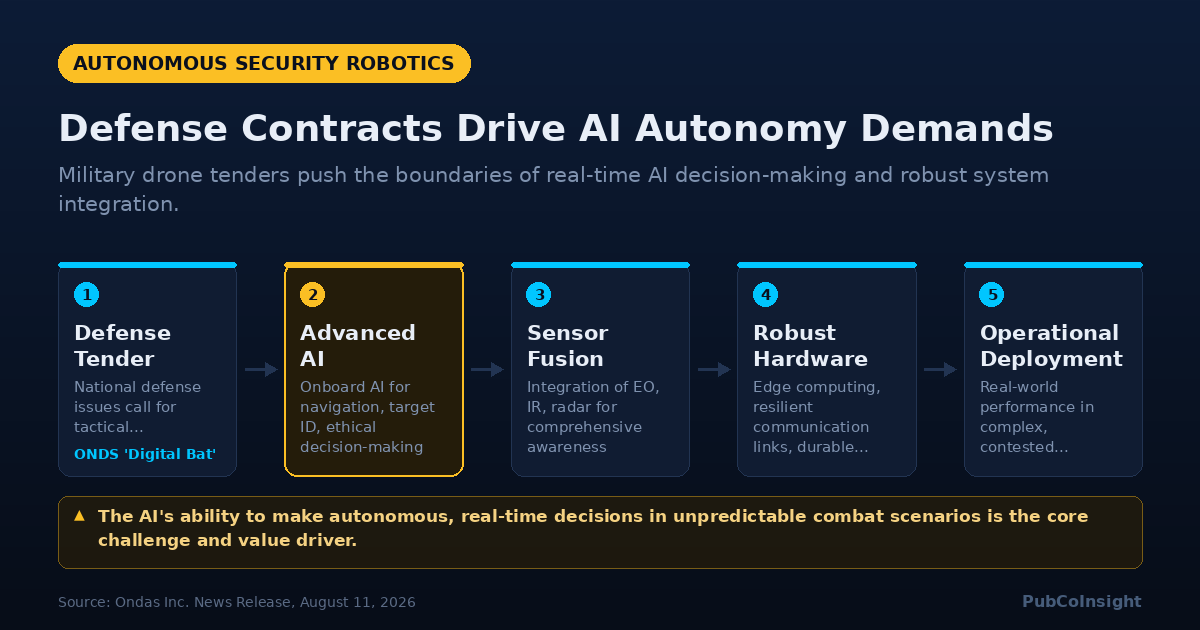
The Mechanism of Autonomous Defense
Military tactical attack drones operate on a different plane than commercial security robots. They require advanced navigation, target identification, and engagement capabilities in dynamic, often contested environments. The core mechanism involves a sophisticated interplay of sensor fusion, real-time AI processing, and secure communication. Drones must integrate data from electro-optical, infrared, and sometimes radar sensors to build a comprehensive situational awareness picture. This data feeds into onboard AI models trained to identify specific threats, differentiate between combatants and non-combatants, and assess optimal engagement parameters. The critical bottleneck here is not just the hardware, but the AI's ability to operate with minimal human intervention in complex scenarios. Unlike a stationary security robot monitoring a fence line, a tactical drone faces unpredictable threats, electronic warfare, and rapidly changing objectives. Its AI must handle sensor degradation, operate in GPS-denied environments, and make rapid, ethical decisions under duress. Training these AI models requires vast datasets of real-world and simulated combat scenarios. The processing power required for real-time, on-board AI inference is substantial, often requiring specialized edge computing units. Furthermore, the communication links must be resilient to jamming and interception, ensuring command and control integrity. A failure in any of these areas - sensor input, AI processing, or secure communication - can render the drone ineffective or, worse, a liability. The "Digital Bat" program's success hinges on proving these integrated systems can perform reliably in active military operations.Companies Operating in This Sector
The move into defense applications highlights the diverse capabilities within the autonomous robotics and AI sector. Several companies are developing technologies that, while not directly military-focused, build foundational expertise relevant to this shift. Ondas Inc. (ONDS), with its recent Israeli defense contracts, is now directly engaged in military-grade drone development. This represents a significant expansion from its previous work, which included counter-drone deals for venues like EverBank Stadium. The company's focus on tactical attack drones suggests a deep dive into advanced autonomy and payload integration for combat scenarios. Ondas’ current stock price is $9.77. In the sensor and perception space, companies like MicroVision, Inc. (MVIS), trading at $4.65, and Arbe Robotics Ltd. (ARBE), at $0.75, develop advanced LiDAR and radar systems, respectively. These technologies are crucial for autonomous navigation and object detection, whether for commercial vehicles or military drones. High-resolution, all-weather perception is a non-negotiable for tactical applications. Kopin Corporation (KOPN), priced at $5.02, focuses on micro-displays and optical solutions, including those for augmented reality and virtual reality. Their work on neural interfaces and high-performance displays through partnerships like Fabric.AI could feed into advanced control interfaces for drone operators, or even direct AI-to-human data streams for enhanced situational awareness in defense contexts. On the software and AI side, BigBear.ai Holdings, Inc. (BBAI), trading at $3.26, provides AI-powered analytics and decision support. While their current focus is often on government and commercial intelligence, the underlying AI models for data fusion and predictive analysis are highly transferable to military operational planning and real-time threat assessment. Other players are building out the broader ecosystem of autonomous systems. Lantronix, Inc. (LTRX), at $6.17, offers embedded computing and networking solutions, critical for the robust and secure communication required by advanced autonomous platforms. Red Cat Holdings, Inc. (RCAT), priced at $10.32, develops drone software and hardware, including for first responders and public safety, which often involves challenging operational environments that share some characteristics with defense scenarios. Finally, companies like Serve Robotics Inc. (SERV), at $4.83, and Unusual Machines, Inc. (UMAC), at $27.03, are developing and deploying delivery and specialized autonomous vehicles. While their applications are civilian, the engineering challenges around robust navigation, obstacle avoidance, and fleet management in complex urban or semi-urban environments contribute to the broader knowledge base for autonomous system development. Uber’s recent full exit from its stake in Serve Robotics, as reported on August 11, 2026, signals a shift in strategic focus for some larger investors concerning last-mile delivery robotics. Unusual Machines, with a recent "Overweight" rating from Piper Sandler, is expanding its capacity, indicating growing demand for its specialized autonomous systems.Artificial Intelligence Technology Solutions, Inc.
Artificial Intelligence Technology Solutions, Inc. (AITX), trading over the counter at $0.0065, operates through subsidiaries including Robotic Assistance Devices, Inc. (RAD-I), Robotic Assistance Devices Mobile (RAD-M), and Robotic Assistance Devices Group (RAD-G). The company develops and delivers AI-driven security and productivity solutions. Its primary subsidiary, RAD-I, focuses on an AI-driven "Solutions-as-a-Service" model for the security and guarding services industry, which it estimates as a $50 billion market in the United States. AITX's solutions aim to deliver cost savings of 35% to 80% compared to traditional manned security. These solutions combine stationary and mobile devices with proprietary software and monitoring platforms. The company's operations are structured around three pillars: stationary security devices (RAD-I), mobile autonomous platforms (RAD-M) including the ROAMEO mobile security unit, and the SARA agentic artificial intelligence platform (RAD-G). Early commercial deployment of the ROAMEO mobile security unit began in May 2026. AITX also operates RAD Lanka, a wholly owned subsidiary in Sri Lanka, which supports software development, AI initiatives, and technical operations. The company refers to the long-term outcome of this integrated strategy as "RAD Town," envisioning autonomous security deployments across campuses, communities, or jurisdictions. For the fiscal year ended February 28, 2026, AITX reported revenue of $7,745,336, a 26% increase year-over-year. Gross profit increased 48% to $5,533,700, with gross margin expanding to 71% from 61%. Operating expenses remained flat at approximately $17,477,097, and the loss from operations improved by about $2.0 million to $(11,943,397). The company reported a net loss of approximately $14.5 million for the fiscal year and had an accumulated deficit of approximately $171 million as of that date. The public record does not yet establish consistent positive cash flow from operations for AITX. The company had negative cash flow from operating activities of $9,344,534 for the year ended February 28, 2026, and negative working capital of $17,017,745. Management does not anticipate achieving positive cash flow from operations in the near term. Recent 8-K filings on August 12 and August 11, 2026, indicate a rapid follow-up order for RAD from a recently signed national dealer and a repeat ROAMEO order in global logistics, respectively.What to watch
Investors should monitor several specific indicators. For Ondas (ONDS), the critical next steps will be public details regarding the progress and timelines of the Israeli military drone contracts. Specific milestones, such as prototype delivery dates or initial deployment schedules, will provide concrete evidence of execution. Any further tenders or contracts in the defense sector, either domestically or internationally, would confirm the expansion of this market segment. Across the broader sector, watch for filings from companies like Unusual Machines (UMAC) detailing their capacity expansion plans, which could indicate growing market demand for their specialized autonomous systems. For Artificial Intelligence Technology Solutions (AITX), observe the quarterly filings for reported increases in recurring revenue, subscription counts, and any updates on the commercial deployment and performance of their ROAMEO mobile security units. The company's ability to reduce its accumulated deficit and move towards positive cash flow from operations will be a key metric. Finally, any new partnerships or expanded non-disclosure agreements from Kopin (KOPN) related to their neural interface or AI interconnect ecosystem could signal deeper integration of their display technology into advanced autonomous systems., { "label": "Advanced AI", "note": "Onboard AI for navigation, target ID, ethical decision-making" }, { "label": "Sensor Fusion", "note": "Integration of EO, IR, radar for comprehensive awareness" }, { "label": "Robust Hardware", "note": "Edge computing, resilient communication links, durable platforms" }, { "label": "Operational Deployment", "note": "Real-world performance in complex, contested environments" } ], "highlight": 1, "highlight_note": "The AI's ability to make autonomous, real-time decisions in unpredictable combat scenarios is the core challenge and value driver.", "footnote": "Source: Ondas Inc. News Release, August 11, 2026" }Companies mentioned
| Ticker | Company | Price |
|---|---|---|
| AITX client | Artificial Intelligence Technology Solutions Inc | $0.0065 |
| ARBE | Arbe Robotics Ltd. | $0.75 |
| BBAI | BigBear.ai Holdings, Inc. | $3.26 |
| KOPN | Kopin Corporation | $5.02 |
| LTRX | Lantronix, Inc. | $6.17 |
| MVIS | MicroVision, Inc. | $4.65 |
| ONDS | Ondas Inc. | $9.77 |
| RCAT | Red Cat Holdings, Inc. | $10.32 |
| SERV | Serve Robotics Inc. | $4.83 |
| UMAC | Unusual Machines, Inc. | $27.03 |
Listed alphabetically, not ranked. Prices as of 2026-08-13 and they move. Check a live quote before relying on any of this.
How we chose the companies in this article
We cover a fixed universe of companies working in autonomous security robotics, physical AI and the guarding services market they are aimed at. Every one of them that had usable market data on 2026-08-13 appears in this article. We do not pick which ones to mention based on what we think of them, and we do not order them by size, price or trading volume, because an ordered list is a verdict and that is not ours to hand down. Companies left out, and why: none. American Lithium Minerals and Artificial Intelligence Technology Solutions pay us, which is disclosed in full at the foot of every article they appear in.
See the dilution and promotion flags before you see the pitch.
Each week: the micro and small-caps now showing dilution or paid-promotion signals, with the SEC filing behind every flag. No recommendations, no price targets.
Sources used in this article
- The Hidden Red Flag in Wall Street’s Price Targets Barrons.com · 2026-08-13
- Antrique Unveils AI Innovation Platform to Advance AI Capability in Brunei Business Wire · 2026-08-13
- 2 Soaring Stocks With More Upside Ahead to Buy and Hold Motley Fool · 2026-08-13
- India's Larsen and Toubro secures order to build AI factory for Nvidia Reuters · 2026-08-13
- What Could Amazon.com (AMZN) Gain From Leading The Decart AI Bidding? Simply Wall St. · 2026-08-13
- Tim Cook Warned of a "100-Year Flood" in Memory Chip Pricing on His Last Earnings Call. Should Apple Investors Be Worried About Margins? Motley Fool · 2026-08-13
- Anthropic in talks to buy Decart AI, source says Reuters · 2026-08-13
- Super Micro Guided Fiscal 2027 Revenue $16 Billion Above Wall Street and Missed the Quarter Anyway Motley Fool · 2026-08-13
- Michael Burry's Nebius Short Is Underwater After a 454% Revenue Quarter Motley Fool · 2026-08-13
- Nvidia’s biggest risk may be coming from inside its customer base TheStreet · 2026-08-13
- Ondas Stock Breaches $10 Ahead Of Earnings: Retail Bulls Expect A 'Short Squeeze' Stocktwits · 2026-08-13
- Will Strength in Connected Devices Unit Continue to Drive AXON's Growth? Zacks · 2026-08-12
Disclosure required by Section 17(b) of the Securities Act of 1933
Artificial Intelligence Technology Solutions, Inc., a Nevada corporation (OTCID: AITX). Artificial Intelligence Technology Solutions, Inc. pays Strategic Innovations First, Inc., a Wyoming corporation doing business as PulseIR. Compensation received: USD 5,000.00 per month for months 1-3 (August, September, October 2026); USD 10,000.00 per month for months 4-6 (November, December 2026, January 2027) contingent on the 90-day review. Minimum committed USD 15,000.00; USD 45,000.00 if the second-period rate triggers.. Form of payment: cash only, invoiced monthly in advance; no stock, options or warrants received or payable. Services: investor relations services under an Investor Relations Services Agreement effective 2026-08-01. Period: six month term, 2026-08-01 through 2027-01-31; 90-day review on or about 2026-10-30. No stock, options or warrants held by PubCo Insight, Pulse IR, Strategic Innovations First, Inc., or Brad Listermann. Confirmed by the executed agreement and by board record recKwdq39X2caPSX7 (POSITIONS HELD: none).
This is information, not investment, financial, legal or tax advice. It is not a recommendation or solicitation to buy, sell or hold any security and it contains no price target. Nothing here is independently verified by us. Confirm every figure against primary filings on SEC EDGAR before you act. Micro-cap and over-the-counter securities are speculative and illiquid and can lose all of their value. The companies named without a disclosure above pay us nothing and have no relationship with us; they are named because a published, mechanical screen selected them. Full disclosure policy.