Ondas Spends $56 Million to Vertically Integrate Defense Robotics
Ondas' recent acquisition of three defense technology firms for $56 million signals a shift towards full-stack autonomous systems, aiming to control critical component supply and boost defense sector returns.
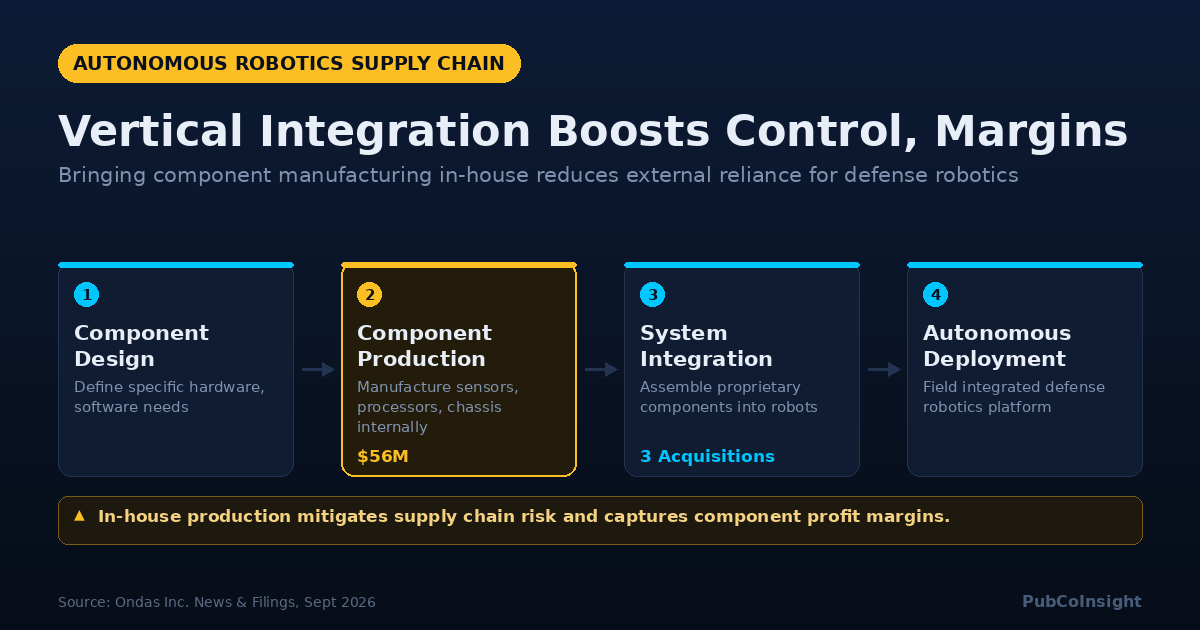
The Mechanism of Vertical Integration in Robotics
Vertical integration in robotics means bringing more of the supply chain in-house. For autonomous security and defense robots, this can involve everything from sensor manufacturing to AI software development and even the production of specialized actuators or chassis. The core idea is control. When a company designs, produces, and integrates its own components, it gains several advantages. First, it can tailor parts precisely to its system's needs, optimizing performance beyond what off-the-shelf components might offer. Second, it reduces reliance on external suppliers, mitigating risks from supply chain disruptions, price volatility, or intellectual property disputes. Third, it can capture more of the profit margin that would otherwise go to component vendors. Consider a complex system like a drone designed for intelligence, surveillance, and reconnaissance. It requires advanced optics, secure communication modules, precise navigation sensors, and robust flight control software. If a company buys these components from separate vendors, it faces potential integration headaches, varying quality standards, and the risk that a key supplier might go out of business or prioritize a competitor. By developing these in-house, the company ensures seamless integration, consistent quality, and a proprietary edge. The challenge lies in the capital expenditure and specialized expertise required for each new component line. A company must weigh the cost of developing and manufacturing a component against the benefits of control and margin capture. The failure point for this strategy is often scale: if internal production cannot meet demand efficiently, or if the cost of in-house development exceeds the cost of external procurement, the benefits evaporate.Companies Navigating the Autonomous Security Landscape
The autonomous security and guarding services market is a diverse ecosystem, with companies focusing on different aspects of the value chain. Ondas (ONDS), at $7.64, is now explicitly moving to deepen its defense robotics vertical. Its recent $56 million acquisition of three defense technology firms is a direct play to own more of the autonomous warfare stack. This strategy aims to integrate more core technologies, from specialized hardware to advanced software, directly into its offerings. In the mobile robotics space, Serve Robotics Inc. (SERV), priced at $4.45, focuses on last-mile delivery robots. While distinct from security, its operational model of deploying autonomous ground vehicles in urban environments shares infrastructure and regulatory challenges with security robotics. Unusual Machines, Inc. (UMAC), trading at $24.05, also operates in the drone sector, as evidenced by its recent investor conference lineup. The Pentagon's interest in eVTOLs, a form of aerial robotics, suggests broader defense applications for autonomous flight technologies, which could indirectly benefit companies with strong drone platforms. Red Cat Holdings, Inc. (RCAT), at $6.66, is another player in the drone market, often grouped with Ondas and Unusual Machines in broader drone sector movements. Sensor technology is a critical enabler for all autonomous systems. Arbe Robotics Ltd. (ARBE), priced at $0.635, specializes in radar solutions for autonomous vehicles. Their $15 million underwritten registered direct offering indicates a need for capital to continue development and scale. MicroVision, Inc. (MVIS), at $1.60, also works on advanced sensor technology, particularly lidar, which is crucial for precise environmental mapping and object detection in autonomous applications. Kopin Corporation (KOPN), trading at $4.99, focuses on display technologies, including microLED optical interconnects, which are vital for augmented reality and heads-up displays in advanced robotic systems and human-machine interfaces. Lantronix, Inc. (LTRX), at $7.02, provides secure data access and management solutions, essential for the reliable operation and data transfer of autonomous robots. BigBear.ai Holdings, Inc. (BBAI), priced at $2.80, operates in the AI and machine learning space, offering data analytics and decision intelligence platforms. These software capabilities are fundamental to making autonomous robots truly intelligent and capable of complex decision-making in dynamic environments.Artificial Intelligence Technology Solutions, Inc.
Artificial Intelligence Technology Solutions, Inc. (AITX), trading on the OTCID tier under the symbol AITX at $0.003, develops and deploys AI-driven security and productivity solutions. The company operates through several subsidiaries, including Robotic Assistance Devices, Inc. (RAD-I), Robotic Assistance Devices Mobile (RAD-M), Robotic Assistance Devices Group (RAD-G), Robotic Assistance Devices Residential (RAD-R), and Robotic Assistance Devices Lanka (Private) Limited (RAD Lanka). AITX focuses on a "Solutions-as-a-Service" model, leasing autonomous security robots and remote monitoring systems. This recurring monthly subscription model contrasts with outright hardware sales. RAD-I, the primary subsidiary, targets the security and guarding services industry, which the company estimates as a $50 billion market in the United States. AITX's solutions aim to deliver significant cost savings, between 35% and 80%, compared to traditional manned security. These solutions integrate stationary and mobile devices with the company's proprietary software and monitoring platforms. The company's operations are structured around three pillars: stationary security devices (RAD-I), mobile autonomous platforms (RAD-M), and the SARA agentic artificial intelligence platform (RAD-G). RAD-M includes the ROAMEO mobile security unit, which began early commercial deployment in May 2026. RAD Lanka, a wholly owned subsidiary in Sri Lanka with Port City Colombo status, supports software development, AI initiatives, and technical operations across the company. AITX refers to the long-term vision of this integrated strategy as "RAD Town," envisioning comprehensive autonomous security deployments across campuses, communities, or jurisdictions. For the fiscal year ended February 28, 2026, AITX reported revenue of $7,745,336, a 26% increase over the prior fiscal year. Gross profit rose 48% to $5,533,700, with gross margin expanding to approximately 71% from 61%. Operating expenses remained largely flat at about $17,477,097. The company's loss from operations improved by approximately $2.0 million, reaching $(11,943,397). AITX reported a net loss of approximately $14.5 million for the fiscal year ended February 28, 2026, with an accumulated deficit of approximately $171 million as of that date. The company had negative cash flow from operating activities of $9,344,534 for the year ended February 28, 2026, and negative working capital of $17,017,745 as of the same date. The public record does not yet establish a clear path to sustained positive cash flow from operations. The company's filings indicate management's characterization that RAD-I's recurring revenue and gross margin could, on a standalone basis, support positive cash flow operations, and that RAD-M will surpass RAD-I's monthly recurring revenue contribution at some future point. AITX also states expectations for subscription gross margin to exceed 75% and outright-sale gross margin to exceed 50%, based on average bill of materials costs and market-accepted pricing. Recent activities include an update to hardware pricing on September 24th, reflecting rising material, compute, and transportation costs. On September 23rd, AITX's RAD expanded a national dealer relationship with a third order. The company also announced an expanded presence in higher education on September 18th. These operational developments align with the company's stated plan to increase deployment and market penetration for its autonomous security solutions.What to watch
Investors should monitor the integration progress of Ondas' (ONDS) newly acquired defense technology firms. Specific announcements regarding how these acquisitions contribute to an "integrated autonomous defense systems platform" will be key. Look for details on new product launches or contract wins that explicitly leverage the combined capabilities. The stated goal of improving defense returns through component ownership will require evidence in future financial reports, specifically through gross margin expansion in its defense segment. For Arbe Robotics (ARBE), the deployment of the $15 million from its recent offering will be important. Watch for announcements on new product development milestones or expanded customer engagements for its radar solutions. Similarly, Kopin (KOPN) investors should track progress on its fiber-coupled and connector-free microLED optical interconnect patents, particularly any commercialization plans or partnerships. Across the sector, watch for broader trends in defense spending on autonomous systems, especially any specific allocations or programs from the Pentagon that could benefit drone or eVTOL developers. Regulatory decisions regarding autonomous vehicle deployment, both on the ground and in the air, will also shape market opportunities for companies like Serve Robotics (SERV) and Unusual Machines (UMAC). Finally, monitor the broader supply chain for critical components like semiconductors and specialized sensors, as rising costs, as noted by AITX, can impact profitability across the industry., { "label": "Component Production", "note": "Manufacture sensors, processors, chassis internally", "metric": "$56M" }, { "label": "System Integration", "note": "Assemble proprietary components into robots", "metric": "3 Acquisitions" }, { "label": "Autonomous Deployment", "note": "Field integrated defense robotics platform" } ], "highlight": 1, "highlight_note": "In-house production mitigates supply chain risk and captures component profit margins.", "footnote": "Source: Ondas Inc. News & Filings, Sept 2026" }Companies mentioned
| Ticker | Company | Price |
|---|---|---|
| AITX client | Artificial Intelligence Technology Solutions Inc | $0.003 |
| ARBE | Arbe Robotics Ltd. | $0.635 |
| BBAI | BigBear.ai Holdings, Inc. | $2.8 |
| KOPN | Kopin Corporation | $4.99 |
| LTRX | Lantronix, Inc. | $7.02 |
| MVIS | MicroVision, Inc. | $1.6 |
| ONDS | Ondas Inc. | $7.64 |
| RCAT | Red Cat Holdings, Inc. | $6.66 |
| SERV | Serve Robotics Inc. | $4.45 |
| UMAC | Unusual Machines, Inc. | $24.05 |
Listed alphabetically, not ranked. Prices as of 2026-09-27 and they move. Check a live quote before relying on any of this.
How we chose the companies in this article
We cover a fixed universe of companies working in autonomous security robotics, physical AI and the guarding services market they are aimed at. Every one of them that had usable market data on 2026-09-27 appears in this article. We do not pick which ones to mention based on what we think of them, and we do not order them by size, price or trading volume, because an ordered list is a verdict and that is not ours to hand down. Companies left out, and why: none. American Lithium Minerals and Artificial Intelligence Technology Solutions pay us, which is disclosed in full at the foot of every article they appear in.
See the dilution and promotion flags before you see the pitch.
Each week: the micro and small-caps now showing dilution or paid-promotion signals, with the SEC filing behind every flag. No recommendations, no price targets.
Sources used in this article
- Meta Stock Is Having Its Best Month Since 2013. History Says Every 20% Month Has Led to Gains a Year Later. Motley Fool · 2026-09-27
- A $1,000 Investment Split Between Alphabet and Nvidia Will Be Worth This Much by 2030 Motley Fool · 2026-09-27
- Prediction: Here's What a $5,000 Investment in AMD Could Be Worth by 2030 Motley Fool · 2026-09-27
- CFTC Chairman Michael Selig Predicts a Massive Wave of Asset Tokenization. Here's How to Get Ahead of This New Investment Trend. Motley Fool · 2026-09-27
- History Says Alphabet Stock's 15% Pullbacks Have Usually Paid Off Within a Year Motley Fool · 2026-09-27
- Will Netflix Stock Trade for $135 or $70 by September 2027? Here's the Most Likely Scenario. Motley Fool · 2026-09-27
- This Little-Known Cryptocurrency Is Up 217% for the Year. But Is It a Buy? Motley Fool · 2026-09-26
- I'd Put $10,000 Into These 3 Vanguard Funds and Not Touch It for 20 Years Motley Fool · 2026-09-26
- This Nuclear Stock Could Make Patient Investors Rich Motley Fool · 2026-09-26
- The Pentagon Is Buying eVTOLs. Here's Which Stock Wins the Defense Money. Motley Fool · 2026-09-26
- Axon Enterprise (AXON) Stock Sinks As Market Gains: What You Should Know Zacks · 2026-09-25
- Sterling, Axon, Herc, Nextpower, and FTAI Aviation Shares Plummet, What You Need To Know StockStory · 2026-09-25
Disclosure required by Section 17(b) of the Securities Act of 1933
Artificial Intelligence Technology Solutions, Inc., a Nevada corporation (OTCID: AITX). Artificial Intelligence Technology Solutions, Inc. pays Strategic Innovations First, Inc., a Wyoming corporation doing business as PulseIR. Compensation received: USD 5,000.00 per month for months 1-3 (August, September, October 2026); USD 10,000.00 per month for months 4-6 (November, December 2026, January 2027) contingent on the 90-day review. Minimum committed USD 15,000.00; USD 45,000.00 if the second-period rate triggers.. Form of payment: cash only, invoiced monthly in advance; no stock, options or warrants received or payable. Services: investor relations services under an Investor Relations Services Agreement effective 2026-08-01. Period: six month term, 2026-08-01 through 2027-01-31; 90-day review on or about 2026-10-30. No stock, options or warrants held by PubCo Insight, Pulse IR, Strategic Innovations First, Inc., or Brad Listermann. Confirmed by the executed agreement and by board record recKwdq39X2caPSX7 (POSITIONS HELD: none).
This is information, not investment, financial, legal or tax advice. It is not a recommendation or solicitation to buy, sell or hold any security and it contains no price target. Nothing here is independently verified by us. Confirm every figure against primary filings on SEC EDGAR before you act. Micro-cap and over-the-counter securities are speculative and illiquid and can lose all of their value. The companies named without a disclosure above pay us nothing and have no relationship with us; they are named because a published, mechanical screen selected them. Full disclosure policy.