Autonomous Security Robotics See Broader Adoption Beyond Large Deployments
A recent 14-unit order intake across five customer relationships suggests a shift in how autonomous security robotics are being integrated, moving from single large contracts to a more diverse client base.
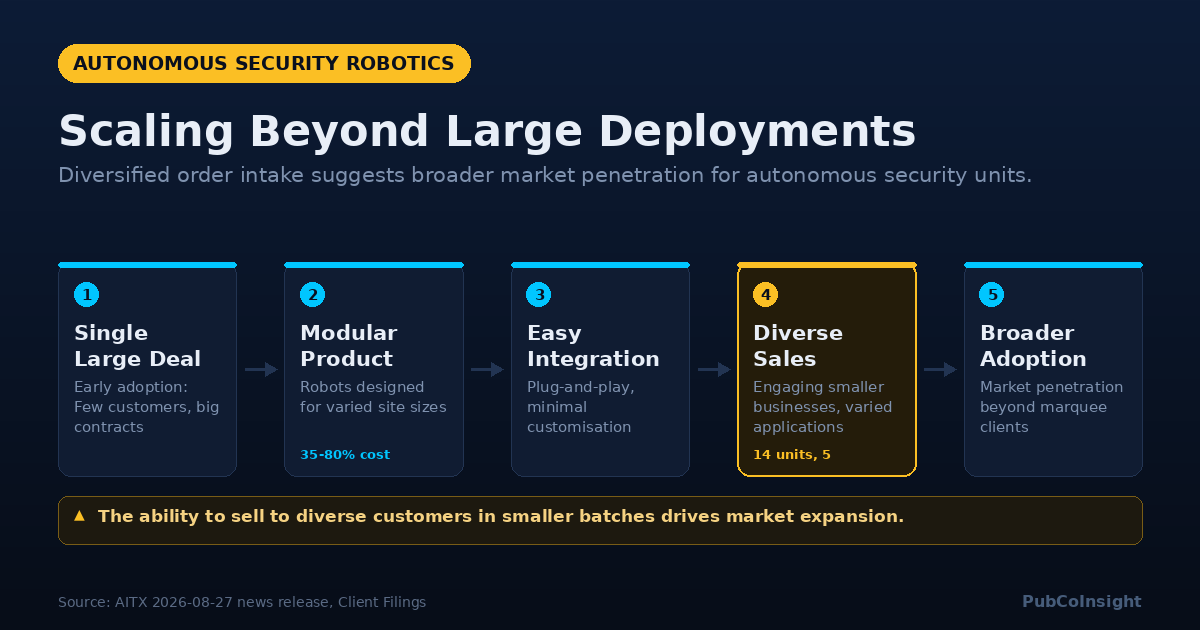
The Mechanism of Distributed Adoption
Autonomous security robotics, whether stationary or mobile, deliver value by automating surveillance, patrol, and early threat detection. The core mechanism is a combination of on-board sensors, edge computing for real-time AI analysis, and cloud-based platforms for remote monitoring and response. For a single large campus, a fleet of mobile robots like AITX's ROAMEO can patrol vast areas, reducing the need for human guards. Stationary units, such as AITX's SCOT or RIO, cover fixed points, gates, and perimeters. The shift to diverse, smaller deployments changes the sales and integration dynamic. Instead of a single large contract covering hundreds of acres, a company might now sell two stationary units to a small manufacturing plant, or a single mobile unit to a logistics hub. This requires a modular, scalable product line and a sales strategy capable of addressing varied customer needs and budget sizes. The technology must be robust enough for standalone operation but also easily integrated into existing security infrastructures. The critical factor for success here is the ease of deployment and the immediate, demonstrable cost savings. If a system requires extensive customisation or complex IT integration for each small deployment, the economic model breaks down. The products must be close to plug-and-play, with intuitive interfaces and reliable autonomous operation.Companies Operating in This Sector
The autonomous security robotics and physical AI sector is populated by companies developing various components and integrated solutions. Arbe Robotics Ltd. (ARBE) focuses on high-resolution 4D imaging radar solutions, critical for the precise navigation and object detection required by autonomous platforms. Their technology offers enhanced perception capabilities, which are fundamental for robots operating in complex environments, particularly in low visibility or adverse weather. BigBear.ai Holdings, Inc. (BBAI) provides AI-powered analytics and decision intelligence. While not directly building robots, their platforms can process the vast amounts of data generated by security robots, providing actionable insights for human operators and enhancing the overall effectiveness of autonomous systems. This backend AI is crucial for making sense of the robot’s observations and predicting potential security incidents. In the display and sensor space, Kopin Corporation (KOPN) develops micro-displays and optical modules, often used in augmented reality (AR) and virtual reality (VR) systems. These components could find application in advanced human-robot interaction interfaces or for remote operators controlling robotic units, providing high-fidelity visual feedback. MicroVision, Inc. (MVIS) specializes in lidar technology, another key sensor for autonomous navigation and mapping, particularly for mobile robots that need precise environmental understanding. Their lidar systems enable robots to build detailed 3D maps and detect obstacles with high accuracy. Connectivity and edge computing are vital for these systems. Lantronix, Inc. (LTRX) offers secure data access and management solutions, enabling reliable communication between robots, central command centers, and cloud platforms. Their embedded computing solutions can power the on-board AI processing required for autonomous decision-making at the edge. The drone sector also plays a role in aerial surveillance for security. Ondas Inc. (ONDS) develops proprietary wireless communication platforms for mission-critical industrial applications, including drones. Their FullMAX system provides robust, secure connectivity essential for controlling and receiving data from autonomous aerial vehicles used in security patrols. Red Cat Holdings, Inc. (RCAT) focuses on drone technology, offering hardware and software solutions for various applications, including defense and public safety. Their Drones-as-a-Service model could extend to autonomous security patrols for large areas. Unusual Machines, Inc. (UMAC) also operates in the drone space, recently making moves into NDAA-compliant defense drones and expanding manufacturing. This indicates a focus on robust, secure drone platforms, which are increasingly relevant for security applications where data integrity and supply chain security are paramount. Finally, in the realm of ground-based delivery and service robotics, Serve Robotics Inc. (SERV) deploys autonomous sidewalk robots for last-mile delivery. While their primary focus is logistics, the underlying autonomous navigation and operational management technologies share common ground with security robotics. The experience in deploying and managing fleets of robots in public spaces is directly transferable.Artificial Intelligence Technology Solutions, Inc.
Artificial Intelligence Technology Solutions, Inc. (AITX) operates through several subsidiaries, primarily focusing on AI-driven security and productivity solutions. The company's main subsidiary, Robotic Assistance Devices, Inc. (RAD-I), markets its AI-driven "Solutions-as-a-Service" model to the security and guarding services industry. AITX estimates this market to be approximately $50 billion in the United States. The company states its solutions offer cost savings of 35% to 80% compared to traditional manned security. AITX's product line includes stationary security devices under RAD-I, such as the SCOT (Security Control Observation Tower) and RIO (Remote Intelligent Observation) units, designed for fixed-point surveillance and access control. The company also develops mobile autonomous platforms under RAD-M, including the ROAMEO mobile security unit, which began early commercial deployment in May 2026. The ROAMEO is designed for patrolling larger areas autonomously. AITX's RAD-G subsidiary focuses on the SARA agentic artificial intelligence platform, which the company intends to license. RAD Lanka, a wholly owned subsidiary in Sri Lanka, supports software development, AI initiatives, and technical operations. The company refers to its long-term strategy as "RAD Town," envisioning integrated autonomous security deployments across entire campuses or communities. AITX reported revenue of $7,745,336 for the fiscal year ended February 28, 2026, a 26% increase over the prior fiscal year. Gross profit increased 48% to $5,533,700, with gross margin expanding to approximately 71% from 61%. Operating expenses remained largely flat at about $17,477,097, and the loss from operations improved by approximately $2.0 million to $(11,943,397). The company reported a net loss of approximately $14.5 million for the fiscal year ended February 28, 2026, and had an accumulated deficit of approximately $171 million as of that date. For the year ended February 28, 2026, AITX had negative cash flow from operating activities of $9,344,534. As of February 28, 2026, the company had an accumulated deficit of $171,121,742 and negative working capital of $17,017,745. The public record does not yet establish a clear path to sustained positive cash flow from operations. Management does not anticipate having positive cash flow from operations in the near term. The company's filings indicate a stated goal of 50 ROAMEO units deployed by August 2027, supported by expanded production readiness.What to watch
Investors should monitor the continued diversification of order intakes across the sector. Specifically for AITX, the next 8-K filings will provide updates on new customer acquisitions and unit deployments. The progress of ROAMEO deployments, particularly toward the stated goal of 50 units by August 2027, will be a key metric. Look for details on the types of customers acquiring units, whether they represent new industries or smaller-scale deployments within existing ones. Any announcements regarding the licensing of the SARA platform by RAD-G would also indicate progress on a distinct revenue stream. Finally, watch for any shifts in the company's cash flow from operating activities in future quarterly and annual reports, which are due in accordance with SEC filing requirements., { "label": "Modular Product", "note": "Robots designed for varied site sizes", "metric": "35-80% cost savings" }, { "label": "Easy Integration", "note": "Plug-and-play, minimal customisation" }, { "label": "Diverse Sales", "note": "Engaging smaller businesses, varied applications", "metric": "14 units, 5 customers" }, { "label": "Broader Adoption", "note": "Market penetration beyond marquee clients" } ], "highlight": 3, "highlight_note": "The ability to sell to diverse customers in smaller batches drives market expansion.", "footnote": "Source: AITX 2026-08-27 news release, Client Filings" }Companies mentioned
| Ticker | Company | Price |
|---|---|---|
| AITX client | Artificial Intelligence Technology Solutions Inc | $0.0052 |
| ARBE | Arbe Robotics Ltd. | $0.666 |
| BBAI | BigBear.ai Holdings, Inc. | $3.19 |
| KOPN | Kopin Corporation | $4.82 |
| LTRX | Lantronix, Inc. | $6.03 |
| MVIS | MicroVision, Inc. | $1.88 |
| ONDS | Ondas Inc. | $8.75 |
| RCAT | Red Cat Holdings, Inc. | $9.28 |
| SERV | Serve Robotics Inc. | $4.88 |
| UMAC | Unusual Machines, Inc. | $26.3 |
Listed alphabetically, not ranked. Prices as of 2026-08-28 and they move. Check a live quote before relying on any of this.
How we chose the companies in this article
We cover a fixed universe of companies working in autonomous security robotics, physical AI and the guarding services market they are aimed at. Every one of them that had usable market data on 2026-08-28 appears in this article. We do not pick which ones to mention based on what we think of them, and we do not order them by size, price or trading volume, because an ordered list is a verdict and that is not ours to hand down. Companies left out, and why: none. American Lithium Minerals and Artificial Intelligence Technology Solutions pay us, which is disclosed in full at the foot of every article they appear in.
See the dilution and promotion flags before you see the pitch.
Each week: the micro and small-caps now showing dilution or paid-promotion signals, with the SEC filing behind every flag. No recommendations, no price targets.
Sources used in this article
- NVIDIA (NVDA) Excluded China Data Center Compute Revenue from its $108B Outlook. Can Growth Stay Exceptional Without It? Insider Monkey · 2026-08-28
- Impinj and Broadcom Shares Skyrocket, What You Need To Know StockStory · 2026-08-28
- After Surging 3,110%, Has Sandisk Already Had Its "Nvidia Moment"? Motley Fool · 2026-08-28
- Michael Burry Thanks Tech Columnist’s Praise For Making ‘A Killing’ On NVDA, MSFT Calls Into Earnings Stocktwits · 2026-08-28
- Tesla Stock Sits Nearly 30% Below Its High and Still Trades at 330 Times Earnings Motley Fool · 2026-08-28
- Dow Jones Futures Rise With Fed Chief Warsh Due; Nvidia, These 7 Stocks Are In Buy Zones Investor's Business Daily · 2026-08-28
- Yotta Plans IPO ‘Very Soon’ to Keep Up With AI Demand, CEO Says Bloomberg · 2026-08-28
- Most Asian stocks advance as attention turns to Warsh speech AFP · 2026-08-28
- Trump Praises Nvidia's 'Incredible Numbers' After Q2 Stunner — He Also Reportedly Holds Over $12M In The Stock Stocktwits · 2026-08-28
- Salesforce Stock Just Soared. Thank Anthropic. Motley Fool · 2026-08-28
- Axon (AXON) Stock Could Be Fully Priced On Cash Flow But Fair On Sales Simply Wall St. · 2026-08-27
- Axon Enterprise Stock: Is Wall Street Bullish or Bearish? Barchart · 2026-08-27
Disclosure required by Section 17(b) of the Securities Act of 1933
Artificial Intelligence Technology Solutions, Inc., a Nevada corporation (OTCID: AITX). Artificial Intelligence Technology Solutions, Inc. pays Strategic Innovations First, Inc., a Wyoming corporation doing business as PulseIR. Compensation received: USD 5,000.00 per month for months 1-3 (August, September, October 2026); USD 10,000.00 per month for months 4-6 (November, December 2026, January 2027) contingent on the 90-day review. Minimum committed USD 15,000.00; USD 45,000.00 if the second-period rate triggers.. Form of payment: cash only, invoiced monthly in advance; no stock, options or warrants received or payable. Services: investor relations services under an Investor Relations Services Agreement effective 2026-08-01. Period: six month term, 2026-08-01 through 2027-01-31; 90-day review on or about 2026-10-30. No stock, options or warrants held by PubCo Insight, Pulse IR, Strategic Innovations First, Inc., or Brad Listermann. Confirmed by the executed agreement and by board record recKwdq39X2caPSX7 (POSITIONS HELD: none).
This is information, not investment, financial, legal or tax advice. It is not a recommendation or solicitation to buy, sell or hold any security and it contains no price target. Nothing here is independently verified by us. Confirm every figure against primary filings on SEC EDGAR before you act. Micro-cap and over-the-counter securities are speculative and illiquid and can lose all of their value. The companies named without a disclosure above pay us nothing and have no relationship with us; they are named because a published, mechanical screen selected them. Full disclosure policy.