The Co-Located Refinery: Why Nevada Lithium Is Merging Extraction with Scrap
American Battery Technology's unified processing blueprint exposes the operational reality that neither primary extraction nor black mass recycling can build an independent domestic battery supply alone.
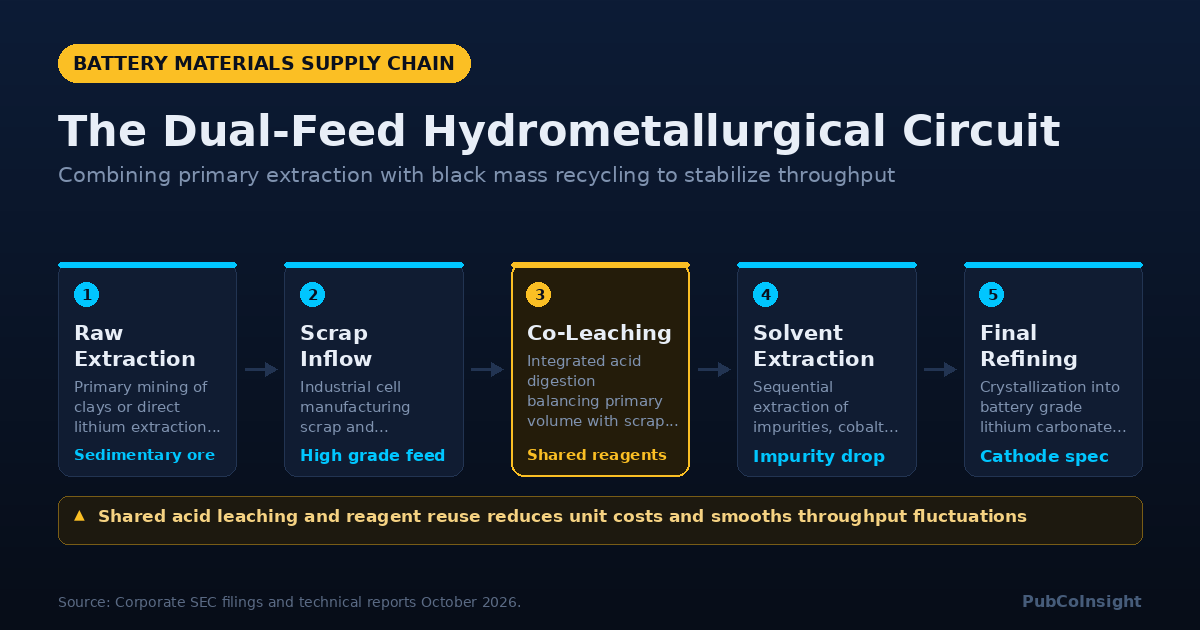
On October 21, 2026, American Battery Technology Company outlined an operational roadmap that formalizes what chemical engineers in the Great Basin have argued privately for two years: primary mineral extraction and secondary battery recycling cannot remain separate businesses if domestic cathode chemistry is ever to scale. The company plan establishes a combined operating hub in Nevada, pairing hydrometallurgical recycling of manufacturing scrap and end of life cells directly alongside primary lithium extraction from domestic sedimentary deposits. The dual track approach targets domestic feedstocks to reduce North American dependence on Chinese chemical conversion, which still controls over seventy percent of refined battery grade lithium salts globally.
The stakes behind this integration are purely industrial. North American battery manufacturing capacity is expanding faster than raw domestic extraction can be permitted, drilled, and commissioned. At the same time, standalone recyclers are finding that battery scrap volumes alone cannot keep commercial scale hydrometallurgical circuits running at full utilization. By bridging primary extraction feedstocks with recycled black mass, operators are attempting to solve the supply variability that has plagued both ends of the critical materials landscape.
The announcement lands during a tense operational window across the sector. Major producers are deferring capital expenditures on greenfield chemical plants, while early stage developers in Nevada, Texas, and the southern brine corridors confront the physical limits of single source processing facilities. Treating battery manufacturing scrap and raw ore as complementary chemical feeds rather than competing industries alters the cost profile of domestic refining.
The Shared Reagent Loop: How Integrated Leaching Alter Smelter Economics
To understand why combining primary clay or brine extraction with battery recycling makes chemical sense, one must look at the circuit level rather than the corporate slide decks. In a standalone lithium clay or spodumene conversion facility, raw ore is crushed, acid leached with concentrated sulfuric acid or roasted with sulfates, and filtered to create an impure pregnant leach solution. That solution contains lithium ions accompanied by problematic impurities, including magnesium, calcium, iron, and sodium. Removing these impurities requires continuous chemical precipitation, consuming massive volumes of sodium hydroxide, soda ash, and quicklime, while generating vast quantities of calcium sulfate and metal hydroxide filter cake.
A standalone battery recycling plant follows an almost identical chemical logic, but in reverse. Shredded battery cells yield black mass, a powder concentrated in lithium, nickel, cobalt, and manganese, bound together with graphite and residual organic solvents. Hydrometallurgical recyclers leach this black mass using sulfuric acid and hydrogen peroxide. They then use solvent extraction circuits to peel off copper, iron, cobalt, and nickel before reaching the lithium sulfate stage. The chronic vulnerability of this model is feedstock availability. The electric vehicle fleet is young, scrap collection yields fluctuate, and high capital expense solvent extraction plants operate at punishing losses when run at forty percent capacity.
Integrating the two feeds changes the mass balance. Primary sedimentary deposits provide high volume, lower grade lithium sulfate feeds that keep crystallization evaporators running at steady state baseload. Recycled black mass injects a high concentration lithium stream alongside valuable cobalt and nickel credits that dilute the operating cost per ton of final salt produced. Crucially, co-located plants can share centralized reagent infrastructure, specifically acid regeneration, crystallization trains, and on site wastewater treatment facilities that typically account for over forty percent of a refinery capital budget.
The thesis falls apart, however, under two specific conditions. First, if primary clay feed contains fluorine or excessive iron that fouls the solvent extraction organic carriers used for battery metals, the cross contamination can ruin entire batches of battery grade cathode precursor. Second, if regional scrap aggregation remains fragmented, logistics costs to haul shredded scrap to remote mining basins in Nevada or Utah erase the reagent savings gained inside the plant gates.
Field Deployments Across Brines, Clays, and Hard Rock Corridors
Operating strategies across the North American and international exploration corridors reflect this push to secure scalable feedstocks. American Battery Technology Company (ABAT, $1.35) is advancing this exact dual strategy, linking its Tonopah Flats lithium deposit in Nevada with its operational recycling facility in McCarran. The company model seeks to feed both mine output and factory scrap into common downstream finishing systems, avoiding the single asset operational vulnerability that has stranded isolated extractors.
Further south in the Nevada basin, ioneer Ltd (IONR, $2.55) is advancing its Rhyolite Ridge lithium boron project in Esmeralda County. Rhyolite Ridge holds a distinct geological profile where lithium occurs in searlesite minerals alongside massive commercial grades of boron. The economics of ioneer depend on co-producing boric acid alongside technical and battery grade lithium carbonate, using on site sulfuric acid production to generate zero carbon steam and power for its entire extraction circuit. The company provides a working template for how multi mineral credit extraction offsets pure lithium price volatility.
Direct extraction developers are pursuing an entirely different infrastructure model. Standard Lithium Ltd. (SLI, $1.43) took a major operational step on October 20, 2026, filing a positive Preliminary Economic Assessment for its high grade Franklin Project in East Texas, outlining a 70,000 tonnes per year commercial target. Standard Lithium focuses on tapping Smackover Formation brines, using direct lithium extraction column absorption to extract lithium chloride directly from tailbrine streams without the surface footprint of evaporation ponds. Its model relies on partnering with commercial energy giants like Equinor to leverage existing brine reinjection wells and pipeline corridors.
Across the border and in hard rock pegmatite fields, developers are racing to prove low cost concentration. Atlas Lithium Corporation (ATLX, $1.93) is constructing spodumene open pit mining and dense media separation facilities in the Minas Gerais lithium valley of Brazil, focused on delivering low impurity lithium concentrates directly into international conversion facilities. In the rare earth and critical alloying space, USA Rare Earth, Inc. (USAR, $9.33) is constructing a domestic magnet production and heavy rare earth refining circuit anchored by its Round Top deposit in Hudspeth County, Texas. NioCorp Developments Ltd. (NB, $2.95) continues engineering work on its Elk Creek project in southeast Nebraska, targeting a commercial flow sheet that separates high purity niobium, scandium, and titanium, three critical defense metals locked in a single carbonatite pipe.
Corporate consolidation is also accelerating to bridge geographical supply chains. Critical Metals Corp. (CRML, $6.36) secured securityholder approval on October 22, 2026, for its acquisition of European Lithium, consolidating ownership around the Wolfsberg lithium project in Austria alongside its Tanbreez rare earth asset in Greenland. The company is actively positioning European mining assets to feed battery Gigafactories across the continent, matching mine face permitting with regional auto manufacturing alliances.
American Lithium Minerals, Inc. (AMLM, $0.0615)
American Lithium Minerals, Inc. (AMLM, $0.0615) operates at the exploration end of the Nevada critical minerals basin. Incorporated in Nevada on March 10, 2005, the company is an exploration stage, pre-revenue entity that files regular reports with the SEC under CIK 0001356371. AMLM has historically acquired and divested prospective assets across cobalt, nickel, and graphite in Central Nevada, as well as rare earth elements projects in Kingman, Arizona, and Southern Illinois, but its declared primary operational focus is its Sarcobatus lithium property.
The Sarcobatus property comprises 1,780 acres of placer mining claims located in Sarcobatus Flat within Central Nevada. Sarcobatus Flat sits along the Walker Lane structural zone, a geological depression containing playa sediments, lithium bearing volcanic tuffs, and closed basin evaporites that share hydrological characteristics with the Clayton Valley basin immediately to the north. The company stated exploration thesis relies on identifying shallow lithium enriched brines and structural sedimentary clays within these claim blocks that could prove amenable to conventional surface trenching, reverse circulation drilling, and hydrometallurgical leaching.
To fund its operations, AMLM secured qualification from the SEC for a Regulation A offering on Form 1-A on February 4, 2026. The offering circular outlines an offering of up to $20,000,000, consisting of up to 80,000,000 units priced to raise up to $8,000,000, accompanied by up to 120,000,000 common shares issuable upon the exercise of warrants exercisable at $0.05 per share through December 31, 2028. The company SEC circular specifies that it owns no real property, processing plants, or physical industrial equipment, and that capital raised under the offering is earmarked for working capital, mineral property acquisition, and preliminary exploratory drilling.
The public record does not yet establish a compliant S-K 1300 or NI 43-101 mineral resource estimate, drill hole assay logs, or metallurgical recovery rates for the Sarcobatus property. In its qualified SEC filings, management has also disclosed an initiative to develop Real World Asset (RWA) tokens on public blockchains to finance mineral exploration and tokenize in-ground mining assets. On October 15, 2026, the company announced the appointment of independent directors and launched a Shareholder Ambassador Program to engage retail holders. Moving from administrative structuring to physical mineral validation will require the company to deploy its offering proceeds directly into permitted ground geophysics, shallow hydrological sampling, and core drilling at Sarcobatus Flat.
What to watch
- SLI definitive feasibility study milestones: Monitor subsequent engineering filings and commercial partnership milestones with Equinor following the October 20, 2026 Preliminary Economic Assessment for the 70,000 tonnes per year Franklin Project in East Texas.
- CRML transaction closing: Watch for the completion filings and post merger trading adjustments for Critical Metals Corp. following European Lithium securityholder approval on October 22, 2026.
- ABAT hydrometallurgical commissioning data: Track recovery yield reports, third party scrap supply contracts, and Nevada state water permit modifications for American Battery Technology Company's integrated recycling and primary extraction operations.
- AMLM field operations and Reg A capital intake: Watch EDGAR filings on Form 1-U and semi-annual Form 1-SA for American Lithium Minerals, Inc. to measure gross proceeds taken down from its $20,000,000 Regulation A offering, alongside the issuance of Bureau of Land Management drilling permits at the Sarcobatus claim block.
- IONR federal permitting progress: Look for final Bureau of Land Management environmental review decisions and formal record of decision dates for ioneer's Rhyolite Ridge lithium boron project in Esmeralda County, Nevada.
Companies mentioned
| Ticker | Company | Price |
|---|---|---|
| ABAT | American Battery Technology Company | $1.35 |
| AMLM client | American Lithium Minerals, Inc. | $0.0615 |
| ATLX | Atlas Lithium Corporation | $1.93 |
| CRML | Critical Metals Corp. | $6.36 |
| IONR | ioneer Ltd | $2.55 |
| NB | NioCorp Developments Ltd. | $2.95 |
| SLI | Standard Lithium Ltd. | $1.43 |
| USAR | USA Rare Earth, Inc. | $9.33 |
Listed alphabetically, not ranked. Prices as of 2026-10-26 and they move. Check a live quote before relying on any of this.
How we chose the companies in this article
We cover a fixed universe of companies working in lithium, boron and the critical minerals that feed battery and energy-storage supply chains. Every one of them that had usable market data on 2026-10-26 appears in this article. We do not pick which ones to mention based on what we think of them, and we do not order them by size, price or trading volume, because an ordered list is a verdict and that is not ours to hand down. Companies left out, and why: none. American Lithium Minerals and Artificial Intelligence Technology Solutions pay us, which is disclosed in full at the foot of every article they appear in.
See the dilution and promotion flags before you see the pitch.
Each week: the micro and small-caps now showing dilution or paid-promotion signals, with the SEC filing behind every flag. No recommendations, no price targets.
Sources used in this article
- Should Q3 Earnings Report Require Action From Albemarle (ALB) Investors? Simply Wall St. · 2026-10-25
- Sociedad Química y Minera De Chile (NYSE:SQM) Stock Looks Reasonable Despite Its 28% Run Simply Wall St. · 2026-10-24
- Top 3 Canadian Lithium Stocks To Watch In October 2026 Simply Wall St. · 2026-10-24
- Is MP Materials Stock a Millionaire Maker? Motley Fool · 2026-10-24
- Can Albemarle Stock Jump 50%? Trefis · 2026-10-23
- Albemarle (ALB) Gains As Market Dips: What You Should Know Zacks · 2026-10-23
- What to Expect From Albemarle's Q3 2026 Earnings Report Barchart · 2026-10-23
- Carrier Plans $600M Fort Worth Advanced Manufacturing Hub CRE Daily · 2026-10-23
- MP vs. LYSDY: Which Rare Earth Stock Has an Edge Right Now? Zacks · 2026-10-23
- Albemarle (ALB) Suffers a Larger Drop Than the General Market: Key Insights Zacks · 2026-10-22
- Is MP Materials Stock Still a Buy After Its Recent Pullback? Motley Fool · 2026-10-22
- Critical Metals And 2 Rare Earth Stocks To Watch Simply Wall St. · 2026-10-22
Disclosure required by Section 17(b) of the Securities Act of 1933
American Lithium Minerals, Inc.. American Lithium Minerals, Inc. (issuer) paid Strategic Innovations First, Inc., an affiliate of PubCo Insight and Pulse IR. Compensation received: USD 11,550.00 total, three equal monthly installments of USD 3,850.00. Form of payment: cash only; no stock, options or warrants. Services: investor relations, marketing and content creation under Master Services Agreement dated June 22, 2026. Period: three month initial term, June 2026 through August 2026. No position, options or warrants held by PubCo Insight, Pulse IR, Strategic Innovations First, Inc., or Brad Listermann.
This is information, not investment, financial, legal or tax advice. It is not a recommendation or solicitation to buy, sell or hold any security and it contains no price target. Nothing here is independently verified by us. Confirm every figure against primary filings on SEC EDGAR before you act. Micro-cap and over-the-counter securities are speculative and illiquid and can lose all of their value. The companies named without a disclosure above pay us nothing and have no relationship with us; they are named because a published, mechanical screen selected them. Full disclosure policy.