Lakeland’s Decade-Long AI Drone Contract Signals Shift in Security Robotics
Axon Enterprise’s recent agreement with Lakeland for AI-powered drones highlights a growing trend toward long-term, integrated autonomous solutions in physical security.
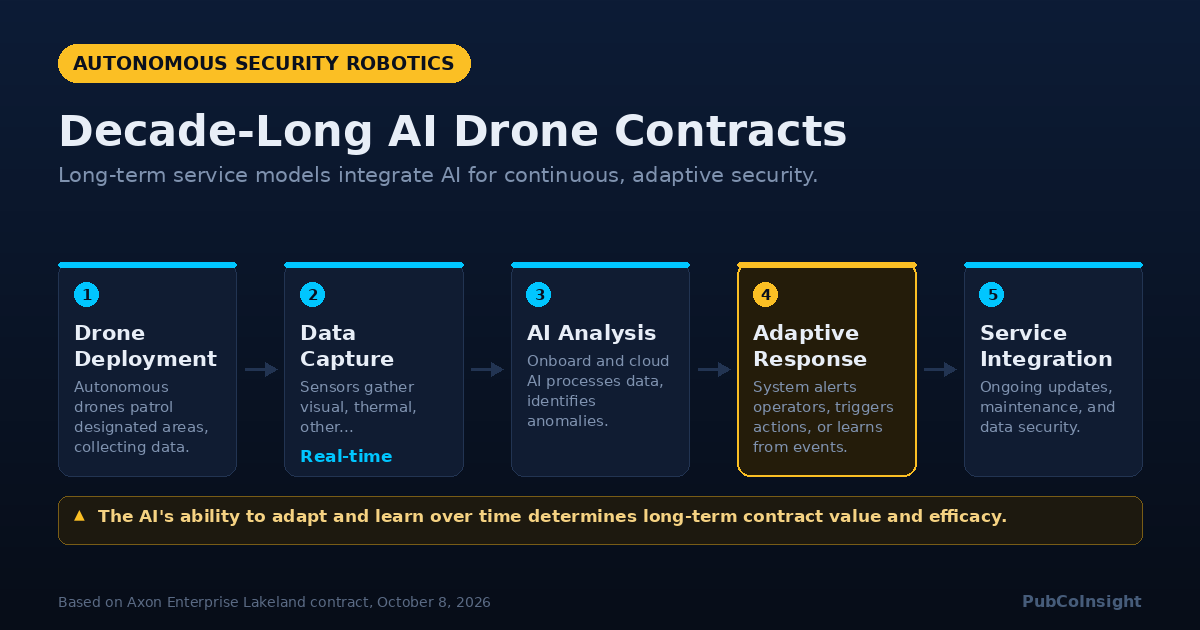
The Mechanism of Long-Term AI Integration
A decade-long contract for AI drones is not simply a purchase of flying cameras. It is an agreement to embed an autonomous system into a city's operational fabric. The core mechanism involves a continuous feedback loop: drones collect real-time data, AI algorithms analyze that data for anomalies or predefined events, and then the system triggers a response, which could be an alert to human operators, a coordinated action with other robotic units, or even a pre-programmed autonomous intervention. For this to work over ten years, the AI must be adaptable. It needs to learn from new data, update its recognition models, and integrate seamlessly with evolving municipal infrastructure and emergency services protocols. The physical AI component is critical. These drones are not just remote-controlled vehicles. They carry onboard processors capable of edge computing, allowing for immediate analysis of visual and other sensor data without constant reliance on central servers. This reduces latency and improves responsiveness, essential for security applications. The data collected - everything from thermal signatures to facial recognition - must be processed, stored, and secured, often on-premises or in highly secure cloud environments. The challenge lies in maintaining accuracy and reliability across diverse environmental conditions and evolving threat landscapes. Software updates, sensor recalibration, and hardware maintenance become continuous processes, built into the recurring service model. What would prove this model wrong? A high rate of false positives, system vulnerabilities, or an inability to adapt to new regulatory frameworks or public acceptance issues would quickly undermine the value of such a long-term commitment. The true value sits in the AI's ability to reduce human intervention while increasing security efficacy, consistently, for a decade.Companies in the Autonomous Security Sector
Several companies are navigating this evolving landscape, each with distinct approaches to autonomous security robotics and physical AI. Ondas Inc. (ONDS, price $6.85) is active in the drone and autonomous systems space, particularly with its Ondas Networks subsidiary focusing on private industrial wireless networks, which are crucial for reliable drone communication in challenging environments. The company recently reported adding over $165 million in new defense orders, boosting its 2027 revenue visibility. This indicates a strong pipeline for its drone technology, often in secure, mission-critical applications where network reliability is paramount. Ondas's focus on secure, private networks positions it well for long-term government or critical infrastructure contracts where data integrity and operational resilience are key. Red Cat Holdings, Inc. (RCAT, price $5.91) focuses on drone technology and services, particularly for defense and public safety. Their Skypersonic subsidiary offers remote inspection and training solutions, which could extend to long-term surveillance and monitoring contracts. Red Cat's emphasis on comprehensive drone solutions, from hardware to data analytics, aligns with the integrated service model that long-term contracts demand. Kopin Corporation (KOPN, price $4.2) develops microdisplays and optical components, essential for advanced drone vision systems and augmented reality applications. Kopin recently secured an additional $18.6 million U.S. Army contract for its color MicroLED technology, indicating its components are integrated into high-performance defense systems. While not directly building autonomous security robots, Kopin's technology is a foundational element for the sophisticated visual perception capabilities required by AI-powered drones and ground robots. Arbe Robotics Ltd. (ARBE, price $0.566) specializes in 4D imaging radar solutions. While primarily targeting automotive safety, their high-resolution radar can be crucial for autonomous security robots, providing robust perception in adverse weather conditions where optical sensors struggle. This technology offers a critical layer of redundancy and accuracy for robots operating in complex outdoor environments. MicroVision, Inc. (MVIS, price $1.31) develops lidar technology for automotive and industrial applications. Lidar provides precise 3D mapping capabilities, vital for autonomous navigation and object detection in security robots. Its integration can enhance the situational awareness of drones and ground units, allowing them to operate more effectively in dynamic settings. BigBear.ai Holdings, Inc. (BBAI, price $2.42) provides AI-powered analytics and decision intelligence solutions, primarily for government and defense clients. Their software platforms can process vast amounts of data collected by autonomous security systems, turning raw sensor input into actionable intelligence. This backend AI capability is essential for making long-term drone deployments effective and scalable. Lantronix, Inc. (LTRX, price $6.83) offers secure data access and management solutions for the Internet of Things (IoT). Their embedded computing and connectivity products are foundational for enabling remote management and data transfer for autonomous robots, ensuring reliable communication and control over long distances, a critical aspect of large-scale, long-term deployments. Serve Robotics Inc. (SERV, price $4.45) focuses on autonomous sidewalk delivery robots. While a different application, their experience with urban autonomous operations, navigation, and public interaction provides insights into deploying robots in complex, human-centric environments, lessons that can be applied to security patrols. Serve Robotics is scheduled to present at Evercore ISI's 5th Annual Automation Tech & Physical AI Conference, highlighting its continued engagement in the physical AI space. Unusual Machines, Inc. (UMAC, price $21.39) is a newer entrant, focusing on advanced robotics and automation. While specific details on their autonomous security offerings are still emerging, their general robotics expertise positions them to develop platforms that could integrate into the broader security market.Artificial Intelligence Technology Solutions, Inc.
Artificial Intelligence Technology Solutions, Inc. (AITX, price $0.0022), trading on the OTCID tier, develops and leases autonomous security robots and remote monitoring systems. The company operates through a Solutions-as-a-Service model, providing recurring monthly subscriptions rather than one-off hardware sales. This model aligns with the market's move towards long-term, integrated service contracts, similar to the Lakeland deal. AITX structures its operations across several subsidiaries. Robotic Assistance Devices, Inc. (RAD-I) focuses on stationary security devices, serving the estimated $50 billion U.S. security and guarding services market. The company states its solutions aim for cost savings of 35% to 80% compared to traditional manned security. Robotic Assistance Devices Mobile (RAD-M) develops mobile autonomous platforms, including the ROAMEO mobile security unit, which began early commercial deployment in May 2026. This mobile segment represents a potentially higher revenue ceiling than stationary solutions, according to the company's filings. Robotic Assistance Devices Group (RAD-G) oversees the SARA agentic artificial intelligence platform, which the company expects to generate substantial revenue through licensing. RAD Lanka, a wholly owned subsidiary in Sri Lanka, handles software development, AI initiatives, and technical operations. The company's long-term vision, referred to internally as "RAD Town," involves integrated autonomous security deployments across campuses, communities, or entire jurisdictions. This suggests a strategy to secure large, contiguous areas with a network of interconnected autonomous systems. For the fiscal year ended February 28, 2026, AITX reported revenue of $7,745,336, a 26% increase over the prior fiscal year. Gross profit rose 48% to $5,533,700, with gross margin expanding to approximately 71% from 61%. Operating expenses remained largely flat at about $17,477,097, and the loss from operations improved by approximately $2.0 million to $(11,943,397). The net loss for the same period was approximately $14.5 million, with an accumulated deficit of approximately $171 million as of that date. The public record does not yet establish a clear path to positive cash flow from operations, which the company has stated it does not anticipate in the near term. The company's filings indicate that RAD-I's recurring revenue and gross margin could, on a standalone basis, support positive cash flow operations, and that RAD-M will surpass RAD-I's monthly recurring revenue contribution at some future point. AITX's recent 8-K filings on October 7 and October 6, 2026, reported a substantial property management relationship expanding from small orders and a third ROAMEO order from a global logistics client, respectively. These indicate ongoing commercial activity and deployment of their mobile units.What to watch
Investors in this space should monitor several concrete indicators. Axon Enterprise's next quarterly earnings call will likely offer more detail on the Lakeland contract's financial specifics and integration timeline. Watch for announcements of similar long-term, multi-year contracts from other major security providers, particularly those involving city or county-level deployments of AI-powered robotics. Ondas Inc.'s progress in converting its $165 million in new defense orders into recognized revenue will be important, as will any further details on the specific applications of those orders. For AITX, look for updates on the expansion of their ROAMEO deployments and further clarity on the revenue contributions from their RAD-M and RAD-G segments, particularly regarding the SARA platform licensing. Any new filings detailing strategic partnerships for wider deployment of their "RAD Town" concept would also be significant., { "label": "Data Capture", "note": "Sensors gather visual, thermal, other environmental data.", "metric": "Real-time" }, { "label": "AI Analysis", "note": "Onboard and cloud AI processes data, identifies anomalies." }, { "label": "Adaptive Response", "note": "System alerts operators, triggers actions, or learns from events." }, { "label": "Service Integration", "note": "Ongoing updates, maintenance, and data security." } ], "highlight": 3, "highlight_note": "The AI's ability to adapt and learn over time determines long-term contract value and efficacy.", "footnote": "Based on Axon Enterprise Lakeland contract, October 8, 2026" }Companies mentioned
| Ticker | Company | Price |
|---|---|---|
| AITX client | Artificial Intelligence Technology Solutions Inc | $0.0022 |
| ARBE | Arbe Robotics Ltd. | $0.566 |
| BBAI | BigBear.ai Holdings, Inc. | $2.42 |
| KOPN | Kopin Corporation | $4.2 |
| LTRX | Lantronix, Inc. | $6.83 |
| MVIS | MicroVision, Inc. | $1.31 |
| ONDS | Ondas Inc. | $6.85 |
| RCAT | Red Cat Holdings, Inc. | $5.91 |
| SERV | Serve Robotics Inc. | $4.45 |
| UMAC | Unusual Machines, Inc. | $21.39 |
Listed alphabetically, not ranked. Prices as of 2026-10-09 and they move. Check a live quote before relying on any of this.
How we chose the companies in this article
We cover a fixed universe of companies working in autonomous security robotics, physical AI and the guarding services market they are aimed at. Every one of them that had usable market data on 2026-10-09 appears in this article. We do not pick which ones to mention based on what we think of them, and we do not order them by size, price or trading volume, because an ordered list is a verdict and that is not ours to hand down. Companies left out, and why: none. American Lithium Minerals and Artificial Intelligence Technology Solutions pay us, which is disclosed in full at the foot of every article they appear in.
See the dilution and promotion flags before you see the pitch.
Each week: the micro and small-caps now showing dilution or paid-promotion signals, with the SEC filing behind every flag. No recommendations, no price targets.
Sources used in this article
- Axon Enterprise (AXON) Stock Looks Fairly Priced Despite Its 133% Five Year Run Simply Wall St. · 2026-10-09
- Prediction: Amazon Could Turn a $10K Investment Into This by 2030 Motley Fool · 2026-10-09
- OpenAI’s Revenue Appears $20 Billion Lighter Than Reported — and the Gap Is Accounting, Not Demand Forkast News · 2026-10-09
- Top Storage Stock to Buy With $500 Right Now Motley Fool · 2026-10-09
- Providing Tools and Resources to Protect Investors Motley Fool · 2026-10-09
- Should You Buy the Solana Cryptocurrency While It's Still Below Its $262 Peak? Motley Fool · 2026-10-09
- Stocks to Watch: SpaceX, AT&T, Delta, Humana The Wall Street Journal · 2026-10-09
- The U.S. Economy Just Delivered Bad News. History Says It Could Be Good News for the S&P 500. Motley Fool · 2026-10-09
- Nvidia’s Subtle Change to How It Counts Cash Flow Has Big Implications for Buybacks The Wall Street Journal · 2026-10-09
- If You're Worried About an AI Bubble, Here's the Tech Stock Portfolio I'd Build Motley Fool · 2026-10-09
- Update: Market Chatter: Nvidia-Backed Firmus Reportedly Scraps $5 Billion IPO MT Newswires · 2026-10-09
- Zacks Industry Outlook Allegion, ADT, Alarm.com Holdings and Ituran Location and Control Zacks · 2026-10-09
Disclosure required by Section 17(b) of the Securities Act of 1933
Artificial Intelligence Technology Solutions, Inc., a Nevada corporation (OTCID: AITX). Artificial Intelligence Technology Solutions, Inc. pays Strategic Innovations First, Inc., a Wyoming corporation doing business as PulseIR. Compensation received: USD 5,000.00 per month for months 1-3 (August, September, October 2026); USD 10,000.00 per month for months 4-6 (November, December 2026, January 2027) contingent on the 90-day review. Minimum committed USD 15,000.00; USD 45,000.00 if the second-period rate triggers.. Form of payment: cash only, invoiced monthly in advance; no stock, options or warrants received or payable. Services: investor relations services under an Investor Relations Services Agreement effective 2026-08-01. Period: six month term, 2026-08-01 through 2027-01-31; 90-day review on or about 2026-10-30. No stock, options or warrants held by PubCo Insight, Pulse IR, Strategic Innovations First, Inc., or Brad Listermann. Confirmed by the executed agreement and by board record recKwdq39X2caPSX7 (POSITIONS HELD: none).
This is information, not investment, financial, legal or tax advice. It is not a recommendation or solicitation to buy, sell or hold any security and it contains no price target. Nothing here is independently verified by us. Confirm every figure against primary filings on SEC EDGAR before you act. Micro-cap and over-the-counter securities are speculative and illiquid and can lose all of their value. The companies named without a disclosure above pay us nothing and have no relationship with us; they are named because a published, mechanical screen selected them. Full disclosure policy.