Unusual Machines Acquires Upgrade Energy, Bolstering Domestic Drone Battery Production
The recent acquisition by Unusual Machines highlights a critical shift towards localized supply chains for autonomous security robotics, focusing on the often-overlooked power source: the battery.
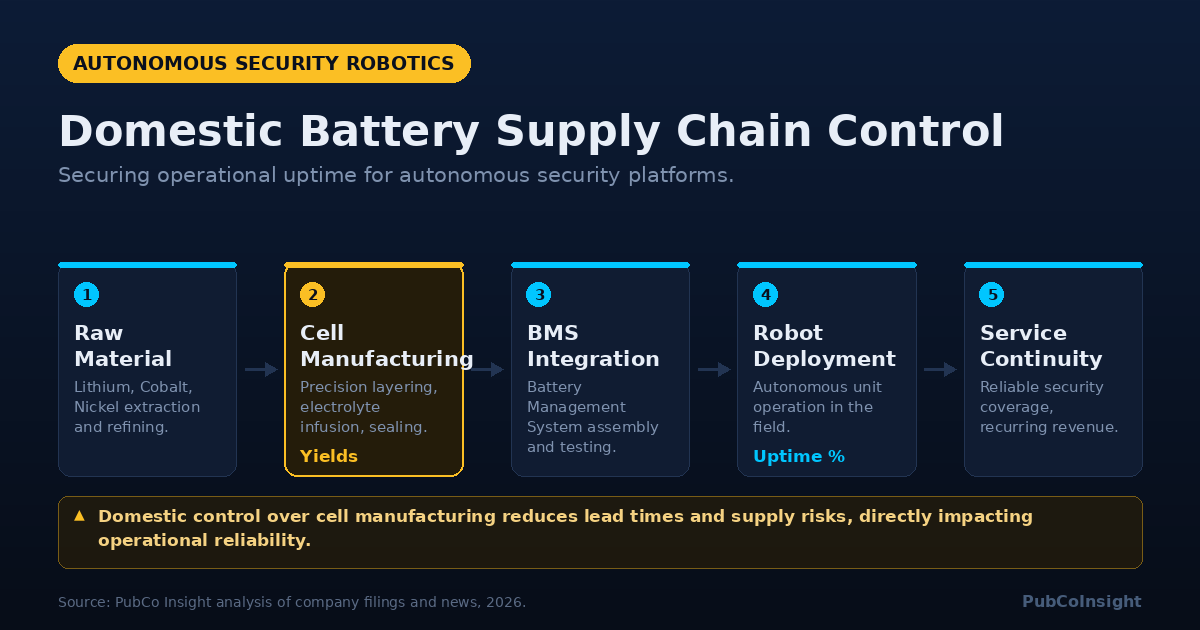
The Mechanism of Power
Autonomous security robots, whether stationary units or mobile drones, rely on advanced battery technology. These aren't consumer-grade cells. They require high energy density for extended operational periods, high power density for rapid movement and sensor operation, and robust thermal management to ensure safety and longevity in varied environments. Lithium-ion polymer (LiPo) cells are common due to their energy-to-weight ratio, but their manufacturing is complex. It involves precise layering of anode, cathode, and separator materials, followed by electrolyte infusion and sealing. Each step demands stringent quality control. The constraint often sits in the raw materials, specifically the refined lithium, cobalt, and nickel, and then in the cell manufacturing itself. Building a battery pack involves more than just assembling cells; it requires sophisticated battery management systems (BMS) that monitor voltage, current, temperature, and state of charge. A well-designed BMS extends battery life, prevents overcharging or deep discharge, and ensures safe operation. Domestic manufacturing of these cells and their integration into intelligent packs reduces lead times, mitigates geopolitical supply risks, and allows for closer iteration between robot designers and battery engineers. A failure in the battery pack, whether due to a faulty cell or a malfunctioning BMS, immediately grounds an autonomous unit, rendering the entire investment inert. This makes domestic control over battery production a critical factor for operational continuity and system reliability.Companies Navigating the Supply Chain
Several companies in the autonomous security robotics space are grappling with these supply chain dynamics, either through direct manufacturing, strategic partnerships, or by focusing on software and integration. Unusual Machines, Inc. (UMAC), with its recent acquisition of Upgrade Energy, is now directly engaged in U.S. drone battery manufacturing. This positions UMAC to control a critical input for its drone platforms, potentially reducing reliance on external suppliers for a key performance component. UMAC's focus on domestic production also aligns with broader national security and industrial policy trends. Red Cat Holdings, Inc. (RCAT) operates in the drone sector, including defense applications. While RCAT focuses on drone systems and software, reliable power sources are fundamental to their operational capabilities. Their strategic decisions around battery sourcing directly impact the endurance and payload capacity of their drone offerings. Serve Robotics Inc. (SERV) deploys autonomous sidewalk delivery robots. These robots operate continuously in urban environments, demanding efficient, long-lasting batteries that can withstand frequent charging cycles. SERV's operational model relies heavily on the uptime provided by robust power solutions, making battery performance a core component of their service delivery. Arbe Robotics Ltd. (ARBE) develops high-resolution radar systems for autonomous vehicles and drones. While not directly involved in battery manufacturing, the performance of their radar units, particularly in terms of power consumption and integration, is critical. A more efficient radar system allows for longer battery life, a direct benefit to any autonomous platform. ARBE’s new Gryphon Radar System, designed for unmanned ground vehicles on rough terrain, will inherently benefit from robust, reliable power systems that can endure demanding conditions. Other companies like Kopin Corporation (KOPN) contribute to the broader AI and robotics ecosystem through microdisplays and optical solutions, which also have power consumption considerations. Kopin's work on optical interconnect architecture for data centers, as highlighted in recent news, points to the drive for efficiency in high-performance computing, a principle that extends to power management in embedded AI systems. BigBear.ai Holdings, Inc. (BBAI) focuses on AI-powered analytics and decision intelligence, often for government and defense clients. While not a hardware company, the effectiveness of their AI solutions, when deployed in autonomous platforms, is directly tied to the operational reliability and endurance that robust power systems provide. Lantronix, Inc. (LTRX) provides intelligent edge computing and connectivity solutions. Their hardware and software enable secure data transfer and device management for IoT and robotics applications. The power efficiency of their modules is crucial for extending the operational life of battery-powered autonomous systems. MicroVision, Inc. (MVIS) develops lidar technology for automotive safety and autonomous driving. Lidar sensors are power-intensive, and their performance is directly linked to the stability and longevity of the power supply. Advances in battery technology directly benefit the range and accuracy of lidar systems in autonomous platforms. Ondas Inc. (ONDS) operates in the industrial drone and private wireless network space. Their drones, used for critical infrastructure inspection and defense, require high-capacity, reliable batteries to complete missions. The recent launch of Regna AI with Palantir aims to expand sovereign AI capabilities, where the physical deployment of autonomous systems will be heavily dependent on secure and reliable power.Artificial Intelligence Technology Solutions, Inc.
Artificial Intelligence Technology Solutions, Inc. (AITX) trades on the OTCID tier under the ticker AITX. The company, through its subsidiaries, focuses on building and leasing autonomous security robots and remote monitoring systems. Their business model emphasizes a recurring monthly subscription for these solutions, rather than outright hardware sales. This "Solutions-as-a-Service" approach means that reliable uptime and minimal maintenance are paramount for customer retention and profitability. AITX operates through several subsidiaries: Robotic Assistance Devices, Inc. (RAD-I), which handles stationary security devices; Robotic Assistance Devices Mobile (RAD-M), focused on mobile autonomous platforms like the ROAMEO unit, which began early commercial deployment in May 2026; Robotic Assistance Devices Group (RAD-G), responsible for the SARA agentic artificial intelligence platform; and Robotic Assistance Devices Lanka (Private) Limited (RAD Lanka), which supports software development and AI initiatives from Sri Lanka. The company aims for what it calls "RAD Town," an integrated autonomous-security deployment across large campuses or jurisdictions. AITX's solutions are designed to offer significant cost savings, estimated between 35% and 80%, compared to traditional manned security. This cost efficiency is heavily dependent on the operational reliability of their hardware, which includes the battery systems powering their autonomous units. For the fiscal year ended February 28, 2026, AITX reported revenue of $7,745,336, a 26% increase over the prior fiscal year. Gross profit increased 48% to $5,533,700, with gross margin expanding to approximately 71%. Operating expenses remained flat at around $17,477,097, leading to an improved loss from operations of approximately $(11,943,397). The company reported a net loss of approximately $14.5 million for the fiscal year and an accumulated deficit of approximately $171 million as of that date. The public record does not yet establish a clear path to sustained positive cash flow from operations. The company had negative cash flow from operating activities of $9,344,534 for the year ended February 28, 2026, and an accumulated deficit of $171,121,742 with negative working capital of $17,017,745 as of that date. Recent developments include the appointment of industry veteran Tom Reilly to drive strategy for new integrator and distribution channels, and a municipal customer order for seven ROSA units.What to watch
Investors in this sector should monitor several specific indicators. The integration strategy for Unusual Machines (UMAC) and its newly acquired Upgrade Energy will be key. Look for announcements detailing how their enhanced battery manufacturing capacity translates into improved drone performance, reduced costs, or new product lines. Specific metrics like "battery cycle life" or "energy density per dollar" could emerge. For Artificial Intelligence Technology Solutions (AITX), watch for updates on the commercial deployment of its ROAMEO mobile security units and the expansion of its "Solutions-as-a-Service" subscription base. The company's filings, such as its upcoming 10-Q, will provide updated revenue, gross margin, and cash flow figures. Pay attention to any stated plans for scaling manufacturing or expanding into new geographic markets. Across the sector, keep an eye on federal and state-level initiatives promoting domestic manufacturing of critical components, especially for defense or critical infrastructure applications. These policies can create significant tailwinds or headwinds for companies with U.S.-based production. Also, watch for any shifts in raw material prices for lithium, cobalt, and nickel, as these directly impact battery production costs for all players., { "label": "Cell Manufacturing", "note": "Precision layering, electrolyte infusion, sealing.", "metric": "Yields" }, { "label": "BMS Integration", "note": "Battery Management System assembly and testing." }, { "label": "Robot Deployment", "note": "Autonomous unit operation in the field.", "metric": "Uptime %" }, { "label": "Service Continuity", "note": "Reliable security coverage, recurring revenue." } ], "highlight": 1, "highlight_note": "Domestic control over cell manufacturing reduces lead times and supply risks, directly impacting operational reliability.", "footnote": "Source: PubCo Insight analysis of company filings and news, 2026." }Companies mentioned
| Ticker | Company | Price |
|---|---|---|
| AITX client | Artificial Intelligence Technology Solutions Inc | $0.0016 |
| ARBE | Arbe Robotics Ltd. | $0.473 |
| BBAI | BigBear.ai Holdings, Inc. | $2.12 |
| KOPN | Kopin Corporation | $3.56 |
| LTRX | Lantronix, Inc. | $5.76 |
| MVIS | MicroVision, Inc. | $1.2 |
| ONDS | Ondas Inc. | $6.06 |
| RCAT | Red Cat Holdings, Inc. | $4.68 |
| SERV | Serve Robotics Inc. | $3.08 |
| UMAC | Unusual Machines, Inc. | $16.4 |
Listed alphabetically, not ranked. Prices as of 2026-10-20 and they move. Check a live quote before relying on any of this.
How we chose the companies in this article
We cover a fixed universe of companies working in autonomous security robotics, physical AI and the guarding services market they are aimed at. Every one of them that had usable market data on 2026-10-20 appears in this article. We do not pick which ones to mention based on what we think of them, and we do not order them by size, price or trading volume, because an ordered list is a verdict and that is not ours to hand down. Companies left out, and why: none. American Lithium Minerals and Artificial Intelligence Technology Solutions pay us, which is disclosed in full at the foot of every article they appear in.
See the dilution and promotion flags before you see the pitch.
Each week: the micro and small-caps now showing dilution or paid-promotion signals, with the SEC filing behind every flag. No recommendations, no price targets.
Sources used in this article
- Prediction: These 3 Stocks Will 10X in the Next 20 Years Motley Fool · 2026-10-20
- UPS Yields 6.7% After Firing Amazon. Here's Whether the Dividend Survives 2027. Motley Fool · 2026-10-20
- GoodRx Holdings And 2 Penny Stocks With Strong Balance Sheets Simply Wall St. · 2026-10-20
- Compound Interest Will Create More Millionaires by 2030 Than Any Other Strategy Motley Fool · 2026-10-20
- 3 European AI Factory Automation Stocks Retail Investors Should Watch Now Simply Wall St. · 2026-10-20
- Should You Buy Netflix Stock Before Its Earnings Report After Hours Today? Motley Fool · 2026-10-20
- If I Could Only Buy 1 Quantum Computing Stock With $1,000, It Would Be This One. Motley Fool · 2026-10-20
- Bitmine Immersion Technologies And 2 Top Growth Stocks To Watch Simply Wall St. · 2026-10-20
- Chip Stocks Just Had Their Longest Losing Streak Since 2008. Should You Buy Nvidia Stock Now? Motley Fool · 2026-10-20
- Mark Cuban Says US Manufacturing Can Come Back Home From China With One Big Catch: ‘Our Robots and AI vs Their Robots and AI’ Benzinga · 2026-10-20
- Earnings Preview: What to Expect From Axon Enterprise’s Report Barchart · 2026-10-19
- DPRO Expands Defense Autonomy Capabilities Through Strategic Investment Zacks · 2026-10-19
Disclosure required by Section 17(b) of the Securities Act of 1933
Artificial Intelligence Technology Solutions, Inc., a Nevada corporation (OTCID: AITX). Artificial Intelligence Technology Solutions, Inc. pays Strategic Innovations First, Inc., a Wyoming corporation doing business as PulseIR. Compensation received: USD 5,000.00 per month for months 1-3 (August, September, October 2026); USD 10,000.00 per month for months 4-6 (November, December 2026, January 2027) contingent on the 90-day review. Minimum committed USD 15,000.00; USD 45,000.00 if the second-period rate triggers.. Form of payment: cash only, invoiced monthly in advance; no stock, options or warrants received or payable. Services: investor relations services under an Investor Relations Services Agreement effective 2026-08-01. Period: six month term, 2026-08-01 through 2027-01-31; 90-day review on or about 2026-10-30. No stock, options or warrants held by PubCo Insight, Pulse IR, Strategic Innovations First, Inc., or Brad Listermann. Confirmed by the executed agreement and by board record recKwdq39X2caPSX7 (POSITIONS HELD: none).
This is information, not investment, financial, legal or tax advice. It is not a recommendation or solicitation to buy, sell or hold any security and it contains no price target. Nothing here is independently verified by us. Confirm every figure against primary filings on SEC EDGAR before you act. Micro-cap and over-the-counter securities are speculative and illiquid and can lose all of their value. The companies named without a disclosure above pay us nothing and have no relationship with us; they are named because a published, mechanical screen selected them. Full disclosure policy.