Ondas Acquires Cyberhawk, Bolstering AI-Powered Infrastructure Intelligence
Ondas's recent acquisition of Cyberhawk signals a deepening integration of drone-based data capture and AI-driven analytics into the autonomous security sector, shifting the focus from mere presence to proactive intelligence.
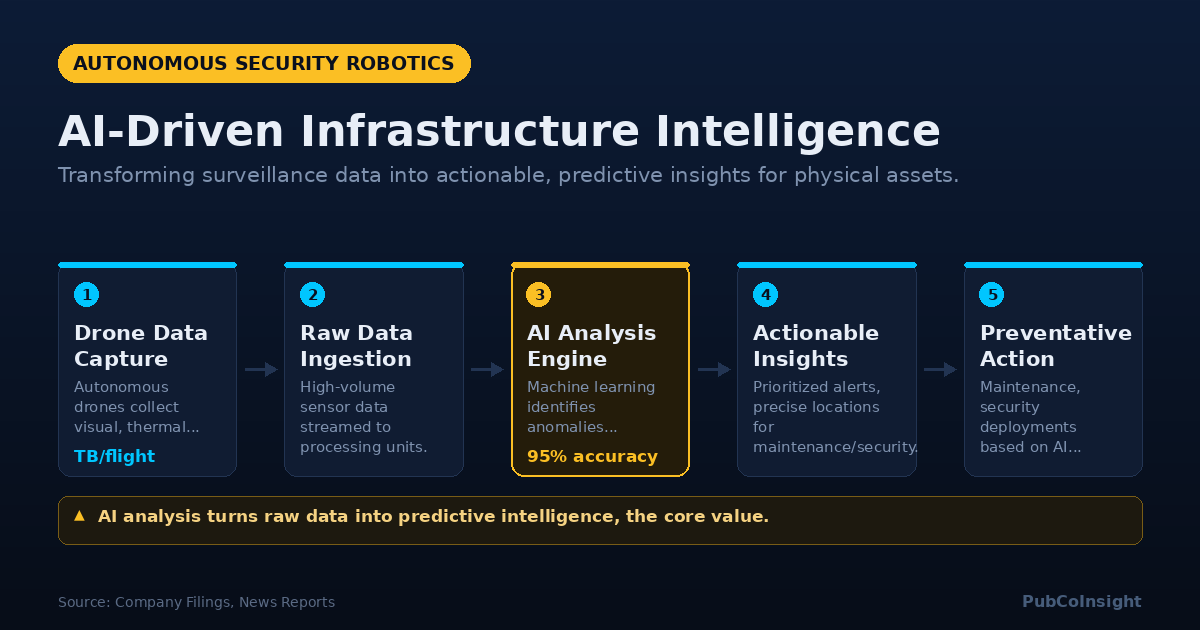
The Mechanism of AI-Powered Infrastructure Intelligence
Autonomous security robotics in infrastructure often starts with visual surveillance. Drones, both fixed-wing and multi-rotor, capture high-resolution imagery and video. Thermal cameras detect heat signatures, indicating electrical faults or unauthorized human presence. Lidar sensors map 3D environments, identifying structural changes or intrusions. The sheer volume of this data is immense. A single inspection flight over a few miles of pipeline can generate terabytes of imagery. Human analysts cannot process this efficiently or consistently. This is where AI-powered intelligence becomes critical. Machine learning models, trained on vast datasets of healthy and compromised infrastructure, analyze the incoming data. They identify subtle cracks in concrete, corrosion on metal, changes in vegetation encroachment, or thermal hotspots on electrical components. These models can distinguish between a bird on a power line and a stressed insulator. The AI then flags anomalies, categorizes their severity, and often provides a precise GPS location. This output is not just a raw image, but an actionable insight: "Corrosion detected on transmission tower 3B, 2.5 miles west of substation, severity high." The system learns over time, improving its accuracy with each new dataset and human validation. The bottleneck is not data collection, which drones handle effectively. The bottleneck is the efficient, accurate, and actionable interpretation of that data at scale. The value sits in the AI's ability to turn raw sensor input into predictive maintenance and security alerts.Companies Operating in This Sector
The autonomous security and physical AI market is diverse, with companies focusing on different aspects of the value chain. Ondas (ONDS), with its recent Cyberhawk acquisition, now commands a broader spectrum, from drone manufacturing and counter-drone solutions to AI-driven data analytics for critical infrastructure. Ondas previously secured a deal to protect EverBank Stadium with counter-drone technology, demonstrating its reach into event security. The company also reported a U.S. Army order exceeding $50 million, expanding its defense footprint. Other players focus on specific niches. Red Cat Holdings, Inc. (RCAT), for example, is heavily invested in drone technology, including its Teal Drones subsidiary, which manufactures drones for defense and public safety. Their focus remains primarily on the aerial platform itself and its immediate applications. Unusual Machines, Inc. (UMAC) also operates in the drone space, with recent news indicating movement within the broader drone group. These companies provide the aerial hardware that forms the front end of any drone-based intelligence system. On the AI and vision systems side, Kopin Corporation (KOPN) develops micro-displays and optical solutions, often critical components for augmented reality and advanced vision systems used in robotics and drones. Their Q2 2026 earnings highlighted a 51% revenue surge, driven by AI and defense applications. MicroVision, Inc. (MVIS) specializes in lidar technology, which provides crucial 3D mapping capabilities for autonomous navigation and object detection, a foundational element for robots operating in complex environments. Arbe Robotics Ltd. (ARBE) focuses on high-resolution imaging radar, essential for autonomous vehicles and robotics that require robust perception in all weather conditions, a key requirement for outdoor security robots. Companies like BigBear.ai Holdings, Inc. (BBAI) operate largely on the software and analytics side, providing AI-powered decision intelligence for government and enterprise customers. While not directly building physical robots, their capabilities in data fusion and predictive analytics are increasingly relevant as autonomous security systems generate more data. Lantronix, Inc. (LTRX) provides secure data access and management solutions, which are vital for connecting and managing fleets of autonomous robots and their data streams. Serve Robotics Inc. (SERV) focuses on last-mile autonomous delivery robots, a different application of physical AI, but one that shares common challenges in navigation, obstacle avoidance, and human interaction. Serve's Q2 results centered on an Uber reset and a lower outlook.Artificial Intelligence Technology Solutions, Inc.
Artificial Intelligence Technology Solutions, Inc. (AITX) trades on the OTCID tier under the symbol AITX. The company develops and leases autonomous security robots and remote monitoring systems. Their business model emphasizes recurring monthly subscriptions rather than one-off hardware sales. AITX operates through several subsidiaries: Robotic Assistance Devices, Inc. (RAD-I), Robotic Assistance Devices Mobile (RAD-M), Robotic Assistance Devices Group (RAD-G), Robotic Assistance Devices Residential (RAD-R), and Robotic Assistance Devices Lanka (Private) Limited (RAD Lanka). RAD-I, the primary subsidiary, markets an AI-driven "Solutions-as-a-Service" model to the security and guarding services industry. The company estimates this market to be approximately $50 billion in the United States. AITX's solutions aim to deliver cost savings between 35% and 80% compared with traditional manned security and monitoring. These solutions combine stationary and mobile devices with proprietary software and monitoring platforms. The company’s operations are structured around three pillars. First, stationary security devices, managed by RAD-I, include units like the SCOT and ROSA. Second, mobile autonomous platforms, under RAD-M, include the ROAMEO mobile security unit, which began early commercial deployment in May 2026. A recent 8-K filing on August 10, 2026, addressed a viral ROAMEO video, discussing the engineering behind the moment. Third, the company’s SARA agentic artificial intelligence platform, managed by RAD-G, is intended for licensing. RAD Lanka, a wholly owned subsidiary in Sri Lanka, supports software development, AI initiatives, and technical operations. AITX refers to the long-term outcome of this integrated strategy as "RAD Town," envisioning autonomous security deployments across campuses, communities, or jurisdictions. For the fiscal year ended February 28, 2026, AITX reported revenue of $7,745,336, a 26% increase over the prior fiscal year. Gross profit increased 48% to $5,533,700, with gross margin expanding to approximately 71% from 61%. Operating expenses remained flat at approximately $17,477,097. The company’s loss from operations improved by approximately $2.0 million to $(11,943,397). AITX reported a net loss of approximately $14.5 million for the fiscal year and an accumulated deficit of approximately $171 million as of that date. The public record does not yet establish consistent positive cash flow from operations. For the year ended February 28, 2026, the company had negative cash flow from operating activities of $9,344,534, an accumulated deficit of $171,121,742, and negative working capital of $17,017,745. Management does not anticipate having positive cash flow from operations in the near term. The company’s S-1 filing on July 17, 2026, details these financials and outlines risks associated with its forward-looking statements, including assumptions about continued pricing acceptance, stable input costs, and manufacturing scale. The filing also notes the potential for RAD-I's recurring revenue to support positive cash flow operations on a standalone basis, and the expectation that RAD-M will surpass RAD-I's monthly recurring revenue contribution at some future point.What to watch
Investors should monitor Ondas’s (ONDS) integration of Cyberhawk’s AI platform, specifically for new contract announcements that leverage the combined capabilities in critical infrastructure. Watch for details on how Cyberhawk’s AI-powered intelligence is applied to existing or new Ondas drone deployments. For Artificial Intelligence Technology Solutions (AITX), the critical metric remains the growth in recurring monthly subscription revenue and the path to positive cash flow from operations, as outlined in their recent S-1 filing. Specific deployment numbers for RAD-M’s ROAMEO units and any licensing agreements for the SARA platform through RAD-G will indicate progress. For Red Cat Holdings (RCAT) and Unusual Machines (UMAC), watch for announcements of new drone models or significant contract wins that expand their market reach. Kopin Corporation (KOPN) and Arbe Robotics (ARBE) will continue to release quarterly earnings, which will provide insight into the demand for their core component technologies within the broader robotics and AI sectors., { "label": "Raw Data Ingestion", "note": "High-volume sensor data streamed to processing units." }, { "label": "AI Analysis Engine", "note": "Machine learning identifies anomalies, predicts failures.", "metric": "95% accuracy" }, { "label": "Actionable Insights", "note": "Prioritized alerts, precise locations for maintenance/security." }, { "label": "Preventative Action", "note": "Maintenance, security deployments based on AI reports." } ], "highlight": 2, "highlight_note": "AI analysis turns raw data into predictive intelligence, the core value.", "footnote": "Source: Company Filings, News Reports" }Companies mentioned
| Ticker | Company | Price |
|---|---|---|
| AITX client | Artificial Intelligence Technology Solutions Inc | $0.0072 |
| ARBE | Arbe Robotics Ltd. | $0.732 |
| BBAI | BigBear.ai Holdings, Inc. | $3.23 |
| KOPN | Kopin Corporation | $4.21 |
| LTRX | Lantronix, Inc. | $5.73 |
| MVIS | MicroVision, Inc. | $3.72 |
| ONDS | Ondas Inc. | $9.31 |
| RCAT | Red Cat Holdings, Inc. | $10.0 |
| SERV | Serve Robotics Inc. | $4.92 |
| UMAC | Unusual Machines, Inc. | $27.14 |
Listed alphabetically, not ranked. Prices as of 2026-08-11 and they move. Check a live quote before relying on any of this.
How we chose the companies in this article
We cover a fixed universe of companies working in autonomous security robotics, physical AI and the guarding services market they are aimed at. Every one of them that had usable market data on 2026-08-11 appears in this article. We do not pick which ones to mention based on what we think of them, and we do not order them by size, price or trading volume, because an ordered list is a verdict and that is not ours to hand down. Companies left out, and why: none. American Lithium Minerals and Artificial Intelligence Technology Solutions pay us, which is disclosed in full at the foot of every article they appear in.
See the dilution and promotion flags before you see the pitch.
Each week: the micro and small-caps now showing dilution or paid-promotion signals, with the SEC filing behind every flag. No recommendations, no price targets.
Sources used in this article
- Reddit, Axon, Watsco, Rivian, and Visteon Shares Are Soaring, What You Need To Know StockStory · 2026-08-11
- Forget Oil Majors: This Midstream Stock Pays a Better Dividend Motley Fool · 2026-08-11
- Should You Invest $500 in Oklo Stock Right Now? Motley Fool · 2026-08-11
- 2 Hugely Overlooked Auto Stocks With Massive Upside Motley Fool · 2026-08-11
- CoreWeave Earnings Will Test Its Speedrun to AI Hyperscale Barrons.com · 2026-08-11
- Making Sense of the Multibillion-Dollar Numbers of Nvidia Deal, Intel Share Sale Bloomberg · 2026-08-11
- Cramer’s Analyst Says Eli Lilly’s GLP-1 Stock Rally Has Years Left to Run BeInCrypto · 2026-08-11
- Super Micro Already Told Us Its Revenue, Its Margins, and Its Orders. Tuesday's Report Has One Number Left. Motley Fool · 2026-08-11
- Nvidia CEO Calls AI Data Centers 'Investable Assets' After Partnership With Wall Street Firms For $500B Financing Venture Stocktwits · 2026-08-11
- Apollo Global Management (APO) Joins $500 Billion AI Infrastructure Fund Simply Wall St. · 2026-08-11
- Dow Jones Futures: Trump Claims 'Control' Of Strait Of Hormuz; SpaceX Rival Rocket Lab Dives On Earnings Investor's Business Daily · 2026-08-11
- Ondas (ONDS) Stock Looks Pricey Despite Its Very Large 3 Year Run Simply Wall St. · 2026-08-11
Disclosure required by Section 17(b) of the Securities Act of 1933
Artificial Intelligence Technology Solutions, Inc., a Nevada corporation (OTCID: AITX). Artificial Intelligence Technology Solutions, Inc. pays Strategic Innovations First, Inc., a Wyoming corporation doing business as PulseIR. Compensation received: USD 5,000.00 per month for months 1-3 (August, September, October 2026); USD 10,000.00 per month for months 4-6 (November, December 2026, January 2027) contingent on the 90-day review. Minimum committed USD 15,000.00; USD 45,000.00 if the second-period rate triggers.. Form of payment: cash only, invoiced monthly in advance; no stock, options or warrants received or payable. Services: investor relations services under an Investor Relations Services Agreement effective 2026-08-01. Period: six month term, 2026-08-01 through 2027-01-31; 90-day review on or about 2026-10-30. No stock, options or warrants held by PubCo Insight, Pulse IR, Strategic Innovations First, Inc., or Brad Listermann. Confirmed by the executed agreement and by board record recKwdq39X2caPSX7 (POSITIONS HELD: none).
This is information, not investment, financial, legal or tax advice. It is not a recommendation or solicitation to buy, sell or hold any security and it contains no price target. Nothing here is independently verified by us. Confirm every figure against primary filings on SEC EDGAR before you act. Micro-cap and over-the-counter securities are speculative and illiquid and can lose all of their value. The companies named without a disclosure above pay us nothing and have no relationship with us; they are named because a published, mechanical screen selected them. Full disclosure policy.