Unusual Machines Secures $16.9 Million Drone Component Order from Powerus
A recent $16.9 million purchase order for American-made drone components highlights the critical role of domestic manufacturing in the autonomous security robotics supply chain.
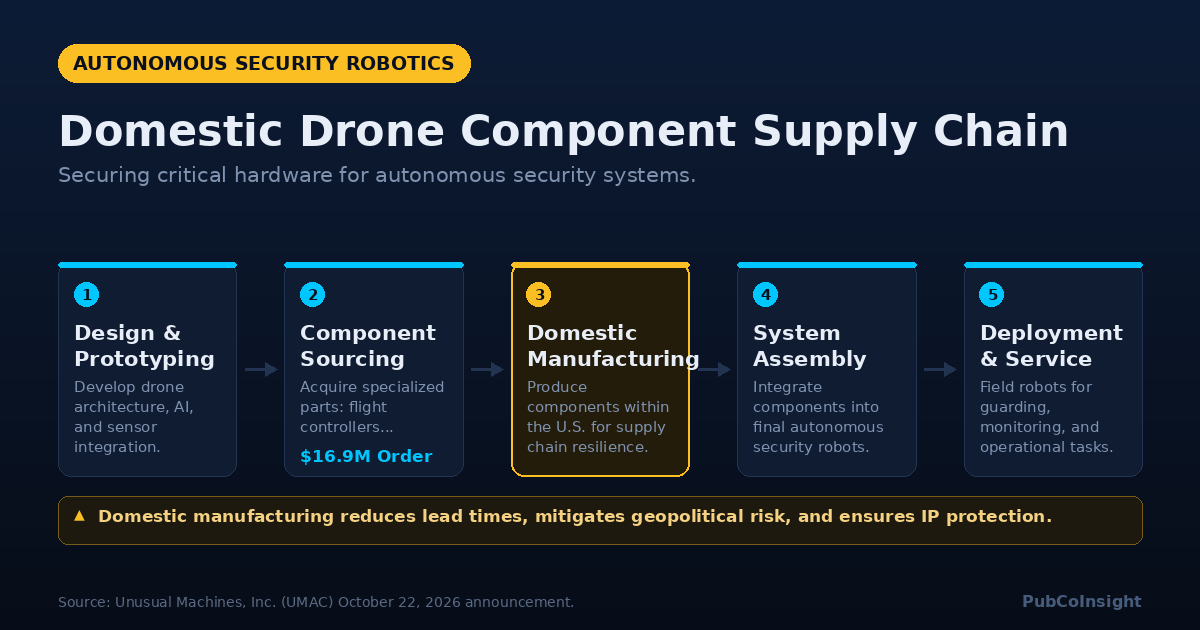
The Mechanism of Domestic Drone Component Supply
Building an autonomous security drone involves more than assembling off-the-shelf parts. The core challenge lies in integrating specialized components: flight controllers, advanced sensor arrays, secure communication modules, and high-density power systems. Each of these requires specific manufacturing expertise and often proprietary intellectual property. For a drone to be "American-made," a significant portion of these sub-assemblies must originate domestically. This includes everything from the printed circuit boards to the custom-machined chassis and the battery cells themselves. The bottleneck often sits at the intersection of advanced material science and precision engineering. For example, high-energy-density lithium polymer batteries, essential for extended flight times, require specialized chemical processes and manufacturing facilities. Producing these at scale, with consistent quality and competitive cost, is a complex undertaking. The alternative is reliance on overseas suppliers, which introduces vulnerabilities in logistics, quality control, and intellectual property protection. An order like Powerus's to Unusual Machines indicates a willingness to invest in or contract with domestic manufacturers who can meet these stringent requirements. Success hinges on a supplier's ability to scale production while maintaining tight specifications and cost efficiency. Failure would mean a return to fragmented international supply lines, increasing lead times and operational risk.Companies in the Sector's Supply Chain
The autonomous security robotics sector draws on a diverse set of companies, each contributing to the ecosystem. Some focus on the foundational AI, others on the physical hardware, and many on the integration of both. Companies like BigBear.ai Holdings, Inc. (BBAI), trading at $2.13, and Lantronix, Inc. (LTRX), at $5.61, are primarily involved in the software and data analytics layers. BigBear.ai provides AI-powered analytics and decision support, essential for interpreting sensor data from autonomous robots. Lantronix specializes in secure connectivity and intelligent edge computing solutions, which are critical for reliable communication and local processing on robotic platforms. On the hardware side, Kopin Corporation (KOPN), priced at $3.35, develops micro-displays and optical solutions, components that could find application in advanced sensor systems or augmented reality interfaces for drone operators. MicroVision, Inc. (MVIS), at $1.14, focuses on lidar technology, a key sensing modality for autonomous navigation and object detection in complex environments. The drone and mobile robotics segments include companies like Red Cat Holdings, Inc. (RCAT), trading at $4.37, which develops and produces drones for various applications, including defense and public safety. Serve Robotics Inc. (SERV), at $2.88, builds and deploys sidewalk delivery robots, demonstrating expertise in autonomous ground vehicle navigation and operation. Ondas Inc. (ONDS), priced at $6.02, works on mission-critical wireless networks and industrial drones, with a recent focus on airborne defense prospects, as evidenced by its EASA certification efforts and partnership with Palantir for Regna AI. Arbe Robotics Ltd. (ARBE), at $0.439, recently introduced its Gryphon Radar System, designed to provide reliable perception for unmanned ground vehicles, addressing a critical need for robust navigation in challenging terrains. This recent order directly impacts Unusual Machines, Inc. (UMAC), which trades at $16.27. Unusual Machines is positioned as a domestic manufacturer of drone components. The $16.9 million order from Powerus underscores their role in building out the physical infrastructure for American-made autonomous systems. Their recent acquisition of Upgrade Energy, announced on October 19, 2026, further solidifies their commitment to expanding U.S. drone battery manufacturing capabilities, a crucial element in the domestic supply chain.Artificial Intelligence Technology Solutions, Inc.
Artificial Intelligence Technology Solutions, Inc. (AITX), trading over the counter at $0.0015, operates through a family of subsidiaries, including Robotic Assistance Devices, Inc. (RAD-I), Robotic Assistance Devices Mobile (RAD-M), Robotic Assistance Devices Group (RAD-G), Robotic Assistance Devices Residential (RAD-R), and RAD Lanka. The company develops and leases AI-driven security robots and remote monitoring systems. These are offered on a recurring monthly subscription model, not as outright hardware sales. The company estimates its target market, the security and guarding services industry in the United States, to be approximately $50 billion. AITX's solutions aim to deliver significant cost savings, between 35% and 80%, compared to traditional manned security. This is achieved by deploying a suite of stationary and mobile devices integrated with the company's software and monitoring platforms. The company's operations are structured around three core pillars: stationary security devices (RAD-I), mobile autonomous platforms (RAD-M), and the SARA agentic artificial intelligence platform (RAD-G). RAD-M includes the ROAMEO mobile security unit, which began early commercial deployment in May 2026. RAD Lanka, a wholly-owned subsidiary in Sri Lanka operating under Port City Colombo status, supports software development, AI initiatives, and technical operations across the company. Internally, AITX envisions an integrated autonomous security deployment across a campus or community, which it refers to as "RAD Town." For the fiscal year ended February 28, 2026, AITX reported revenue of $7,745,336, a 26% increase year-over-year. Gross profit rose 48% to $5,533,700, with gross margin expanding to approximately 71% from 61%. Operating expenses remained largely flat at about $17,477,097, and the loss from operations improved by approximately $2.0 million to $(11,943,397). The company reported a net loss of approximately $14.5 million for the fiscal year and had an accumulated deficit of approximately $171 million as of that date. The public record does not yet establish consistent positive cash flow from operations for AITX. The company had negative cash flow from operating activities of $9,344,534 for the year ended February 28, 2026, and an accumulated deficit of $171,121,742 with negative working capital of $17,017,745 as of that date. Management does not anticipate achieving positive cash flow from operations without additional financing. Despite this, AITX's Q2 FY2027 revenue, excluding its largest customer, increased 61% year-over-year and 8% sequentially. The company projected monthly operating cash breakeven in January 2027, anticipating revenue ramps from RAIA, SARA, and ROAMEO. AITX also recently expanded its security distribution strategy by appointing industry veteran Tom Reilly to drive new integrator and distribution channels. On October 22, 2026, AITX's RAD subsidiary secured orders across three product lines, indicating continued market penetration.What to watch
Investors should monitor several specific developments. Unusual Machines (UMAC) is scheduled to announce its Third Quarter 2026 Financial Results and provide a corporate update, likely detailing the Powerus order's impact, on an upcoming date. Axon Enterprise (AXON) will release its Third Quarter 2026 earnings on November 5, 2026. Serve Robotics (SERV) will report its Third Quarter 2026 financial results on November 5, 2026. ADT (ADT) is set to release its Third Quarter 2026 results on November 3, 2026. For AITX, watch for further updates on the projected monthly operating cash breakeven in January 2027, and any specific details regarding the revenue ramp from RAIA, SARA, and ROAMEO. Any further large-scale domestic component orders similar to the Powerus deal will indicate a sustained trend towards localized supply chains in the autonomous security sector., { "label": "Component Sourcing", "note": "Acquire specialized parts: flight controllers, batteries, sensors.", "metric": "$16.9M Order" }, { "label": "Domestic Manufacturing", "note": "Produce components within the U.S. for supply chain resilience." }, { "label": "System Assembly", "note": "Integrate components into final autonomous security robots." }, { "label": "Deployment & Service", "note": "Field robots for guarding, monitoring, and operational tasks." } ], "highlight": 2, "highlight_note": "Domestic manufacturing reduces lead times, mitigates geopolitical risk, and ensures IP protection.", "footnote": "Source: Unusual Machines, Inc. (UMAC) October 22, 2026 announcement." }Companies mentioned
| Ticker | Company | Price |
|---|---|---|
| AITX client | Artificial Intelligence Technology Solutions Inc | $0.0015 |
| ARBE | Arbe Robotics Ltd. | $0.439 |
| BBAI | BigBear.ai Holdings, Inc. | $2.13 |
| KOPN | Kopin Corporation | $3.35 |
| LTRX | Lantronix, Inc. | $5.61 |
| MVIS | MicroVision, Inc. | $1.14 |
| ONDS | Ondas Inc. | $6.02 |
| RCAT | Red Cat Holdings, Inc. | $4.37 |
| SERV | Serve Robotics Inc. | $2.88 |
| UMAC | Unusual Machines, Inc. | $16.27 |
Listed alphabetically, not ranked. Prices as of 2026-10-23 and they move. Check a live quote before relying on any of this.
How we chose the companies in this article
We cover a fixed universe of companies working in autonomous security robotics, physical AI and the guarding services market they are aimed at. Every one of them that had usable market data on 2026-10-23 appears in this article. We do not pick which ones to mention based on what we think of them, and we do not order them by size, price or trading volume, because an ordered list is a verdict and that is not ours to hand down. Companies left out, and why: none. American Lithium Minerals and Artificial Intelligence Technology Solutions pay us, which is disclosed in full at the foot of every article they appear in.
See the dilution and promotion flags before you see the pitch.
Each week: the micro and small-caps now showing dilution or paid-promotion signals, with the SEC filing behind every flag. No recommendations, no price targets.
Sources used in this article
- I've Covered Tesla for Over a Decade. Here's Whether It's a Stock to Buy More Than 21% Below Its Record. Motley Fool · 2026-10-23
- PepsiCo Renews Partnership With Taco Bell for 11 More Years. Here’s What Investors Need to Know. Motley Fool · 2026-10-23
- 3 AI Stocks Under 27x P E Simply Wall St. · 2026-10-23
- Google’s AI chip could become a $75 billion business TheStreet · 2026-10-23
- Cathie Wood Just Bought Netflix Stock. Should You Follow Her? Motley Fool · 2026-10-23
- How Nvidia AI Security Tie Up At Zscaler (ZS) Has Changed Its Investment Story Simply Wall St. · 2026-10-23
- Tom Lee Says Yields Below 5% Mean the AI Selloff Is Nearly Over BeInCrypto · 2026-10-23
- SOXX, SOXL, SMH Plunge As Chip Stocks Sell Off Amid Supply Chain Concerns Stocktwits · 2026-10-23
- Nebius borrows $3.5 billion as investors question neocloud debt TheStreet · 2026-10-23
- Why a Merger With Tesla Could Be a Disaster for SpaceX Motley Fool · 2026-10-23
- Axon to Release Third Quarter 2026 Earnings on November 5, 2026 PR Newswire · 2026-10-22
- Serve Robotics to Report Third Quarter 2026 Financial Results, Host Conference Call and Webcast on November 5 GlobeNewswire · 2026-10-22
Disclosure required by Section 17(b) of the Securities Act of 1933
Artificial Intelligence Technology Solutions, Inc., a Nevada corporation (OTCID: AITX). Artificial Intelligence Technology Solutions, Inc. pays Strategic Innovations First, Inc., a Wyoming corporation doing business as PulseIR. Compensation received: USD 5,000.00 per month for months 1-3 (August, September, October 2026); USD 10,000.00 per month for months 4-6 (November, December 2026, January 2027) contingent on the 90-day review. Minimum committed USD 15,000.00; USD 45,000.00 if the second-period rate triggers.. Form of payment: cash only, invoiced monthly in advance; no stock, options or warrants received or payable. Services: investor relations services under an Investor Relations Services Agreement effective 2026-08-01. Period: six month term, 2026-08-01 through 2027-01-31; 90-day review on or about 2026-10-30. No stock, options or warrants held by PubCo Insight, Pulse IR, Strategic Innovations First, Inc., or Brad Listermann. Confirmed by the executed agreement and by board record recKwdq39X2caPSX7 (POSITIONS HELD: none).
This is information, not investment, financial, legal or tax advice. It is not a recommendation or solicitation to buy, sell or hold any security and it contains no price target. Nothing here is independently verified by us. Confirm every figure against primary filings on SEC EDGAR before you act. Micro-cap and over-the-counter securities are speculative and illiquid and can lose all of their value. The companies named without a disclosure above pay us nothing and have no relationship with us; they are named because a published, mechanical screen selected them. Full disclosure policy.