Drone Tariffs Reshape Domestic Autonomous Security Robotics Landscape
New tariffs on foreign drone imports, announced August 14, 2026, by former President Trump, are pushing domestic manufacturers into a more competitive position within the autonomous security robotics and guarding services market.
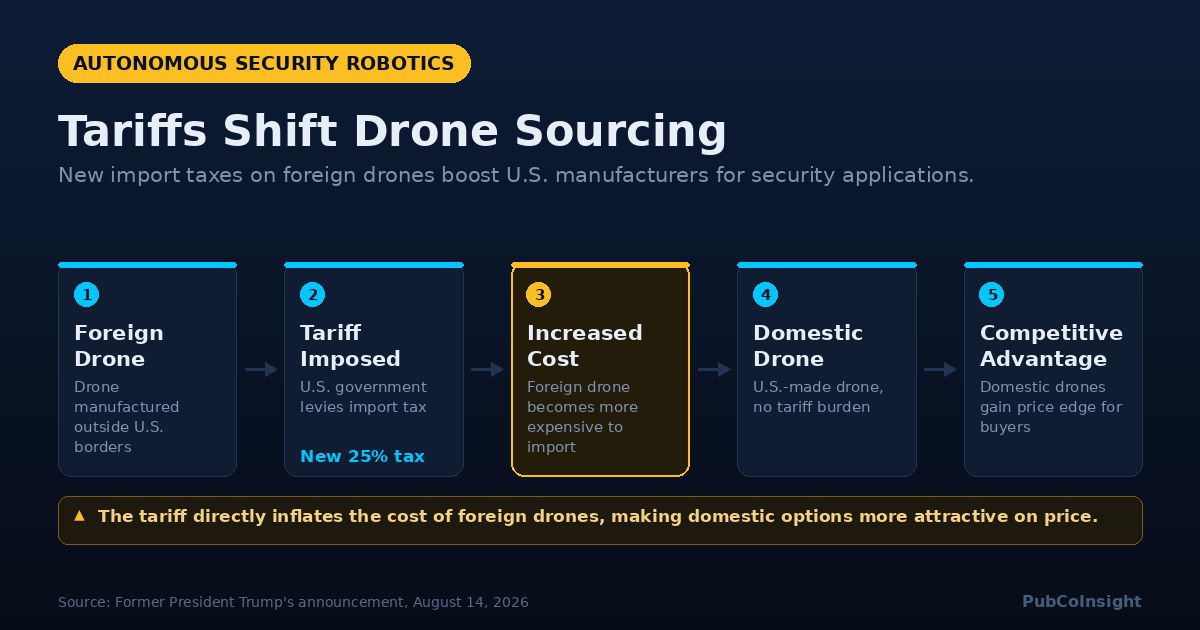
The Mechanism of Tariff Protection
Tariffs act as a direct tax on imported goods. In this case, the announced tariffs on foreign drones increase their landed cost in the United States. For a foreign-made security drone that might cost $10,000 to manufacture and ship, a 25% tariff adds $2,500 to its price before it even reaches a distributor. This makes a comparable domestic drone, which does not incur the tariff, significantly more attractive on price alone. The core mechanism here is artificial price inflation for imports. This changes the calculus for guarding service providers and enterprise clients considering autonomous security solutions. They now face a clear cost differential favoring U.S.-sourced hardware, even if the underlying manufacturing costs or technological capabilities were previously similar. The impact is immediate for new procurements and long-term for supply chain restructuring. This protection aims to foster domestic manufacturing capacity, encourage investment in U.S.-based research and development, and potentially create new jobs within the sector. The tariffs would prove less effective if foreign manufacturers absorb the cost, or if domestic capacity cannot meet demand, leading to price increases across the board.Companies Operating in the Sector
The autonomous security robotics sector encompasses a range of technologies, from ground-based mobile units to aerial drones and advanced sensor arrays. The recent tariff announcement directly impacts companies producing or integrating drone technology. Unusual Machines, Inc. (UMAC) saw a significant surge in its stock price following the tariff news. The company focuses on drone platforms, positioning itself to benefit from increased demand for U.S.-made aerial solutions. Their operational focus involves developing and deploying drones for various applications, including security and surveillance. Red Cat Holdings, Inc. (RCAT) also experienced a notable rise. Red Cat operates within the drone industry, with a focus on enterprise and defense applications. Their offerings include drone hardware and software, aiming to provide comprehensive aerial solutions. The tariff environment could accelerate adoption of their domestic platforms. Ondas Inc. (ONDS), known for its industrial drone and data solutions, saw its stock price climb. Ondas develops autonomous systems for critical infrastructure and government applications, a market segment where domestic sourcing is often a priority. Their recent Q2 2026 earnings call highlighted record revenue and strategic expansion, indicating ongoing growth independent of the tariffs, which now provide an additional tailwind. Beyond drone-specific companies, the broader autonomous security market includes firms developing sensor technologies and AI platforms. Arbe Robotics Ltd. (ARBE) specializes in imaging radar solutions for advanced driver-assistance systems and autonomous vehicles, a technology with clear crossover applications in mobile security robotics for enhanced perception and navigation. MicroVision, Inc. (MVIS) develops lidar technology for similar applications, providing high-resolution 3D mapping capabilities crucial for autonomous navigation in complex environments. Kopin Corporation (KOPN) provides micro-displays and optical components, essential for the visual systems and user interfaces of advanced robotics and augmented reality systems used by human operators interacting with autonomous platforms. Lantronix, Inc. (LTRX) offers secure data access and management solutions for the Internet of Things (IoT), which is fundamental for the connectivity and remote operation of autonomous security robots. BigBear.ai Holdings, Inc. (BBAI) provides AI-powered analytics and data insights, which can be integrated into autonomous security systems for predictive analysis, threat detection, and operational optimization. Serve Robotics Inc. (SERV), while primarily focused on food delivery robotics, demonstrates the broader application of physical AI in urban environments, showcasing the potential for similar autonomous ground units in security patrols and logistics.Artificial Intelligence Technology Solutions, Inc.
Artificial Intelligence Technology Solutions, Inc. (AITX) operates on the OTCID tier under the ticker AITX. The company builds and leases autonomous security robots and remote monitoring systems. AITX structures its revenue through a recurring monthly subscription model, rather than one-time hardware sales. Its primary subsidiary, Robotic Assistance Devices, Inc. (RAD-I), markets an AI-driven "Solutions-as-a-Service" model to the security and guarding services industry. AITX estimates this U.S. market to be approximately $50 billion. The company states its solutions can deliver cost savings of between 35% and 80% compared with traditional manned security and monitoring. AITX operates through several subsidiaries: RAD-I for stationary security devices, Robotic Assistance Devices Mobile (RAD-M) for mobile autonomous platforms, and Robotic Assistance Devices Group (RAD-G) for its SARA agentic artificial intelligence platform. RAD-M began early commercial deployment of its ROAMEO mobile security unit in May 2026. RAD Lanka, a wholly-owned subsidiary in Sri Lanka with Port City Colombo status, supports software development, AI initiatives, and technical operations. The company envisions an integrated autonomous security deployment across campuses or communities, which it internally refers to as "RAD Town." For the fiscal year ended February 28, 2026, AITX reported revenue of $7,745,336, a 26% increase over the prior fiscal year. Gross profit rose 48% to $5,533,700, with gross margin expanding to approximately 71% from 61%. Operating expenses remained flat at around $17,477,097, and the loss from operations improved by approximately $2.0 million to $(11,943,397). The company reported a net loss of approximately $14.5 million for the fiscal year ended February 28, 2026, and an accumulated deficit of approximately $171 million as of that date. The public record does not yet establish the specific impact of the recent drone tariffs on AITX's product lines or supply chain, given its primary focus on ground-based and stationary units. The company had negative cash flow from operating activities of $9,344,534 for the year ended February 28, 2026, and an accumulated deficit of $171,121,742 with negative working capital of $17,017,745. Management does not anticipate having positive cash flow from operations in the near term.What to watch
Investors should monitor several concrete developments. The specific details of the tariff implementation, including the exact percentage and product categories, will be crucial. Watch for official government publications or Commerce Department rulings on the scope and enforcement mechanisms. Beyond the initial announcement, observe how foreign drone manufacturers adjust their pricing strategies. Will they absorb the tariff cost to maintain market share, or will they pass it entirely to consumers? Domestically, look for announcements from companies like Unusual Machines (UMAC) and Red Cat Holdings (RCAT) regarding increased production capacity, new order inflows, or expansion plans directly attributed to the tariff protection. Any new capital expenditure filings or hiring announcements in the U.S. drone manufacturing sector would be significant. For guarding service providers, watch for shifts in procurement patterns. Are they publicly committing to domestic drone suppliers, or are they exploring alternative security solutions that bypass drone reliance? Finally, track any legislative efforts to challenge or modify these tariffs, as political dynamics could alter the landscape as quickly as they created it., {"label": "Tariff Imposed", "note": "U.S. government levies import tax", "metric": "New 25% tax"}, {"label": "Increased Cost", "note": "Foreign drone becomes more expensive to import"}, {"label": "Domestic Drone", "note": "U.S.-made drone, no tariff burden"}, {"label": "Competitive Advantage", "note": "Domestic drones gain price edge for buyers"}], "highlight": 2, "highlight_note": "The tariff directly inflates the cost of foreign drones, making domestic options more attractive on price.", "footnote": "Source: Former President Trump's announcement, August 14, 2026"}Companies mentioned
| Ticker | Company | Price |
|---|---|---|
| AITX client | Artificial Intelligence Technology Solutions Inc | $0.007 |
| ARBE | Arbe Robotics Ltd. | $0.797 |
| BBAI | BigBear.ai Holdings, Inc. | $3.27 |
| KOPN | Kopin Corporation | $5.5 |
| LTRX | Lantronix, Inc. | $6.47 |
| MVIS | MicroVision, Inc. | $2.24 |
| ONDS | Ondas Inc. | $9.24 |
| RCAT | Red Cat Holdings, Inc. | $11.13 |
| SERV | Serve Robotics Inc. | $4.99 |
| UMAC | Unusual Machines, Inc. | $34.06 |
Listed alphabetically, not ranked. Prices as of 2026-08-15 and they move. Check a live quote before relying on any of this.
How we chose the companies in this article
We cover a fixed universe of companies working in autonomous security robotics, physical AI and the guarding services market they are aimed at. Every one of them that had usable market data on 2026-08-15 appears in this article. We do not pick which ones to mention based on what we think of them, and we do not order them by size, price or trading volume, because an ordered list is a verdict and that is not ours to hand down. Companies left out, and why: none. American Lithium Minerals and Artificial Intelligence Technology Solutions pay us, which is disclosed in full at the foot of every article they appear in.
See the dilution and promotion flags before you see the pitch.
Each week: the micro and small-caps now showing dilution or paid-promotion signals, with the SEC filing behind every flag. No recommendations, no price targets.
Sources used in this article
- Elon Musk Admits He Underestimated Anthropic's AI -- Why Amazon Investors Should Care Motley Fool · 2026-08-15
- The Market Is Doing Something It's Only Done Once Before. Here's What History Says Happens Next. Motley Fool · 2026-08-15
- Amkor (AMKR) Stock Looks Cheap On Cash Flow But Less So On Earnings Simply Wall St. · 2026-08-15
- Why H&R Block Stock Jumped This Week Motley Fool · 2026-08-15
- Duan Yongping's Second Quarter 2026 13F: A Strategic Pivot Away from NVIDIA GuruFocus.com · 2026-08-15
- Lee Ainslie's Bold Q2 2026 Move: Nearly Exits ASML Holding NV, a -3.93% Portfolio Impact GuruFocus.com · 2026-08-15
- Amkor Technology (AMKR) Is Up 6.7% After Dividend Approval And Advanced-Packaging Pipeline Updates Simply Wall St. · 2026-08-15
- Warren Buffett's Successor, Greg Abel, Pared Down Bank of America, and Piled Into a Virtual Monopoly That's Now Berkshire's 3rd-Largest Holding Motley Fool · 2026-08-15
- Axon Enterprise (AXON) Is Up 17.8% After Raising 2026 Revenue Outlook On Connected Devices Momentum Simply Wall St. · 2026-08-14
- Liberty All-Star® Growth Fund, Inc. July 2026 Monthly Update Business Wire · 2026-08-14
- The 5 Most Interesting Analyst Questions From Axon’s Q2 Earnings Call StockStory · 2026-08-14
- Jim Cramer Reviews NVIDIA (NVDA) and Data Center Demand Insider Monkey · 2026-08-14
Disclosure required by Section 17(b) of the Securities Act of 1933
Artificial Intelligence Technology Solutions, Inc., a Nevada corporation (OTCID: AITX). Artificial Intelligence Technology Solutions, Inc. pays Strategic Innovations First, Inc., a Wyoming corporation doing business as PulseIR. Compensation received: USD 5,000.00 per month for months 1-3 (August, September, October 2026); USD 10,000.00 per month for months 4-6 (November, December 2026, January 2027) contingent on the 90-day review. Minimum committed USD 15,000.00; USD 45,000.00 if the second-period rate triggers.. Form of payment: cash only, invoiced monthly in advance; no stock, options or warrants received or payable. Services: investor relations services under an Investor Relations Services Agreement effective 2026-08-01. Period: six month term, 2026-08-01 through 2027-01-31; 90-day review on or about 2026-10-30. No stock, options or warrants held by PubCo Insight, Pulse IR, Strategic Innovations First, Inc., or Brad Listermann. Confirmed by the executed agreement and by board record recKwdq39X2caPSX7 (POSITIONS HELD: none).
This is information, not investment, financial, legal or tax advice. It is not a recommendation or solicitation to buy, sell or hold any security and it contains no price target. Nothing here is independently verified by us. Confirm every figure against primary filings on SEC EDGAR before you act. Micro-cap and over-the-counter securities are speculative and illiquid and can lose all of their value. The companies named without a disclosure above pay us nothing and have no relationship with us; they are named because a published, mechanical screen selected them. Full disclosure policy.