Unusual Machines Ramps Drone Component Output for Defense Contracts
Unusual Machines (UMAC) has significantly expanded its U.S. drone component manufacturing, signaling a shift in the autonomous security and robotics sector towards domestic defense supply chains, a development that could reshape market dynamics for several key players.
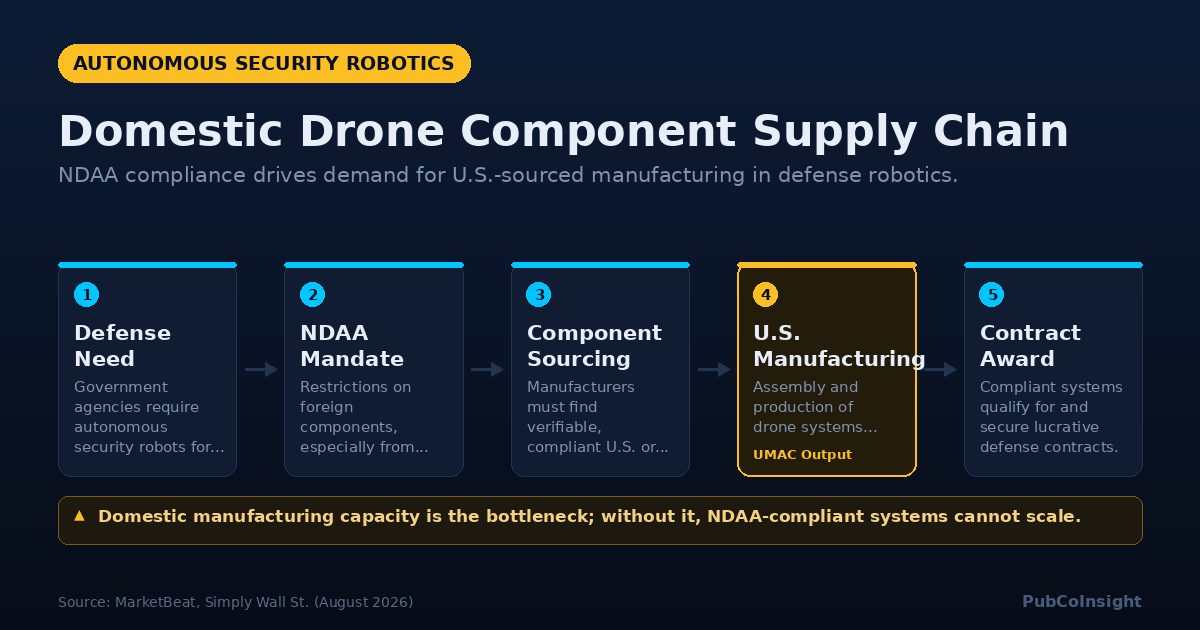
The Mechanism of Domestic Sourcing
Domestic sourcing in autonomous security robotics, especially for defense applications, hinges on two core principles: supply chain resilience and regulatory compliance. Resilience means reducing dependence on single points of failure, particularly from geopolitical rivals. This involves identifying and qualifying multiple U.S.-based or allied suppliers for critical components like sensors, processors, and power systems. The process is not trivial; it requires extensive auditing, quality control, and often, co-development with smaller, specialized manufacturers. Regulatory compliance, specifically adherence to the National Defense Authorization Act (NDAA), is the hard constraint. The NDAA restricts federal agencies from procuring certain telecommunications and video surveillance equipment, and services from designated Chinese companies. This prohibition extends to components used within broader systems. For a drone manufacturer, this means every camera, every communication module, every flight controller must trace back to an approved origin. Proving this provenance requires meticulous documentation, often down to the raw material level. Component separation, for example, of rare earth oxides, is a complex chemical engineering task. These elements, vital for high-performance magnets in motors and advanced sensors, often arrive from a single geographic region. Separating them from their ore, typically through solvent extraction or ion exchange, demands precise control over pH and temperature in multi-stage processes to achieve the required purity, a capability not widely distributed globally. Without this verifiable, compliant component chain, a product cannot enter the defense market, regardless of its technical merit. This stricture creates a high barrier to entry and a significant advantage for companies that can navigate it.Companies Navigating the Landscape
Several companies are actively positioning themselves within this evolving market, each with a distinct approach to autonomous security and defense-related opportunities. Unusual Machines (UMAC), with its recent manufacturing expansion and battery deal, directly addresses the demand for U.S.-sourced drone components. The company's focus on increasing domestic output for defense suggests a strategic alignment with the NDAA requirements, aiming to capture a larger share of government contracts. UMAC's stock price sits at $27.43. Ondas Inc. (ONDS), trading at $8.71, operates in critical infrastructure and government markets with its autonomous drone solutions. The company's recent acquisition of Aran Defense and its focus on sovereign defense strategies indicate a clear intent to serve the domestic defense sector. Ondas is building out drone operations centers, such as the one launched in Springfield, Ohio, to support its deployment and service capabilities. Red Cat Holdings, Inc. (RCAT), priced at $9.62, also focuses on drone technology, including solutions for defense and public safety. Their strategy often involves providing integrated drone systems, which would necessitate careful attention to the provenance of all components to meet stringent government procurement standards. Beyond drones, the broader autonomous security market includes companies like Serve Robotics Inc. (SERV), at $4.98. Serve Robotics focuses on last-mile delivery robots, a different application but still within the physical AI domain. Their pivot to partnerships like Grubhub after losing an Uber Eats deal highlights the competitive nature of commercial deployment, where operational efficiency and scalability are paramount. In the sensor and AI processing space, companies like Arbe Robotics Ltd. (ARBE) at $0.715, MicroVision, Inc. (MVIS) at $1.66, and Kopin Corporation (KOPN) at $5.04, develop critical enabling technologies. Arbe specializes in imaging radar for autonomous vehicles, MicroVision in lidar solutions, and Kopin in micro-displays and optics. These components are foundational for advanced perception systems in autonomous security robots, and their domestic availability or compliance with sourcing regulations is crucial for integrators building defense-grade systems. Lantronix, Inc. (LTRX), at $5.98, provides intelligent edge computing and connectivity solutions. Their hardware and software enable secure data transmission and processing for IoT and autonomous systems, a vital link in the chain for remote monitoring and control of robotic assets. BigBear.ai Holdings, Inc. (BBAI), priced at $3.22, offers AI-powered analytics and decision intelligence, often for government and defense clients. While not directly manufacturing physical robots, their software capabilities could integrate with autonomous platforms to enhance their operational effectiveness and data analysis, particularly in surveillance and threat detection.Artificial Intelligence Technology Solutions, Inc.
Artificial Intelligence Technology Solutions, Inc. (AITX), trading on the OTCID at $0.0047, develops and leases AI-driven security robots and remote monitoring systems. The company employs a "Solutions-as-a-Service" model, providing recurring monthly subscriptions rather than outright hardware sales. This approach targets the approximately $50 billion U.S. security and guarding services market, aiming to deliver cost savings between 35% and 80% compared to traditional manned security. AITX operates through several subsidiaries: Robotic Assistance Devices, Inc. (RAD-I) handles stationary security devices, Robotic Assistance Devices Mobile (RAD-M) focuses on mobile autonomous platforms like the ROAMEO unit, which began early commercial deployment in May 2026, and Robotic Assistance Devices Group (RAD-G) manages the SARA agentic artificial intelligence platform. RAD Lanka, a wholly-owned subsidiary in Sri Lanka, provides software development, AI initiatives, and technical operations support. The company's long-term vision, internally referred to as "RAD Town," involves integrated autonomous security deployments across large campuses or jurisdictions. For the fiscal year ended February 28, 2026, AITX reported revenue of $7,745,336, a 26% increase year-over-year. Gross profit rose 48% to $5,533,700, expanding gross margin to approximately 71% from 61%. Operating expenses remained flat at around $17,477,097, and the loss from operations improved by approximately $2.0 million to $(11,943,397). The company reported a net loss of approximately $14.5 million for the fiscal year and had an accumulated deficit of approximately $171 million as of that date. The public record does not yet establish a clear path to sustained positive cash flow from operations for AITX. The company's filings indicate management does not anticipate positive cash flow from operations in the near term. As of February 28, 2026, AITX had negative cash flow from operating activities of $9,344,534 and negative working capital of $17,017,745. The independent registered public accounting firm included an explanatory paragraph in its report expressing substantial doubt about the company's ability to continue as a going concern. AITX's stated plan includes RAD-I's recurring revenue supporting positive cash flow, RAD-M surpassing RAD-I's monthly recurring revenue, and RAD-G generating substantial revenue from SARA platform licensing. They project subscription gross margins exceeding 75% and outright-sale gross margins exceeding 50%, based on current pricing and bill of materials costs.What to watch
Investors in this sector should monitor several key indicators. The first is the ongoing flow of defense contracts and their specific sourcing requirements. Watch for announcements from the Department of Defense or other federal agencies detailing new procurement programs for autonomous systems and any explicit mentions of domestic content mandates. Second, observe company filings for specific details on manufacturing capacity expansion and supply chain partnerships. Unusual Machines' (UMAC) continued reporting on its U.S. drone component output will be crucial. Look for concrete figures on production volumes, facility locations, and named suppliers. Third, track any new NDAA-related guidance or amendments. The regulatory landscape around defense procurement can shift, impacting which components and suppliers are deemed compliant. Any tightening or loosening of these rules will directly affect the market. Finally, pay attention to the financial performance of companies actively pursuing this strategy. Increased revenue from government contracts, improved gross margins from localized production, and reduced supply chain risks will be tangible signs of success., { "label": "NDAA Mandate", "note": "Restrictions on foreign components, especially from adversaries, for federal procurement." }, { "label": "Component Sourcing", "note": "Manufacturers must find verifiable, compliant U.S. or allied suppliers for critical parts." }, { "label": "U.S. Manufacturing", "note": "Assembly and production of drone systems must occur domestically.", "metric": "UMAC Output Ramps" }, { "label": "Contract Award", "note": "Compliant systems qualify for and secure lucrative defense contracts." } ], "highlight": 3, "highlight_note": "Domestic manufacturing capacity is the bottleneck; without it, NDAA-compliant systems cannot scale.", "footnote": "Source: MarketBeat, Simply Wall St. (August 2026)" }Companies mentioned
| Ticker | Company | Price |
|---|---|---|
| AITX client | Artificial Intelligence Technology Solutions Inc | $0.0047 |
| ARBE | Arbe Robotics Ltd. | $0.715 |
| BBAI | BigBear.ai Holdings, Inc. | $3.22 |
| KOPN | Kopin Corporation | $5.04 |
| LTRX | Lantronix, Inc. | $5.98 |
| MVIS | MicroVision, Inc. | $1.66 |
| ONDS | Ondas Inc. | $8.71 |
| RCAT | Red Cat Holdings, Inc. | $9.62 |
| SERV | Serve Robotics Inc. | $4.98 |
| UMAC | Unusual Machines, Inc. | $27.43 |
Listed alphabetically, not ranked. Prices as of 2026-08-24 and they move. Check a live quote before relying on any of this.
How we chose the companies in this article
We cover a fixed universe of companies working in autonomous security robotics, physical AI and the guarding services market they are aimed at. Every one of them that had usable market data on 2026-08-24 appears in this article. We do not pick which ones to mention based on what we think of them, and we do not order them by size, price or trading volume, because an ordered list is a verdict and that is not ours to hand down. Companies left out, and why: none. American Lithium Minerals and Artificial Intelligence Technology Solutions pay us, which is disclosed in full at the foot of every article they appear in.
See the dilution and promotion flags before you see the pitch.
Each week: the micro and small-caps now showing dilution or paid-promotion signals, with the SEC filing behind every flag. No recommendations, no price targets.
Sources used in this article
- The Zacks Analyst Blog Highlights AppLovin's, Unity and The Trade Desk Zacks · 2026-08-24
- 3 Market-Beating Stocks on Our Watchlist StockStory · 2026-08-24
- US Equity Investors to Focus on Nvidia's Earnings, Chair Warsh's Jackson Hole Speech, PCE Inflation This Week MT Newswires · 2026-08-24
- If an AI Bubble Burst Is Coming, Warren Buffett's 1999 Warning to Investors Is More Crucial Than Ever Motley Fool · 2026-08-24
- Here's How Much You Actually Need to Build a $1 Million Portfolio -- and the Simplest Way to Get There Motley Fool · 2026-08-24
- S&P, Nasdaq futures slip as markets await Iran sanctions, Nvidia results Reuters · 2026-08-24
- If a Stock Market Crash Is Coming, I'm Loading Up On This 1 Brilliant ETF Motley Fool · 2026-08-24
- The One Line in Anthropic's S-1 That Amazon Investors Should Read First Motley Fool · 2026-08-24
- Should You Buy Dogecoin While It's Below $0.10? The Answer Might Shock You. Motley Fool · 2026-08-24
- XRP vs Ethereum: Which Crypto Will Reach Its All-Time High First? 24/7 Wall St. · 2026-08-24
- Beyond Nvidia, AMD, and Broadcom: Why This Chip Stock Will Emerge as the Biggest Winner of the AI Semiconductor Boom Motley Fool · 2026-08-24
- Nvidia’s $30B Perplexity Bet Extends the Compute Landlord Thesis Into AI Search Forkast News · 2026-08-24
Disclosure required by Section 17(b) of the Securities Act of 1933
Artificial Intelligence Technology Solutions, Inc., a Nevada corporation (OTCID: AITX). Artificial Intelligence Technology Solutions, Inc. pays Strategic Innovations First, Inc., a Wyoming corporation doing business as PulseIR. Compensation received: USD 5,000.00 per month for months 1-3 (August, September, October 2026); USD 10,000.00 per month for months 4-6 (November, December 2026, January 2027) contingent on the 90-day review. Minimum committed USD 15,000.00; USD 45,000.00 if the second-period rate triggers.. Form of payment: cash only, invoiced monthly in advance; no stock, options or warrants received or payable. Services: investor relations services under an Investor Relations Services Agreement effective 2026-08-01. Period: six month term, 2026-08-01 through 2027-01-31; 90-day review on or about 2026-10-30. No stock, options or warrants held by PubCo Insight, Pulse IR, Strategic Innovations First, Inc., or Brad Listermann. Confirmed by the executed agreement and by board record recKwdq39X2caPSX7 (POSITIONS HELD: none).
This is information, not investment, financial, legal or tax advice. It is not a recommendation or solicitation to buy, sell or hold any security and it contains no price target. Nothing here is independently verified by us. Confirm every figure against primary filings on SEC EDGAR before you act. Micro-cap and over-the-counter securities are speculative and illiquid and can lose all of their value. The companies named without a disclosure above pay us nothing and have no relationship with us; they are named because a published, mechanical screen selected them. Full disclosure policy.