Autonomous Security Robotics See Broad Selloff, But Sector Fundamentals Hold
While speculative drone names like Red Cat and Unusual Machines experience a month-long slide, the underlying shift towards AI-powered physical security solutions continues to reshape the guarding services market.
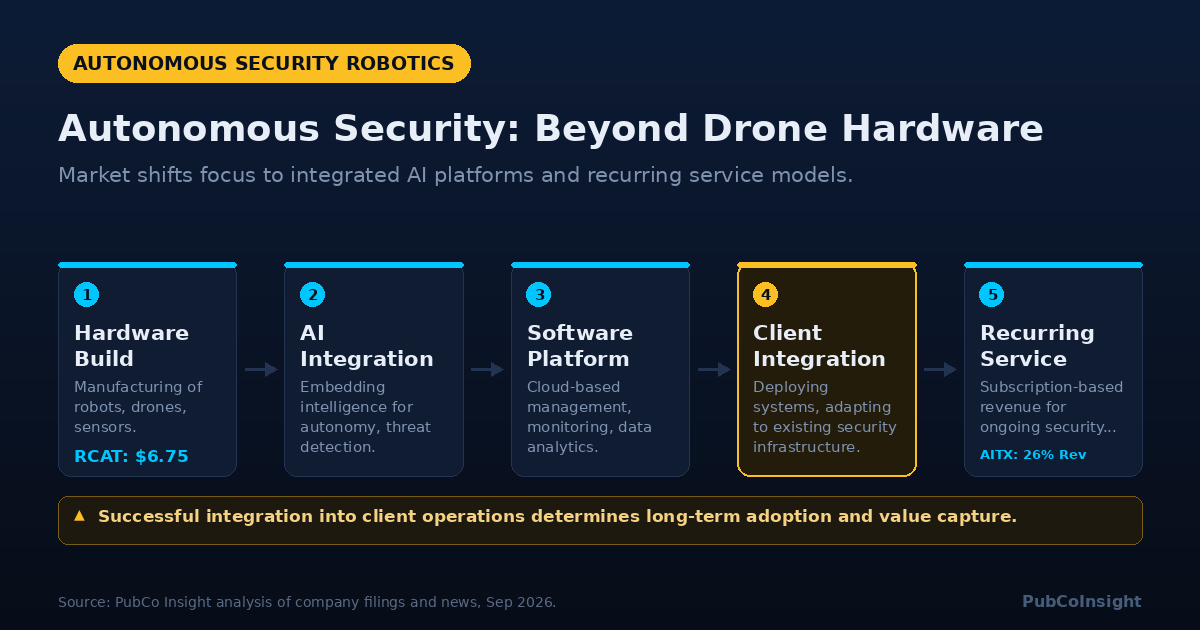
The Mechanism of Autonomous Security Adoption
The core mechanism driving autonomous security adoption is the replacement of human labor with automated systems. This is not a simple one-for-one substitution. Instead, it involves a fundamental redesign of security protocols. A traditional security guard patrols a fixed route, observes, and reports. An autonomous security robot, whether stationary or mobile, performs these tasks with greater consistency and often at a lower operational cost. The technology stack for these systems typically involves several layers. First, the physical robot or device itself, equipped with cameras, sensors, and communication hardware. Second, the on-board artificial intelligence, which processes sensor data to detect anomalies, identify threats, and navigate environments. This AI capability is crucial. It moves the system beyond simple remote control to true autonomy. Third, a cloud-based software platform for remote monitoring, data analysis, and fleet management. This platform allows human operators to supervise multiple robots, respond to alerts, and review incident footage. The bottleneck in this adoption process often sits at the integration stage. Deploying autonomous security requires more than just buying a robot. It demands a re-evaluation of existing security infrastructure, training for human staff to interact with robotic counterparts, and robust software integration with existing command centers. The value proposition is clear: reduced labor costs, 24/7 vigilance, and consistent performance. However, achieving these benefits requires a thoughtful implementation strategy. Successful deployments demonstrate clear cost savings and improved security outcomes, which then drive further adoption. A failed integration, often due to poor software, inadequate AI, or a lack of customer support, can quickly sour a client on the entire concept.Companies in the Sector
Several companies are working to capture this evolving market. They approach the challenge from different angles, focusing on specific hardware, software, or service models. Red Cat Holdings, Inc. (RCAT) designs and manufactures small unmanned aerial systems, primarily for defense and public safety applications. Their focus is on the drone hardware itself, including their FPV (First Person View) drones. While drones have security applications, RCAT's recent stock performance suggests the market is distinguishing between general drone manufacturing and integrated autonomous security platforms. Unusual Machines, Inc. (UMAC) also operates in the wireless and drone space. Like Red Cat, its recent stock movement indicates that investors are scrutinizing companies with a primary emphasis on drone hardware. The company's investor conference lineup suggests a focus on broader wireless applications, but the market reaction points to a need for clearer differentiation in the autonomous security niche. Ondas Inc. (ONDS) is another player in the drone sector, providing mission-critical drone solutions for industrial and government clients. The company recently bought GATE and Bron, indicating a move towards component ownership to improve defense returns. This suggests a strategy to control more of its supply chain and enhance its offerings in specialized drone applications, including those with security implications. Serve Robotics Inc. (SERV) focuses on autonomous sidewalk delivery robots. While not directly in physical security, their work in developing and deploying autonomous mobile platforms in urban environments shares significant technological overlap. Their "Beacon" platform aims to overcome restaurant integration barriers, a challenge similar to the integration issues faced by autonomous security solutions. Kopin Corporation (KOPN) provides micro-displays and optical solutions for augmented reality (AR) and virtual reality (VR) systems, as well as defense applications. While not a direct autonomous security robot developer, their display technology is critical for the human-machine interface in advanced robotic systems, particularly for remote operation and situational awareness. Fabric.AI recently appointed Haynes Boone as counsel to support joint intellectual property with Kopin, highlighting their role in core display technology. Arbe Robotics Ltd. (ARBE) develops high-resolution 4D imaging radar solutions. This technology is crucial for autonomous systems, providing superior object detection and tracking capabilities in all weather conditions. While their primary market is autonomous vehicles, their radar systems are directly applicable to enhancing the perception capabilities of security robots, allowing them to operate more effectively in complex environments. MicroVision, Inc. (MVIS) also focuses on lidar technology for autonomous systems. Their lidar sensors provide precise 3D mapping and object detection, essential for navigation and obstacle avoidance in mobile security robots. Like Arbe, their core technology is a foundational component for advanced autonomous operations, even if their direct market is not security. Lantronix, Inc. (LTRX) provides secure data access and management solutions for the Internet of Things (IoT). Their technology enables the connectivity and remote management of connected devices, including autonomous security robots. Reliable and secure communication is paramount for a distributed fleet of robots, making Lantronix a key enabler for large-scale deployments. BigBear.ai Holdings, Inc. (BBAI) specializes in artificial intelligence, machine learning, and data analytics. Their AI capabilities are vital for processing the vast amounts of data generated by security robots, enabling predictive analytics, threat assessment, and intelligent decision-making. They provide the "brain" behind the autonomous operations, turning raw sensor data into actionable intelligence.Artificial Intelligence Technology Solutions, Inc.
Artificial Intelligence Technology Solutions, Inc. (AITX) operates through several subsidiaries, including Robotic Assistance Devices, Inc. (RAD-I), Robotic Assistance Devices Mobile (RAD-M), and Robotic Assistance Devices Group (RAD-G). The company focuses on building and leasing autonomous security robots and remote monitoring systems. Their business model emphasizes a recurring monthly subscription, rather than outright hardware sales. This "Solutions-as-a-Service" approach targets the security and guarding services industry. RAD-I, the primary subsidiary, markets AI-driven stationary security devices. These units are designed to deliver significant cost savings over traditional manned security. The company has stated these savings can range from 35% to 80%. AITX's RAD recently expanded its presence in higher education, indicating traction in specific institutional verticals. The company also reinforced ROSA's role as the foundation of its stationary security platform. RAD-M focuses on mobile autonomous platforms. This includes the ROAMEO mobile security unit, which began early commercial deployment in May 2026. The company views RAD-M as having a higher revenue ceiling than its stationary solutions. RAD-G manages the SARA agentic artificial intelligence platform, which AITX intends to license to generate substantial revenue. RAD Lanka, a wholly owned subsidiary in Sri Lanka, handles software development, AI initiatives, and technical operations. The company refers to its long-term strategy as "RAD Town," envisioning integrated autonomous security deployments across campuses or communities. For the fiscal year ended February 28, 2026, AITX reported revenue of $7,745,336, a 26% increase over the prior year. Gross profit rose 48% to $5,533,700, with gross margin expanding to approximately 71% from 61%. Operating expenses remained flat at around $17,477,097, leading to an improved operating loss of $(11,943,397). The company reported a net loss of approximately $14.5 million for the fiscal year. AITX had an accumulated deficit of approximately $171 million as of February 28, 2026, and negative working capital of $17,017,745. The public record does not yet establish positive cash flow from operations. The company has stated that RAD-I's recurring revenue and gross margin could, on a standalone basis, support positive cash flow operations, and that RAD-I has "achieved a point" where it could support positive cash flow today. They also project subscription gross margin to exceed 75% and outright-sale gross margin to exceed 50%. These projections depend on continued pricing acceptance, stable input costs, and manufacturing scale.What to watch
Investors should monitor several specific developments. For Artificial Intelligence Technology Solutions, Inc. (AITX), watch for further details on ROAMEO deployments and revenue contributions from RAD-M, as well as any licensing agreements for the SARA platform. The company's frequent 8-K filings, such as those on September 18, September 16, and September 15, 2026, often contain operational updates. Look for concrete metrics on subscription growth and customer acquisition. For Ondas Inc. (ONDS), the integration of GATE and Bron and their impact on defense returns will be key. Serve Robotics Inc. (SERV) will need to demonstrate successful overcoming of restaurant integration barriers for its Beacon platform. For the broader sector, watch for major contract awards for autonomous security deployments, particularly those that involve integrated hardware and software solutions. Any new regulatory frameworks for autonomous ground or aerial security systems will also be significant., { "label": "AI Integration", "note": "Embedding intelligence for autonomy, threat detection." }, { "label": "Software Platform", "note": "Cloud-based management, monitoring, data analytics." }, { "label": "Client Integration", "note": "Deploying systems, adapting to existing security infrastructure." }, { "label": "Recurring Service", "note": "Subscription-based revenue for ongoing security operations.", "metric": "AITX: 26% Rev Growth" } ], "highlight": 3, "highlight_note": "Successful integration into client operations determines long-term adoption and value capture.", "footnote": "Source: PubCo Insight analysis of company filings and news, Sep 2026." }Companies mentioned
| Ticker | Company | Price |
|---|---|---|
| AITX client | Artificial Intelligence Technology Solutions Inc | $0.0039 |
| ARBE | Arbe Robotics Ltd. | $0.67 |
| BBAI | BigBear.ai Holdings, Inc. | $2.8 |
| KOPN | Kopin Corporation | $4.74 |
| LTRX | Lantronix, Inc. | $5.85 |
| MVIS | MicroVision, Inc. | $1.66 |
| ONDS | Ondas Inc. | $7.39 |
| RCAT | Red Cat Holdings, Inc. | $6.75 |
| SERV | Serve Robotics Inc. | $4.41 |
| UMAC | Unusual Machines, Inc. | $23.18 |
Listed alphabetically, not ranked. Prices as of 2026-09-21 and they move. Check a live quote before relying on any of this.
How we chose the companies in this article
We cover a fixed universe of companies working in autonomous security robotics, physical AI and the guarding services market they are aimed at. Every one of them that had usable market data on 2026-09-21 appears in this article. We do not pick which ones to mention based on what we think of them, and we do not order them by size, price or trading volume, because an ordered list is a verdict and that is not ours to hand down. Companies left out, and why: none. American Lithium Minerals and Artificial Intelligence Technology Solutions pay us, which is disclosed in full at the foot of every article they appear in.
See the dilution and promotion flags before you see the pitch.
Each week: the micro and small-caps now showing dilution or paid-promotion signals, with the SEC filing behind every flag. No recommendations, no price targets.
Sources used in this article
- Hyperliquid Just Hit a New All-Time High of $92. How Hyped Should Investors Be For HYPE? Motley Fool · 2026-09-21
- Axon Enterprise (AXON) Prices $1B of Zero-Coupon Notes. What is the Real Cost? Insider Monkey · 2026-09-20
- Should You Buy Goldman Sachs Stock After Its 26% Run-Up From Its 52-Week Low? Motley Fool · 2026-09-20
- Prediction: Nvidia's Revenue Growth Will Drive Shares to $400 Next Year Motley Fool · 2026-09-20
- Palantir Nearly Doubled Its Revenue. Its Stock Stood Still. Is It Time to Buy the Stock? Motley Fool · 2026-09-20
- Meet the Vanguard ETF That Increased Its SpaceX Holding by 39% in 1 Month and Shows No Signs of Slowing Down Motley Fool · 2026-09-20
- Bill Ackman Built a $2.4 Billion Stake in Microsoft, Calling It a "Core Holding" Bought at a "Highly Compelling Valuation." Here's Why He's Betting Big on Big Tech. Motley Fool · 2026-09-20
- 3 Things You Need to Know Before Buying IonQ Stock Motley Fool · 2026-09-20
- The Stock Market's Best Quarter of the Year Is About to Start. The S&P 500 Has Risen in 34 of the Last 41. Motley Fool · 2026-09-20
- The Ultimate Dividend Growth stock to Buy With $1,000 Right Now. Motley Fool · 2026-09-20
- AI Bubble Fears Grow, But Nvidia CEO Gives Bulls a New Argument Anyway BeInCrypto · 2026-09-20
- Axon (AXON) Stock Looks Fairly Valued As 149% Run Meets Funding Test Simply Wall St. · 2026-09-19
Disclosure required by Section 17(b) of the Securities Act of 1933
Artificial Intelligence Technology Solutions, Inc., a Nevada corporation (OTCID: AITX). Artificial Intelligence Technology Solutions, Inc. pays Strategic Innovations First, Inc., a Wyoming corporation doing business as PulseIR. Compensation received: USD 5,000.00 per month for months 1-3 (August, September, October 2026); USD 10,000.00 per month for months 4-6 (November, December 2026, January 2027) contingent on the 90-day review. Minimum committed USD 15,000.00; USD 45,000.00 if the second-period rate triggers.. Form of payment: cash only, invoiced monthly in advance; no stock, options or warrants received or payable. Services: investor relations services under an Investor Relations Services Agreement effective 2026-08-01. Period: six month term, 2026-08-01 through 2027-01-31; 90-day review on or about 2026-10-30. No stock, options or warrants held by PubCo Insight, Pulse IR, Strategic Innovations First, Inc., or Brad Listermann. Confirmed by the executed agreement and by board record recKwdq39X2caPSX7 (POSITIONS HELD: none).
This is information, not investment, financial, legal or tax advice. It is not a recommendation or solicitation to buy, sell or hold any security and it contains no price target. Nothing here is independently verified by us. Confirm every figure against primary filings on SEC EDGAR before you act. Micro-cap and over-the-counter securities are speculative and illiquid and can lose all of their value. The companies named without a disclosure above pay us nothing and have no relationship with us; they are named because a published, mechanical screen selected them. Full disclosure policy.