Drone Stocks Slide as FEMA Counter-Drone Grant Program Takes Shape
A broad decline hit high-beta drone stocks on October 30, 2026, coinciding with new details emerging about the $250 million FEMA counter-drone grant program.
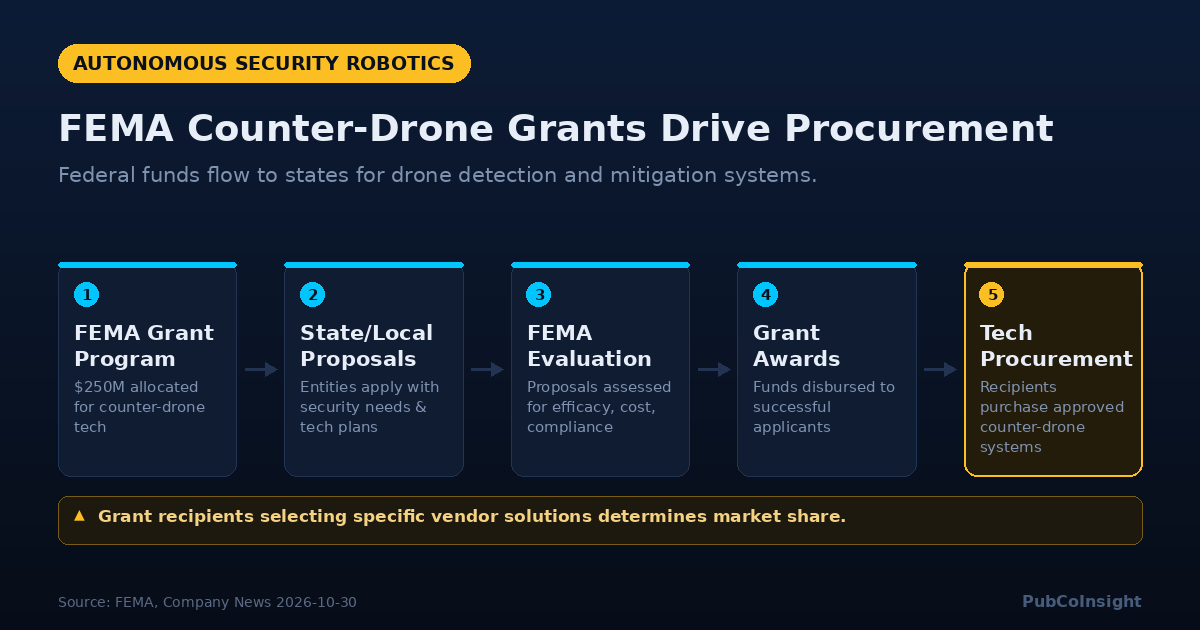
The Mechanism of Counter-Drone Grants
The FEMA counter-drone grant program allocates $250 million to state and local entities. This funding is specifically for acquiring and deploying technologies to detect, track, and mitigate unauthorized drones. The mechanism involves states and localities submitting proposals to FEMA, outlining their specific security needs and the counter-drone solutions they intend to procure. FEMA then evaluates these proposals against criteria that typically include threat assessment, operational effectiveness, and cost-efficiency. Successful applicants receive federal funds to purchase approved systems. For a technology provider, the critical step is gaining inclusion on an approved vendor list or having their specific solutions cited in successful grant applications. This requires demonstrating compliance with federal guidelines, proving system efficacy in real-world scenarios, and often, establishing existing relationships with state and local law enforcement or critical infrastructure operators. The value sits in the procurement cycle, specifically the point where grant recipients select and purchase hardware and software. A system that is easy to integrate, offers comprehensive threat detection, and provides reliable mitigation capabilities will likely see higher adoption. Proof of concept, such as successful deployments in urban environments or at critical facilities, provides a significant advantage. The inverse would be a system that requires extensive customization, lacks interoperability, or has not demonstrated consistent performance in diverse operational settings.Companies Operating in Autonomous Security Robotics
Several companies are active in the broader autonomous security robotics and drone market, each with distinct offerings that could intersect with the FEMA grant program's objectives. Ondas (ONDS) has positioned its aerial security portfolio to support the FEMA counter-drone initiative. The company's Iron Drone system, for example, is a counter-UAS platform designed to detect and neutralize rogue drones. Ondas also develops autonomous drone solutions for critical infrastructure inspection and data collection, which could indirectly benefit from increased security spending around such assets. The company reported a growing backlog on October 30, 2026, suggesting some traction in its defense platforms. Red Cat Holdings (RCAT) focuses on drone technology across defense and commercial sectors. Its Skypersonic subsidiary provides drone solutions for industrial inspection in GPS-denied environments, while its Teal Drones unit manufactures small, high-performance drones for military and public safety applications. Teal's Golden Eagle drone, built in the USA, could be a candidate for government contracts under programs like FEMA's, particularly where domestic manufacturing is prioritized. Unusual Machines (UMAC) operates in the drone and robotics space, though specific details of its counter-drone offerings are less prominent in recent news. The company's stock movement on October 30, 2026, suggests it is perceived as a high-beta drone play, sensitive to sector-wide sentiment. Serve Robotics Inc. (SERV) is primarily known for its sidewalk delivery robots. While not directly involved in counter-drone technology, increased investment in general physical security infrastructure could, in the long term, create opportunities for broader autonomous deployment in secure environments. Other companies in the sector offer components or AI capabilities relevant to autonomous security. Arbe Robotics Ltd. (ARBE) develops 4D imaging radar solutions for autonomous vehicles, which could be adapted for advanced drone detection and tracking in complex environments. MicroVision, Inc. (MVIS) provides LiDAR technology, another crucial sensor for autonomous navigation and object detection, potentially applicable to advanced surveillance drones. Kopin Corporation (KOPN) produces microdisplays and optical solutions, essential components for drone control systems and augmented reality applications used by security personnel. BigBear.ai Holdings, Inc. (BBAI) offers AI-powered analytics and decision intelligence, which could be critical for processing vast amounts of surveillance data gathered by autonomous security systems, including counter-drone platforms. Lantronix, Inc. (LTRX) provides secure data access and management solutions for the Internet of Things (IoT), which is foundational for connecting and managing fleets of autonomous security robots.Artificial Intelligence Technology Solutions, Inc.
Artificial Intelligence Technology Solutions, Inc. (AITX) operates through its subsidiary Robotic Assistance Devices (RAD), focusing on the development and leasing of autonomous security robots and remote monitoring systems. The company's business model centers on recurring monthly subscriptions for its deployed units, rather than one-time hardware sales. AITX trades over the counter under the ticker AITX on the OTCID tier. AITX's product line includes stationary and mobile autonomous security robots designed for a range of applications, such as perimeter security, access control, and remote surveillance. Their stated goal is to augment human security personnel, reducing costs and increasing efficiency for clients. The company has highlighted its RAIA system, targeting the $1.49 billion mobile surveillance tower market. This suggests a focus on scalable, deployable solutions that can be moved to different locations as security needs change. According to its August 31, 2026, condensed consolidated financial statements, AITX reported total assets of $8,856,123, with current assets at $3,012,097. Revenue-earning devices, net of accumulated depreciation, stood at $4,677,987. The company's liabilities totaled $70,214,632, with current liabilities at $58,906,967. AITX had an accumulated deficit of $184,084,880 and negative working capital of $55,894,870 as of August 31, 2026. Cash flow from operating activities for the six months ended August 31, 2026, was negative $4,820,842. Management has stated its commitment to raising funds to support operations, including growing revenues, securing equity proceeds, and issuing debt. An equity financing agreement entered into on June 23, 2026, allows an investor to purchase up to $10,000,000 of common stock over three years, with approximately $9.8 million remaining under this arrangement. The company has also engaged in various debt exchanges and convertible debt issuances throughout 2026. For example, on March 9, 2026, $224,000 in accrued interest was exchanged for 7,000,000 common shares. On May 4, 2026, a $700,000 convertible note was issued. The public record does not yet establish a clear path to sustained positive operating cash flow for AITX. The company's numerous promissory notes, some maturing as early as October 31, 2026, carry interest rates ranging from 12% to 22%. These financial activities indicate an ongoing effort to fund operations and expand its installed base of security robots.What to watch
Investors should monitor the specific grant awards under the FEMA counter-drone program. The announcements of successful state and local applications, and the vendors they select, will provide concrete evidence of which companies are gaining traction. Watch for any official vendor lists or preferred solutions published by FEMA or participating states. Ondas (ONDS) is scheduled to report its third-quarter 2026 financial results on November 12, 2026, at 8:30 AM ET. This report will offer insights into its backlog growth and any progress in converting defense platform interest into revenue. For Artificial Intelligence Technology Solutions (AITX), the maturity dates of its various promissory notes, particularly those due on October 31, 2026, are important. The company's 8-K filings, such as the one on October 30, 2026, should be reviewed for updates on these obligations and any new financing activities. Continued monitoring of its subscription revenue growth and progress toward positive operating cash flow will be key. The overall sentiment in the drone sector, particularly for high-beta names, will remain sensitive to broader market conditions and geopolitical developments affecting security spending., { "label": "State/Local Proposals", "note": "Entities apply with security needs & tech plans" }, { "label": "FEMA Evaluation", "note": "Proposals assessed for efficacy, cost, compliance" }, { "label": "Grant Awards", "note": "Funds disbursed to successful applicants" }, { "label": "Tech Procurement", "note": "Recipients purchase approved counter-drone systems" } ], "highlight": 4, "highlight_note": "Grant recipients selecting specific vendor solutions determines market share.", "footnote": "Source: FEMA, Company News 2026-10-30" }Companies mentioned
| Ticker | Company | Price |
|---|---|---|
| AITX client | Artificial Intelligence Technology Solutions Inc | $0.0007 |
| ARBE | Arbe Robotics Ltd. | $0.392 |
| BBAI | BigBear.ai Holdings, Inc. | $2.6 |
| KOPN | Kopin Corporation | $3.79 |
| LTRX | Lantronix, Inc. | $6.01 |
| MVIS | MicroVision, Inc. | $1.35 |
| ONDS | Ondas Inc. | $6.32 |
| RCAT | Red Cat Holdings, Inc. | $4.63 |
| SERV | Serve Robotics Inc. | $2.6 |
| UMAC | Unusual Machines, Inc. | $15.53 |
Listed alphabetically, not ranked. Prices as of 2026-10-31 and they move. Check a live quote before relying on any of this.
How we chose the companies in this article
We cover a fixed universe of companies working in autonomous security robotics, physical AI and the guarding services market they are aimed at. Every one of them that had usable market data on 2026-10-31 appears in this article. We do not pick which ones to mention based on what we think of them, and we do not order them by size, price or trading volume, because an ordered list is a verdict and that is not ours to hand down. Companies left out, and why: none. American Lithium Minerals and Artificial Intelligence Technology Solutions pay us, which is disclosed in full at the foot of every article they appear in.
See the dilution and promotion flags before you see the pitch.
Each week: the micro and small-caps now showing dilution or paid-promotion signals, with the SEC filing behind every flag. No recommendations, no price targets.
Sources used in this article
- Axon Enterprise vs. ServiceNow: Which Industrials Stock Is a Better Buy in 2026? Motley Fool · 2026-10-31
- Axon Enterprise vs. Fastly: Which Industrials Stock Is a Better Buy in 2026? Motley Fool · 2026-10-31
- Prediction: 2 Under $1 Trillion Stocks That Will Be Worth More Than Micron 5 Years From Now Motley Fool · 2026-10-31
- Netflix's Problem Isn't Profits. It's Viewing Time. Motley Fool · 2026-10-31
- Betting on Archer Aviation or Joby Aviation Being the Tesla of eVTOLs? They Could End Up More Like Lucid. Motley Fool · 2026-10-31
- Is SpaceX Stock a Buy After Plummeting 28%? Motley Fool · 2026-10-31
- Vanguard's Tech ETF Is About 10% Below Its Record. History Says What Usually Comes Next. Motley Fool · 2026-10-31
- Intel Drags Down CPU Rivals. Is it a Buying Opportunity for AMD and Arm? Motley Fool · 2026-10-31
- Elon Musk Warns Of AI Shakeout, While Zuckerberg, Pichai, Nadella, Jassy Discuss The Costs: MAG 7 Voices This Week Stocktwits · 2026-10-31
- Why Intel Stock Crashed on Friday Motley Fool · 2026-10-31
- Johnson & Johnson Just Took $7 Billion in Charges and Still Raised Its Outlook. Here's What That Tells Investors. Motley Fool · 2026-10-31
- Prediction: Here's Where Corning Stock Will Trade in 2030 Motley Fool · 2026-10-31
Disclosure required by Section 17(b) of the Securities Act of 1933
Artificial Intelligence Technology Solutions, Inc., a Nevada corporation (OTCID: AITX). Artificial Intelligence Technology Solutions, Inc. pays Strategic Innovations First, Inc., a Wyoming corporation doing business as PulseIR. Compensation received: USD 5,000.00 per month for months 1-3 (August, September, October 2026); USD 10,000.00 per month for months 4-6 (November, December 2026, January 2027) contingent on the 90-day review. Minimum committed USD 15,000.00; USD 45,000.00 if the second-period rate triggers.. Form of payment: cash only, invoiced monthly in advance; no stock, options or warrants received or payable. Services: investor relations services under an Investor Relations Services Agreement effective 2026-08-01. Period: six month term, 2026-08-01 through 2027-01-31; 90-day review on or about 2026-10-30. No stock, options or warrants held by PubCo Insight, Pulse IR, Strategic Innovations First, Inc., or Brad Listermann. Confirmed by the executed agreement and by board record recKwdq39X2caPSX7 (POSITIONS HELD: none).
This is information, not investment, financial, legal or tax advice. It is not a recommendation or solicitation to buy, sell or hold any security and it contains no price target. Nothing here is independently verified by us. Confirm every figure against primary filings on SEC EDGAR before you act. Micro-cap and over-the-counter securities are speculative and illiquid and can lose all of their value. The companies named without a disclosure above pay us nothing and have no relationship with us; they are named because a published, mechanical screen selected them. Full disclosure policy.