Autonomous Security Robotics See Revenue Growth, Profitability Questions
Ondas Inc.'s Q2 2026 earnings report, showing record revenue but widening losses, highlights a sector-wide tension between expanding sales and achieving sustainable profitability in autonomous security robotics.
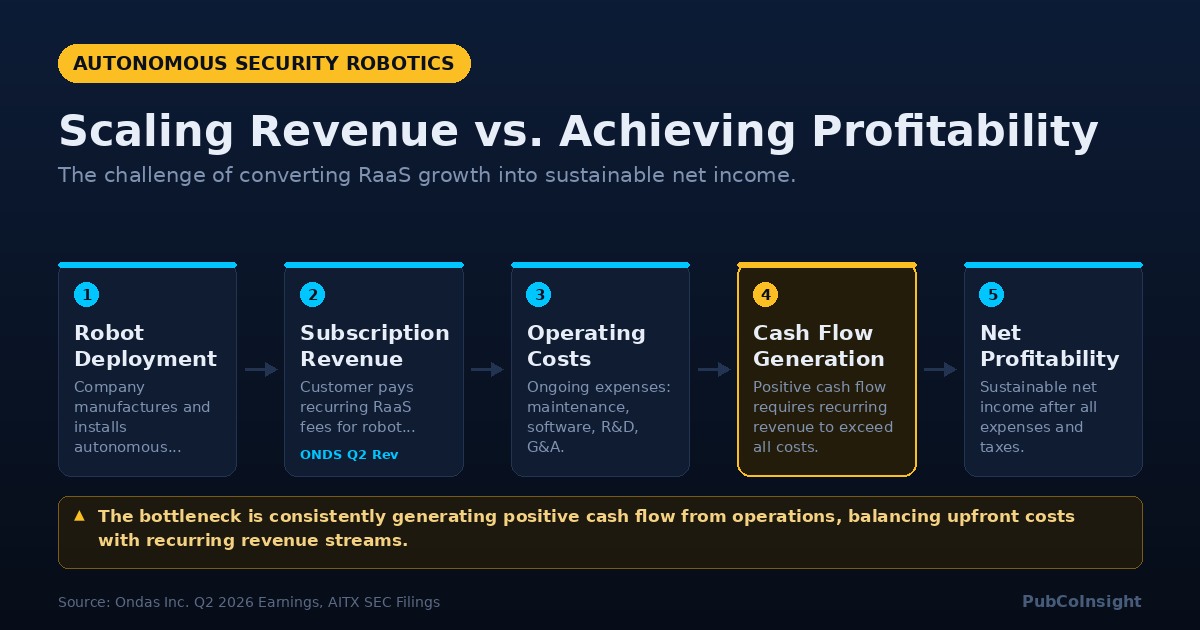
The Mechanism of Profitability in Robotics-as-a-Service
The business model for autonomous security robotics often revolves around a "Robotics-as-a-Service," or RaaS, framework. Instead of a large, one-time capital expenditure for hardware, customers pay a recurring subscription fee for the robot, its software, maintenance, and often remote monitoring services. This shifts the financial burden from the customer's capital budget to their operating budget, making adoption easier. For the robotics company, RaaS promises predictable, recurring revenue streams, which are highly valued by investors. However, achieving profitability within RaaS is complex. The upfront cost of manufacturing and deploying a robot is substantial. These costs include materials, assembly, software development, and initial field support. To generate a profit, the cumulative subscription fees must eventually exceed these initial costs, plus ongoing operational expenses like data center hosting, software updates, and field service technicians. The "break-even" point for a single robot or a fleet can be years away, depending on pricing, durability, and customer retention. High customer churn means the company must constantly acquire new customers, incurring new upfront costs, without fully recouping prior investments. Conversely, long-term contracts and high retention rates allow the company to amortize initial costs over a longer period, improving lifetime value per customer and, eventually, profitability. The challenge lies in managing this initial capital outlay and operational burn rate while scaling the subscriber base to a critical mass where recurring revenue consistently outstrips aggregate costs.Companies Navigating the Autonomous Security Landscape
Several companies are actively developing and deploying autonomous security robotics and related technologies. Their approaches vary, reflecting different strategies for market penetration and profitability. In the mobile robotics space, Serve Robotics Inc. (SERV) focuses on last-mile delivery robots, which share many operational and RaaS model characteristics with security patrols. Similarly, Unusual Machines, Inc. (UMAC), recently initiated with an "Overweight" rating by Piper Sandler, is developing drone technology, a sector that overlaps with autonomous security for aerial surveillance. Red Cat Holdings, Inc. (RCAT) also operates in the drone sector, with its stock rising recently on news of potential new tariffs on foreign drones, indicating a focus on domestic manufacturing or supply chain resilience. Other firms provide critical components or software for these autonomous systems. Arbe Robotics Ltd. (ARBE) specializes in imaging radar solutions, essential for environmental perception in autonomous vehicles and robots. MicroVision, Inc. (MVIS) develops lidar technology, another key sensor for navigation and object detection. Kopin Corporation (KOPN), with its stock seeing fair value lift after higher analyst targets on FPV outlook, focuses on micro-displays and optical solutions, which are crucial for remote operation interfaces and augmented reality applications in the field. Lantronix, Inc. (LTRX) provides secure data access and management solutions, enabling the robust connectivity required for remote monitoring and control of autonomous fleets. Software and AI development are central to this sector's growth. BigBear.ai Holdings, Inc. (BBAI) offers AI-powered analytics and decision intelligence, which can be integrated into autonomous security platforms for predictive threat assessment and optimized patrol routes. Ondas Inc. (ONDS), despite its recent earnings volatility, remains a player in drone systems, with its record revenue demonstrating market acceptance for its specialized drone solutions.Artificial Intelligence Technology Solutions, Inc.
Artificial Intelligence Technology Solutions, Inc. (AITX), trading on the OTCID tier, builds and leases autonomous security robots and remote monitoring systems. The company operates through a Solutions-as-a-Service model, providing its technology on a recurring monthly subscription rather than as outright hardware sales. This approach targets the estimated $50 billion U.S. security and guarding services market, aiming to deliver significant cost savings, between 35% and 80%, compared to traditional manned security. AITX structures its operations across several subsidiaries. Robotic Assistance Devices, Inc. (RAD-I) focuses on stationary security devices. Robotic Assistance Devices Mobile (RAD-M) develops mobile autonomous platforms, including the ROAMEO mobile security unit, which began early commercial deployment in May 2026. Robotic Assistance Devices Group (RAD-G) oversees the SARA agentic artificial intelligence platform, which the company states it expects to generate substantial revenue through licensing. Robotic Assistance Devices Residential (RAD-R) targets residential applications. Additionally, RAD Lanka, a wholly owned subsidiary in Sri Lanka, supports software development, AI initiatives, and technical operations. The company's long-term vision, internally referred to as "RAD Town," involves integrated autonomous security deployments across large campuses or communities. Financially, AITX reported revenue of $7,745,336 for the fiscal year ended February 28, 2026, a 26% increase over the prior year. Gross profit rose 48% to $5,533,700, with gross margin expanding to approximately 71% from 61%. Operating expenses remained essentially flat at about $17,477,097, leading to an improved loss from operations of approximately $(11,943,397). The company reported a net loss of approximately $14.5 million for the fiscal year ended February 28, 2026, and an accumulated deficit of approximately $171 million. Negative cash flow from operating activities for the year was $9,344,534. The public record does not yet establish the specific number of active subscriptions or units deployed for RAD-M's ROAMEO units since their early commercial deployment in May 2026, beyond the general statement of "early commercial deployment." Management has stated that RAD-I's recurring revenue and gross margin could, on a standalone basis, support positive cash flow operations today, and that RAD-M will eventually surpass RAD-I's monthly recurring revenue contribution. The company also projects subscription gross margin to exceed 75% and outright-sale gross margin to exceed 50%, based on current bill of materials costs and market-accepted pricing.What to watch
Investors should monitor several specific developments for signs of how the autonomous security robotics sector is addressing the profitability challenge. Watch for Q3 2026 earnings reports from companies like Ondas Inc. (ONDS) and Unusual Machines (UMAC) to see if revenue growth continues and if there are any shifts in their profitability outlooks or cost management strategies. Any new national dealer agreements or rapid follow-up orders, such as the one AITX's RAD secured on August 12, indicate continued market adoption and potential scaling. Look for announcements regarding the expansion of commercial deployments for mobile autonomous platforms, like AITX's ROAMEO, including specific customer names, locations, and the number of units deployed. Finally, observe any new permit approvals for autonomous robot operations in specific counties or jurisdictions, as these signal regulatory acceptance and open new market opportunities., { "label": "Subscription Revenue", "note": "Customer pays recurring RaaS fees for robot, software, service.", "metric": "ONDS Q2 Rev +1236%" }, { "label": "Operating Costs", "note": "Ongoing expenses: maintenance, software, R&D, G&A." }, { "label": "Cash Flow Generation", "note": "Positive cash flow requires recurring revenue to exceed all costs." }, { "label": "Net Profitability", "note": "Sustainable net income after all expenses and taxes." } ], "highlight": 3, "highlight_note": "The bottleneck is consistently generating positive cash flow from operations, balancing upfront costs with recurring revenue streams.", "footnote": "Source: Ondas Inc. Q2 2026 Earnings, AITX SEC Filings" }Companies mentioned
| Ticker | Company | Price |
|---|---|---|
| AITX client | Artificial Intelligence Technology Solutions Inc | $0.0066 |
| ARBE | Arbe Robotics Ltd. | $0.768 |
| BBAI | BigBear.ai Holdings, Inc. | $3.34 |
| KOPN | Kopin Corporation | $4.83 |
| LTRX | Lantronix, Inc. | $6.09 |
| MVIS | MicroVision, Inc. | $3.77 |
| ONDS | Ondas Inc. | $8.91 |
| RCAT | Red Cat Holdings, Inc. | $10.23 |
| SERV | Serve Robotics Inc. | $4.94 |
| UMAC | Unusual Machines, Inc. | $27.24 |
Listed alphabetically, not ranked. Prices as of 2026-08-14 and they move. Check a live quote before relying on any of this.
How we chose the companies in this article
We cover a fixed universe of companies working in autonomous security robotics, physical AI and the guarding services market they are aimed at. Every one of them that had usable market data on 2026-08-14 appears in this article. We do not pick which ones to mention based on what we think of them, and we do not order them by size, price or trading volume, because an ordered list is a verdict and that is not ours to hand down. Companies left out, and why: none. American Lithium Minerals and Artificial Intelligence Technology Solutions pay us, which is disclosed in full at the foot of every article they appear in.
See the dilution and promotion flags before you see the pitch.
Each week: the micro and small-caps now showing dilution or paid-promotion signals, with the SEC filing behind every flag. No recommendations, no price targets.
Sources used in this article
- The 5 Most Interesting Analyst Questions From Axon’s Q2 Earnings Call StockStory · 2026-08-14
- Stock market today: Dow, S&P 500, Nasdaq futures waver after stocks hit record high Yahoo Finance · 2026-08-14
- Michael Saylor's Strategy Is Selling Bitcoin Again. Here's Why I'm Still Bullish on Bitcoin. Motley Fool · 2026-08-14
- This Tech Stock Is 1 of the Most Shorted Stocks of 2026: Is Now the Time to Buy? Motley Fool · 2026-08-14
- Wall Street's riskiest trades are suddenly back on top: Chart of the Day Yahoo Finance · 2026-08-14
- L&T’s Vyoma.AI to construct NVIDIA B300 AI Factory in India World Construction Network · 2026-08-14
- The next AI winners may look nothing like Nvidia or Micron: One Big Investment Idea Yahoo Finance · 2026-08-14
- Larry Fink's BlackRock Just Crossed $15.3 Trillion in Assets. Here's What That Scale Actually Earns. Motley Fool · 2026-08-14
- Vanguard Is Bullish on Developed Markets Outside the U.S. -- But How Can You Buy Them? These 2 ETFs Can Help. Motley Fool · 2026-08-14
- Warren Buffett's Successor, Greg Abel, Is About to Drop a Bombshell on Wall Street Later Today, Aug. 14 Motley Fool · 2026-08-14
- SpaceX Stock Climbs Back Above Its $135 IPO Price -- Here's Where It Could Trade by August 2027 Motley Fool · 2026-08-14
- Serve Robotics (SERV) Q2 2026 Earnings Call Transcript Motley Fool · 2026-08-14
Disclosure required by Section 17(b) of the Securities Act of 1933
Artificial Intelligence Technology Solutions, Inc., a Nevada corporation (OTCID: AITX). Artificial Intelligence Technology Solutions, Inc. pays Strategic Innovations First, Inc., a Wyoming corporation doing business as PulseIR. Compensation received: USD 5,000.00 per month for months 1-3 (August, September, October 2026); USD 10,000.00 per month for months 4-6 (November, December 2026, January 2027) contingent on the 90-day review. Minimum committed USD 15,000.00; USD 45,000.00 if the second-period rate triggers.. Form of payment: cash only, invoiced monthly in advance; no stock, options or warrants received or payable. Services: investor relations services under an Investor Relations Services Agreement effective 2026-08-01. Period: six month term, 2026-08-01 through 2027-01-31; 90-day review on or about 2026-10-30. No stock, options or warrants held by PubCo Insight, Pulse IR, Strategic Innovations First, Inc., or Brad Listermann. Confirmed by the executed agreement and by board record recKwdq39X2caPSX7 (POSITIONS HELD: none).
This is information, not investment, financial, legal or tax advice. It is not a recommendation or solicitation to buy, sell or hold any security and it contains no price target. Nothing here is independently verified by us. Confirm every figure against primary filings on SEC EDGAR before you act. Micro-cap and over-the-counter securities are speculative and illiquid and can lose all of their value. The companies named without a disclosure above pay us nothing and have no relationship with us; they are named because a published, mechanical screen selected them. Full disclosure policy.