Drone Stocks Fluctuate as Guarding Services Seek Cost Savings
Recent volatility in drone sector equities underscores a market grappling with the long-term potential of autonomous security robotics against short-term risk aversion, even as demand for cost-efficient guarding solutions grows.
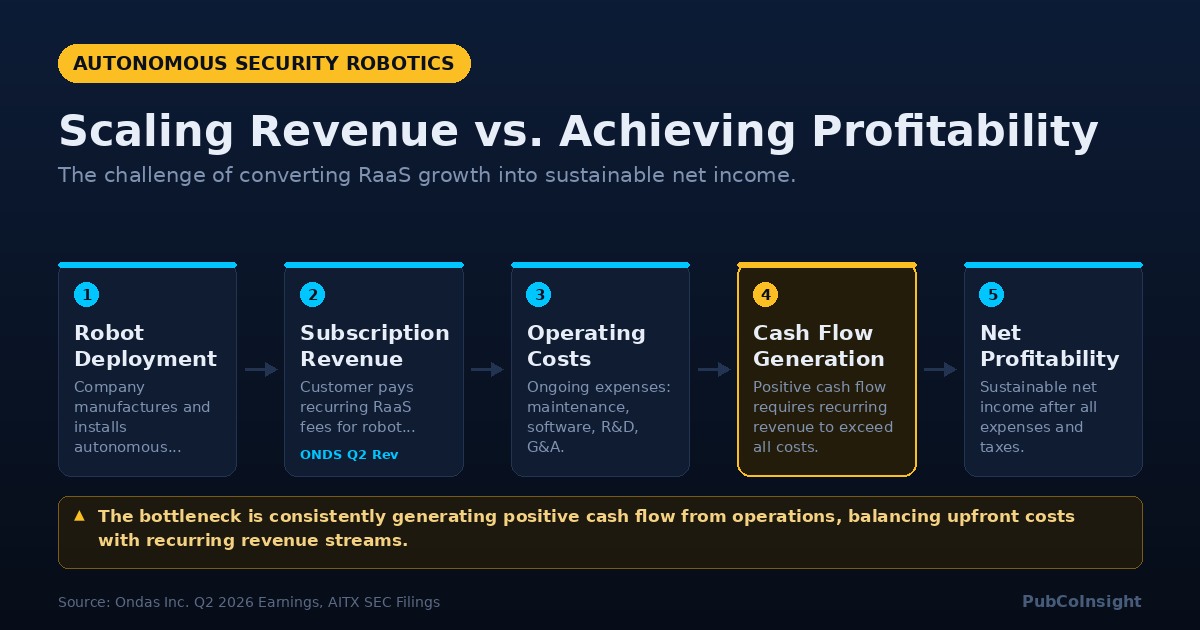
The Cost Arbitrage of Autonomous Guarding
The core mechanism driving the shift to autonomous security is simple economics: robots are a fixed, depreciable asset, while human labor is a recurring, escalating expense. A security robot, whether stationary or mobile, requires an initial capital outlay and ongoing maintenance, software subscriptions, and power. These costs are largely predictable. A human guard, by contrast, commands wages, benefits, training, and management oversight, all subject to inflation and labor market dynamics. Consider a typical guarding post requiring 24/7 coverage. This demands multiple human guards working shifts, accounting for breaks, sick days, and vacation. The fully loaded cost of a human guard can easily exceed $50,000 annually per position, multiplying for continuous coverage. An autonomous unit, once deployed, operates continuously, often recharging itself, and can cover the same area for a fraction of that annual cost. The cost savings are not linear; they scale with the number of posts and the complexity of the patrol routes. For a large industrial campus or a sprawling logistics center, replacing even a few human positions with autonomous units creates immediate and substantial operational leverage. This cost advantage is what makes the technology compelling, even with the upfront investment and the ongoing technical support needed. The challenge lies in the integration of these systems into existing security protocols and the public's acceptance of robot patrols.Companies Navigating the Autonomous Security Landscape
Several companies are working to capitalize on this cost arbitrage, each with a distinct approach to the autonomous security market. Serve Robotics Inc. (SERV), currently trading at $4.88, focuses on last-mile delivery robots, a related but distinct segment of physical AI. While its direct application is not security guarding, the underlying technology in autonomous navigation and human-robot interaction shares common ground. Serve's deployments in urban environments provide real-world data on robot reliability and public acceptance, factors crucial for broader autonomous adoption. In the drone space, Ondas Holdings (ONDS), priced at $8.75, and Unusual Machines, Inc. (UMAC), trading at $26.30, represent the aerial component of autonomous security. Ondas focuses on critical infrastructure and industrial applications for its drone systems, which can provide aerial surveillance and inspection. Unusual Machines, on the other hand, has made moves to expand its manufacturing and secure battery deals, with its NDAA-compliant expansion suggesting a focus on defense and government contracts. Red Cat Holdings, Inc. (RCAT), at $9.28, also operates in the drone sector, providing hardware and software for various applications, including defense and public safety. The volatility in these drone stocks reflects the early-stage nature of widespread drone integration into daily security operations, where regulatory hurdles and public perception still present significant variables. Companies like Arbe Robotics Ltd. (ARBE), at $0.666, and MicroVision, Inc. (MVIS), at $1.88, are developing advanced sensor technologies, particularly radar and lidar, which are critical components for autonomous navigation and perception in security robots. Arbe's 4D imaging radar technology provides high-resolution sensing for object detection and tracking, essential for robots operating in complex environments. MicroVision's lidar solutions offer precise distance measurement and mapping capabilities, fundamental for safe and efficient autonomous movement. These companies provide the foundational "eyes and ears" for the robots deployed by others. Further up the stack, Lantronix, Inc. (LTRX), trading at $6.03, offers secure data access and management solutions, which are vital for connecting and controlling fleets of autonomous devices. Their technology ensures that data from security robots is transmitted securely and reliably to monitoring centers. Kopin Corporation (KOPN), at $4.82, develops micro-displays and optical systems, which could find applications in remote monitoring interfaces or augmented reality overlays for human operators supervising autonomous fleets. BigBear.ai Holdings, Inc. (BBAI), at $3.19, provides AI-powered analytics and decision support, which can be leveraged to process the vast amounts of data collected by security robots, identifying patterns and anomalies that human operators might miss.Artificial Intelligence Technology Solutions, Inc.
Artificial Intelligence Technology Solutions, Inc. (AITX), trading over the counter at $0.0052, develops and leases AI-driven security robots and remote monitoring systems. The company operates through a Solutions-as-a-Service model, focusing on recurring monthly subscriptions rather than one-time hardware sales. This model aims to align with the operational expenditure budgets of security and guarding services clients. AITX structures its operations across several subsidiaries. Robotic Assistance Devices, Inc. (RAD-I) handles stationary security devices. Robotic Assistance Devices Mobile (RAD-M) focuses on mobile autonomous platforms, including the ROAMEO unit, which began early commercial deployment in May 2026. Robotic Assistance Devices Group (RAD-G) develops and licenses the SARA agentic artificial intelligence platform. The company also maintains Robotic Assistance Devices Residential (RAD-R) and Robotic Assistance Devices Lanka (Private) Limited (RAD Lanka), a Sri Lanka-based subsidiary that supports software development and AI initiatives. The company's stated goal is to achieve an integrated autonomous security deployment across a campus, community, or jurisdiction, which it refers to internally as "RAD Town." AITX has reported that its solutions are designed to deliver significant cost savings, between 35% and 80%, compared to traditional manned security. For the fiscal year ended February 28, 2026, AITX reported revenue of $7,745,336, a 26% increase over the prior fiscal year. Gross profit for the same period was $5,533,700, with gross margin expanding to approximately 71%. Operating expenses remained largely flat at $17,477,097. The company's net loss for the fiscal year was approximately $14.5 million, with an accumulated deficit of approximately $171 million as of February 28, 2026. The public record does not yet establish a clear path to sustained positive cash flow from operations, which management does not anticipate in the near term. The company's filings indicate a negative cash flow from operating activities of $9,344,534 for the year ended February 28, 2026, and negative working capital of $17,017,745. AITX disclosed an equity purchase agreement with Trillium, from which it expects to receive proceeds from the sale of Put Shares, as detailed in its July 16, 2026 prospectus. On August 27th, AITX's RAD subsidiary recorded a 14-unit order intake across five customer relationships, which the company described as its most diverse 24-hour order intake to date. On August 25th, AITX's PURSUON initiative reported a growing ROAMEO deployment pipeline and expanded production readiness, targeting 50 units by August 2027. This followed an August 24th announcement that RAD-M would become PURSUON, advancing the company's mobile security strategy.What to watch
Investors should monitor several specific developments. The deployment pipeline for mobile autonomous security units, particularly AITX's ROAMEO, will provide concrete data on market adoption. AITX has stated a goal of 50 ROAMEO units deployed by August 2027; progress towards this target will be a key indicator. Watch for further details on new contracts and deployments from AITX, such as the 14-unit order intake reported on August 27th, and the specific locations and industries involved. For drone operators like Ondas Holdings (ONDS) and Unusual Machines (UMAC), regulatory shifts regarding autonomous flight and expanded operational permits will be critical. Any new federal or state-level approvals for drone use in security or infrastructure inspection could accelerate adoption. Keep an eye on the filings of these companies for updates on manufacturing capacity expansions, like those mentioned by Unusual Machines, and any new battery supply agreements, as these impact scalability. Finally, watch for financial filings that provide clearer insights into revenue growth, gross margins, and, crucially, cash flow from operations across the sector. Companies that can demonstrate a path to positive operational cash flow, driven by recurring subscription revenues, will likely garner increased attention. The market will be looking for evidence that the cost savings promised by autonomous security are translating into sustainable business models for the providers., { "label": "Robot Deployment", "note": "Initial capital outlay for autonomous units" }, { "label": "Operational Phase", "note": "Predictable, lower recurring costs for robot services" }, { "label": "Cost Savings", "note": "Significant annual operational savings realized by clients", "metric": "35-80% savings" } ], "highlight": 2, "highlight_note": "The transition to predictable, lower recurring costs from robot services is the core value proposition.", "footnote": "Source: Company filings, industry estimates" }Companies mentioned
| Ticker | Company | Price |
|---|---|---|
| AITX client | Artificial Intelligence Technology Solutions Inc | $0.0052 |
| ARBE | Arbe Robotics Ltd. | $0.666 |
| BBAI | BigBear.ai Holdings, Inc. | $3.19 |
| KOPN | Kopin Corporation | $4.82 |
| LTRX | Lantronix, Inc. | $6.03 |
| MVIS | MicroVision, Inc. | $1.88 |
| ONDS | Ondas Inc. | $8.75 |
| RCAT | Red Cat Holdings, Inc. | $9.28 |
| SERV | Serve Robotics Inc. | $4.88 |
| UMAC | Unusual Machines, Inc. | $26.3 |
Listed alphabetically, not ranked. Prices as of 2026-08-29 and they move. Check a live quote before relying on any of this.
How we chose the companies in this article
We cover a fixed universe of companies working in autonomous security robotics, physical AI and the guarding services market they are aimed at. Every one of them that had usable market data on 2026-08-29 appears in this article. We do not pick which ones to mention based on what we think of them, and we do not order them by size, price or trading volume, because an ordered list is a verdict and that is not ours to hand down. Companies left out, and why: none. American Lithium Minerals and Artificial Intelligence Technology Solutions pay us, which is disclosed in full at the foot of every article they appear in.
See the dilution and promotion flags before you see the pitch.
Each week: the micro and small-caps now showing dilution or paid-promotion signals, with the SEC filing behind every flag. No recommendations, no price targets.
Sources used in this article
- Is AGCO’s (AGCO) Precision Autonomy Push Quietly Redefining Its Long‑Term Competitive Moat? Simply Wall St. · 2026-08-29
- What Happens When You Invest Just $100 a Month in the S&P 500 for 20 Years? Motley Fool · 2026-08-29
- Billionaire Hedge Fund Investor Ray Dalio Now Advises Holding a Small Amount of Bitcoin. Here's Why He's Wrong. Motley Fool · 2026-08-29
- Nvidia Just Locked In a $279 Billion Bet on Memory Chips Motley Fool · 2026-08-29
- Jim Cramer Explained What Turned The Tide For NVIDIA Corporation (NASDAQ:NVDA)’s Stock Insider Monkey · 2026-08-29
- Nvidia CEO Jensen Huang Not Taking OpenAI's 'Jalapeño' Chip Personally: 'Lots of Projects Get Started. Lots of Projects Get Canceled' Benzinga · 2026-08-29
- Nancy Pelosi’s Husband Bought Millions of This AI Power Stock. Nvidia Just Strengthened the Bull Case Insider Monkey · 2026-08-29
- A Costco Special Dividend Could Be Coming, but Walmart Has Raised Its Dividend for 53 Consecutive Years. Here's the Better Buy Now. Motley Fool · 2026-08-29
- Marvell's AI Bookings Are Stellar. But Its Gross Margin Guide Is What Moved the Stock. Motley Fool · 2026-08-29
- Why Elastic Stock Snapped Back Today Motley Fool · 2026-08-29
- Will Strength in Dedrone Platform Continue to Drive AXON's Growth? Zacks · 2026-08-28
- Drone Stocks Drop While Broad Market Rises: Unusual Machines Sinks 9%, Ondas Falls 6%, Red Cat Slides 5% 24/7 Wall St. · 2026-08-28
Disclosure required by Section 17(b) of the Securities Act of 1933
Artificial Intelligence Technology Solutions, Inc., a Nevada corporation (OTCID: AITX). Artificial Intelligence Technology Solutions, Inc. pays Strategic Innovations First, Inc., a Wyoming corporation doing business as PulseIR. Compensation received: USD 5,000.00 per month for months 1-3 (August, September, October 2026); USD 10,000.00 per month for months 4-6 (November, December 2026, January 2027) contingent on the 90-day review. Minimum committed USD 15,000.00; USD 45,000.00 if the second-period rate triggers.. Form of payment: cash only, invoiced monthly in advance; no stock, options or warrants received or payable. Services: investor relations services under an Investor Relations Services Agreement effective 2026-08-01. Period: six month term, 2026-08-01 through 2027-01-31; 90-day review on or about 2026-10-30. No stock, options or warrants held by PubCo Insight, Pulse IR, Strategic Innovations First, Inc., or Brad Listermann. Confirmed by the executed agreement and by board record recKwdq39X2caPSX7 (POSITIONS HELD: none).
This is information, not investment, financial, legal or tax advice. It is not a recommendation or solicitation to buy, sell or hold any security and it contains no price target. Nothing here is independently verified by us. Confirm every figure against primary filings on SEC EDGAR before you act. Micro-cap and over-the-counter securities are speculative and illiquid and can lose all of their value. The companies named without a disclosure above pay us nothing and have no relationship with us; they are named because a published, mechanical screen selected them. Full disclosure policy.