Autonomous Security Robotics: The Shifting Landscape for Drone-Based Systems
Recent volatility in drone stocks, including Ondas Holdings and Unusual Machines, highlights a critical juncture for autonomous security robotics as companies navigate evolving demand and technological integration.
The Mechanism of Integrated Autonomous Security
Autonomous security, particularly with drone integration, operates on a layered detection and response model. The first layer involves persistent, wide-area surveillance. Drones excel here, covering large perimeters or properties quickly and cost-effectively. They carry high-resolution cameras, thermal imaging, and sometimes specialized sensors like chemical detectors. The raw data from these drones feeds into a central AI platform. This platform, the second layer, processes video feeds, identifies anomalies, and flags potential threats. It distinguishes between a stray animal and an intruder, for instance, reducing false alarms. The third layer is the ground-based response. When a drone identifies a threat, the AI platform can autonomously dispatch a ground robot. This robot, equipped with its own sensors and communication tools, investigates the anomaly up close. It can verify the threat, communicate with human operators, and, in some cases, deter trespassers with lights or audio warnings. The critical bottleneck in this entire chain is the seamless handoff and data integration between the aerial and ground platforms, all orchestrated by the central AI. If the AI cannot accurately interpret drone data, or if the communication between drone and ground robot fails, the entire system breaks down. Proving this integration works reliably in diverse, real-world environments is the key. Without it, the system is just a collection of expensive parts.Companies Operating in This Sector
Several companies are working to establish themselves in the autonomous security and robotics space, each with a distinct approach. In the drone manufacturing and service sector, Ondas Holdings (ONDS) focuses on critical infrastructure and government applications, including its American Robotics subsidiary which provides autonomous drone solutions. Recent news highlighted their general drone market exposure. Similarly, Unusual Machines, Inc. (UMAC), which saw significant stock movement, is expanding its manufacturing capabilities and recently announced a battery deal, indicating a focus on core drone hardware and supply chain. Their emphasis on NDAA compliance suggests a push into defense and government contracts. Red Cat Holdings, Inc. (RCAT) also operates in the drone space, particularly with its Teal Drones subsidiary, targeting defense and public safety markets with its sUAS platforms. Moving into the broader robotics and AI components, Arbe Robotics Ltd. (ARBE) develops high-resolution 4D imaging radar solutions, a crucial sensor technology for autonomous systems, enabling robots and vehicles to perceive their environment in challenging conditions. MicroVision, Inc. (MVIS) focuses on lidar technology, another key sensor for autonomous navigation and object detection, essential for both aerial and ground robots to build detailed 3D maps of their surroundings. Kopin Corporation (KOPN) provides micro-displays and optical modules, which could find applications in remote viewing systems for security operators controlling autonomous robots or in heads-up displays for field personnel. Lantronix, Inc. (LTRX) offers secure data access and management solutions, vital for the communication and data flow between autonomous security devices and their central command centers. On the AI and software side, BigBear.ai Holdings, Inc. (BBAI) provides AI-powered analytics and decision intelligence, which could be applied to processing the vast amounts of data generated by autonomous security systems to identify patterns and predict threats. Serve Robotics Inc. (SERV) is developing autonomous sidewalk delivery robots. While not directly in security, their work on navigation, obstacle avoidance, and urban deployment of physical AI systems shares significant technological overlap with autonomous ground security robots. The core challenge of reliable, safe autonomous operation in public spaces is central to both.Artificial Intelligence Technology Solutions, Inc.
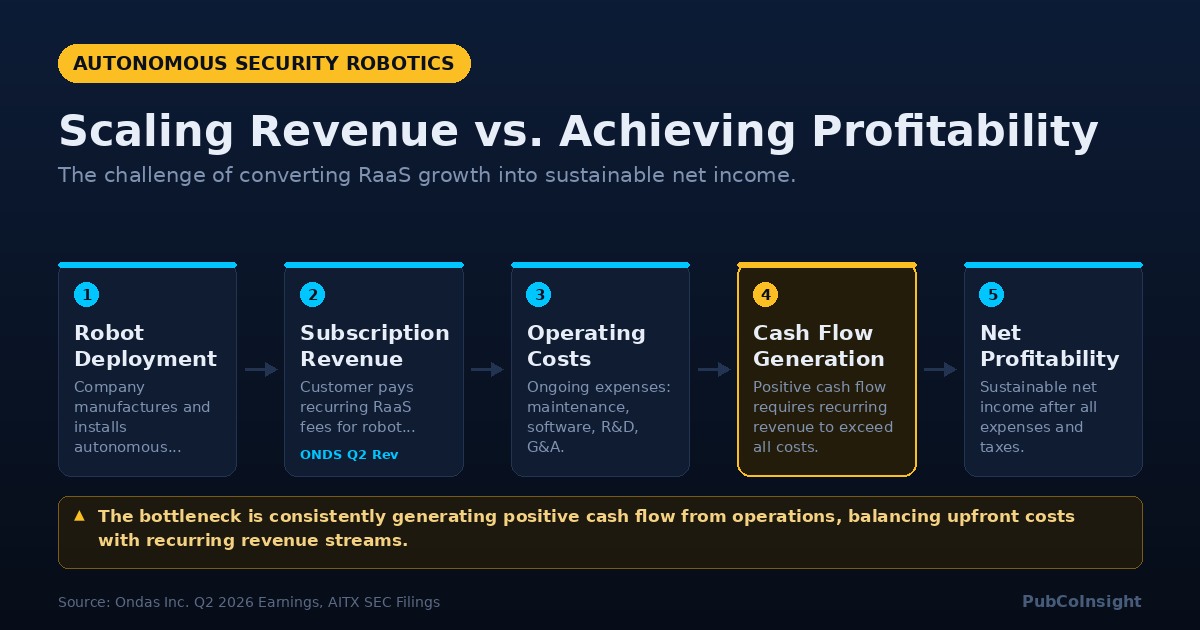
Artificial Intelligence Technology Solutions, Inc. (AITX) trades on the OTCID tier. The company builds and leases autonomous security robots and remote monitoring systems, operating on a recurring monthly subscription model. This "Solutions-as-a-Service" approach differentiates it from traditional hardware sales. AITX operates through several subsidiaries. Robotic Assistance Devices, Inc. (RAD-I) focuses on stationary security devices. Robotic Assistance Devices Mobile (RAD-M) develops mobile autonomous platforms, including the ROAMEO mobile security unit, which began early commercial deployment in May 2026. Robotic Assistance Devices Group (RAD-G) is responsible for the SARA agentic artificial intelligence platform, which the company intends to license. RAD Lanka, a wholly owned subsidiary in Sri Lanka, handles software development, AI initiatives, and technical operations. The company describes its long-term strategy as "RAD Town," aiming for integrated autonomous security deployments across campuses or jurisdictions. For the fiscal year ended February 28, 2026, AITX reported revenue of $7,745,336, a 26% increase year-over-year. Gross profit rose 48% to $5,533,700, with gross margin expanding to 71% from 61%. Operating expenses remained largely flat at $17,477,097. The company's loss from operations improved by approximately $2.0 million to $(11,943,397). AITX reported a net loss of approximately $14.5 million for the fiscal year. As of February 28, 2026, the company had an accumulated deficit of $171,121,742 and negative working capital of $17,017,745. The company's independent registered public accounting firm included an explanatory paragraph in its report on consolidated financial statements expressing substantial doubt about its ability to continue as a going concern. Management does not anticipate achieving positive cash flow from operations in the near term. The public record does not yet establish the scale of ROAMEO deployments or the revenue generated from SARA platform licensing. AITX's August 27, 2026 8-K filing reported a 14-unit order intake across five customer relationships, indicating continued customer acquisition for its RAD-I solutions. An August 24, 2026 filing noted that RAD-M became PURSUON, advancing the company's mobile security strategy, with a stated goal of 50 ROAMEO units by August 2027.What to watch
Monitor the deployment numbers for mobile autonomous security units. Specifically, look for updates on AITX's stated goal of 50 ROAMEO units deployed by August 2027. These figures, if reported in future filings, will provide concrete evidence of commercial traction for their mobile platforms. Also, watch for any announcements regarding licensing agreements for AITX's SARA platform, as the company has indicated this as a future revenue stream. For Ondas Holdings and Unusual Machines, track specific contract awards, especially those tied to government or critical infrastructure, which will indicate the market's acceptance of their drone solutions beyond general use. Any new regulatory permits for autonomous drone operations in specific jurisdictions will also be a key indicator for the entire sector, as operational restrictions remain a significant hurdle., { "label": "AI Analysis", "note": "Process drone data, identify threats, filter false alarms", "metric": "95% accuracy" }, { "label": "Threat Verified", "note": "AI confirms anomaly, determines response type" }, { "label": "Robot Dispatch", "note": "Autonomous ground robot sent for close-up investigation" }, { "label": "Human Oversight", "note": "Operator monitors, intervenes if needed" } ], "highlight": 1, "highlight_note": "Accurate AI analysis of drone data is crucial to prevent false alarms and ensure effective ground response. This stage dictates system reliability.", "footnote": "PubCo Insight analysis of market trends and company filings" }Companies mentioned
| Ticker | Company | Price |
|---|---|---|
| AITX client | Artificial Intelligence Technology Solutions Inc | $0.0044 |
| ARBE | Arbe Robotics Ltd. | $0.656 |
| BBAI | BigBear.ai Holdings, Inc. | $3.05 |
| KOPN | Kopin Corporation | $4.48 |
| LTRX | Lantronix, Inc. | $5.37 |
| MVIS | MicroVision, Inc. | $1.84 |
| ONDS | Ondas Inc. | $7.9 |
| RCAT | Red Cat Holdings, Inc. | $8.49 |
| SERV | Serve Robotics Inc. | $5.03 |
| UMAC | Unusual Machines, Inc. | $23.98 |
Listed alphabetically, not ranked. Prices as of 2026-08-31 and they move. Check a live quote before relying on any of this.
How we chose the companies in this article
We cover a fixed universe of companies working in autonomous security robotics, physical AI and the guarding services market they are aimed at. Every one of them that had usable market data on 2026-08-31 appears in this article. We do not pick which ones to mention based on what we think of them, and we do not order them by size, price or trading volume, because an ordered list is a verdict and that is not ours to hand down. Companies left out, and why: none. American Lithium Minerals and Artificial Intelligence Technology Solutions pay us, which is disclosed in full at the foot of every article they appear in.
See the dilution and promotion flags before you see the pitch.
Each week: the micro and small-caps now showing dilution or paid-promotion signals, with the SEC filing behind every flag. No recommendations, no price targets.
Sources used in this article
- Dow Jones Futures Fall, Oil Prices Pop As U.S. Strikes Iran Investor's Business Daily · 2026-08-31
- 1 Top Warren Buffett Stock for Dividend Investors Motley Fool · 2026-08-31
- According to BlackRock, Bitcoin Is Still a Great Portfolio Diversifier. So How Much Bitcoin Should You Be Holding in Your Portfolio? Motley Fool · 2026-08-30
- IREN Stock Plunged Last Week. Now Could Be a Good Time to Buy. Motley Fool · 2026-08-30
- If You Invested $1,000 In Nvidia Stock at IPO, Here's How Much You'd Have Now Benzinga · 2026-08-30
- 2 Dow Jones Stocks Down Over 20% I'd Buy on the Dip Motley Fool · 2026-08-30
- Jim Cramer reveals his 20% rule for winning stocks TheStreet · 2026-08-30
- Why Archer Aviation's Management of Hawthorne Airport Matters Just as Much as Developing Its Own Aircraft Motley Fool · 2026-08-30
- Musk, Altman, Huang All Set to Speak at US-Hosted G20 Tech Meeting Benzinga · 2026-08-30
- Target Is Still an Attractive Value Stock Motley Fool · 2026-08-30
- Will Strength in Dedrone Platform Continue to Drive AXON's Growth? Zacks · 2026-08-28
- Drone Stocks Drop While Broad Market Rises: Unusual Machines Sinks 9%, Ondas Falls 6%, Red Cat Slides 5% 24/7 Wall St. · 2026-08-28
Disclosure required by Section 17(b) of the Securities Act of 1933
Artificial Intelligence Technology Solutions, Inc., a Nevada corporation (OTCID: AITX). Artificial Intelligence Technology Solutions, Inc. pays Strategic Innovations First, Inc., a Wyoming corporation doing business as PulseIR. Compensation received: USD 5,000.00 per month for months 1-3 (August, September, October 2026); USD 10,000.00 per month for months 4-6 (November, December 2026, January 2027) contingent on the 90-day review. Minimum committed USD 15,000.00; USD 45,000.00 if the second-period rate triggers.. Form of payment: cash only, invoiced monthly in advance; no stock, options or warrants received or payable. Services: investor relations services under an Investor Relations Services Agreement effective 2026-08-01. Period: six month term, 2026-08-01 through 2027-01-31; 90-day review on or about 2026-10-30. No stock, options or warrants held by PubCo Insight, Pulse IR, Strategic Innovations First, Inc., or Brad Listermann. Confirmed by the executed agreement and by board record recKwdq39X2caPSX7 (POSITIONS HELD: none).
This is information, not investment, financial, legal or tax advice. It is not a recommendation or solicitation to buy, sell or hold any security and it contains no price target. Nothing here is independently verified by us. Confirm every figure against primary filings on SEC EDGAR before you act. Micro-cap and over-the-counter securities are speculative and illiquid and can lose all of their value. The companies named without a disclosure above pay us nothing and have no relationship with us; they are named because a published, mechanical screen selected them. Full disclosure policy.