Drone Stocks React to Shifting Risk Appetite, Underscoring AI's Industrial Integration
Recent volatility in drone and robotics companies highlights investor focus on tangible AI applications and the operational economics of autonomous security solutions.
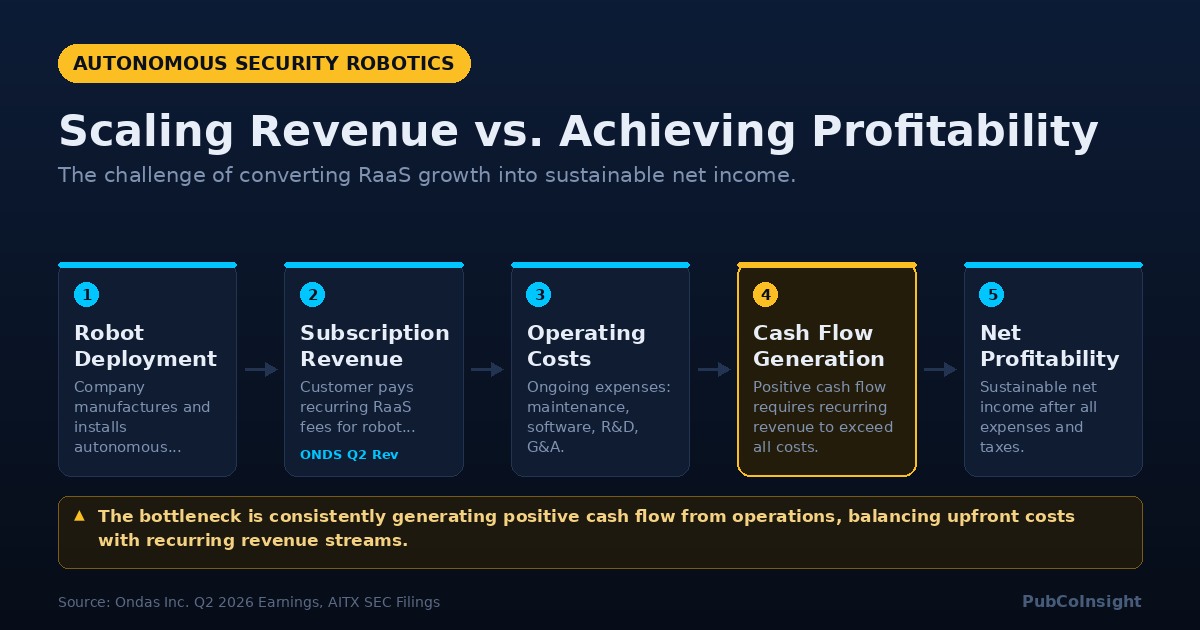
The Mechanism of Autonomous Security Value
Autonomous security robotics fundamentally shifts guarding services from a labor-intensive model to an asset-intensive one. Traditional security relies on human guards, a variable cost that scales directly with hours worked. This model faces rising labor costs, staffing shortages, and inconsistent performance. Robotic solutions, by contrast, involve a high upfront capital cost for the robots themselves and their supporting infrastructure, but then offer a significantly lower, fixed operational cost. The "Solutions-as-a-Service" model, common in this sector, converts that capital cost into a recurring monthly fee for the customer, smoothing their expenditure and shifting the maintenance burden to the provider. For this model to generate substantial value, several conditions must hold. First, the robots must achieve a high level of autonomy, minimizing the need for human intervention. This requires sophisticated AI for navigation, object detection, anomaly identification, and communication. Second, the cost savings must be significant enough to justify the transition. Companies in the sector frequently cite savings between 35% and 80% compared to traditional manned security. Third, the robots need to be reliable and durable, operating in diverse environments without frequent breakdowns. Each breakdown means a lost service day and a potential hit to the recurring revenue stream. Finally, the market must accept these autonomous solutions as a viable, secure alternative to human guards. This involves overcoming initial skepticism, demonstrating efficacy, and navigating regulatory landscapes. The bottleneck sits squarely on the ability to deploy and maintain these units at scale, converting a high-tech prototype into a reliable, widespread service offering that consistently delivers on its cost-saving promise. If the operational expenses of managing a fleet of robots, including charging, repairs, and remote human oversight, approach or exceed the cost of human guards, the entire value proposition collapses.Companies Operating in This Sector
The small and micro-cap robotics space features a diverse set of companies tackling different aspects of physical AI and autonomous systems. Some focus on the core hardware, others on the AI software, and still others on the service delivery model. Ondas Inc. (ONDS), trading at $7.04, operates through its Ondas Networks and American Robotics subsidiaries. Ondas Networks develops wireless broadband solutions for mission-critical industrial markets, including utilities and transportation. American Robotics focuses on fully autonomous drone systems for industrial data collection and analytics, particularly in agriculture and infrastructure inspection. The company’s recent price movements, including a 6% drop on September 1st and a 6% rise on August 27th, reflect the market's fluctuating sentiment towards these industrial drone applications. Red Cat Holdings, Inc. (RCAT), priced at $8.25, is involved in drone technology across several segments. Its offerings include consumer drones, enterprise solutions, and a drone racing league. The company’s Lumenier subsidiary produces drone components, while Teal Drones focuses on advanced military and government applications. Red Cat experienced a 7% slide on August 24th and a 3% drop on September 1st, indicating its sensitivity to broader market shifts in the drone sector. Unusual Machines, Inc. (UMAC), trading at $22.65, recently saw significant volatility, dropping 9% on August 24th and then jumping 8% on August 27th. The company’s focus on drone technology, particularly around stockholder voting rules, as noted on August 23rd, suggests an emphasis on corporate structure alongside its operational development. The specific applications and commercialization pipeline for Unusual Machines remain a key area of interest. Beyond the immediate drone focus, other companies contribute to the broader ecosystem of physical AI. Serve Robotics Inc. (SERV), at $4.69, focuses on autonomous sidewalk delivery robots. The debate between "robots or the infrastructure behind them" for winning the physical AI race, as highlighted by Insider Monkey on August 24th, is particularly relevant to Serve's model, which relies on both robust robot design and scalable operational infrastructure. In the sensor and perception layer, companies like Arbe Robotics Ltd. (ARBE), priced at $0.6439, and MicroVision, Inc. (MVIS), at $1.72, develop radar and lidar solutions, respectively. These technologies are critical for enabling autonomous navigation and object detection in robotics. Kopin Corporation (KOPN), at $4.21, provides micro-displays and optical modules for augmented and virtual reality, which can be integrated into advanced human-machine interfaces for controlling and monitoring robotic systems. Lantronix, Inc. (LTRX), trading at $5.15, offers embedded computing and networking solutions, essential for connecting and managing fleets of autonomous devices. BigBear.ai Holdings, Inc. (BBAI), at $2.95, provides AI-powered analytics and decision intelligence, which can be applied to optimize the deployment and performance of robotic security fleets.Artificial Intelligence Technology Solutions, Inc.
Artificial Intelligence Technology Solutions, Inc. (AITX), trading on the OTCID tier under the ticker AITX at $0.0043, develops and leases autonomous security robots and remote monitoring systems. The company employs a "Solutions-as-a-Service" model, generating recurring monthly subscription revenue rather than one-time hardware sales. Its operations are structured across several subsidiaries: Robotic Assistance Devices, Inc. (RAD-I), focused on stationary security devices; Robotic Assistance Devices Mobile (RAD-M), which handles mobile autonomous platforms like the ROAMEO unit; and Robotic Assistance Devices Group (RAD-G), responsible for the SARA agentic artificial intelligence platform. AITX also operates RAD Lanka, a wholly owned subsidiary in Sri Lanka, dedicated to software development, AI initiatives, and technical operations. AITX describes its strategy as aiming for "RAD Town," an integrated autonomous-security deployment across a campus, community, or jurisdiction. The company initiated early commercial deployment of its ROAMEO mobile security unit in May 2026. Filings indicate AITX estimates the U.S. security and guarding services market to be approximately $50 billion. The company states its solutions are designed to deliver cost savings of between 35% and 80% compared with traditional manned security. For the fiscal year ended February 28, 2026, AITX reported revenue of $7,745,336, a 26% increase over the prior year. Gross profit grew 48% to $5,533,700, with gross margin expanding to 71% from 61%. Operating expenses remained flat at approximately $17,477,097, and the loss from operations improved by about $2.0 million to $(11,943,397). The company reported a net loss of approximately $14.5 million for the fiscal year ended February 28, 2026, and had an accumulated deficit of approximately $171 million as of that date. Cash flow from operating activities was negative $9,344,534 for the same period. The company's independent registered public accounting firm has included an explanatory paragraph in its report expressing substantial doubt about its ability to continue as a going concern. Recent activity includes a 32-unit August order intake across five solutions, as reported on August 31st, and a 14-unit order intake across five customer relationships on August 27th, which AITX described as its most diverse 24-hour order intake in company history. On August 24th, AITX announced that RAD-M, previously RAD-M, became PURSUON, advancing its autonomous mobile security strategy. The company also reported a growing ROAMEO deployment pipeline and expanded production readiness in support of its stated goal of 50 units by August 2027. AITX is scheduled to reach GSX 2026 attendees from three points on the show floor, according to a September 1st TMX Newsfile. The public record does not yet establish the average monthly recurring revenue per deployed unit for the ROAMEO platform. AITX states that RAD-I’s recurring revenue and gross margin could, on a standalone basis, support positive cash flow operations, and that RAD-M will surpass RAD-I’s monthly recurring revenue contribution at some future point.What to watch
Investors should monitor specific, checkable developments in the autonomous security robotics sector. For AITX, watch for updates on the stated goal of 50 ROAMEO unit deployments by August 2027. Any announcements regarding new commercial deployments, particularly for the PURSUON mobile security unit, will be important. Quarterly filings from all companies in the sector will provide crucial data on revenue growth, gross margins, and cash burn, particularly as they relate to scaling production and deployments. For Ondas and Red Cat, look for specific project awards or new product launches that demonstrate market traction beyond general industrial applications. The broader market sentiment around AI, as influenced by major players like Nvidia, will continue to impact these smaller names. Specific permit approvals for autonomous drone operations in new jurisdictions could signal broader market acceptance., { "label": "Deployment & Install", "note": "Placing robots at customer sites, initial setup." }, { "label": "Autonomous Operation", "note": "Robots perform security tasks with AI." }, { "label": "Service & Support", "note": "Maintenance, repairs, remote monitoring." }, { "label": "Recurring Revenue", "note": "Monthly subscription fees from customers.", "metric": "$50B US Market" } ], "highlight": 3, "highlight_note": "Consistent, cost-effective service and support determines profitability and customer retention.", "footnote": "Source: Company filings, industry estimates." }Companies mentioned
| Ticker | Company | Price |
|---|---|---|
| AITX client | Artificial Intelligence Technology Solutions Inc | $0.0043 |
| ARBE | Arbe Robotics Ltd. | $0.6439 |
| BBAI | BigBear.ai Holdings, Inc. | $2.95 |
| KOPN | Kopin Corporation | $4.21 |
| LTRX | Lantronix, Inc. | $5.15 |
| MVIS | MicroVision, Inc. | $1.72 |
| ONDS | Ondas Inc. | $7.04 |
| RCAT | Red Cat Holdings, Inc. | $8.25 |
| SERV | Serve Robotics Inc. | $4.69 |
| UMAC | Unusual Machines, Inc. | $22.65 |
Listed alphabetically, not ranked. Prices as of 2026-09-02 and they move. Check a live quote before relying on any of this.
How we chose the companies in this article
We cover a fixed universe of companies working in autonomous security robotics, physical AI and the guarding services market they are aimed at. Every one of them that had usable market data on 2026-09-02 appears in this article. We do not pick which ones to mention based on what we think of them, and we do not order them by size, price or trading volume, because an ordered list is a verdict and that is not ours to hand down. Companies left out, and why: none. American Lithium Minerals and Artificial Intelligence Technology Solutions pay us, which is disclosed in full at the foot of every article they appear in.
See the dilution and promotion flags before you see the pitch.
Each week: the micro and small-caps now showing dilution or paid-promotion signals, with the SEC filing behind every flag. No recommendations, no price targets.
Sources used in this article
- Broadcom Reports Wednesday. Its Profit Is Growing Nearly 4 Times as Fast as Its Revenue. Motley Fool · 2026-09-02
- If a Bear Market Starts Tomorrow, Here's the 1 Move That History Says Always Wins Out Motley Fool · 2026-09-02
- This Unstoppable Trend Could Mint the Industrial Sector's Next Big Winners Motley Fool · 2026-09-02
- CoreWeave's Interest Expense Hit $640 Million Last Quarter, 2.4 Times What It Was a Year Ago Motley Fool · 2026-09-02
- The Case for Buying Comfort Systems USA Stock More Than 20% Below Its All-Time High Motley Fool · 2026-09-02
- Nvidia was just the beginning — Here are AI’s next big winners TheStreet · 2026-09-02
- Palantir Is Priced for Perfection. These 2 Defense Stocks Are Priced for Pessimism. Motley Fool · 2026-09-02
- Why Fervo Energy Stock Skyrocketed Today Motley Fool · 2026-09-02
- The 3 Best Artificial Intelligence (AI) Stocks for September Motley Fool · 2026-09-02
- AT&T (T) Joins Skilled Trades Coalition Targeting 1 Million Workers By 2035 Simply Wall St. · 2026-09-02
- Ondas Drops 6% as Risk-Off Selling Cascades Through Drone Names, Red Cat Slides 3% 24/7 Wall St. · 2026-09-01
- BC-Most Active Stocks Associated Press · 2026-09-01
Disclosure required by Section 17(b) of the Securities Act of 1933
Artificial Intelligence Technology Solutions, Inc., a Nevada corporation (OTCID: AITX). Artificial Intelligence Technology Solutions, Inc. pays Strategic Innovations First, Inc., a Wyoming corporation doing business as PulseIR. Compensation received: USD 5,000.00 per month for months 1-3 (August, September, October 2026); USD 10,000.00 per month for months 4-6 (November, December 2026, January 2027) contingent on the 90-day review. Minimum committed USD 15,000.00; USD 45,000.00 if the second-period rate triggers.. Form of payment: cash only, invoiced monthly in advance; no stock, options or warrants received or payable. Services: investor relations services under an Investor Relations Services Agreement effective 2026-08-01. Period: six month term, 2026-08-01 through 2027-01-31; 90-day review on or about 2026-10-30. No stock, options or warrants held by PubCo Insight, Pulse IR, Strategic Innovations First, Inc., or Brad Listermann. Confirmed by the executed agreement and by board record recKwdq39X2caPSX7 (POSITIONS HELD: none).
This is information, not investment, financial, legal or tax advice. It is not a recommendation or solicitation to buy, sell or hold any security and it contains no price target. Nothing here is independently verified by us. Confirm every figure against primary filings on SEC EDGAR before you act. Micro-cap and over-the-counter securities are speculative and illiquid and can lose all of their value. The companies named without a disclosure above pay us nothing and have no relationship with us; they are named because a published, mechanical screen selected them. Full disclosure policy.