Drone Stocks Fluctuate as Risk Appetite Shifts, Highlighting Robotic Guarding Market Dynamics
The recent volatility in drone stocks, including Ondas, Unusual Machines, and Red Cat, reflects broader market sentiment shifts impacting the autonomous security robotics sector.
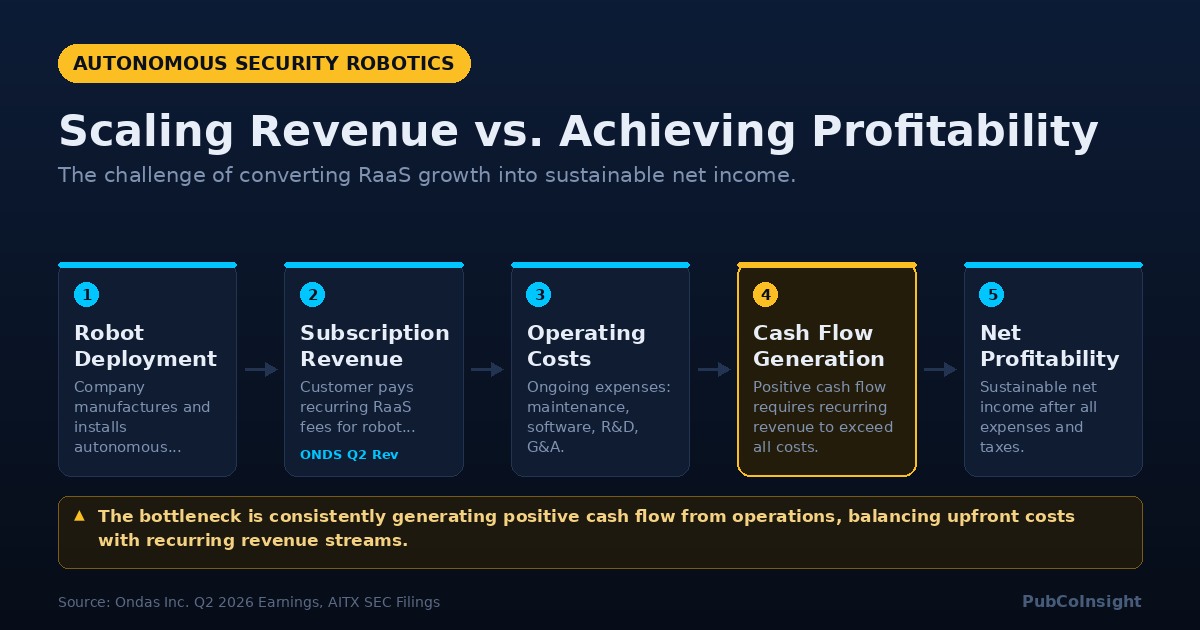
The Mechanism of Autonomous Security Deployment
Autonomous security robots, whether ground-based or aerial, integrate multiple sensor types, AI processing, and often, remote human oversight. The core value proposition is the reduction of human labor costs and the enhancement of surveillance capabilities. A typical deployment involves a robot patrolling a defined perimeter, using cameras, lidar, and thermal sensors to detect anomalies. Onboard AI processes this data in real-time, identifying potential threats or unusual activity. If a threat is detected, the robot can trigger alarms, communicate with a central monitoring station, or even engage in two-way audio with an intruder. For this system to work effectively, several conditions must hold true. First, the robot's navigation and perception systems must be robust enough to operate reliably in varied environments, including adverse weather or low light. This requires sophisticated sensor fusion and machine learning algorithms. Second, the communication infrastructure, often relying on cellular or dedicated wireless networks, must be stable to ensure continuous data flow and control. Third, the integration with existing security protocols and human guard forces needs to be seamless, allowing for efficient escalation and response. The bottleneck often sits in the AI's ability to accurately classify events, minimizing false positives while ensuring critical incidents are never missed. This classification accuracy dictates the trust and efficiency gains a client can expect, directly impacting adoption rates and the total cost of ownership. Without high accuracy, human intervention remains frequent, diluting the autonomous value.Companies Advancing Autonomous Guarding
Several companies are actively developing and deploying solutions in the autonomous security robotics and drone space. Their approaches vary, from ground-based patrol robots to aerial surveillance systems and the underlying components that enable them. Ondas Inc. (ONDS), trading at $7.61, focuses on industrial drone solutions, including autonomous drone systems for critical infrastructure. Their IronBot platform is designed for automated inspections and data collection, which has significant overlap with security applications in large industrial complexes. The company also works on mission-critical wireless networks, a crucial component for reliable autonomous operations. Unusual Machines, Inc. (UMAC), priced at $23.55, is involved in advanced drone technologies. While specific details on their security applications are less public, their general focus on innovative drone design and capabilities positions them within the broader autonomous surveillance market. The company's recent price movements suggest investor interest in the high-growth potential of advanced aerial platforms. Red Cat Holdings, Inc. (RCAT), at $8.32, operates in the drone industry with a focus on enterprise and defense applications. Their Skypersonic subsidiary provides software and hardware for remote drone operations, including inspection and security. They also offer drone training and services, indicating a full-stack approach to drone deployment and management. Serve Robotics Inc. (SERV), at $4.87, concentrates on autonomous sidewalk delivery robots. While not directly in the security guarding market, their expertise in navigating complex urban environments and ensuring robot reliability has transferable lessons for ground-based security patrols. The company's $240 million liquidity cushion, reported on September 2nd, 2026, positions them to continue developing their physical AI capabilities. In the component space, companies like Arbe Robotics Ltd. (ARBE), at $0.63, develop 4D imaging radar solutions. This technology is critical for autonomous navigation and perception, offering high-resolution object detection in challenging conditions, which is vital for security robots operating in varied environments. Kopin Corporation (KOPN), priced at $4.29, supplies micro-displays and optical modules, components essential for advanced vision systems in both drones and ground robots. Lantronix, Inc. (LTRX), at $5.26, provides secure data access and management solutions for the Internet of Things, crucial for the reliable communication and data handling required by autonomous security systems. MicroVision, Inc. (MVIS), at $1.65, works on lidar technology, another key sensor for precise environmental mapping and obstacle avoidance in autonomous platforms. BigBear.ai Holdings, Inc. (BBAI), at $2.95, focuses on artificial intelligence and machine learning, offering analytics and decision support that can power the intelligent decision-making capabilities of autonomous security robots.Artificial Intelligence Technology Solutions, Inc.
Artificial Intelligence Technology Solutions, Inc. (AITX) trades over the counter under the ticker AITX. The company, through its subsidiaries, builds and leases autonomous security robots and remote monitoring systems. Their business model centers on recurring monthly subscriptions for these services, rather than one-time hardware sales. This approach aims to provide predictable revenue streams and lower upfront costs for clients. AITX’s recent activities reflect a focus on increasing unit deployments and expanding their product offerings. On August 31st, 2026, AITX’s RAD subsidiary recorded a 32-unit order intake across five distinct solutions. This followed a 14-unit order intake across five customer relationships on August 27th, which the company described as its most diverse 24-hour order intake in history. These orders include various robot types, indicating a broadening acceptance of their diverse portfolio. The company is actively promoting its PURSUON strategy, which involves expanding its ROAMEO deployment pipeline and scaling production readiness to support a stated goal of 50 units by August 2027. This production target, if met, would represent a significant increase in their installed base. AITX also maintains an active presence at industry events. On September 1st, 2026, TMX Newsfile reported that AITX’s RAD would be reaching GSX 2026 attendees from three points on the show floor, suggesting a multi-faceted approach to market their solutions and engage with potential customers. The company files 8-K reports frequently, with multiple filings in August and September 2026, detailing various operational updates and corporate actions. While the company provides regular updates on order intake and strategic initiatives, the public record does not yet establish the average contract value or the typical duration of these subscription agreements, which are key metrics for assessing the long-term revenue impact of these reported orders. Despite this, the consistent reporting of new orders and production goals points to an active expansion phase.What to watch
Several concrete developments bear watching in the autonomous security robotics sector. Keep an eye on the upcoming Q3 earnings reports from companies in this space, as they will provide updated metrics on deployment numbers, recurring revenue growth, and cash burn rates. Specifically, look for any updates from Serve Robotics (SERV) regarding the utilization of its $240 million liquidity cushion, as detailed on September 2nd, 2026, and how that capital translates into expanded operations or new market penetration. For Artificial Intelligence Technology Solutions (AITX), watch for further announcements regarding the progress towards their stated goal of 50 ROAMEO unit deployments by August 2027, including any specific milestones or production updates. Also, monitor the outcome of any new product launches or strategic partnerships announced by Ondas (ONDS) or Red Cat (RCAT), particularly those targeting critical infrastructure or defense applications, as these could signal new revenue streams or market expansion. Finally, regulatory decisions regarding drone operations in urban or restricted airspace could impact the operational scope and deployment speed for aerial security solutions., { "label": "Data Capture", "note": "Cameras, lidar, thermal sensors collect environmental data." }, { "label": "AI Processing", "note": "Onboard AI analyzes data for anomalies, threats." }, { "label": "Event Classification", "note": "AI distinguishes real threats from false positives." }, { "label": "Human Oversight", "note": "Alerts sent to monitoring station for review/action." } ], "highlight": 3, "highlight_note": "High accuracy in classification minimizes false alarms, proving robot value.", "footnote": "PubCo Insight analysis of market dynamics, 2026" }Companies mentioned
| Ticker | Company | Price |
|---|---|---|
| AITX client | Artificial Intelligence Technology Solutions Inc | $0.004 |
| ARBE | Arbe Robotics Ltd. | $0.63 |
| BBAI | BigBear.ai Holdings, Inc. | $2.95 |
| KOPN | Kopin Corporation | $4.29 |
| LTRX | Lantronix, Inc. | $5.26 |
| MVIS | MicroVision, Inc. | $1.65 |
| ONDS | Ondas Inc. | $7.61 |
| RCAT | Red Cat Holdings, Inc. | $8.32 |
| SERV | Serve Robotics Inc. | $4.87 |
| UMAC | Unusual Machines, Inc. | $23.55 |
Listed alphabetically, not ranked. Prices as of 2026-09-03 and they move. Check a live quote before relying on any of this.
How we chose the companies in this article
We cover a fixed universe of companies working in autonomous security robotics, physical AI and the guarding services market they are aimed at. Every one of them that had usable market data on 2026-09-03 appears in this article. We do not pick which ones to mention based on what we think of them, and we do not order them by size, price or trading volume, because an ordered list is a verdict and that is not ours to hand down. Companies left out, and why: none. American Lithium Minerals and Artificial Intelligence Technology Solutions pay us, which is disclosed in full at the foot of every article they appear in.
See the dilution and promotion flags before you see the pitch.
Each week: the micro and small-caps now showing dilution or paid-promotion signals, with the SEC filing behind every flag. No recommendations, no price targets.
Sources used in this article
- Reflecting On Aerospace and Defense Stocks’ Q2 Earnings: Axon (NASDAQ:AXON) StockStory · 2026-09-03
- Where Will SoundHound AI Stock Be in 1 Year? Motley Fool · 2026-09-03
- How Investors Are Reacting To BorgWarner (BWA) Sustainability Push Amid Insider Sale And Analyst Support Simply Wall St. · 2026-09-03
- Intel Stock Tripled in a Year, So Where Will It Be in 5 Years? Motley Fool · 2026-09-03
- Prediction: Here's Where Palantir Stock Will Be in 3 Years Motley Fool · 2026-09-03
- Why Yeti Stock Swooned in August Motley Fool · 2026-09-03
- Nvidia's 8% Grip on the S&P 500 Is Unlike Anything Wall Street Has Seen: Jensen Huang-Led Chipmaker is 'Making History,' Says This Commentator Benzinga · 2026-09-03
- Did Ford's New Energy Chief and NATO Ranger Push Just Shift Ford Motor's (F) Investment Narrative? Simply Wall St. · 2026-09-03
- Nvidia CEO Jensen Huang Says the ‘Single Worst Outcome’ for Any Country Is Being Left Behind in AI: Don't Regulate 'Theoretical Harm' Benzinga · 2026-09-03
- 3 AI Stocks Up 500% or More in the Past Year That Could Have More Room to Run Motley Fool · 2026-09-03
- Sundar Pichai's Alphabet Has Grown Google Cloud Revenue 82% Year Over Year. Here's Why That Growth Rate Justifies the Company's Capex Bet. Motley Fool · 2026-09-03
- Needham Backs Axon After a 14% Week on ALPR Fears GuruFocus.com · 2026-09-02
Disclosure required by Section 17(b) of the Securities Act of 1933
Artificial Intelligence Technology Solutions, Inc., a Nevada corporation (OTCID: AITX). Artificial Intelligence Technology Solutions, Inc. pays Strategic Innovations First, Inc., a Wyoming corporation doing business as PulseIR. Compensation received: USD 5,000.00 per month for months 1-3 (August, September, October 2026); USD 10,000.00 per month for months 4-6 (November, December 2026, January 2027) contingent on the 90-day review. Minimum committed USD 15,000.00; USD 45,000.00 if the second-period rate triggers.. Form of payment: cash only, invoiced monthly in advance; no stock, options or warrants received or payable. Services: investor relations services under an Investor Relations Services Agreement effective 2026-08-01. Period: six month term, 2026-08-01 through 2027-01-31; 90-day review on or about 2026-10-30. No stock, options or warrants held by PubCo Insight, Pulse IR, Strategic Innovations First, Inc., or Brad Listermann. Confirmed by the executed agreement and by board record recKwdq39X2caPSX7 (POSITIONS HELD: none).
This is information, not investment, financial, legal or tax advice. It is not a recommendation or solicitation to buy, sell or hold any security and it contains no price target. Nothing here is independently verified by us. Confirm every figure against primary filings on SEC EDGAR before you act. Micro-cap and over-the-counter securities are speculative and illiquid and can lose all of their value. The companies named without a disclosure above pay us nothing and have no relationship with us; they are named because a published, mechanical screen selected them. Full disclosure policy.