Drone Tariffs Reshape Domestic Autonomous Security Robotics Landscape
A new 100% tariff on drone imports, announced August 14, 2026, by former President Trump, has sent immediate ripples through the autonomous security robotics sector, boosting domestic manufacturers and forcing a re-evaluation of supply chains and market strategies.
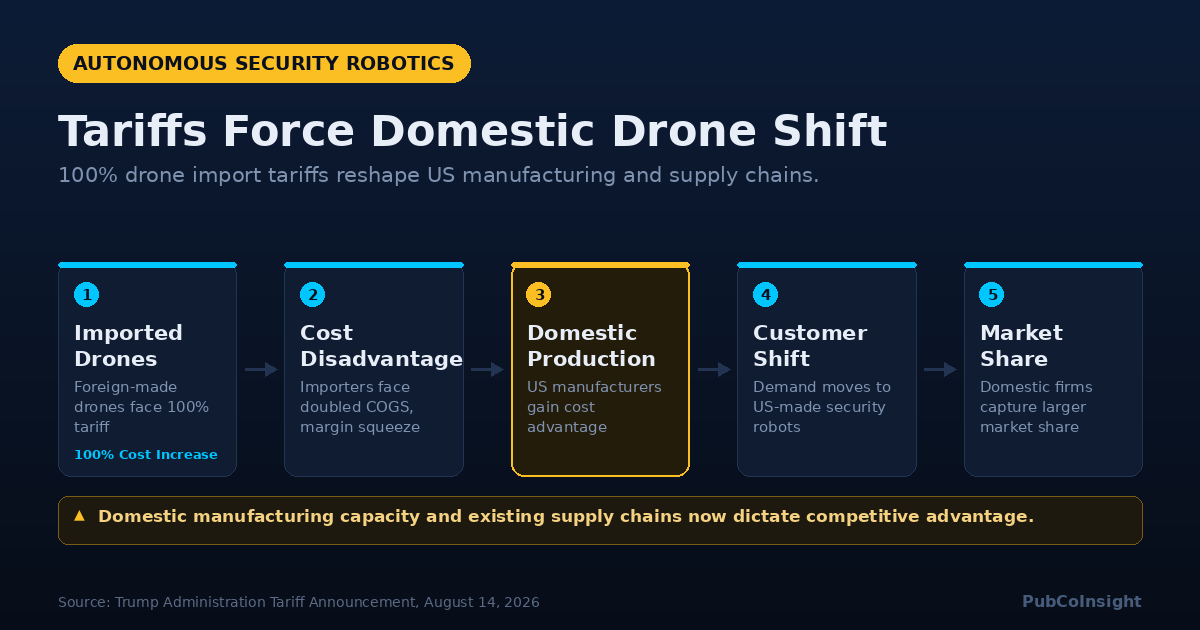
The Mechanism of Tariff Impact
Tariffs function as a direct tax on imported goods. In this case, a 100% tariff doubles the cost of any drone or drone component classified for import. This makes a foreign-made drone costing $1,000 suddenly cost $2,000 at the border, before any other duties or shipping. For autonomous security robotics, this impacts two main areas: finished drone units used in security applications, and critical sub-components like specialized sensors, flight controllers, or propulsion systems that are often integrated into larger robotic platforms. The core of the impact lies in the bill of materials. A company importing a finished drone for resale or integration sees its direct cost of goods sold (COGS) double. If a company manufactures domestically but relies on a key imported sensor, that sensor's cost doubles. This directly erodes gross margins unless the price to the end customer can be increased by a similar amount. In a competitive market, passing on a 100% cost increase is difficult. Therefore, the immediate effect is a severe margin squeeze for importers. Conversely, domestic manufacturers, or those with existing domestic component supply chains, suddenly find their products significantly more cost-competitive. Their COGS remains stable while imported alternatives become prohibitively expensive. This creates a strong incentive for customers to shift purchases to domestically produced options. The tariff's effectiveness hinges on the availability and scalability of domestic alternatives. If domestic capacity is limited, the tariff might lead to higher prices across the board or supply shortages rather than a pure market shift. Proof of its impact will be seen in order books and production ramp-ups from U.S.-based manufacturers, and conversely, in reduced imports reported by customs data.Companies Operating in Autonomous Security Robotics
The autonomous security robotics sector features a range of players, each with distinct approaches to hardware and software. The recent tariff announcement creates a new lens through which to view their operational models. Companies like Unusual Machines, Inc. (UMAC), which saw a significant stock jump, are positioned as domestic drone manufacturers. Their recent Q2 growth has been strong, as noted by Barchart, and Piper Sandler's bullish stance on the stock, also reported by Barchart, highlights their perceived advantage in this new environment. UMAC's focus on domestic production directly benefits from tariffs penalizing imports. Red Cat Holdings, Inc. (RCAT), another beneficiary of the tariff news, operates in the drone industry with a focus on enterprise and defense applications. Their existing U.S. manufacturing footprint or robust domestic supply chain would grant them a competitive edge as imported alternatives become less viable. Ondas Inc. (ONDS), which also saw a gain, has a diversified drone and industrial IoT platform. While they reported a wider-than-expected Q2 loss, their strong sales growth and new orders, as reported by Zacks, suggest underlying demand. The tariffs could accelerate their domestic drone segment's growth, potentially improving profitability timelines if they can leverage U.S. production capabilities. Beyond direct drone manufacturers, companies like Serve Robotics Inc. (SERV) are developing physical AI for ground-based delivery. While not directly impacted by drone tariffs, the broader shift towards domestic robotics manufacturing could influence component availability or foster a more robust U.S. robotics ecosystem. Serve Robotics' Q2 2026 earnings call transcript, reported by Motley Fool, discussed scaling physical AI beyond food delivery, suggesting a focus on broader automation trends. Other companies contribute critical technologies to the sector. Arbe Robotics Ltd. (ARBE) develops 4D imaging radar solutions, essential for autonomous navigation in both aerial and ground robotics. MicroVision, Inc. (MVIS) focuses on lidar technology for advanced driver-assistance systems and autonomous vehicles, with potential applications in larger mobile security platforms. Kopin Corporation (KOPN) provides micro-displays and optical modules, which are vital for drone control interfaces and augmented reality applications in security. Lantronix, Inc. (LTRX) offers secure data access and management solutions, crucial for connecting and managing fleets of autonomous security devices. BigBear.ai Holdings, Inc. (BBAI) provides AI-powered analytics and decision intelligence, which forms the brain for many advanced autonomous systems, regardless of their physical form. These companies, while not direct drone manufacturers, are integral to the functionality of autonomous security robots and could see shifts in demand for their components based on the tariff-driven changes in the drone manufacturing landscape.Artificial Intelligence Technology Solutions, Inc.
Artificial Intelligence Technology Solutions, Inc. (AITX) trades on the OTCID tier under the symbol AITX. The company, through its subsidiaries, develops and leases autonomous security robots and remote monitoring systems. Their business model emphasizes a recurring monthly subscription for these services, rather than one-time hardware sales. This "Solutions-as-a-Service" approach is primarily delivered through its Robotic Assistance Devices, Inc. (RAD-I) subsidiary, targeting the estimated $50 billion U.S. security and guarding services market. AITX states its solutions offer cost savings between 35% and 80% compared to traditional manned security. AITX's operations are structured around three main pillars. First, RAD-I focuses on stationary security devices. Second, Robotic Assistance Devices Mobile (RAD-M) develops mobile autonomous platforms, including the ROAMEO unit, which began early commercial deployment in May 2026. The company views RAD-M as having a higher revenue ceiling than its stationary counterparts. Third, Robotic Assistance Devices Group (RAD-G) is centered on the SARA agentic artificial intelligence platform, which AITX intends to license for substantial revenue. A wholly-owned subsidiary, RAD Lanka, located in Sri Lanka and operating under Port City Colombo status, supports software development, AI initiatives, and technical operations across the company's various subsidiaries. The long-term vision for AITX is an integrated autonomous-security deployment across large areas, which they refer to as "RAD Town." For the fiscal year ended February 28, 2026, AITX reported revenue of $7,745,336, a 26% increase year-over-year. Gross profit rose 48% to $5,533,700, with gross margin expanding to approximately 71% from 61%. Operating expenses remained largely flat at $17,477,097, leading to an improved loss from operations of $(11,943,397). The net loss for the year was approximately $14.5 million, contributing to an accumulated deficit of $171 million as of February 28, 2026. The company had negative cash flow from operating activities of $9,344,534 for the same period. As of February 28, 2026, AITX had negative working capital of $17,017,745. The public record does not yet establish a clear timeline for the company to achieve positive cash flow from operations. Management anticipates that RAD-I's recurring revenue and gross margin could, on a standalone basis, support positive cash flow operations, and characterizes RAD-I as having "achieved a point" where it could support positive cash flow today. They also project RAD-M will surpass RAD-I's monthly recurring revenue contribution at some future point. Subscription gross margin is expected to exceed 75% and outright-sale gross margin to exceed 50%, based on average bill of materials costs and market-accepted pricing. These projections are dependent on assumptions about continued pricing acceptance, stable input costs, and manufacturing scale.What to watch
Investors should monitor several concrete indicators in the coming months. Look for specific announcements from Unusual Machines (UMAC), Red Cat (RCAT), and Ondas (ONDS) regarding increased domestic production capacity or new supply chain partnerships, particularly in their upcoming Q3 earnings calls. Any new U.S.-based manufacturing facility permits or expansion announcements from these companies would signal tangible responses to the tariffs. Also, watch for customer testimonials or contract awards explicitly citing a shift from imported drone solutions to domestic alternatives. For Artificial Intelligence Technology Solutions (AITX), the deployment rate of their ROAMEO mobile security units, which began early commercial deployment in May 2026, will be critical. Filings regarding new subscription counts for both stationary and mobile units will provide insight into their market penetration. The company's 8-K filings, which have been frequent, will detail operational developments. The next quarterly report, expected around November 2026, will offer an update on revenue and gross margin trends, and any specific commentary on how the tariff environment impacts their component sourcing or competitive positioning. Broader market signals will include any adjustments to import data for drones and drone components, which will be released by the Department of Commerce in late 2026 and early 2027. These figures will confirm the actual reduction in imports and the corresponding increase in demand for domestic products., { "label": "Cost Disadvantage", "note": "Importers face doubled COGS, margin squeeze" }, { "label": "Domestic Production", "note": "US manufacturers gain cost advantage" }, { "label": "Customer Shift", "note": "Demand moves to US-made security robots" }, { "label": "Market Share", "note": "Domestic firms capture larger market share" } ], "highlight": 2, "highlight_note": "Domestic manufacturing capacity and existing supply chains now dictate competitive advantage.", "footnote": "Source: Trump Administration Tariff Announcement, August 14, 2026" }Companies mentioned
| Ticker | Company | Price |
|---|---|---|
| AITX client | Artificial Intelligence Technology Solutions Inc | $0.007 |
| ARBE | Arbe Robotics Ltd. | $0.797 |
| BBAI | BigBear.ai Holdings, Inc. | $3.27 |
| KOPN | Kopin Corporation | $5.5 |
| LTRX | Lantronix, Inc. | $6.47 |
| MVIS | MicroVision, Inc. | $2.24 |
| ONDS | Ondas Inc. | $9.24 |
| RCAT | Red Cat Holdings, Inc. | $11.13 |
| SERV | Serve Robotics Inc. | $4.99 |
| UMAC | Unusual Machines, Inc. | $34.06 |
Listed alphabetically, not ranked. Prices as of 2026-08-17 and they move. Check a live quote before relying on any of this.
How we chose the companies in this article
We cover a fixed universe of companies working in autonomous security robotics, physical AI and the guarding services market they are aimed at. Every one of them that had usable market data on 2026-08-17 appears in this article. We do not pick which ones to mention based on what we think of them, and we do not order them by size, price or trading volume, because an ordered list is a verdict and that is not ours to hand down. Companies left out, and why: none. American Lithium Minerals and Artificial Intelligence Technology Solutions pay us, which is disclosed in full at the foot of every article they appear in.
See the dilution and promotion flags before you see the pitch.
Each week: the micro and small-caps now showing dilution or paid-promotion signals, with the SEC filing behind every flag. No recommendations, no price targets.
Sources used in this article
- This Software Stock Just Produced a Rule of 40 Score Nearly as High as Palantir's, and Its Valuation Is Much More Attractive Motley Fool · 2026-08-17
- Dow Jones Futures: Nvidia Leads 5 Stocks In Buy Areas, Sandisk Needs This; Walmart Looms Investor's Business Daily · 2026-08-17
- Mastercard CEO: Cybersecurity Is Our Fastest-Growing Business Motley Fool · 2026-08-17
- NuScale's Potential TVA Deal Could Be 6 to 8 Gigawatts. Here's Why the CEO Calls It the Largest Nuclear Build-Out in U.S. History. Motley Fool · 2026-08-17
- Home Depot's Customer Transactions Have Fallen for 5 Straight Quarters Motley Fool · 2026-08-17
- The Trade Desk’s Woes & A New AI Doughnut? Motley Fool · 2026-08-16
- Billionaires Battle on NVIDIA: David Tepper Bought More. Dan Loeb Sold Every Share. George Soros Bought Puts. 24/7 Wall St. · 2026-08-16
- Elon Musk and Jensen Huang’s New Partnership Could Create the Next Era of Technology 24/7 Wall St. · 2026-08-16
- Amazon, Alphabet, and Microsoft Are Dropping Nearly $600 Billion on Capital Expenditures: 1 Clear Winner Emerges Motley Fool · 2026-08-16
- Wall Street’s Biggest Funds Are Dumping Broadcom and Adding Taiwan Semiconductor. Time to Follow the ‘Smart Money?’ 24/7 Wall St. · 2026-08-16
- 1 Cash-Producing Stock for Long-Term Investors and 2 We Question StockStory · 2026-08-16
- Is It Too Late to Buy Ondas Stock? Motley Fool · 2026-08-15
Disclosure required by Section 17(b) of the Securities Act of 1933
Artificial Intelligence Technology Solutions, Inc., a Nevada corporation (OTCID: AITX). Artificial Intelligence Technology Solutions, Inc. pays Strategic Innovations First, Inc., a Wyoming corporation doing business as PulseIR. Compensation received: USD 5,000.00 per month for months 1-3 (August, September, October 2026); USD 10,000.00 per month for months 4-6 (November, December 2026, January 2027) contingent on the 90-day review. Minimum committed USD 15,000.00; USD 45,000.00 if the second-period rate triggers.. Form of payment: cash only, invoiced monthly in advance; no stock, options or warrants received or payable. Services: investor relations services under an Investor Relations Services Agreement effective 2026-08-01. Period: six month term, 2026-08-01 through 2027-01-31; 90-day review on or about 2026-10-30. No stock, options or warrants held by PubCo Insight, Pulse IR, Strategic Innovations First, Inc., or Brad Listermann. Confirmed by the executed agreement and by board record recKwdq39X2caPSX7 (POSITIONS HELD: none).
This is information, not investment, financial, legal or tax advice. It is not a recommendation or solicitation to buy, sell or hold any security and it contains no price target. Nothing here is independently verified by us. Confirm every figure against primary filings on SEC EDGAR before you act. Micro-cap and over-the-counter securities are speculative and illiquid and can lose all of their value. The companies named without a disclosure above pay us nothing and have no relationship with us; they are named because a published, mechanical screen selected them. Full disclosure policy.