Drone Sector Volatility Highlights Shifting Defense and Commercial Demand
Recent trading swings for Ondas and Unusual Machines underscore the market's re-evaluation of drone applications, from military contracts to last-mile delivery.
The Dual-Use Dilemma for Drone Manufacturers
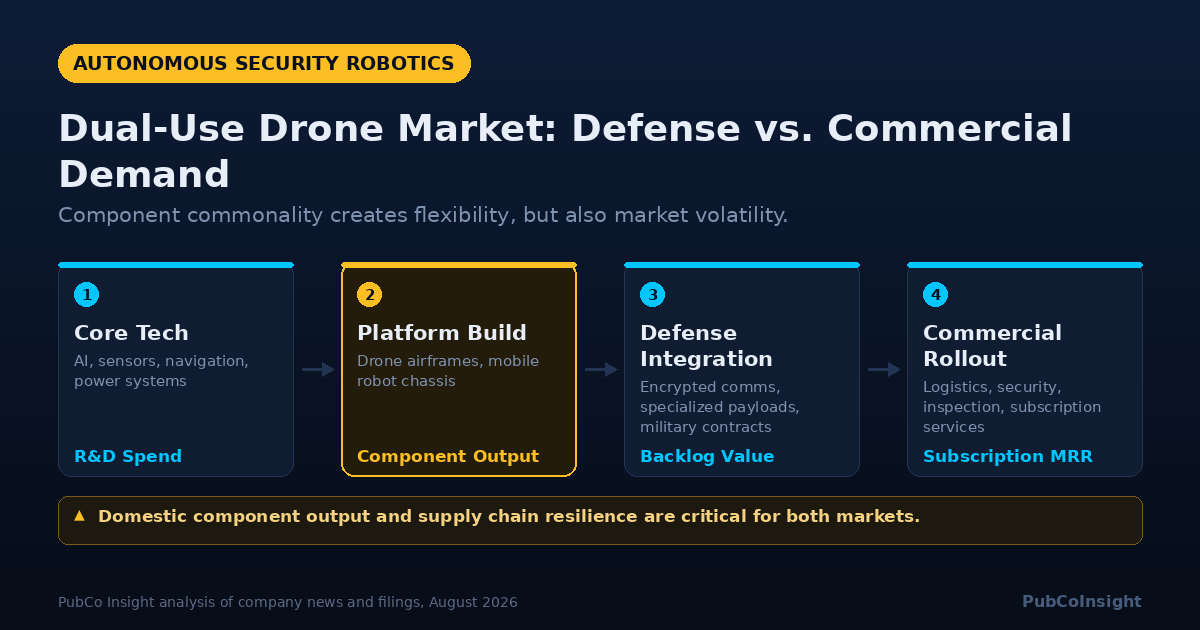
The core of this market volatility lies in the dual-use nature of drone technology. A drone designed for military reconnaissance might share many fundamental components with one built for industrial inspection or even package delivery. This overlap creates both opportunity and risk. Companies can pivot to capitalize on different demand surges, but they also become susceptible to policy shifts, geopolitical events, and economic cycles in multiple, often unrelated, sectors. For instance, a new defense contract might boost a company's backlog, but a shift in trade policy, like China reportedly pressing the US to scrap drone tariffs, can introduce immediate uncertainty. The physical mechanism of a drone, whether for defense or commercial use, involves a platform, a payload, navigation, and power. The platform is the airframe itself, often constructed from lightweight composites. The payload varies widely: high-resolution cameras for surveillance, thermal sensors for inspections, or cargo bays for delivery. Navigation relies on GPS, inertial measurement units, and increasingly, on-board AI for obstacle avoidance and autonomous pathfinding. Power typically comes from lithium-ion batteries, though some larger or longer-endurance drones use hybrid-electric or even small internal combustion engines. The critical distinction, and where value often concentrates, is in the software and sensor integration that tailors the general drone platform to a specific application, be it military-grade encrypted communications for defense or precision landing algorithms for commercial logistics.Companies Navigating the Autonomous Landscape
Several companies are actively working across different segments of this market. Ondas (ONDS), for example, is building out its defense capabilities. The company recently launched a drone operations center in Springfield, Ohio, signaling a focus on sovereign defense strategies. Its acquisition of Aran Defense is also intended to bolster this push. Ondas reported raising its 2026 guidance based on a record backlog and Q2 results, but also noted high growth and high cash burn, a common characteristic in developing technology sectors. Red Cat Holdings (RCAT) also operates in the drone space, often compared to Ondas in terms of market positioning. Unusual Machines (UMAC) is ramping up its U.S. drone component output. This focus on domestic manufacturing of critical parts positions them to capitalize on defense demand, especially given ongoing trade tensions and calls for supply chain resilience. Their Swarmer’s SkyKnight platform and broader platform expansion efforts indicate a move towards more integrated solutions. Kopin Corporation (KOPN) develops micro-displays and optical solutions, components vital for augmented reality (AR) and virtual reality (VR) systems that often interface with drone operations, particularly for remote piloting or data visualization. MicroVision (MVIS) focuses on lidar technology, a key sensor for autonomous navigation in drones and robotics, providing precise 3D mapping capabilities. Arbe Robotics (ARBE) also operates in the sensor space, developing 4D imaging radar solutions that could enhance autonomous perception for mobile platforms. In the broader AI and robotics ecosystem, BigBear.ai Holdings (BBAI) provides AI-powered analytics and data solutions, which can be critical for processing the vast amounts of data collected by autonomous security robots and drones. Lantronix (LTRX) offers secure data access and management solutions, essential for the reliable operation and monitoring of distributed robotic systems. Serve Robotics (SERV) is focused on the last-mile delivery segment, deploying autonomous robots for food and grocery delivery. The company recently announced a new delivery and hospital push, and a deal with Grubhub, after losing an Uber Eats deal. Serve Robotics reported 400% revenue growth in Q2, but also faced a guidance cut. ADT (ADT) represents the traditional security market, a sector ripe for disruption by autonomous solutions. Their Q2 results for specialized consumer services are being benchmarked against the evolving landscape.Artificial Intelligence Technology Solutions, Inc.
Artificial Intelligence Technology Solutions, Inc. (AITX) trades on the OTCID tier under the symbol AITX. The company, through its subsidiaries like Robotic Assistance Devices, Inc. (RAD-I), Robotic Assistance Devices Mobile (RAD-M), and Robotic Assistance Devices Group (RAD-G), develops and leases AI-driven security robots and remote monitoring systems. AITX’s model centers on a recurring monthly subscription for its solutions, rather than outright hardware sales. The company estimates the U.S. security and guarding services market to be approximately $50 billion. Its solutions are designed to deliver significant cost savings, between 35% and 80%, compared to traditional manned security. AITX’s product suite includes both stationary and mobile devices, integrated with its proprietary software and monitoring platforms. RAD-I focuses on stationary security devices, offering an AI-driven "Solutions-as-a-Service" model. RAD-M develops mobile autonomous platforms, with early commercial deployments of its ROAMEO mobile security unit beginning in May 2026. RAD-G is responsible for the company’s SARA agentic artificial intelligence platform. A wholly owned subsidiary, RAD Lanka, located in Sri Lanka, handles software development, AI initiatives, and technical operations. The company envisions an integrated autonomous-security deployment across campuses or communities, a concept it refers to as "RAD Town." For the fiscal year ended February 28, 2026, AITX reported revenue of $7,745,336, a 26% increase over the prior year. Gross profit rose 48% to $5,533,700, with gross margin expanding to 71% from 61%. Operating expenses remained flat at $17,477,097, and the loss from operations improved by $2.0 million to $(11,943,397). The company reported a net loss of approximately $14.5 million for the fiscal year and an accumulated deficit of approximately $171 million as of that date. AITX had negative cash flow from operating activities of $9,344,534 for the year ended February 28, 2026, and negative working capital of $17,017,745. The public record does not yet establish a clear path to positive cash flow from operations. Management states that RAD-I’s recurring revenue and gross margin could, on a standalone basis, support positive cash flow operations, and that RAD-M is expected to surpass RAD-I’s monthly recurring revenue at some future point. The company also anticipates subscription gross margins exceeding 75% and outright-sale gross margins exceeding 50%, based on current costs and market-accepted pricing. AITX recently secured a third ROSA order, with a property management client expanding its deployment, indicating repeat business and client satisfaction.What to watch
Investors should monitor several specific developments. For Ondas (ONDS), the progress and scale of its defense contracts, particularly the impact of the Aran Defense buyout, will be key. Any further updates on its Springfield, Ohio operations center will signal strategic direction. For Unusual Machines (UMAC), watch for concrete announcements regarding increased U.S. drone component output and new defense supply chain agreements. Serve Robotics (SERV) needs to demonstrate sustained revenue growth and improved margins from its Grubhub partnership and hospital deployments to offset previous guidance cuts. For Artificial Intelligence Technology Solutions (AITX), look for increases in subscription counts and specific deployment numbers for its ROAMEO mobile units. The company's filings regarding cash flow from operations and progress towards stated gross margin targets will provide critical insights into its financial trajectory. Broader market trends, such as any resolution or escalation of drone-related trade tariffs between the US and China, will also influence the sector., { "label": "Platform Build", "note": "Drone airframes, mobile robot chassis", "metric": "Component Output" }, { "label": "Defense Integration", "note": "Encrypted comms, specialized payloads, military contracts", "metric": "Backlog Value" }, { "label": "Commercial Rollout", "note": "Logistics, security, inspection, subscription services", "metric": "Subscription MRR" } ], "highlight": 1, "highlight_note": "Domestic component output and supply chain resilience are critical for both markets.", "footnote": "PubCo Insight analysis of company news and filings, August 2026" }Companies mentioned
| Ticker | Company | Price |
|---|---|---|
| AITX client | Artificial Intelligence Technology Solutions Inc | $0.0049 |
| ARBE | Arbe Robotics Ltd. | $0.715 |
| BBAI | BigBear.ai Holdings, Inc. | $3.22 |
| KOPN | Kopin Corporation | $5.04 |
| LTRX | Lantronix, Inc. | $5.98 |
| MVIS | MicroVision, Inc. | $1.66 |
| ONDS | Ondas Inc. | $8.71 |
| RCAT | Red Cat Holdings, Inc. | $9.62 |
| SERV | Serve Robotics Inc. | $4.98 |
| UMAC | Unusual Machines, Inc. | $27.43 |
Listed alphabetically, not ranked. Prices as of 2026-08-22 and they move. Check a live quote before relying on any of this.
How we chose the companies in this article
We cover a fixed universe of companies working in autonomous security robotics, physical AI and the guarding services market they are aimed at. Every one of them that had usable market data on 2026-08-22 appears in this article. We do not pick which ones to mention based on what we think of them, and we do not order them by size, price or trading volume, because an ordered list is a verdict and that is not ours to hand down. Companies left out, and why: none. American Lithium Minerals and Artificial Intelligence Technology Solutions pay us, which is disclosed in full at the foot of every article they appear in.
See the dilution and promotion flags before you see the pitch.
Each week: the micro and small-caps now showing dilution or paid-promotion signals, with the SEC filing behind every flag. No recommendations, no price targets.
Sources used in this article
- Why Ubiquiti Stock Just Sank Motley Fool · 2026-08-22
- Intel Sold $20 Billion of Stock at $95 a Share. It Now Trades Below $93. Motley Fool · 2026-08-22
- Can Shopify Integration Drive AppLovin's Next Growth Wave? Zacks · 2026-08-21
- Can Axon Enterprise Sustain Margin Performance Amid Rising Costs? Zacks · 2026-08-21
- Axon Enterprise vs. Celsius: Comparing Steady Incremental Gains and Historical Volatility in Quarterly Revenue Trends Motley Fool · 2026-08-21
- Why Morgan Stanley Stock Rocked the Market Today Motley Fool · 2026-08-21
- With Archer Aviation's Share Price Down 53%, Could a Reverse Stock Split Be About to Happen? Motley Fool · 2026-08-21
- Why Cardano Was on Fire Today Motley Fool · 2026-08-21
- The Best Semiconductor Stock to Buy Isn't AMD or Qualcomm: It's Nvidia, and Our Data Proves It Motley Fool · 2026-08-21
- Neoclouds Shine in AI Build Out Motley Fool · 2026-08-21
- Why Broadcom Stock Inched Higher on Friday Motley Fool · 2026-08-21
- Nvidia’s $7 Billion Poolside Deal Reveals a Licensing Playbook That Sidesteps Acquisition Scrutiny Forkast News · 2026-08-21
Disclosure required by Section 17(b) of the Securities Act of 1933
Artificial Intelligence Technology Solutions, Inc., a Nevada corporation (OTCID: AITX). Artificial Intelligence Technology Solutions, Inc. pays Strategic Innovations First, Inc., a Wyoming corporation doing business as PulseIR. Compensation received: USD 5,000.00 per month for months 1-3 (August, September, October 2026); USD 10,000.00 per month for months 4-6 (November, December 2026, January 2027) contingent on the 90-day review. Minimum committed USD 15,000.00; USD 45,000.00 if the second-period rate triggers.. Form of payment: cash only, invoiced monthly in advance; no stock, options or warrants received or payable. Services: investor relations services under an Investor Relations Services Agreement effective 2026-08-01. Period: six month term, 2026-08-01 through 2027-01-31; 90-day review on or about 2026-10-30. No stock, options or warrants held by PubCo Insight, Pulse IR, Strategic Innovations First, Inc., or Brad Listermann. Confirmed by the executed agreement and by board record recKwdq39X2caPSX7 (POSITIONS HELD: none).
This is information, not investment, financial, legal or tax advice. It is not a recommendation or solicitation to buy, sell or hold any security and it contains no price target. Nothing here is independently verified by us. Confirm every figure against primary filings on SEC EDGAR before you act. Micro-cap and over-the-counter securities are speculative and illiquid and can lose all of their value. The companies named without a disclosure above pay us nothing and have no relationship with us; they are named because a published, mechanical screen selected them. Full disclosure policy.