Drone Sector Volatility Highlights Shifting Defense and Commercial Strategies
Recent sharp movements in drone stocks like Ondas and Unusual Machines underscore a growing divergence between defense-driven demand and the broader commercial autonomous security market.
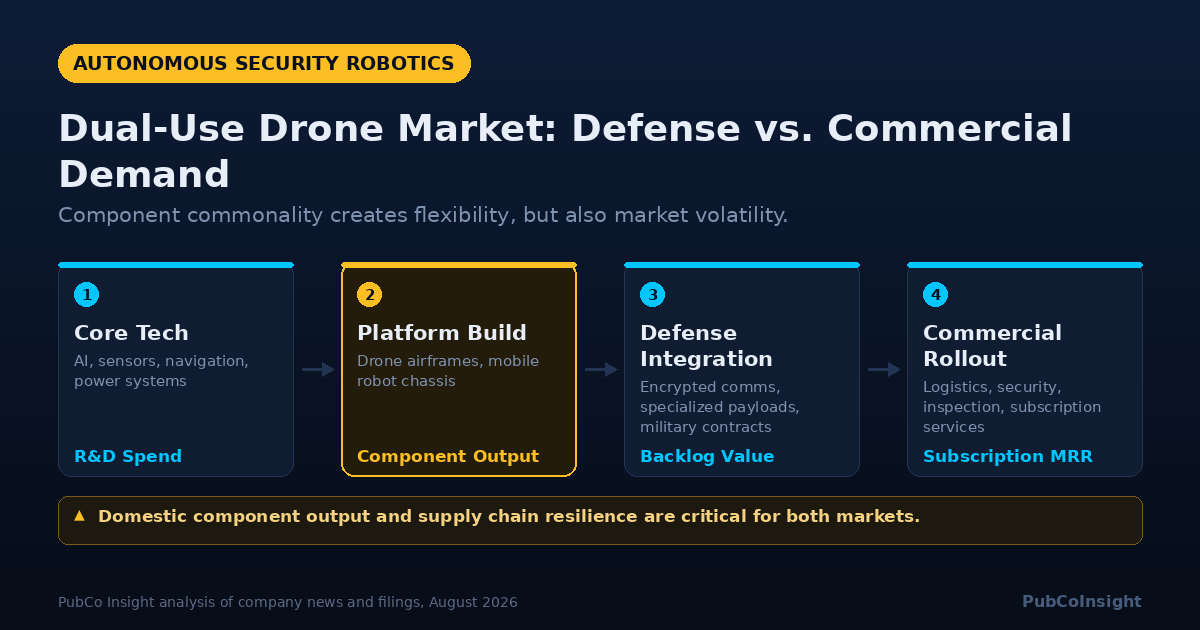
The Mechanism of Demand: Defense vs. Commercial
The core mechanism driving this volatility is the differing demand elasticity and regulatory frameworks between defense and commercial drone applications. Defense contracts, particularly those for NDAA-compliant systems, offer large, lumpy revenue streams and often come with long-term commitments. However, they are subject to geopolitical shifts, government procurement cycles, and specific compliance hurdles like the National Defense Authorization Act (NDAA) that restrict sourcing from certain countries. This creates high barriers to entry but also high rewards for compliant manufacturers. When a company like Unusual Machines (UMAC) expands its U.S. drone component output, as reported on August 21st, it directly addresses this defense demand, signaling a potential for stable, high-value contracts. Commercial applications, by contrast, target a broader, more fragmented market. This includes autonomous security robotics for guarding services, logistics, and infrastructure monitoring. Here, the demand is driven by cost savings, operational efficiency, and the ability to augment or replace human labor. The sales cycle is often shorter, but individual contracts are typically smaller and more numerous, often structured as recurring subscriptions. This market is less susceptible to sudden geopolitical shifts but more sensitive to economic cycles and the pace of technological adoption by enterprises. The key constraint here is often the integration of diverse AI systems and robotic platforms into existing operational workflows, requiring robust software, reliable hardware, and effective human-machine interfaces. A slowdown in adoption or a perceived technical hurdle can quickly dampen enthusiasm, while a successful deployment demonstrating significant cost savings can open up substantial recurring revenue. The market's reaction to Ondas's (ONDS) Q2 2026 earnings call, where it raised guidance on a record backlog but still saw a 5.9% drop on August 21st, suggests that even strong operational performance can be overshadowed by broader sector sentiment or concerns about cash burn.Companies Operating in Autonomous Security Robotics
The companies in this sector navigate these distinct demand landscapes with varied strategies. Some focus heavily on the defense sector, while others build out commercial solutions. Unusual Machines, Inc. (UMAC), trading at $27.43, has actively pursued the defense market. Its recent moves, including changes to stockholder voting rules on August 23rd and a manufacturing expansion coupled with a battery deal, indicate a strategic focus on scaling production for defense applications. The emphasis on NDAA-compliant expansion, as highlighted on August 22nd, directly addresses the stringent requirements of government contracts, positioning UMAC for potentially large defense orders. Ondas Inc. (ONDS), at $8.71, also has a significant defense component. The company launched a drone operations center in Springfield, Ohio, on August 19th, underscoring its commitment to defense technology. Its Q2 2026 earnings call on August 20th discussed a record backlog, hinting at strong order flow, potentially from defense. Ondas's sovereign defense strategy, bolstered by the Aran Defense buyout, as reported on August 20th, further solidifies its position in this segment. However, the market's "high growth, high cash burn" narrative around Ondas, noted on August 21st, suggests investors are weighing future potential against current operational costs. Other players focus on broader AI and robotics. Red Cat Holdings, Inc. (RCAT), priced at $9.62, operates in the drone space, often mentioned alongside Ondas in market discussions, suggesting some overlap in investor perception of their market segments. Arbe Robotics Ltd. (ARBE), at $0.715, specializes in imaging radar, a critical component for autonomous navigation in both drones and ground robots. Its technology provides high-resolution sensing, essential for safe and effective operation in complex environments. MicroVision, Inc. (MVIS), trading at $1.66, develops lidar technology, another key sensor for autonomous systems, offering precise distance and depth perception. In the AI and software layer, BigBear.ai Holdings, Inc. (BBAI), at $3.22, provides AI-powered analytics and decision support, which can be integrated into autonomous platforms for enhanced intelligence and operational efficiency. Lantronix, Inc. (LTRX), priced at $5.98, offers embedded computing and networking solutions, crucial for connecting and managing fleets of autonomous devices. Kopin Corporation (KOPN), at $5.04, develops micro-displays and optical modules, which are vital for augmented reality applications in human-robot interfaces and remote control systems. Finally, companies like Serve Robotics Inc. (SERV), at $4.98, are directly in the commercial delivery robotics space. Serve Robotics' recent deal with Grubhub, reported on August 19th, following the loss of its Uber Eats deal, shows the competitive dynamics and shifting partnerships in last-mile autonomous delivery. While its Q2 revenue grew 400%, a guidance cut sent the stock plunging on August 18th, illustrating the market's sensitivity to growth projections in this segment.Artificial Intelligence Technology Solutions, Inc.
Artificial Intelligence Technology Solutions, Inc. (AITX), trading over the counter at $0.0047, operates through subsidiaries like Robotic Assistance Devices, Inc. (RAD-I), Robotic Assistance Devices Mobile (RAD-M), and Robotic Assistance Devices Group (RAD-G). The company’s core strategy revolves around a "Solutions-as-a-Service" model for the security and guarding services industry. This model emphasizes recurring monthly subscriptions rather than outright hardware sales, aiming to deliver cost savings between 35% and 80% compared to traditional manned security. RAD-I focuses on stationary security devices, while RAD-M develops mobile autonomous platforms, including the ROAMEO unit, which began early commercial deployment in May 2026. RAD-G is centered on the SARA agentic artificial intelligence platform, which AITX intends to license for substantial revenue. The company’s wholly-owned subsidiary, RAD Lanka, located in Sri Lanka and operating under Port City Colombo status, handles software development, AI initiatives, and technical operations. AITX describes its long-term vision as "RAD Town," an integrated autonomous-security deployment across a campus or community. For the fiscal year ended February 28, 2026, AITX reported revenue of $7,745,336, a 26% increase year-over-year. Gross profit rose 48% to $5,533,700, with gross margin expanding to approximately 71%. Operating expenses remained flat at around $17,477,097, leading to an improved loss from operations of $(11,943,397). The company reported a net loss of approximately $14.5 million and an accumulated deficit of $171 million as of February 28, 2026. Cash flow from operating activities was negative $9,344,534 for the same period. The public record does not yet establish a clear path to positive cash flow from operations, as the company's independent registered public accounting firm has expressed substantial doubt about its ability to continue as a going concern. AITX has stated its belief that RAD-I's recurring revenue and gross margin could, on a standalone basis, support positive cash flow operations, and that RAD-M will surpass RAD-I's monthly recurring revenue contribution at some future point. It also projects subscription gross margin to exceed 75% and outright-sale gross margin to exceed 50%. The company has an equity purchase agreement with Trillium, under which it will receive proceeds from the sale of Put Shares. Recent filings include an S-1 registration statement from July 17, 2026, and multiple 8-K filings throughout July and August 2026, detailing various corporate actions.What to watch
Investors should monitor specific developments that will clarify market direction. For the defense drone sector, watch for announcements from the Department of Defense regarding new NDAA-compliant drone procurement contracts. A major contract award to Unusual Machines (UMAC) or Ondas (ONDS) would signal continued strong government spending. Also, observe any official statements or policy changes regarding US-China trade tariffs on drones, as reported on August 20th, which could impact supply chains and cost structures across the industry. In the commercial autonomous security and delivery space, look for quarterly reports from Serve Robotics (SERV) for updates on its Grubhub partnership and any revised guidance on robot deployment numbers or revenue growth. For Artificial Intelligence Technology Solutions (AITX), watch for further 8-K filings detailing additional ROAMEO deployments or new SARA platform licensing agreements. Specifically, the company's stated goal for RAD-M to surpass RAD-I's monthly recurring revenue contribution will be a key metric to track in future financial disclosures. Pay attention to any updates on AITX's cash position and accumulated deficit in its upcoming 10-Q or 10-K filings, as these will provide insight into its operational runway., { "label": "Commercial Services", "note": "Recurring subscriptions, cost savings, operational efficiency.", "metric": "Enterprise adoption" }, { "label": "Supply Chain Resil.", "note": "Domestic sourcing, battery deals, tariff impacts." }, { "label": "AI & Integration", "note": "Software, sensors, human-machine interface." }, { "label": "Market Sentiment", "note": "Rapid shifts, cash burn concerns." } ], "highlight": 2, "highlight_note": "Domestic sourcing and supply chain resilience are critical for defense contracts and cost control in commercial deployments.", "footnote": "Based on market reports and company filings, August 2026" }Companies mentioned
| Ticker | Company | Price |
|---|---|---|
| AITX client | Artificial Intelligence Technology Solutions Inc | $0.0047 |
| ARBE | Arbe Robotics Ltd. | $0.715 |
| BBAI | BigBear.ai Holdings, Inc. | $3.22 |
| KOPN | Kopin Corporation | $5.04 |
| LTRX | Lantronix, Inc. | $5.98 |
| MVIS | MicroVision, Inc. | $1.66 |
| ONDS | Ondas Inc. | $8.71 |
| RCAT | Red Cat Holdings, Inc. | $9.62 |
| SERV | Serve Robotics Inc. | $4.98 |
| UMAC | Unusual Machines, Inc. | $27.43 |
Listed alphabetically, not ranked. Prices as of 2026-08-23 and they move. Check a live quote before relying on any of this.
How we chose the companies in this article
We cover a fixed universe of companies working in autonomous security robotics, physical AI and the guarding services market they are aimed at. Every one of them that had usable market data on 2026-08-23 appears in this article. We do not pick which ones to mention based on what we think of them, and we do not order them by size, price or trading volume, because an ordered list is a verdict and that is not ours to hand down. Companies left out, and why: none. American Lithium Minerals and Artificial Intelligence Technology Solutions pay us, which is disclosed in full at the foot of every article they appear in.
See the dilution and promotion flags before you see the pitch.
Each week: the micro and small-caps now showing dilution or paid-promotion signals, with the SEC filing behind every flag. No recommendations, no price targets.
Sources used in this article
- Walmart Just Posted Its Biggest One-Day Drop Since 2022. History Says What Its Big Drops Have Been Worth. Motley Fool · 2026-08-23
- Dow Jones Futures Due With Market At Key Point; Nvidia, Tariffs, Warsh In Focus Investor's Business Daily · 2026-08-23
- Billionaires Stanley Druckenmiller and Dan Loeb Both Sold Broadcom and Piled Into This Virtual Monopoly Artificial Intelligence (AI) Stock Instead Motley Fool · 2026-08-23
- I Love NuScale Stock for 1 Reason, and It's Not What You Think Motley Fool · 2026-08-23
- Target Just Reported Earnings. Here's Whether the Dividend King Is Still a Buy. Motley Fool · 2026-08-23
- Nvidia, Fed Confab, Inflation, GDP, and More to Watch This Week Barrons.com · 2026-08-23
- The U.S. National Debt Officially Surpassed $40 Trillion in August: Here's What History Says This Means for the Stock Market Motley Fool · 2026-08-23
- SentinelOne Is Up 42% This Year and Reports Earnings on August 27. Should You Buy Before the Earnings Release? Motley Fool · 2026-08-23
- Broadcom vs. Marvell Technology: 1 Critical Metric Decides the Better Custom AI Chip Stock Motley Fool · 2026-08-23
- Should You Buy Oracle Stock Before September? The Answer Might Surprise You. Motley Fool · 2026-08-23
- Unusual Machines (UMAC) Changes Stockholder Voting Rules Simply Wall St. · 2026-08-23
- Is Unusual Machines’ (UMAC) NDAA-Compliant Expansion Redefining Its Long-Term Defense Drone Investment Profile? Simply Wall St. · 2026-08-22
Disclosure required by Section 17(b) of the Securities Act of 1933
Artificial Intelligence Technology Solutions, Inc., a Nevada corporation (OTCID: AITX). Artificial Intelligence Technology Solutions, Inc. pays Strategic Innovations First, Inc., a Wyoming corporation doing business as PulseIR. Compensation received: USD 5,000.00 per month for months 1-3 (August, September, October 2026); USD 10,000.00 per month for months 4-6 (November, December 2026, January 2027) contingent on the 90-day review. Minimum committed USD 15,000.00; USD 45,000.00 if the second-period rate triggers.. Form of payment: cash only, invoiced monthly in advance; no stock, options or warrants received or payable. Services: investor relations services under an Investor Relations Services Agreement effective 2026-08-01. Period: six month term, 2026-08-01 through 2027-01-31; 90-day review on or about 2026-10-30. No stock, options or warrants held by PubCo Insight, Pulse IR, Strategic Innovations First, Inc., or Brad Listermann. Confirmed by the executed agreement and by board record recKwdq39X2caPSX7 (POSITIONS HELD: none).
This is information, not investment, financial, legal or tax advice. It is not a recommendation or solicitation to buy, sell or hold any security and it contains no price target. Nothing here is independently verified by us. Confirm every figure against primary filings on SEC EDGAR before you act. Micro-cap and over-the-counter securities are speculative and illiquid and can lose all of their value. The companies named without a disclosure above pay us nothing and have no relationship with us; they are named because a published, mechanical screen selected them. Full disclosure policy.