Autonomous Security Robotics Sector Prepares for Q3 2026 Earnings
Key players in autonomous security, including Axon, Serve Robotics, Unusual Machines, and ADT, are set to release their Q3 2026 financial results, highlighting a sector-wide push for transparency and performance as the fiscal year draws to a close.
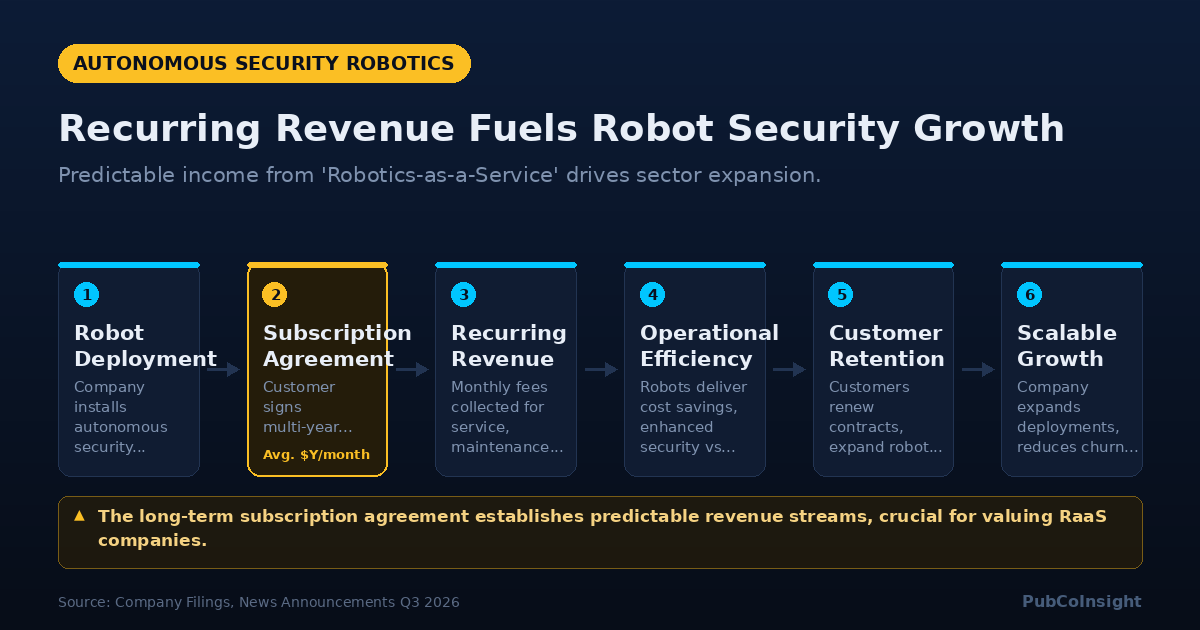
The Mechanism of Recurring Revenue in Robotic Security
The core economic mechanism driving growth in this sector is the shift from one-time hardware sales to recurring revenue models. Companies deploy autonomous security robots, drones, or AI-powered surveillance systems, then charge customers a monthly subscription fee for their use, maintenance, and data services. This model, often termed "Robotics-as-a-Service" (RaaS) or "Security-as-a-Service" (SaaS), provides predictable income streams. For it to matter, the robots must deliver demonstrable cost savings or enhanced security compared to traditional human guarding, or offer capabilities that human guards cannot match, like persistent, autonomous patrols in hazardous environments. The value sits in the long-term contract. A customer signs a multi-year agreement for a robot that costs $X to build and deploy, but generates $Y per month. The margin on that recurring revenue, after accounting for operational support and depreciation, is where profitability lies. Proof of concept comes from expanding deployments and reducing churn. If customers renew contracts, or scale up their robot fleets, the model works. Conversely, high churn rates or failure to secure new contracts would indicate a fundamental flaw in the value proposition or operational execution.Companies Operating in Autonomous Security
The autonomous security landscape features a range of companies, each tackling different aspects of the market. Axon (AXON), a larger player in public safety technology, recently unveiled its Body 5 camera on October 24, a next-generation device built for the AI era. This follows a period where Axon stock rebounded after a sharp selloff, with Raymond James still seeing significant upside. Axon's focus on integrated hardware and software solutions for law enforcement and security personnel positions it at the intersection of human and autonomous guarding. In the robotics delivery space, Serve Robotics (SERV) reported a significant stock plunge in mid-October. Serve Robotics focuses on last-mile autonomous delivery, a segment with direct parallels to autonomous security in terms of navigation, obstacle avoidance, and public interaction. Their upcoming November 5 earnings report will detail their financial performance and operational progress in this challenging market. The drone sector sees Unusual Machines (UMAC) making moves. On October 22, the company announced a $16.9 million order from Powerus for American-made drone components. This follows their October 19 acquisition of Upgrade Energy, expanding their U.S. drone battery manufacturing capabilities. Unusual Machines aims to be a key supplier in the drone ecosystem, which underpins many autonomous security and surveillance applications. Ondas Inc. (ONDS), with its Ondas Networks and American Robotics subsidiaries, is active in industrial and defense-related autonomous solutions. Ondas Networks develops wireless connectivity platforms, while American Robotics focuses on fully autonomous drone systems for industrial inspection and data collection. Recent news from October 20 highlighted potential boosts from EASA certification for its airborne defense prospects, and an October 19 strategic investment to expand defense autonomy capabilities. Other companies contribute to the underlying technologies. Arbe Robotics Ltd. (ARBE), for instance, introduced its Gryphon Radar System on October 17, designed to bring reliable perception to unmanned ground vehicles on rough terrain. This radar technology is critical for the safe and effective operation of autonomous security robots in complex environments. Kopin Corporation (KOPN), on October 19, published analysis finding optical interconnect architecture could address data center bottlenecks, a development relevant for the high-speed data processing required by advanced AI security systems. Lantronix, Inc. (LTRX) provides secure access and management solutions for IoT and IT assets, a foundational element for connecting and controlling distributed autonomous security networks. MicroVision, Inc. (MVIS) develops lidar technology, another key perception sensor for autonomous navigation. BigBear.ai Holdings, Inc. (BBAI) offers AI-powered analytics and decision intelligence, which can be integrated into broader security platforms to interpret data from autonomous systems. Red Cat Holdings, Inc. (RCAT) focuses on drone technology, including hardware, software, and services, serving both defense and commercial markets.Artificial Intelligence Technology Solutions, Inc.
Artificial Intelligence Technology Solutions, Inc. (AITX) trades on the OTCID tier under the ticker AITX. The company, through its subsidiary Robotic Assistance Devices (RAD), designs, builds, and leases autonomous security robots and remote monitoring systems. These are offered on a recurring monthly subscription basis rather than as outright hardware purchases. The company’s Q2 FY2027 results, reported on October 21, showed revenue, excluding its largest customer, up 61% year-over-year, and overall revenue up 8% sequentially. On October 22, AITX's RAD subsidiary secured orders across three product lines. The company projects achieving monthly operating cash breakeven in January 2027, ahead of anticipated revenue ramps from its RAIA, SARA, and ROAMEO product lines. AITX expanded its security distribution strategy on October 19 with the appointment of industry veteran Tom Reilly to drive new integrator and distribution channels. The company's most recent 10-Q filing for the six months ended August 31, 2026, details a negative cash flow from operating activities of $4,820,842 and an accumulated deficit of $184,084,880. It also shows negative working capital of $55,894,870. Management does not anticipate positive cash flow from operations in the near future. These factors, as stated in the filing, raise substantial doubt about the company’s ability to continue as a going concern for the twelve months following the issuance of these financial statements. The company acknowledges it lacks the resources to repay all debt obligations or fully implement its business plan without additional capital. Management is committed to raising funds, including through an equity financing agreement from June 23, 2026, where an investor will purchase up to $10,000,000 of common stock over three years, with approximately $9.8 million remaining under this arrangement. The filing also details numerous promissory notes with varying maturity dates, including several that mature on October 31, 2026. The public record does not yet establish a clear path to sustained positive operating cash flow without continued external financing. Despite this, management expressed confidence in maintaining operations through growing revenues, equity proceeds, and issuing debt. As of August 31, 2026, the company reported cash of $220,275, accounts receivable of $947,146, and revenue-earning devices, net of depreciation, valued at $4,677,987.What to watch
Investors should monitor the upcoming Q3 2026 earnings reports closely. Axon (AXON) and Serve Robotics (SERV) both report on November 5. ADT (ADT) reports on November 3. The specific details on revenue growth, gross margins, and customer acquisition costs in these reports will provide concrete data points on the health of the recurring revenue model. Unusual Machines (UMAC) has not specified a date for its Q3 report, but its announcement of a corporate update alongside financials suggests a broader strategic discussion. Look for details on the Powerus order fulfillment and the integration of Upgrade Energy. For AITX, the Q3 FY2027 report will be critical for assessing progress towards their stated goal of monthly operating cash breakeven in January 2027. Pay attention to any updates on the remaining $9.8 million equity financing and the maturity of promissory notes due on October 31, 2026. Any new distribution agreements or significant customer deployments will also be important to track., { "label": "Subscription Agreement", "note": "Customer signs multi-year contract for RaaS.", "metric": "Avg. $Y/month" }, { "label": "Recurring Revenue", "note": "Monthly fees collected for service, maintenance, data." }, { "label": "Operational Efficiency", "note": "Robots deliver cost savings, enhanced security vs. human guards." }, { "label": "Customer Retention", "note": "Customers renew contracts, expand robot fleet." }, { "label": "Scalable Growth", "note": "Company expands deployments, reduces churn for profitability." } ], "highlight": 1, "highlight_note": "The long-term subscription agreement establishes predictable revenue streams, crucial for valuing RaaS companies.", "footnote": "Source: Company Filings, News Announcements Q3 2026" }Companies mentioned
| Ticker | Company | Price |
|---|---|---|
| AITX client | Artificial Intelligence Technology Solutions Inc | $0.0013 |
| ARBE | Arbe Robotics Ltd. | $0.432 |
| BBAI | BigBear.ai Holdings, Inc. | $2.14 |
| KOPN | Kopin Corporation | $3.38 |
| LTRX | Lantronix, Inc. | $5.75 |
| MVIS | MicroVision, Inc. | $1.18 |
| ONDS | Ondas Inc. | $6.2 |
| RCAT | Red Cat Holdings, Inc. | $4.43 |
| SERV | Serve Robotics Inc. | $2.78 |
| UMAC | Unusual Machines, Inc. | $17.02 |
Listed alphabetically, not ranked. Prices as of 2026-10-26 and they move. Check a live quote before relying on any of this.
How we chose the companies in this article
We cover a fixed universe of companies working in autonomous security robotics, physical AI and the guarding services market they are aimed at. Every one of them that had usable market data on 2026-10-26 appears in this article. We do not pick which ones to mention based on what we think of them, and we do not order them by size, price or trading volume, because an ordered list is a verdict and that is not ours to hand down. Companies left out, and why: none. American Lithium Minerals and Artificial Intelligence Technology Solutions pay us, which is disclosed in full at the foot of every article they appear in.
See the dilution and promotion flags before you see the pitch.
Each week: the micro and small-caps now showing dilution or paid-promotion signals, with the SEC filing behind every flag. No recommendations, no price targets.
Sources used in this article
- Axon Unveils Body 5 as Its Stock Sits 26% Lower in 2026. Here’s Where the Stock Could Go by 2030 TIKR · 2026-10-26
- Here's What $1,000 Spread Across These 4 Memory and Storage Stocks Could Be Worth by 2030 Motley Fool · 2026-10-26
- Got $5,000? 3 Growth Stocks to Buy and Hold Through 2030. Motley Fool · 2026-10-26
- Is SpaceX a Buy After Its Latest Quarterly Results? Motley Fool · 2026-10-26
- Musk Predicts “Guppy-Level Death” For Neocloud Companies As CoreWeave Stock Falls 38% In October 24/7 Wall St. · 2026-10-26
- Alphabet Has $514 Billion in Cloud Orders. Here’s What Matters More Than That Number on Oct. 28. Motley Fool · 2026-10-26
- Wall Street's Blockbuster Stock Split Was Just Announced, and It's Anything but Conventional Motley Fool · 2026-10-26
- Musk Says SpaceX Closed $40 Billion Debt Deal, Blasts Neoclouds Bloomberg · 2026-10-26
- Should You Buy the Dip in Nike Stock While the Market Is This Nervous? Motley Fool · 2026-10-26
- Here’s What a $10,000 Investment in Micron Stock Will Be Worth by 2030 Motley Fool · 2026-10-26
- 'The world's super company': Wall Street weighs SpaceX earnings, company's likely Tesla tie-up Yahoo Finance · 2026-10-26
- Axon Announces Body 5: Next-Generation Camera Built for the AI Era PR Newswire · 2026-10-24
Disclosure required by Section 17(b) of the Securities Act of 1933
Artificial Intelligence Technology Solutions, Inc., a Nevada corporation (OTCID: AITX). Artificial Intelligence Technology Solutions, Inc. pays Strategic Innovations First, Inc., a Wyoming corporation doing business as PulseIR. Compensation received: USD 5,000.00 per month for months 1-3 (August, September, October 2026); USD 10,000.00 per month for months 4-6 (November, December 2026, January 2027) contingent on the 90-day review. Minimum committed USD 15,000.00; USD 45,000.00 if the second-period rate triggers.. Form of payment: cash only, invoiced monthly in advance; no stock, options or warrants received or payable. Services: investor relations services under an Investor Relations Services Agreement effective 2026-08-01. Period: six month term, 2026-08-01 through 2027-01-31; 90-day review on or about 2026-10-30. No stock, options or warrants held by PubCo Insight, Pulse IR, Strategic Innovations First, Inc., or Brad Listermann. Confirmed by the executed agreement and by board record recKwdq39X2caPSX7 (POSITIONS HELD: none).
This is information, not investment, financial, legal or tax advice. It is not a recommendation or solicitation to buy, sell or hold any security and it contains no price target. Nothing here is independently verified by us. Confirm every figure against primary filings on SEC EDGAR before you act. Micro-cap and over-the-counter securities are speculative and illiquid and can lose all of their value. The companies named without a disclosure above pay us nothing and have no relationship with us; they are named because a published, mechanical screen selected them. Full disclosure policy.