Federal Delays Hit Autonomous Security Robot Deployments, Axon Revenue
Axon Enterprise’s recent revenue miss and guidance cut, driven by federal delays in drone deals, highlight a critical bottleneck for the entire autonomous security and physical AI sector.
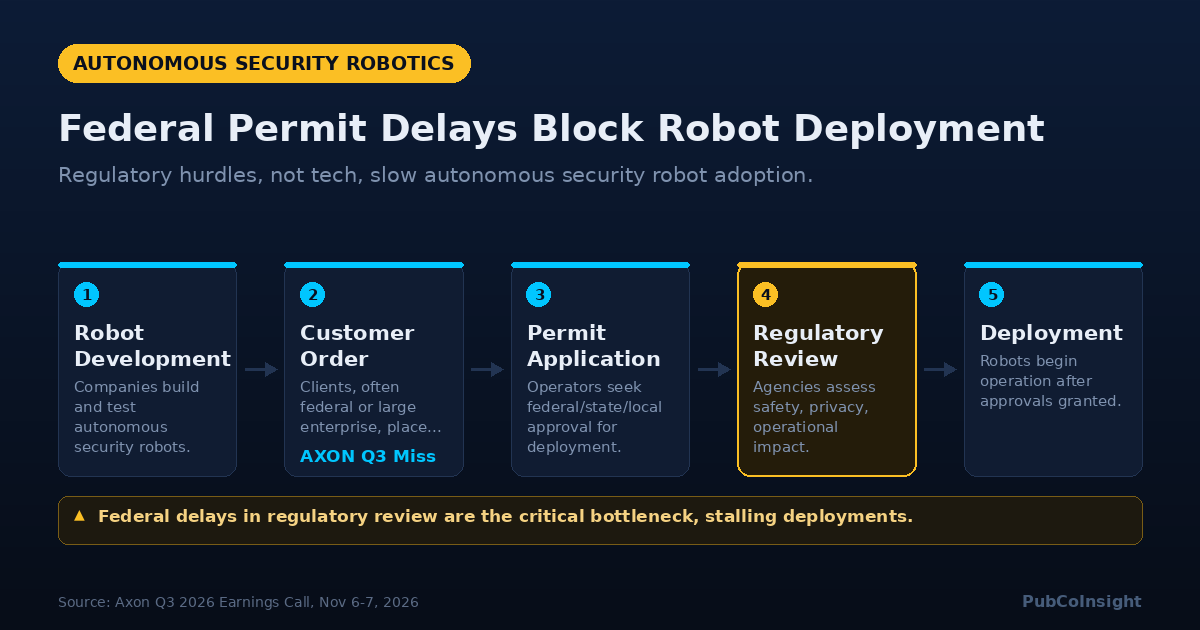
The Mechanism of Federal Delay
Autonomous security robots and drone-based systems, especially those intended for public safety or critical infrastructure, often operate under a patchwork of federal, state, and local regulations. The core issue lies in the permitting and approval process for expanded operational envelopes. Current FAA regulations, for example, typically require line-of-sight operation for drones. Waivers for beyond visual line of sight (BVLOS) operations are complex, time-consuming, and often granted on a case-by-case basis, limiting scalability. For ground-based robots, state and municipal ordinances around public right-of-way and liability create similar hurdles. A single permit for a wide-area deployment can take months, sometimes years, to secure, involving multiple agencies, public comment periods, and often political wrangling. The "federal delays" Axon cited point to a slowdown in granting these critical operational permissions, impacting not just drone sales, but the entire ecosystem of autonomous physical security. Without these permits, even fully developed, market-ready hardware sits idle. The constraint is regulatory approval, not technological readiness or customer demand.Companies Navigating the Regulatory Landscape
Several companies are operating in this environment, each with a distinct approach to autonomous security and physical AI. Ondas Inc. (ONDS), trading at $5.335, focuses on mission-critical wireless networks and drone solutions. Their recent surge on November 6th, ahead of Q3 earnings, was tied to a broader drone stock rebound. Ondas plans significant U.S. manufacturing expansion to scale ULTRA ISR aircraft production, targeting 10 aircraft per month by 2028. This move suggests a commitment to domestic supply chains, which could be a strategic advantage if federal procurement prioritizes U.S.-made systems. Red Cat Holdings, Inc. (RCAT), priced at $4.04, also saw a jump on November 6th, reflecting investor anticipation in the drone sector. Red Cat develops drone technology for defense and public safety, a segment directly exposed to the federal delays Axon highlighted. Their ability to navigate federal contracting and certification processes will be key. Serve Robotics Inc. (SERV), at $3.22, reported Q3 2026 revenue surges over 300% on November 6th and 7th. Serve focuses on sidewalk delivery robots, a segment with different, but still present, regulatory challenges at the municipal level. Their recent launch of Physical AI Services, opening their robot fleet technology to other AI companies, indicates a strategy to diversify revenue beyond direct robot deployment. Unusual Machines, Inc. (UMAC), trading at $11.9, reported Q3 2026 revenue soaring 551% on November 6th, driven by defense contracts. Like Red Cat, their focus on defense positions them squarely within the federal procurement sphere, where delays can have substantial impacts on revenue recognition and project timelines. In the sensor and AI component space, Arbe Robotics Ltd. (ARBE), at $0.434, develops 4D imaging radar for advanced driver-assistance systems and autonomous vehicles. MicroVision, Inc. (MVIS), priced at $1.16, works on lidar solutions. Kopin Corporation (KOPN), at $3.04, focuses on micro-displays and optical systems. Lantronix, Inc. (LTRX), at $5.17, provides embedded computing and networking solutions. These companies supply critical components that enable autonomous security systems, and their fortunes are tied to the broader adoption and deployment of these systems. BigBear.ai Holdings, Inc. (BBAI), trading at $2.22, provides AI-powered decision intelligence software. While not directly building robots, their AI platforms are essential for processing data from autonomous systems, making them a key player in the physical AI ecosystem.Artificial Intelligence Technology Solutions, Inc.
Artificial Intelligence Technology Solutions, Inc. (AITX) trades over the counter at $0.0005. The company, through its subsidiary RAD, designs, builds, and leases autonomous security robots and remote monitoring systems. AITX’s business model centers on recurring monthly subscriptions for its devices rather than one-off hardware sales. This approach aims to provide predictable revenue streams. The company's most recent substantive filing, a 10-Q for the period ended August 31, 2026, details its financial position. As of that date, AITX reported cash of $220,275 and total current assets of $3,012,097. Revenue-earning devices, net of accumulated depreciation, stood at $4,677,987. On the liability side, total current liabilities were $58,906,967, contributing to negative working capital of $55,894,870. The company had an accumulated deficit of $184,084,880. AITX’s filings indicate a "going concern" qualification, noting negative cash flow from operating activities of $4,820,842 for the six months ended August 31, 2026. Management states it does not anticipate positive cash flow from operations in the near future. The company is actively pursuing funding, with approximately $9.8 million remaining under an equity financing agreement entered into on June 23, 2026, designed to purchase common stock at a discount over a three-year period. Management’s plan to address its financial situation involves growing revenues, securing equity proceeds, and issuing debt. The public record does not yet establish a clear timeline for AITX to achieve positive operating cash flow. AITX’s subsidiary RAD recently secured its fourth ROAMEO security robot order from a global logistics customer, as reported on November 6th. This indicates repeat business and traction within the logistics sector for its larger, mobile security robots. The company's strategy involves deploying a range of autonomous devices, from stationary monitoring units to mobile robots like ROAMEO, offering a tiered approach to physical security automation.What to watch
The immediate focus for the autonomous security sector will be on federal regulatory actions. Watch for any announcements from the FAA regarding new BVLOS drone waivers or changes to the Part 107 regulations for commercial drone operations. Any streamlining of these processes could unlock significant deployment potential. For Ondas (ONDS), their Q3 earnings report, expected next week, will provide more details on their manufacturing expansion and any impact from federal contracting. Serve Robotics (SERV) will likely continue to report on its expansion with existing partners and the uptake of its Physical AI Services. Axon’s (AXON) next earnings call will be critical for updates on the specific federal delays it cited, and whether any progress has been made in clearing the backlog. The nature of these delays, whether bureaucratic or policy-driven, will inform the outlook for the entire sector. Pay attention to any legislative efforts in Congress aimed at accelerating autonomous system deployment for public safety or critical infrastructure. Specific permit approvals for large-scale drone or robot deployments by any company, especially those in federal or state jurisdictions, will signal a shift in the regulatory environment., { "label": "Customer Order", "note": "Clients, often federal or large enterprise, place orders.", "metric": "AXON Q3 Miss" }, { "label": "Permit Application", "note": "Operators seek federal/state/local approval for deployment." }, { "label": "Regulatory Review", "note": "Agencies assess safety, privacy, operational impact." }, { "label": "Deployment", "note": "Robots begin operation after approvals granted." } ], "highlight": 3, "highlight_note": "Federal delays in regulatory review are the critical bottleneck, stalling deployments.", "footnote": "Source: Axon Q3 2026 Earnings Call, Nov 6-7, 2026" }Companies mentioned
| Ticker | Company | Price |
|---|---|---|
| AITX client | Artificial Intelligence Technology Solutions Inc | $0.0005 |
| ARBE | Arbe Robotics Ltd. | $0.434 |
| BBAI | BigBear.ai Holdings, Inc. | $2.22 |
| KOPN | Kopin Corporation | $3.04 |
| LTRX | Lantronix, Inc. | $5.17 |
| MVIS | MicroVision, Inc. | $1.16 |
| ONDS | Ondas Inc. | $5.335 |
| RCAT | Red Cat Holdings, Inc. | $4.04 |
| SERV | Serve Robotics Inc. | $3.22 |
| UMAC | Unusual Machines, Inc. | $11.9 |
Listed alphabetically, not ranked. Prices as of 2026-11-07 and they move. Check a live quote before relying on any of this.
How we chose the companies in this article
We cover a fixed universe of companies working in autonomous security robotics, physical AI and the guarding services market they are aimed at. Every one of them that had usable market data on 2026-11-07 appears in this article. We do not pick which ones to mention based on what we think of them, and we do not order them by size, price or trading volume, because an ordered list is a verdict and that is not ours to hand down. Companies left out, and why: none. American Lithium Minerals and Artificial Intelligence Technology Solutions pay us, which is disclosed in full at the foot of every article they appear in.
See the dilution and promotion flags before you see the pitch.
Each week: the micro and small-caps now showing dilution or paid-promotion signals, with the SEC filing behind every flag. No recommendations, no price targets.
Sources used in this article
- Axon Plunged To a 2-Year Low. Here's Why It Could Be a Golden Buying Opportunity Motley Fool · 2026-11-07
- Axon Enterprise (AXON) Stock Price Sinks As Q3 Report Resets Cash Outlook Simply Wall St. · 2026-11-07
- 3 US Semiconductor Stocks With Less China Exposure To Watch Now Simply Wall St. · 2026-11-07
- Cathie Wood-Led Ark Loads Up On GOOG, AMD, NVDA And Biotech Stocks — But Sells CRWV, AVGO, LLY Stocktwits · 2026-11-07
- Better Stock Split to Buy: Meta Platforms vs. Sandisk Motley Fool · 2026-11-07
- A Retiree Who Bought 1,000 Nvidia Shares at $122 Just Watched Chips Have Their Worst Day Since 2020 24/7 Wall St. · 2026-11-07
- 5 Best Stocks To Buy According to Billionaire Armitage Insider Monkey · 2026-11-07
- Sweetgreen Is Finally Growing Again. Time To Buy? Motley Fool · 2026-11-07
- Think Arm Is Too Expensive? 1 Thing You Need To Understand About the Chip Stock Motley Fool · 2026-11-07
- The S&P 500 Just Fell More Than 4% in a Day From Near Its Record. Here's What Happened Next in 2 Similar Situations Since 1950. Motley Fool · 2026-11-07
- Why Iren Stock Soared Today Motley Fool · 2026-11-07
- Serve Robotics (SERV) Q3 2026 Earnings Call Transcript Motley Fool · 2026-11-07
Disclosure required by Section 17(b) of the Securities Act of 1933
Artificial Intelligence Technology Solutions, Inc., a Nevada corporation (OTCID: AITX). Artificial Intelligence Technology Solutions, Inc. pays Strategic Innovations First, Inc., a Wyoming corporation doing business as PulseIR. Compensation received: USD 5,000.00 per month for months 1-3 (August, September, October 2026); USD 10,000.00 per month for months 4-6 (November, December 2026, January 2027) contingent on the 90-day review. Minimum committed USD 15,000.00; USD 45,000.00 if the second-period rate triggers.. Form of payment: cash only, invoiced monthly in advance; no stock, options or warrants received or payable. Services: investor relations services under an Investor Relations Services Agreement effective 2026-08-01. Period: six month term, 2026-08-01 through 2027-01-31; 90-day review on or about 2026-10-30. No stock, options or warrants held by PubCo Insight, Pulse IR, Strategic Innovations First, Inc., or Brad Listermann. Confirmed by the executed agreement and by board record recKwdq39X2caPSX7 (POSITIONS HELD: none).
This is information, not investment, financial, legal or tax advice. It is not a recommendation or solicitation to buy, sell or hold any security and it contains no price target. Nothing here is independently verified by us. Confirm every figure against primary filings on SEC EDGAR before you act. Micro-cap and over-the-counter securities are speculative and illiquid and can lose all of their value. The companies named without a disclosure above pay us nothing and have no relationship with us; they are named because a published, mechanical screen selected them. Full disclosure policy.