CFTC Review Delays GPU Futures Launch, Impacts AI Robotics Cost Management
The Commodity Futures Trading Commission's delay of CME's GPU futures impacts how autonomous security robotics firms manage the critical and volatile costs of AI compute power.
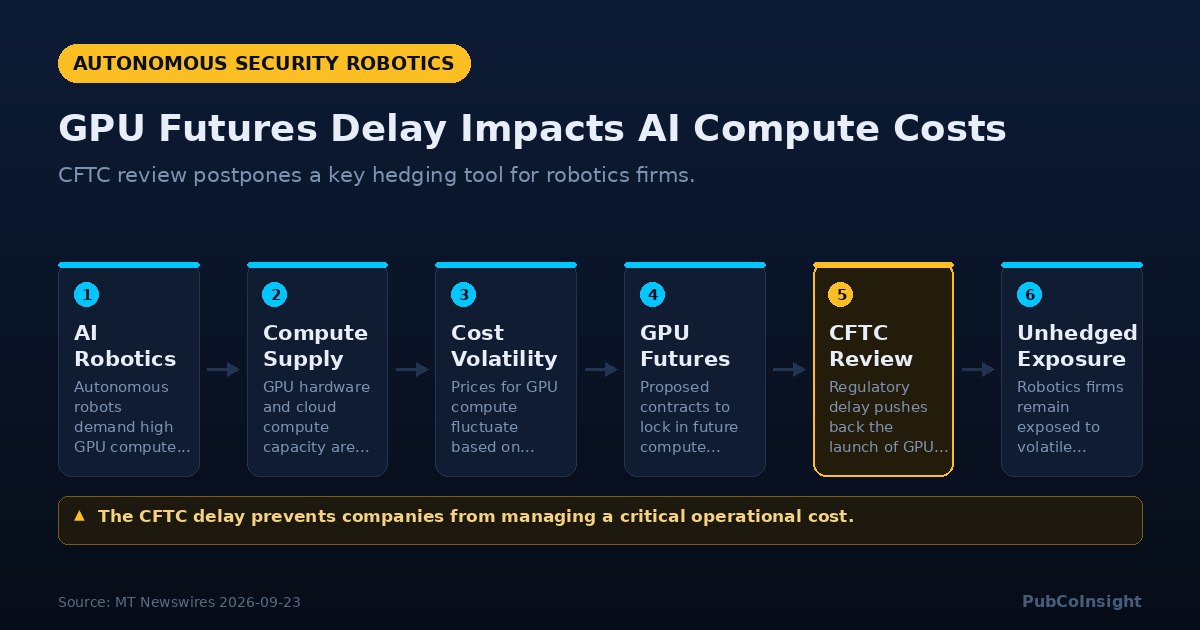
The Mechanism of Compute Futures
GPU futures aim to provide a standardized, tradable contract for access to GPU computing power. Think of it like oil futures, but instead of barrels of crude, you're trading access to a specific amount of processing cycles on a defined GPU architecture for a future date. The core idea is to decouple the physical acquisition of GPUs from the need for compute capacity. A company needing, say, 1,000 hours of NVIDIA H100 equivalent compute in six months could buy a futures contract today. This locks in a price, mitigating the risk of a sudden spike in spot market rates for either hardware or cloud-based compute services. For autonomous security robotics, this matters because AI model training and real-time inference are compute-intensive. Training a new, more sophisticated object recognition model for a robot fleet can take thousands of GPU hours. If a company plans this training for Q2 next year, a futures contract allows them to budget that compute cost with greater certainty. Without it, they are exposed to the spot market, where prices can fluctuate based on supply chain issues, new product launches, or surges in demand from other AI sectors. The CFTC's review likely centers on the technical specifications of the underlying asset, the settlement mechanisms, and the potential for market manipulation in a novel asset class. Proving the concept wrong would involve demonstrating that the underlying compute market is too illiquid or too diverse in its offerings to be effectively standardized and hedged by a single futures contract.Companies Navigating Compute Costs
The companies in this sector approach compute needs in various ways, from direct hardware investment to cloud-based solutions. Each strategy carries different exposures to the underlying cost of GPU power. Kopin Corporation (KOPN), trading at $4.85, focuses on microdisplays and optical solutions, which are critical inputs for advanced robotic vision systems. While not directly a compute provider, their customers, including those in robotics, face these compute cost issues when integrating Kopin's high-resolution displays with AI processing. Kopin's recent partnership with Fabric.AI for joint intellectual property suggests an increasing reliance on AI integration within their product roadmap. Companies like Lantronix, Inc. (LTRX) at $6.18, and MicroVision, Inc. (MVIS) at $1.67, provide specialized hardware and software for IoT and lidar systems respectively. Their products often serve as data input layers for AI systems. The efficiency of their data processing, and thus their customers' compute requirements, can be a differentiator. Lantronix's embedded solutions often integrate edge AI capabilities, meaning they need to optimize for lower compute footprints, but still rely on robust, cost-effective processing. MicroVision's lidar, a key sensor for autonomous navigation, generates massive datasets that require significant GPU power for real-time interpretation. BigBear.ai Holdings, Inc. (BBAI), priced at $2.90, operates directly in the AI and machine learning space, providing solutions for decision intelligence. Their business model inherently involves substantial compute resources for data analysis and model development. The delay in GPU futures impacts their ability to forecast and manage the operational costs associated with their core offering. In the drone and mobile robotics space, Ondas Inc. (ONDS) at $7.38, Red Cat Holdings, Inc. (RCAT) at $6.95, and Unusual Machines, Inc. (UMAC) at $24.25, are all active. Ondas, through its recent acquisitions of GATE and Bron, is expanding its component ownership, which could include some control over embedded processing, but large-scale AI for fleet management or complex mission planning still leans on external compute. Red Cat and Unusual Machines, both in the drone sector, face a similar challenge: processing drone-collected data for security applications, like anomaly detection or perimeter surveillance, demands significant GPU power, whether on-board or in the cloud. Serve Robotics Inc. (SERV), trading at $4.44, deploying autonomous delivery robots, also depends on efficient, cost-managed compute for navigation and interaction in dynamic environments. Arbe Robotics Ltd. (ARBE), at $0.687, develops 4D imaging radar solutions. Their technology generates rich data streams that, when combined with AI for perception and prediction, require substantial processing. The ability to hedge compute costs could influence their customers' adoption rates and the overall cost-effectiveness of their radar systems in autonomous vehicles and robotics.Artificial Intelligence Technology Solutions, Inc.
Artificial Intelligence Technology Solutions, Inc. (AITX), trading at $0.0037, operates through subsidiaries like Robotic Assistance Devices, Inc. (RAD-I), Robotic Assistance Devices Mobile (RAD-M), and Robotic Assistance Devices Group (RAD-G). The company focuses on an "AI-driven Solutions-as-a-Service" model for the security and guarding services industry, which it estimates as a $50 billion market in the United States. AITX's solutions, including stationary devices like ROSA and mobile units like ROAMEO, aim to deliver cost savings between 35% and 80% compared to traditional manned security. These systems rely on AI for tasks such as threat detection, access control, and patrol monitoring. AITX's filings indicate a strategy to scale its recurring revenue and expand its gross margin. For the fiscal year ended February 28, 2026, the company reported revenue of $7,745,336, a 26% increase over the prior year, with gross profit rising 48% to $5,533,700. Gross margin expanded to approximately 71% from 61%. Operating expenses remained flat at around $17,477,097, leading to an improved operating loss of approximately $(11,943,397). The company reported a net loss of approximately $14.5 million for the year and an accumulated deficit of approximately $171 million as of February 28, 2026. AITX's independent registered public accounting firm has expressed substantial doubt about its ability to continue as a going concern, a standard disclosure given its accumulated deficit and negative working capital. RAD-I focuses on stationary security devices, while RAD-M develops mobile autonomous platforms, with early commercial deployment of the ROAMEO mobile security unit beginning in May 2026. RAD-G is responsible for the SARA agentic artificial intelligence platform, which the company expects to generate substantial licensing revenue. AITX's wholly-owned subsidiary, RAD Lanka, located in Sri Lanka, supports software development, AI initiatives, and technical operations. The company's long-term vision, referred to internally as "RAD Town," involves integrated autonomous-security deployments across large campuses or jurisdictions. The public record does not yet establish the scale or timing of cash flow positive operations from RAD-M or RAD-G. The company's filings state that RAD-I's recurring revenue and gross margin could, on a standalone basis, support positive cash flow operations, and that management believes RAD-I has "achieved a point" where it could do so today, but this is a forward-looking characterization dependent on assumptions about continued pricing acceptance, stable input costs, and manufacturing scale.What to Watch
The CFTC's review of CME's GPU Futures is the immediate focal point. A decision on the contract's approval or further delays will directly impact the hedging tools available to the AI and robotics sector. Market participants should watch for any official announcements from the CFTC or CME regarding the revised launch timeline. Beyond that, monitor the broader compute market. NVIDIA's next-generation GPU announcements or unexpected shifts in cloud compute pricing from major providers like Amazon Web Services or Microsoft Azure will continue to drive spot market volatility. Any new entrants offering alternative compute hedging mechanisms, even private ones, could also emerge as a response to the futures delay. For AITX, watch for specific announcements regarding new deployments of ROAMEO units or licensing agreements for the SARA platform, as these would indicate progress on the RAD-M and RAD-G initiatives. The company's 8-K filings, which have been frequent, will detail new sales and operational developments., { "label": "Compute Supply", "note": "GPU hardware and cloud compute capacity are essential inputs." }, { "label": "Cost Volatility", "note": "Prices for GPU compute fluctuate based on demand and supply." }, { "label": "GPU Futures", "note": "Proposed contracts to lock in future compute costs." }, { "label": "CFTC Review", "note": "Regulatory delay pushes back the launch of GPU futures." }, { "label": "Unhedged Exposure", "note": "Robotics firms remain exposed to volatile compute prices." } ], "highlight": 4, "highlight_note": "The CFTC delay prevents companies from managing a critical operational cost.", "footnote": "Source: MT Newswires 2026-09-23" }Companies mentioned
| Ticker | Company | Price |
|---|---|---|
| AITX client | Artificial Intelligence Technology Solutions Inc | $0.0037 |
| ARBE | Arbe Robotics Ltd. | $0.687 |
| BBAI | BigBear.ai Holdings, Inc. | $2.9 |
| KOPN | Kopin Corporation | $4.85 |
| LTRX | Lantronix, Inc. | $6.18 |
| MVIS | MicroVision, Inc. | $1.67 |
| ONDS | Ondas Inc. | $7.38 |
| RCAT | Red Cat Holdings, Inc. | $6.95 |
| SERV | Serve Robotics Inc. | $4.44 |
| UMAC | Unusual Machines, Inc. | $24.25 |
Listed alphabetically, not ranked. Prices as of 2026-09-23 and they move. Check a live quote before relying on any of this.
How we chose the companies in this article
We cover a fixed universe of companies working in autonomous security robotics, physical AI and the guarding services market they are aimed at. Every one of them that had usable market data on 2026-09-23 appears in this article. We do not pick which ones to mention based on what we think of them, and we do not order them by size, price or trading volume, because an ordered list is a verdict and that is not ours to hand down. Companies left out, and why: none. American Lithium Minerals and Artificial Intelligence Technology Solutions pay us, which is disclosed in full at the foot of every article they appear in.
See the dilution and promotion flags before you see the pitch.
Each week: the micro and small-caps now showing dilution or paid-promotion signals, with the SEC filing behind every flag. No recommendations, no price targets.
Sources used in this article
- 2 Stocks to Buy Hand Over Fist if a Stock Market Crash Is Coming Motley Fool · 2026-09-23
- Investing $275 Monthly in SCHD Could Build Serious Passive Income Over 20 Years Motley Fool · 2026-09-23
- Prediction: This Is What a $5,000 Investment in Micron Technology Will Be Worth by 2028 Motley Fool · 2026-09-23
- D-Wave Quantum Just Got $100 Million From the U.S. Government. It's Also Burning Through Roughly $37 Million a Quarter. With Its Stock Down 60% From the Peak, Is It a Bargain or a Trap? Motley Fool · 2026-09-23
- Stock market today: Dow, S&P 500, Nasdaq futures muted as oil falls, markets eye looming Trump-Xi meeting Yahoo Finance · 2026-09-23
- Snap Has Launched Its High-Powered Glasses. Will There Be Enough Demand? Motley Fool · 2026-09-23
- If I Had $10,000 to Invest Today, Here's the Trillion-Dollar Stock I'd Buy Instead of SpaceX Motley Fool · 2026-09-23
- Market Chatter: CME's GPU Futures Launch Pushed Back by CFTC Review MT Newswires · 2026-09-23
- Sandisk Stock Is Up 695% in 2026 and This Market Indicator Predicted It. Here’s What It Says About 2027. Motley Fool · 2026-09-23
- Axon Stock Just Fell 22% in a Month. Here’s the Number That Explains Why TIKR · 2026-09-22
- Goldman Sachs Adjusts PT on Axon Enterprise to $675 From $715, Maintains Buy Rating MT Newswires · 2026-09-21
- 3 Small-Cap Stocks We Keep Off Our Radar StockStory · 2026-09-21
Disclosure required by Section 17(b) of the Securities Act of 1933
Artificial Intelligence Technology Solutions, Inc., a Nevada corporation (OTCID: AITX). Artificial Intelligence Technology Solutions, Inc. pays Strategic Innovations First, Inc., a Wyoming corporation doing business as PulseIR. Compensation received: USD 5,000.00 per month for months 1-3 (August, September, October 2026); USD 10,000.00 per month for months 4-6 (November, December 2026, January 2027) contingent on the 90-day review. Minimum committed USD 15,000.00; USD 45,000.00 if the second-period rate triggers.. Form of payment: cash only, invoiced monthly in advance; no stock, options or warrants received or payable. Services: investor relations services under an Investor Relations Services Agreement effective 2026-08-01. Period: six month term, 2026-08-01 through 2027-01-31; 90-day review on or about 2026-10-30. No stock, options or warrants held by PubCo Insight, Pulse IR, Strategic Innovations First, Inc., or Brad Listermann. Confirmed by the executed agreement and by board record recKwdq39X2caPSX7 (POSITIONS HELD: none).
This is information, not investment, financial, legal or tax advice. It is not a recommendation or solicitation to buy, sell or hold any security and it contains no price target. Nothing here is independently verified by us. Confirm every figure against primary filings on SEC EDGAR before you act. Micro-cap and over-the-counter securities are speculative and illiquid and can lose all of their value. The companies named without a disclosure above pay us nothing and have no relationship with us; they are named because a published, mechanical screen selected them. Full disclosure policy.