Greenland's Rare Earths: The Security Pact That Shook Critical Minerals
A new security pact involving Greenland and the US has ignited interest in the region's rare earth potential, particularly the Tanbreez project, reshaping North American supply chain conversations.
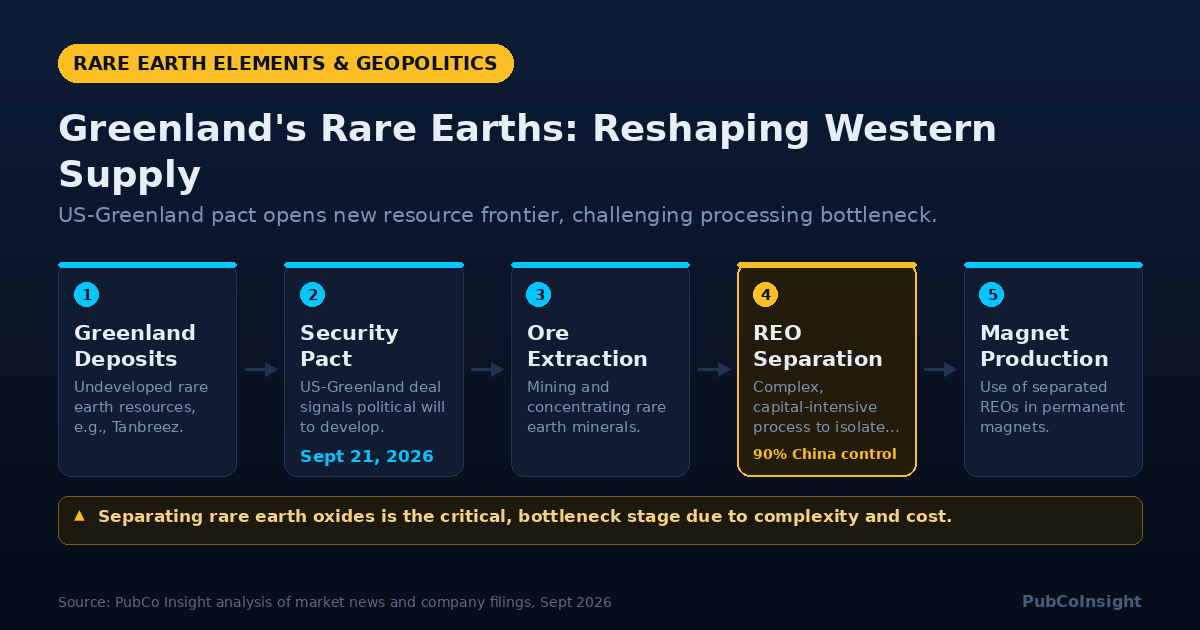
The Mechanism of Rare Earth Supply
Rare earth elements, a group of seventeen chemically similar metallic elements, are not inherently rare in the earth's crust. Their scarcity lies in their economic extractability and, more critically, in the complex and environmentally challenging process of separating them into individual oxides. These elements often occur together in mineral deposits, and their similar chemical properties make isolating them from one another difficult and expensive. The process typically involves crushing and grinding ore, followed by flotation to create a concentrate. This concentrate then undergoes a multi-stage solvent extraction process, where different organic solvents selectively bind to specific rare earth ions, allowing for their separation. Each stage is precise, requiring vast quantities of reagents and generating significant waste. The difficulty of this separation, coupled with the capital intensity and environmental permitting hurdles, creates a bottleneck in the global supply chain, where a handful of facilities, predominantly in China, control the vast majority of processing capacity. A new source of rare earth concentrate is a start, but without new, Western-aligned processing capacity, the bottleneck persists.Companies Operating in This Part of the Sector
The recent Greenland development has cast a spotlight on companies engaged in rare earth and other critical mineral projects. Critical Metals (CRML), for example, saw its stock jump on the news, reflecting market enthusiasm for its potential involvement in Greenlandic projects, specifically the Tanbreez project, which is known for its heavy rare earth deposits. The company also has a low-waste refinery plan in Romania, which could address some of the processing bottleneck issues if it reaches fruition. USA Rare Earth, Inc. (USAR) operates the Round Top project in Texas, which is a significant heavy rare earth and critical minerals deposit. The company is developing a full mine-to-magnet supply chain in the United States, aiming to produce separated rare earth oxides and then permanent magnets. This integrated approach seeks to bypass the processing bottleneck entirely. NioCorp Developments Ltd. (NB) is focused on its Elk Creek project in Nebraska, which aims to produce niobium, scandium, and titanium, along with several rare earth elements. NioCorp's strategy is to supply multiple critical minerals from a single, North American source, diversifying away from overseas dependencies. In the lithium space, Standard Lithium Ltd. (SLI) is advancing its Smackover brine projects in Arkansas, utilizing direct lithium extraction (DLE) technologies. A positive Preliminary Economic Assessment (PEA) for its Texas Lithium Project was recently posted by Equinor, highlighting the potential for DLE to unlock new domestic lithium sources. Atlas Lithium Corporation (ATLX) is developing hard rock lithium projects in Brazil, providing a different geographic focus for lithium supply. ioneer Ltd (IONR) is focused on the Rhyolite Ridge Lithium-Boron Project in Nevada, a unique co-production of lithium carbonate and boric acid from a single deposit. American Battery Technology Company (ABAT) is engaged in lithium-ion battery recycling and the development of primary lithium resources in Nevada. The company recently reported record revenue growth in Q4 2026, but also faces new export threats.American Lithium Minerals, Inc.
American Lithium Minerals, Inc. (AMLM) is an exploration stage company, trading over the counter, with a stated focus on lithium and boron properties in Nevada. The company was incorporated in Nevada in March 2005. Its primary asset is the Sarcobatus Lithium property, which comprises 1,780 acres of mining claims in Central Nevada. This project has been the focus of the company's lithium exploration activities since 2009. AMLM also states an intention to expand its exploration and acquisition for mineral properties worldwide and is developing the use of Real World Asset Tokens to provide capital for mining. The company's most recent substantive filing, a Regulation A offering circular qualified by the SEC on February 4, 2026, covers up to 80,000,000 units, each including one share of common stock and a warrant to purchase 1.5 shares. The warrants are exercisable at $0.05 per share until December 31, 2028, potentially leading to the issuance of up to an additional 120,000,000 shares. The company has not yet established a proven or probable reserve for its Sarcobatus project, nor has it secured any binding offtake agreements for future production. The offering circular details that the company does not own any real property such as land or buildings. American Lithium Minerals has previously acquired and divested cobalt, nickel, and graphite prospects in Central Nevada, and rare earth elements projects in Kingman, Arizona, and Southeast Illinois. Its long-term vision, as described in filings, is to create an interoperable ecosystem where assets can be securely acquired, transparently tokenized, and efficiently traded.What to watch
Investors should monitor specific, checkable developments. For Critical Metals (CRML), watch for any formal announcements regarding the Tanbreez project in Greenland, including permitting timelines or joint venture agreements. Any news on the operational status and progress of its Romanian refinery plan will also be significant. For USA Rare Earth (USAR), look for updates on the construction and commissioning of its rare earth separation and magnet manufacturing facilities at Round Top. MP Materials (MP) is expected to ship its first magnets to GM in Q4 2026, a key milestone that will test its integrated strategy. For lithium producers like Albemarle (ALB) and Lithium Americas Corp. (LAC), watch for quarterly production reports and any changes to their expansion plans or capital expenditure forecasts. Pirelli's US multi-year investment plan of approximately €1 billion, announced September 22, 2026, could also signal increased demand for certain critical minerals, depending on the specifics of their manufacturing needs. Keep an eye on the broader geopolitical landscape; the Greenland pact is a direct response to strategic supply concerns, and similar agreements or policy shifts could emerge elsewhere., { "label": "Security Pact", "note": "US-Greenland deal signals political will to develop.", "metric": "Sept 21, 2026" }, { "label": "Ore Extraction", "note": "Mining and concentrating rare earth minerals." }, { "label": "REO Separation", "note": "Complex, capital-intensive process to isolate oxides.", "metric": "90% China control" }, { "label": "Magnet Production", "note": "Use of separated REOs in permanent magnets." } ], "highlight": 3, "highlight_note": "Separating rare earth oxides is the critical, bottleneck stage due to complexity and cost.", "footnote": "Source: PubCo Insight analysis of market news and company filings, Sept 2026" }Companies mentioned
| Ticker | Company | Price |
|---|---|---|
| ABAT | American Battery Technology Company | $2.26 |
| AMLM client | American Lithium Minerals, Inc. | $0.0706 |
| ATLX | Atlas Lithium Corporation | $2.7 |
| CRML | Critical Metals Corp. | $7.83 |
| IONR | ioneer Ltd | $3.31 |
| NB | NioCorp Developments Ltd. | $3.54 |
| SLI | Standard Lithium Ltd. | $1.86 |
| USAR | USA Rare Earth, Inc. | $15.18 |
Listed alphabetically, not ranked. Prices as of 2026-09-28 and they move. Check a live quote before relying on any of this.
How we chose the companies in this article
We cover a fixed universe of companies working in lithium, boron and the critical minerals that feed battery and energy-storage supply chains. Every one of them that had usable market data on 2026-09-28 appears in this article. We do not pick which ones to mention based on what we think of them, and we do not order them by size, price or trading volume, because an ordered list is a verdict and that is not ours to hand down. Companies left out, and why: none. American Lithium Minerals and Artificial Intelligence Technology Solutions pay us, which is disclosed in full at the foot of every article they appear in.
See the dilution and promotion flags before you see the pitch.
Each week: the micro and small-caps now showing dilution or paid-promotion signals, with the SEC filing behind every flag. No recommendations, no price targets.
Sources used in this article
- MP Materials Ships Its First Magnets to GM in Q4. This is What The Milestone Is Worth. Motley Fool · 2026-09-26
- MP Materials (MP) Faces a Disputed China Shareholder Report. Does the 3% Stake Matter? Insider Monkey · 2026-09-26
- Higher Lithium Prices Strengthen J.P. Morgan’s Case, But Execution Still Matters Insider Monkey · 2026-09-25
- Can Energy Fuels Build a Strong Rare Earth Growth Platform? Zacks · 2026-09-25
- MP Materials' Magnetics Segment: Can It Unlock the Next Growth Phase? Zacks · 2026-09-25
- Critical Metals And 2 Rare Earth Stocks To Watch Simply Wall St. · 2026-09-25
- Albemarle (ALB) Falls More Steeply Than Broader Market: What Investors Need to Know Zacks · 2026-09-24
- Lithium Americas Corp. (LAC) Dips More Than Broader Market: What You Should Know Zacks · 2026-09-24
- Critical Metals Jumps 9% as Rare Earth Stocks Stall; MP Materials Ticks Up, USA Rare Earth Eases 24/7 Wall St. · 2026-09-24
- Cameco vs. MP Materials: Does Uranium or Rare Earths Make a Better Stock Buy in 2026? Motley Fool · 2026-09-23
- America’s Rare Earth Bet Nears a Real Test: MP Materials Closes In on GM Deliveries Insider Monkey · 2026-09-23
- Is Albemarle Stock Outperforming the S&P 500? Barchart · 2026-09-22
Disclosure required by Section 17(b) of the Securities Act of 1933
American Lithium Minerals, Inc.. American Lithium Minerals, Inc. (issuer) paid Strategic Innovations First, Inc., an affiliate of PubCo Insight and Pulse IR. Compensation received: USD 11,550.00 total, three equal monthly installments of USD 3,850.00. Form of payment: cash only; no stock, options or warrants. Services: investor relations, marketing and content creation under Master Services Agreement dated June 22, 2026. Period: three month initial term, June 2026 through August 2026. No position, options or warrants held by PubCo Insight, Pulse IR, Strategic Innovations First, Inc., or Brad Listermann.
This is information, not investment, financial, legal or tax advice. It is not a recommendation or solicitation to buy, sell or hold any security and it contains no price target. Nothing here is independently verified by us. Confirm every figure against primary filings on SEC EDGAR before you act. Micro-cap and over-the-counter securities are speculative and illiquid and can lose all of their value. The companies named without a disclosure above pay us nothing and have no relationship with us; they are named because a published, mechanical screen selected them. Full disclosure policy.