Axon's 2026 Outlook Highlights Shift to Connected Security Devices
Axon's recent outlook for 2026 emphasizes integrated connected devices, signaling a strategic pivot in the guarding services market that impacts both traditional security and autonomous robotics.
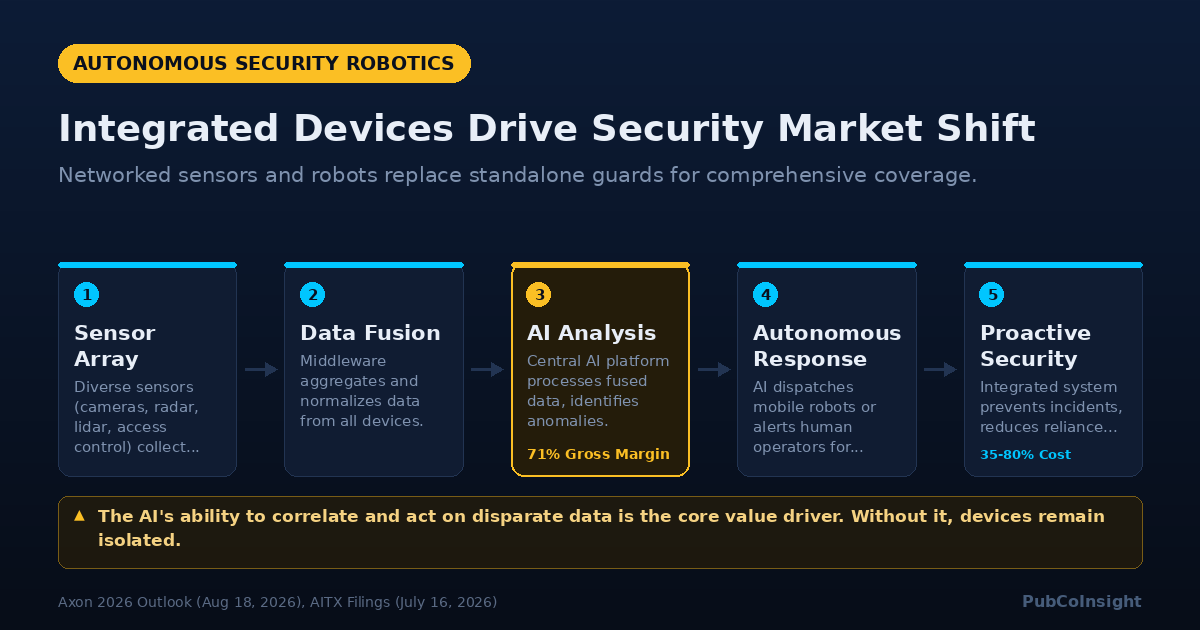
The Mechanism of Integrated Security
The core mechanism at play here is the networked intelligence of disparate security assets. Think of it as a central nervous system for a physical space. Instead of a lone guard patrolling a perimeter, or a single camera recording a blind spot, an integrated system deploys a range of devices: stationary cameras, mobile robots, access control points, and environmental sensors. These devices are not just collecting data; they are sharing it in real-time with a central AI-powered platform. This platform then correlates the information. A motion sensor triggers a camera, which in turn alerts a patrolling robot to investigate, all while notifying a human operator who can remotely intervene or dispatch personnel. The critical element for this system to matter is the seamless flow of data and actionable intelligence. If a camera detects an anomaly, but the mobile robot cannot receive the alert or navigate to the location efficiently, the system fails. The bottleneck often sits in the middleware, the software layer that translates between different hardware protocols and feeds data to the central AI. Robust APIs, standardized communication protocols, and efficient edge processing are essential. Without these, the system becomes a collection of expensive, disconnected components. What would prove this wrong? A significant failure in interoperability, where devices from different manufacturers cannot communicate effectively, or where the central AI struggles to process the volume and variety of data. This would force a return to simpler, less integrated solutions.Companies Operating in Autonomous Security Robotics
Several companies are navigating this evolving landscape, each with a distinct approach to autonomous security robotics and integrated solutions. The sector includes developers of radar and lidar systems, AI platforms, and various robotic form factors. In the realm of perception and sensing, Arbe Robotics Ltd. (ARBE, price $0.774) focuses on high-resolution 4D imaging radar solutions. Their technology aims to provide detailed environmental sensing for autonomous systems, crucial for navigation and object detection in complex security environments. Similarly, MicroVision, Inc. (MVIS, price $1.77) develops lidar technology, which uses pulsed laser light to measure distances and create precise 3D maps of surroundings. Both companies provide foundational sensing capabilities that are integral to autonomous robot operation, feeding data into the larger integrated security network. For the AI and data processing layer, BigBear.ai Holdings, Inc. (BBAI, price $3.17) specializes in AI-powered analytics and decision intelligence. Their platforms could be leveraged to process the vast amounts of data generated by connected security devices, identifying patterns and anomalies that human operators might miss. Kopin Corporation (KOPN, price $4.93) is involved in micro-displays and optical solutions, and their recent joint steering committee with Fabric.AI for Neural I/o™ suggests a focus on advanced human-machine interfaces and potentially on integrating AI at the display level for security operators. On the hardware and platform side, Ondas Inc. (ONDS, price $8.9) is expanding its defense and commercial drone operations. The company’s recent agreement to acquire Aran Defense for $33 million, announced August 18th, strengthens its position in unmanned aerial systems, which can serve as mobile, elevated sensors within an integrated security framework. Their new drone operations center in Springfield, Ohio, further supports this expansion. Red Cat Holdings, Inc. (RCAT, price $9.89) also operates in the drone space, offering small unmanned aircraft systems and related software. These aerial platforms provide a flexible layer of surveillance that can be integrated with ground-based autonomous robots and stationary sensors. Beyond security, autonomous delivery robots also share core technologies. Serve Robotics Inc. (SERV, price $4.78) develops self-driving robots for last-mile delivery. While not directly in security, their August 17th partnership with Grubhub and expanded DoorDash deal highlight the ongoing development and deployment of autonomous mobile platforms in urban environments, facing similar challenges in navigation, perception, and public interaction. Serve Robotics' August 18th guidance cut, despite the Grubhub deal, points to the operational complexities and financial hurdles in scaling autonomous services. Unusual Machines, Inc. (UMAC, price $28.3) also operates in the robotics sector, though specific details on their security applications are less publicized. Finally, Lantronix, Inc. (LTRX, price $6.01) provides secure data access and management solutions for the Internet of Things (IoT). Their technology enables the secure connectivity and remote management of devices, which is fundamental to building a robust, integrated security network where data from various sensors and robots needs to be collected, transmitted, and processed securely.Artificial Intelligence Technology Solutions, Inc.
Artificial Intelligence Technology Solutions, Inc. (AITX, price $0.0047) operates in the autonomous security robotics sector through its subsidiaries, focusing on a "Solutions-as-a-Service" model. The company develops and leases AI-driven security robots and remote monitoring systems. This recurring monthly subscription model differentiates it from one-off hardware sales. AITX estimates the U.S. security and guarding services market, which it targets, to be approximately $50 billion. The company claims its solutions can deliver cost savings ranging from 35% to 80% compared to traditional manned security. AITX structures its operations around three main pillars. The first, Robotic Assistance Devices, Inc. (RAD-I), focuses on stationary security devices. The second, Robotic Assistance Devices Mobile (RAD-M), develops mobile autonomous platforms, including the ROAMEO mobile security unit, which began early commercial deployment in May 2026. The third pillar, Robotic Assistance Devices Group (RAD-G), is centered on the company's SARA agentic artificial intelligence platform. A wholly owned subsidiary, RAD Lanka, located in Sri Lanka, supports software development, AI initiatives, and technical operations across the company's various subsidiaries. The company envisions an integrated autonomous-security deployment across large areas, which it refers to internally as "RAD Town." For the fiscal year ended February 28, 2026, AITX reported revenue of $7,745,336, marking a 26% increase over the previous fiscal year. Gross profit rose 48% to $5,533,700, with gross margin expanding to approximately 71% from 61%. Operating expenses remained largely flat at about $17,477,097, and the loss from operations improved by roughly $2.0 million to $(11,943,397). The company reported a net loss of approximately $14.5 million for the fiscal year and an accumulated deficit of approximately $171 million as of February 28, 2026. Cash flow from operating activities was negative $9,344,534 for the same period. The company's independent registered public accounting firm has included an explanatory paragraph in its report expressing substantial doubt about AITX's ability to continue as a going concern. While the company outlines a vision for RAD-I's recurring revenue to support positive cash flow operations, and for RAD-M to surpass RAD-I's monthly recurring revenue, the public record does not yet establish the consistent achievement of these financial targets. The company recently secured a third ROSA order from a property management client, indicating expanding deployments for its stationary devices.What to Watch
Investors should monitor specific, checkable developments. For Ondas, watch for further announcements regarding the integration of Aran Defense, particularly how this acquisition translates into new defense contracts or expanded commercial drone applications. Serve Robotics' ability to scale its Grubhub and DoorDash partnerships will be key; look for updates on delivery volumes or expanded operational territories. For Artificial Intelligence Technology Solutions, Inc., watch for consistent reporting on subscription growth, cash flow from operations, and the successful commercial deployment and scaling of its mobile ROAMEO units. Regular 8-K filings often contain updates on new orders or partnerships, offering insight into operational momentum. The company’s ability to address the going concern qualification in future filings will also be a critical point of observation., { "label": "Data Fusion", "note": "Middleware aggregates and normalizes data from all devices." }, { "label": "AI Analysis", "note": "Central AI platform processes fused data, identifies anomalies.", "metric": "71% Gross Margin" }, { "label": "Autonomous Response", "note": "AI dispatches mobile robots or alerts human operators for intervention." }, { "label": "Proactive Security", "note": "Integrated system prevents incidents, reduces reliance on human patrols.", "metric": "35-80% Cost Savings" } ], "highlight": 2, "highlight_note": "The AI's ability to correlate and act on disparate data is the core value driver. Without it, devices remain isolated.", "footnote": "Axon 2026 Outlook (Aug 18, 2026), AITX Filings (July 16, 2026)" }Companies mentioned
| Ticker | Company | Price |
|---|---|---|
| AITX client | Artificial Intelligence Technology Solutions Inc | $0.0047 |
| ARBE | Arbe Robotics Ltd. | $0.774 |
| BBAI | BigBear.ai Holdings, Inc. | $3.17 |
| KOPN | Kopin Corporation | $4.93 |
| LTRX | Lantronix, Inc. | $6.01 |
| MVIS | MicroVision, Inc. | $1.77 |
| ONDS | Ondas Inc. | $8.9 |
| RCAT | Red Cat Holdings, Inc. | $9.89 |
| SERV | Serve Robotics Inc. | $4.78 |
| UMAC | Unusual Machines, Inc. | $28.3 |
Listed alphabetically, not ranked. Prices as of 2026-08-20 and they move. Check a live quote before relying on any of this.
How we chose the companies in this article
We cover a fixed universe of companies working in autonomous security robotics, physical AI and the guarding services market they are aimed at. Every one of them that had usable market data on 2026-08-20 appears in this article. We do not pick which ones to mention based on what we think of them, and we do not order them by size, price or trading volume, because an ordered list is a verdict and that is not ours to hand down. Companies left out, and why: none. American Lithium Minerals and Artificial Intelligence Technology Solutions pay us, which is disclosed in full at the foot of every article they appear in.
See the dilution and promotion flags before you see the pitch.
Each week: the micro and small-caps now showing dilution or paid-promotion signals, with the SEC filing behind every flag. No recommendations, no price targets.
Sources used in this article
- Stripe agrees to acquire AI model router OpenRouter Electronic Payments · 2026-08-20
- Nvidia Chip-Filled Data Centers Need More Power Than Any Utility Can Promise. Here's Who Actually Wins. Motley Fool · 2026-08-20
- Why Regeneron (REGN) Is Up 5.4% After FDA Approves Pasatru For Ultra-Rare FOP Therapy Simply Wall St. · 2026-08-20
- Masayoshi Son Has 67% of SoftBank's U.S. Stock Portfolio in Intel. He Didn't Buy a Single Share Last Quarter. Motley Fool · 2026-08-20
- Why Marvell Stock Surged Today Motley Fool · 2026-08-20
- Louis Navellier sets eye-opening Nvidia stock price target for rest of this year TheStreet · 2026-08-20
- Big Tech Is on Pace to Spend $735 Billion on AI Data Centers in 2026. These 3 Industrial Stocks Collect the Checks. Motley Fool · 2026-08-20
- Nvidia Guided to $91 Billion. Wall Street Penciled In $92 Billion. Motley Fool · 2026-08-20
- Why Moderna Stock Skyrocketed Today Motley Fool · 2026-08-20
- Why Wheaton Precious Metals Zoomed 11% Higher Today Motley Fool · 2026-08-19
- What Could Serve Robotics (SERV) New Delivery And Hospital Push Mean For Growth? Simply Wall St. · 2026-08-19
- Serve Robotics (SERV) Stock Looks Cheap on Book Value While Broader Checks Look Weak Simply Wall St. · 2026-08-19
Disclosure required by Section 17(b) of the Securities Act of 1933
Artificial Intelligence Technology Solutions, Inc., a Nevada corporation (OTCID: AITX). Artificial Intelligence Technology Solutions, Inc. pays Strategic Innovations First, Inc., a Wyoming corporation doing business as PulseIR. Compensation received: USD 5,000.00 per month for months 1-3 (August, September, October 2026); USD 10,000.00 per month for months 4-6 (November, December 2026, January 2027) contingent on the 90-day review. Minimum committed USD 15,000.00; USD 45,000.00 if the second-period rate triggers.. Form of payment: cash only, invoiced monthly in advance; no stock, options or warrants received or payable. Services: investor relations services under an Investor Relations Services Agreement effective 2026-08-01. Period: six month term, 2026-08-01 through 2027-01-31; 90-day review on or about 2026-10-30. No stock, options or warrants held by PubCo Insight, Pulse IR, Strategic Innovations First, Inc., or Brad Listermann. Confirmed by the executed agreement and by board record recKwdq39X2caPSX7 (POSITIONS HELD: none).
This is information, not investment, financial, legal or tax advice. It is not a recommendation or solicitation to buy, sell or hold any security and it contains no price target. Nothing here is independently verified by us. Confirm every figure against primary filings on SEC EDGAR before you act. Micro-cap and over-the-counter securities are speculative and illiquid and can lose all of their value. The companies named without a disclosure above pay us nothing and have no relationship with us; they are named because a published, mechanical screen selected them. Full disclosure policy.