Axon Insider Sales and the Shifting Landscape of Automated Guarding
Significant insider stock sales at Axon Enterprise highlight a broader re-evaluation within the security sector, pushing autonomous robotics and physical AI to the forefront of cost-efficiency and operational transformation.
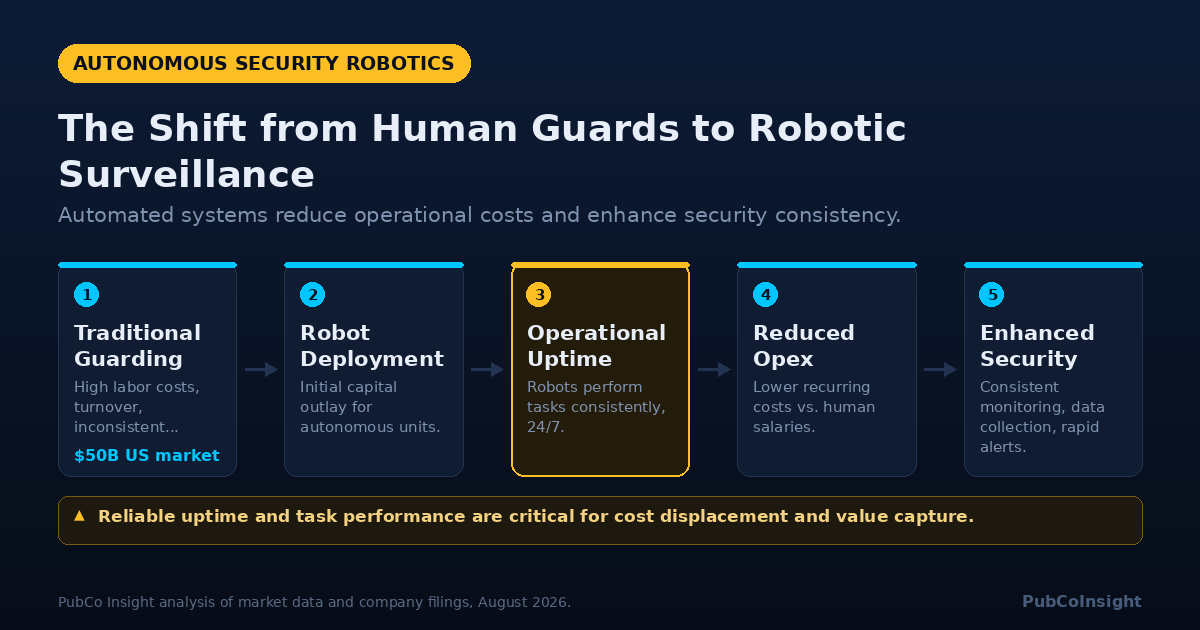
The Mechanism of Cost Displacement
The core economic driver for autonomous security robotics is simple: replacing a recurring, high-cost human labor input with a depreciable capital asset and a lower, predictable operational expenditure. A human security guard commands a salary, benefits, training costs, and requires breaks, supervision, and often, multiple shifts to cover 24/7 operations. This aggregate cost can easily exceed $50,000 to $70,000 per post per year, depending on location and skill level. An autonomous security robot, by contrast, involves an upfront hardware cost, which can be amortized over its operational life, plus ongoing maintenance, software licensing, and remote monitoring fees. These fees are typically fixed or scale predictably with usage, lacking the wage inflation pressures of human labor. The robot does not require breaks, works continuously, and its performance is consistent. The critical bottleneck is the initial capital expenditure and the reliability of the autonomous system. If a robot frequently malfunctions, requires constant human intervention, or cannot cover the required patrol area effectively, the cost savings evaporate. The value sits in the operational uptime and the breadth of tasks the robot can reliably perform without human oversight. This means robust hardware, self-diagnosing capabilities, and sophisticated AI for navigation, threat detection, and communication are paramount. A system that achieves 95% autonomy, meaning it only needs human intervention 5% of the time, can deliver substantial savings. A system requiring 50% human intervention offers no real advantage.Companies Navigating the Autonomous Security Space
The companies operating in this sector approach the problem from various angles, focusing on different aspects of the autonomous security stack. Some build the full robotic platform, others specialize in the underlying AI, and some provide the critical sensor arrays that enable perception. Serve Robotics Inc. (SERV), for example, focuses on last-mile delivery robots, a related but distinct application of physical AI. While their current focus is logistics, the underlying autonomous navigation and interaction technologies share common ground with security applications. Their Q2 earnings highlighted their path to scaling robot deployments. In the drone sector, companies like Ondas Inc. (ONDS) and Red Cat Holdings, Inc. (RCAT) develop unmanned aerial systems. Ondas recently raised its 2026 guidance on record backlog and Q2 results, indicating strong demand for their drone platforms. Red Cat, at $8.93, also operates in this space. These aerial platforms can provide wide-area surveillance and rapid response capabilities, complementing ground-based autonomous units. Unusual Machines, Inc. (UMAC), trading at $23.89, is another player in the drone market, recently expanding its U.S. drone component output, driven by defense demand and NDAA compliance. The sensor and AI components are critical. Arbe Robotics Ltd. (ARBE), at $0.67, specializes in 4D imaging radar solutions, which are crucial for autonomous navigation and object detection in all weather conditions. Reliable perception is fundamental to any autonomous system. MicroVision, Inc. (MVIS), priced at $1.85, develops lidar technology, another key sensing modality for environmental mapping and obstacle avoidance. Kopin Corporation (KOPN), trading at $4.73, focuses on display technologies, which are essential for remote human operators monitoring autonomous systems and for augmented reality interfaces. On the software and AI side, BigBear.ai Holdings, Inc. (BBAI), at $3.05, provides AI-powered analytics and decision intelligence, which can be integrated into autonomous security platforms for predictive threat assessment and optimized patrol routes. Lantronix, Inc. (LTRX), at $5.66, offers secure data access and management solutions, critical for the reliable and protected operation of networked autonomous devices.Artificial Intelligence Technology Solutions, Inc.
Artificial Intelligence Technology Solutions, Inc. (AITX) operates through several subsidiaries, including Robotic Assistance Devices, Inc. (RAD-I), Robotic Assistance Devices Mobile (RAD-M), and Robotic Assistance Devices Group (RAD-G). The company’s core business model centers on developing and leasing AI-driven security robots and remote monitoring systems, delivered via a "Solutions-as-a-Service" model rather than outright hardware sales. This recurring revenue model aims to align with the operational expenditure budgets of security clients. AITX's strategy focuses on transforming security and operational workflows across industries. Their filings indicate solutions are designed to deliver cost savings between 35% and 80% compared to traditional manned security. The company’s offerings are structured around three pillars: stationary security devices (RAD-I), mobile autonomous platforms (RAD-M), and the SARA agentic artificial intelligence platform (RAD-G). RAD Lanka, a wholly-owned subsidiary in Sri Lanka, supports software development and AI initiatives. The company reported revenue of $7,745,336 for the fiscal year ended February 28, 2026, a 26% increase over the prior fiscal year. Gross profit increased 48% to $5,533,700, with gross margin expanding to approximately 71% from 61%. Operating expenses remained stable at around $17,477,097, leading to an improved loss from operations of approximately $11,943,397. The net loss for the fiscal year was approximately $14.5 million, with an accumulated deficit of approximately $171 million as of February 28, 2026. The company had negative cash flow from operating activities of $9,344,534 for the same period. The public record does not yet establish positive cash flow from operations. AITX has stated its RAD-I stationary solutions could, on a standalone basis, support positive cash flow operations. They also project RAD-M will surpass RAD-I's monthly recurring revenue contribution at some future point. Early commercial deployment of the ROAMEO mobile security unit, a RAD-M product, began in May 2026. The company recently rebranded RAD-M as PURSUON, advancing its autonomous mobile security strategy. AITX's PURSUON unit reported a growing ROAMEO deployment pipeline and expanded production readiness, with a stated goal of 50 units by August 2027. The company's filings also mention the potential for RAD-G to generate substantial revenue from SARA platform licensing.What to watch
Investors should monitor several concrete developments. Look for Axon Enterprise's next quarterly earnings call for any executive commentary on the company's strategic direction regarding autonomous security and guarding services, especially in light of the recent insider sales. For AITX, watch for updates on the actual deployment numbers for its PURSUON (formerly RAD-M) ROAMEO units against its stated goal of 50 units by August 2027. Specific announcements regarding new client contracts, particularly for multi-unit deployments, will provide insight into market acceptance and scaling. Also, keep an eye on filings from Ondas and Red Cat for further backlog growth or new government contracts, which often signal broader adoption trends for drone-based security. Finally, any news of partnerships between sensor providers like Arbe Robotics or MicroVision and larger security integrators could indicate a maturing ecosystem for autonomous solutions., { "label": "Robot Deployment", "note": "Initial capital outlay for autonomous units." }, { "label": "Operational Uptime", "note": "Robots perform tasks consistently, 24/7." }, { "label": "Reduced Opex", "note": "Lower recurring costs vs. human salaries." }, { "label": "Enhanced Security", "note": "Consistent monitoring, data collection, rapid alerts." } ], "highlight": 2, "highlight_note": "Reliable uptime and task performance are critical for cost displacement and value capture.", "footnote": "PubCo Insight analysis of market data and company filings, August 2026." }Companies mentioned
| Ticker | Company | Price |
|---|---|---|
| AITX client | Artificial Intelligence Technology Solutions Inc | $0.0063 |
| ARBE | Arbe Robotics Ltd. | $0.67 |
| BBAI | BigBear.ai Holdings, Inc. | $3.05 |
| KOPN | Kopin Corporation | $4.73 |
| LTRX | Lantronix, Inc. | $5.66 |
| MVIS | MicroVision, Inc. | $1.85 |
| ONDS | Ondas Inc. | $8.22 |
| RCAT | Red Cat Holdings, Inc. | $8.93 |
| SERV | Serve Robotics Inc. | $4.78 |
| UMAC | Unusual Machines, Inc. | $23.89 |
Listed alphabetically, not ranked. Prices as of 2026-08-27 and they move. Check a live quote before relying on any of this.
How we chose the companies in this article
We cover a fixed universe of companies working in autonomous security robotics, physical AI and the guarding services market they are aimed at. Every one of them that had usable market data on 2026-08-27 appears in this article. We do not pick which ones to mention based on what we think of them, and we do not order them by size, price or trading volume, because an ordered list is a verdict and that is not ours to hand down. Companies left out, and why: none. American Lithium Minerals and Artificial Intelligence Technology Solutions pay us, which is disclosed in full at the foot of every article they appear in.
See the dilution and promotion flags before you see the pitch.
Each week: the micro and small-caps now showing dilution or paid-promotion signals, with the SEC filing behind every flag. No recommendations, no price targets.
Sources used in this article
- Stock Market: Will S&P 500 Open Up or Down Today? Benzinga Prediction Markets · 2026-08-27
- Asian stocks rise for third day as Nvidia beats Reuters · 2026-08-27
- If I Were in My 20s, I'd Buy These 2 Trillion-Dollar Stocks and Hold Them Until Retirement Motley Fool · 2026-08-27
- Up 25% in August, Is Bitcoin Now a No-Brainer Buy? Motley Fool · 2026-08-27
- Johnson & Johnson Just Got a Big FDA Win Motley Fool · 2026-08-27
- ‘How the Heck’ Can Nvidia Grow Revenue 70% From Here? Jensen Huang Tells Jim Cramer ‘It’s Not Easy’ Stocktwits · 2026-08-27
- Morning Bid: Jensen to market: We're so back Reuters · 2026-08-27
- No AI, No Problem: 5 Consumer Stocks Quietly Outperforming Nvidia This Year Stocktwits · 2026-08-27
- Jim Cramer Says Nvidia Is 'Not Going to Stop Here' as Ross Gerber Sees NVDA Stock Hitting $450 as Analysts Dissect Q2 Earnings Benzinga · 2026-08-27
- Asian stocks are mixed after Wall Street losses following economic updates Associated Press · 2026-08-27
- Axon Enterprise vs. Booking Holdings: Evaluating Absolute Scale and Sequential Volatility in Quarterly Revenue Trends Motley Fool · 2026-08-26
- Axon Enterprise CPO Jeffrey Kunins Sells $6 Million in Stock: Should Investors Sell Too? Motley Fool · 2026-08-26
Disclosure required by Section 17(b) of the Securities Act of 1933
Artificial Intelligence Technology Solutions, Inc., a Nevada corporation (OTCID: AITX). Artificial Intelligence Technology Solutions, Inc. pays Strategic Innovations First, Inc., a Wyoming corporation doing business as PulseIR. Compensation received: USD 5,000.00 per month for months 1-3 (August, September, October 2026); USD 10,000.00 per month for months 4-6 (November, December 2026, January 2027) contingent on the 90-day review. Minimum committed USD 15,000.00; USD 45,000.00 if the second-period rate triggers.. Form of payment: cash only, invoiced monthly in advance; no stock, options or warrants received or payable. Services: investor relations services under an Investor Relations Services Agreement effective 2026-08-01. Period: six month term, 2026-08-01 through 2027-01-31; 90-day review on or about 2026-10-30. No stock, options or warrants held by PubCo Insight, Pulse IR, Strategic Innovations First, Inc., or Brad Listermann. Confirmed by the executed agreement and by board record recKwdq39X2caPSX7 (POSITIONS HELD: none).
This is information, not investment, financial, legal or tax advice. It is not a recommendation or solicitation to buy, sell or hold any security and it contains no price target. Nothing here is independently verified by us. Confirm every figure against primary filings on SEC EDGAR before you act. Micro-cap and over-the-counter securities are speculative and illiquid and can lose all of their value. The companies named without a disclosure above pay us nothing and have no relationship with us; they are named because a published, mechanical screen selected them. Full disclosure policy.