Lakeland’s Decade-Long AI Drone Contract Signals Shift in Security Robotics
A recent long-term contract in Lakeland, Florida, highlights the accelerating shift towards AI-powered drone systems in the physical guarding services market, demanding a closer look at the underlying technology and the companies deploying it.
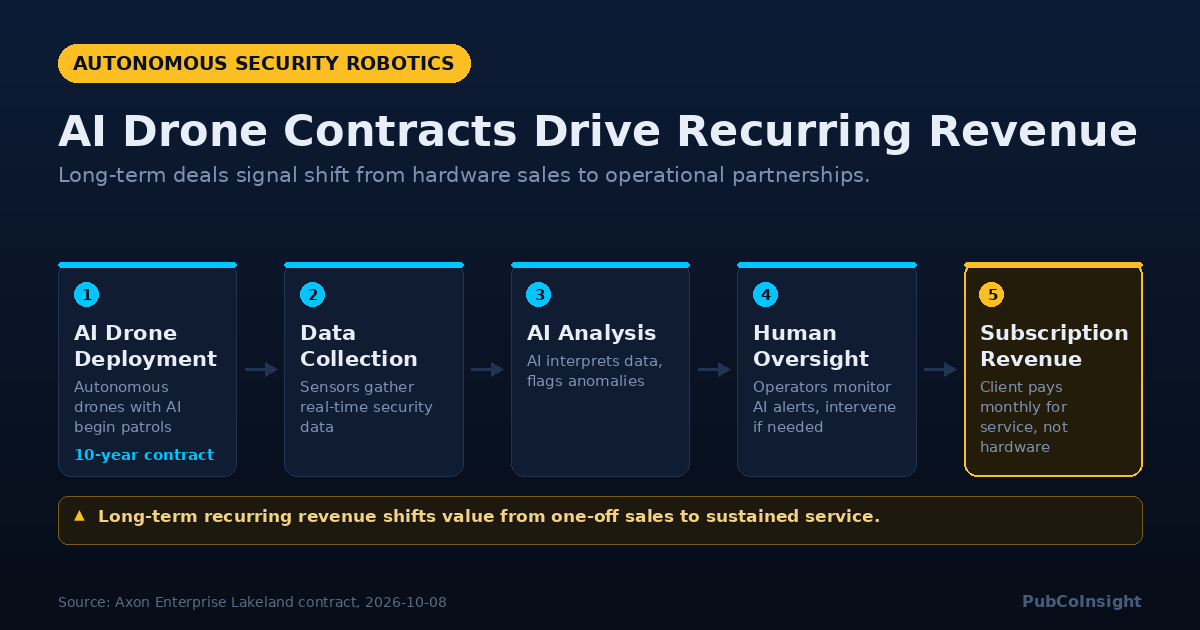
The Mechanism of Autonomous Guarding
Autonomous guarding systems rely on a layered approach, integrating sensor data, AI processing, and robotic platforms to create a continuous, intelligent security presence. At its core, the system begins with data acquisition. Drones, stationary cameras, and mobile ground robots collect visual, thermal, and acoustic information from a designated area. This raw data streams into a central processing unit, often located on-site or in a secure cloud environment. The critical next step is AI inference. This is where specialized algorithms, often trained on vast datasets of security incidents, analyze the incoming data in real-time. The AI identifies anomalies: unauthorized entry, suspicious objects, changes in environmental conditions, or unusual patterns of movement. For example, a drone might detect a person scaling a fence, or a ground robot could flag an abandoned package. The AI’s ability to filter out false positives, like wildlife or weather events, is crucial for efficiency. This is where the quality of the AI model, its training data, and its computational backbone truly matter. A poorly trained model generates constant alerts, defeating the purpose of automation. NVIDIA’s push for open-weight AI via Reflection AI, as reported on October 14, 2026, speaks to the ongoing development in making these AI models more accessible and adaptable for specific security applications. Once an anomaly is detected and classified, the system triggers a response protocol. This can range from an automated alert sent to human operators, to deploying a mobile robot for closer inspection, or even activating on-board deterrents like lights or audio warnings. The system’s effectiveness hinges on its ability to operate autonomously for extended periods, recharging itself, navigating complex environments, and communicating seamlessly with a central command. The long-term Lakeland contract highlights that municipalities are now willing to commit to these integrated, AI-driven solutions for a decade, signaling confidence in their reliability and cost-effectiveness. The key constraint is the continuous refinement of AI models to reduce false positives and enhance threat identification accuracy, making the initial data processing stage the most critical.Companies in the Sector
Several companies are navigating this evolving landscape, each with distinct approaches to autonomous security. The market spans hardware manufacturers, software developers, and integrated service providers. Ondas Inc. (ONDS), trading at $6.71, recently expanded its defense capabilities with EASA certification for an advanced missile protection system on Bombardier Global 7500 aircraft, as reported on October 13, 2026. This indicates a focus on high-end, specialized drone applications, particularly in defense. More recently, on October 12, 2026, Ondas partnered with Palantir to launch Regna AI, a venture specifically aimed at developing and deploying sovereign AI models for surveillance systems. This move into AI model development, particularly for defense missions, positions Ondas for deeper integration into advanced security and intelligence operations. Their work with Regna AI suggests a focus on the algorithmic backbone crucial for sophisticated autonomous systems. Ondas also sees potential in medical drone delivery, as reported on October 13, 2026, indicating a broader view of drone utility beyond security. Red Cat Holdings, Inc. (RCAT), priced at $5.185, debuted its TRICHON drone around October 12, 2026. While specific details on TRICHON's AI capabilities for autonomous guarding are still emerging, Red Cat generally focuses on drone technology, suggesting a hardware-centric approach that could integrate with AI platforms. Unusual Machines, Inc. (UMAC), trading at $19.44, has seen a recent dip, but analysts like Needham still see significant upside, as reported on October 11, 2026. Unusual Machines operates in the drone sector, implying a focus on the aerial platforms themselves, which form a key component of the broader autonomous security ecosystem. Companies like Arbe Robotics Ltd. (ARBE), at $0.528, and MicroVision, Inc. (MVIS), at $1.18, are critical component suppliers. Arbe focuses on 4D imaging radar solutions, essential for precise environmental perception in autonomous systems, allowing robots to "see" in challenging conditions. MicroVision develops lidar technology, another crucial sensor for accurate distance measurement and mapping, vital for autonomous navigation and object detection in complex security environments. Lantronix, Inc. (LTRX), trading at $6.38, provides secure data access and management solutions. Their technology is vital for connecting and securing the vast amounts of data generated by autonomous security systems, ensuring reliable communication between robots, sensors, and command centers. BigBear.ai Holdings, Inc. (BBAI), at $2.39, specializes in AI-powered analytics and data processing for defense and intelligence. Their expertise in turning raw data into actionable insights is directly applicable to the complex data streams generated by autonomous security robots, helping to identify threats and predict potential incidents. Serve Robotics Inc. (SERV), at $3.785, primarily focuses on autonomous sidewalk delivery robots. While not directly in physical security, their work in autonomous navigation and last-mile robotics shares foundational technologies with ground-based security robots. Uber's autonomous head Maredia departing, as reported on October 13, 2026, signals ongoing shifts in leadership within the broader autonomous vehicle space, which impacts talent and strategic direction across all robotics segments. Kopin Corporation (KOPN), priced at $4.22, secured an additional $18.6 million U.S. Army contract for color MicroLED technology on October 8, 2026. Kopin's micro-display technology is critical for advanced optics in defense and potentially for augmented reality interfaces used by human operators monitoring autonomous systems. Their work on the Neural I/o™ Optical Interconnect Platform, with Kearney leading commercialization strategy, as reported on October 6, 2026, points to advancements in high-speed data transfer within complex systems.Artificial Intelligence Technology Solutions, Inc.
Artificial Intelligence Technology Solutions, Inc. (AITX), trading at $0.0021, operates through a "Solutions-as-a-Service" model, providing AI-driven security and productivity solutions. The company generates recurring monthly subscription revenue rather than one-off hardware sales. Its primary subsidiary, Robotic Assistance Devices, Inc. (RAD-I), targets the estimated $50 billion U.S. security and guarding services market. AITX states its solutions aim to deliver cost savings between 35% and 80% compared to traditional manned security. AITX's operations are structured around three main pillars. First, stationary security devices through RAD-I, which include units like the stationary security devices. Second, mobile autonomous platforms under Robotic Assistance Devices Mobile (RAD-M), which includes the ROAMEO mobile security unit. Early commercial deployment of ROAMEO began in May 2026. The company recently secured a third ROAMEO order from a global logistics client, as reported on October 6, 2026. Third, the SARA agentic artificial intelligence platform, managed by Robotic Assistance Devices Group (RAD-G). This platform is intended for licensing. AITX also operates Robotic Assistance Devices Lanka (Private) Limited (RAD Lanka) in Sri Lanka, which handles software development, AI initiatives, and technical operations. Internally, AITX envisions an integrated autonomous-security deployment across campuses or jurisdictions, a concept they refer to as "RAD Town." For the fiscal year ended February 28, 2026, AITX reported revenue of $7,745,336, a 26% increase year-over-year. Gross profit rose 48% to $5,533,700, with gross margin expanding to approximately 71% from 61%. Operating expenses remained flat at around $17,477,097, leading to an improved loss from operations of $(11,943,397). The company reported a net loss of approximately $14.5 million for the fiscal year and had an accumulated deficit of approximately $171 million as of that date. The company had negative cash flow from operating activities of $9,344,534 for the year ended February 28, 2026. As of that date, AITX had negative working capital of $17,017,745. The public record does not yet establish consistent positive cash flow from operations. Management does not anticipate having positive cash flow from operations in the near term. The company has stated that RAD-I’s recurring revenue and gross margin could, on a standalone basis, support positive cash flow operations, and that RAD-M will surpass RAD-I’s monthly recurring revenue contribution at some future point. They project subscription gross margin to exceed 75% and outright-sale gross margin to exceed 50%, based on average bill of materials costs and market-accepted pricing. AITX also anticipates RAD-G will generate substantial revenue from SARA platform licensing. A recent 8-K filing on October 7, 2026, noted that RAD turned small orders into a substantial property management relationship, indicating a strategy of expanding customer engagements from initial deployments.What to watch
The immediate focus for this sector will be on further long-term contract announcements, similar to Axon's Lakeland deal. These contracts validate the shift towards integrated AI and robotics in guarding services. Watch for specific details on the scope of these contracts, including the number of deployed units, the types of AI capabilities, and the recurring revenue structures. For Ondas (ONDS), the development and commercialization progress of Regna AI will be key. Look for announcements regarding specific defense missions or surveillance systems that adopt their sovereign AI models. The success of these deployments will indicate the market's acceptance of their specialized AI offerings. For Artificial Intelligence Technology Solutions (AITX), watch for updates on ROAMEO deployments and the expansion of property management relationships. Specific figures on subscription counts and average contract values will be important. Filings will provide details on revenue growth and cash flow. Any acceleration in RAD-M's revenue contribution, as the company projects, will be a significant indicator. Across the board, monitor advancements in sensor technologies from companies like Arbe Robotics (ARBE) and MicroVision (MVIS). Improvements in radar and lidar performance directly enhance the capabilities and reliability of autonomous platforms. Finally, keep an eye on the broader AI ecosystem, including developments from NVIDIA (NVDA) in open-weight AI, as these foundational technologies underpin the intelligence of all autonomous security solutions., { "label": "AI Inference", "note": "Algorithms analyze data, identify anomalies, filter false positives.", "metric": "Real-time" }, { "label": "Automated Response", "note": "Alerts, mobile robot deployment, on-board deterrents activated." }, { "label": "Continuous Operation", "note": "Autonomous navigation, recharging, communication with command." }, { "label": "Long-Term Contracts", "note": "Municipalities commit to decade-plus AI security solutions." } ], "highlight": 1, "highlight_note": "AI model accuracy and computational power determine system reliability and efficiency, reducing false alerts.", "footnote": "Source: PubCo Insight analysis of market news and filings, Oct 2026" }Companies mentioned
| Ticker | Company | Price |
|---|---|---|
| AITX client | Artificial Intelligence Technology Solutions Inc | $0.0021 |
| ARBE | Arbe Robotics Ltd. | $0.528 |
| BBAI | BigBear.ai Holdings, Inc. | $2.39 |
| KOPN | Kopin Corporation | $4.22 |
| LTRX | Lantronix, Inc. | $6.38 |
| MVIS | MicroVision, Inc. | $1.18 |
| ONDS | Ondas Inc. | $6.71 |
| RCAT | Red Cat Holdings, Inc. | $5.185 |
| SERV | Serve Robotics Inc. | $3.785 |
| UMAC | Unusual Machines, Inc. | $19.44 |
Listed alphabetically, not ranked. Prices as of 2026-10-14 and they move. Check a live quote before relying on any of this.
How we chose the companies in this article
We cover a fixed universe of companies working in autonomous security robotics, physical AI and the guarding services market they are aimed at. Every one of them that had usable market data on 2026-10-14 appears in this article. We do not pick which ones to mention based on what we think of them, and we do not order them by size, price or trading volume, because an ordered list is a verdict and that is not ours to hand down. Companies left out, and why: none. American Lithium Minerals and Artificial Intelligence Technology Solutions pay us, which is disclosed in full at the foot of every article they appear in.
See the dilution and promotion flags before you see the pitch.
Each week: the micro and small-caps now showing dilution or paid-promotion signals, with the SEC filing behind every flag. No recommendations, no price targets.
Sources used in this article
- Is NVIDIA’s Open‑Weight AI Push via Reflection AI Recasting Its Full‑Stack Narrative (NVDA)? Simply Wall St. · 2026-10-14
- Prediction: $1,000 Invested in SpaceX Will Be Worth This Much by 2030 Motley Fool · 2026-10-14
- Compal Accelerates Time-to-AI with Next-Generation NVIDIA Platforms at OCP Global Summit 2026 PR Newswire · 2026-10-14
- Here's Where Netflix and 3 Other Streaming and Media Stocks Could Be by 2030 Motley Fool · 2026-10-14
- Harvard's Judgment Professor: The Curse of Optionality and One Habit That Builds Better Judgment Motley Fool · 2026-10-14
- Why Valero Energy Stock Triumphed Today Motley Fool · 2026-10-14
- Down 12.5% in 2 Months, Is the Sell-Off in Realty Income a Buying Opportunity for Income Investors? Motley Fool · 2026-10-14
- Can Axon Sustain EBITDA Margin Momentum Amid Cost Pressures? Zacks · 2026-10-13
- Why FB Financial Stock Tumbled on Tuesday Motley Fool · 2026-10-13
- Coca-Cola vs. PepsiCo: Which Dividend King Deserves a Premium Valuation Right Now? Motley Fool · 2026-10-13
- SpaceX Stock Has Climbed About 50% Through 6 Insider Share Unlocks. The Biggest Is Still Ahead. Motley Fool · 2026-10-13
- Uber autonomous head Maredia to depart as leadership shifts continue - Bloomberg Investing.com · 2026-10-13
Disclosure required by Section 17(b) of the Securities Act of 1933
Artificial Intelligence Technology Solutions, Inc., a Nevada corporation (OTCID: AITX). Artificial Intelligence Technology Solutions, Inc. pays Strategic Innovations First, Inc., a Wyoming corporation doing business as PulseIR. Compensation received: USD 5,000.00 per month for months 1-3 (August, September, October 2026); USD 10,000.00 per month for months 4-6 (November, December 2026, January 2027) contingent on the 90-day review. Minimum committed USD 15,000.00; USD 45,000.00 if the second-period rate triggers.. Form of payment: cash only, invoiced monthly in advance; no stock, options or warrants received or payable. Services: investor relations services under an Investor Relations Services Agreement effective 2026-08-01. Period: six month term, 2026-08-01 through 2027-01-31; 90-day review on or about 2026-10-30. No stock, options or warrants held by PubCo Insight, Pulse IR, Strategic Innovations First, Inc., or Brad Listermann. Confirmed by the executed agreement and by board record recKwdq39X2caPSX7 (POSITIONS HELD: none).
This is information, not investment, financial, legal or tax advice. It is not a recommendation or solicitation to buy, sell or hold any security and it contains no price target. Nothing here is independently verified by us. Confirm every figure against primary filings on SEC EDGAR before you act. Micro-cap and over-the-counter securities are speculative and illiquid and can lose all of their value. The companies named without a disclosure above pay us nothing and have no relationship with us; they are named because a published, mechanical screen selected them. Full disclosure policy.